Most EMS agencies review patient care reports. However, far fewer turn those reviews into measurable data that actually improves documentation.
A reviewer reads a chart, identifies a problem, sends feedback to the crew, and moves to the next PCR. Meanwhile, another reviewer may focus on completely different documentation elements. After hundreds of reviews, leadership knows that problems exist but may still struggle to answer a basic question:
Where, specifically, is our EMS documentation weakest?
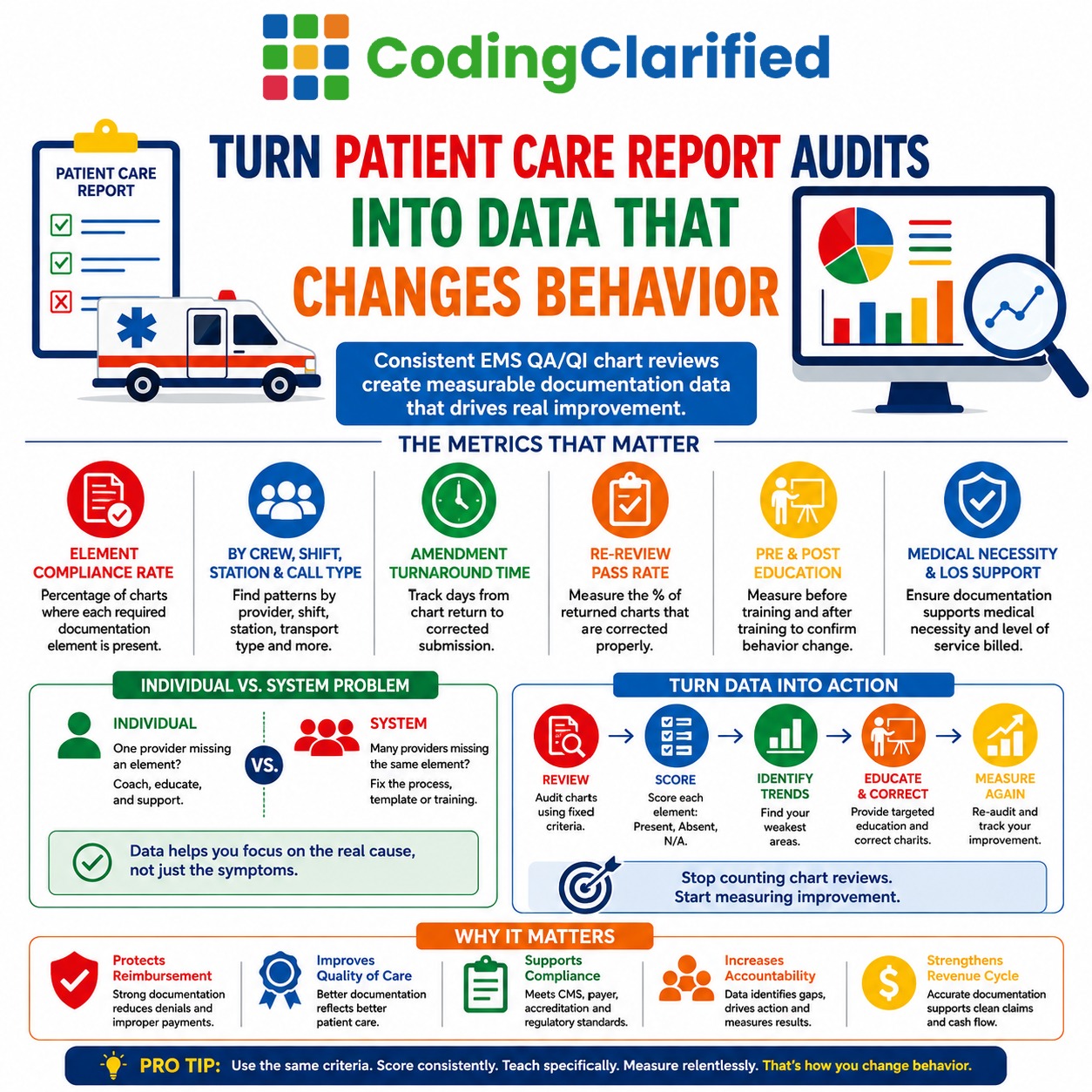
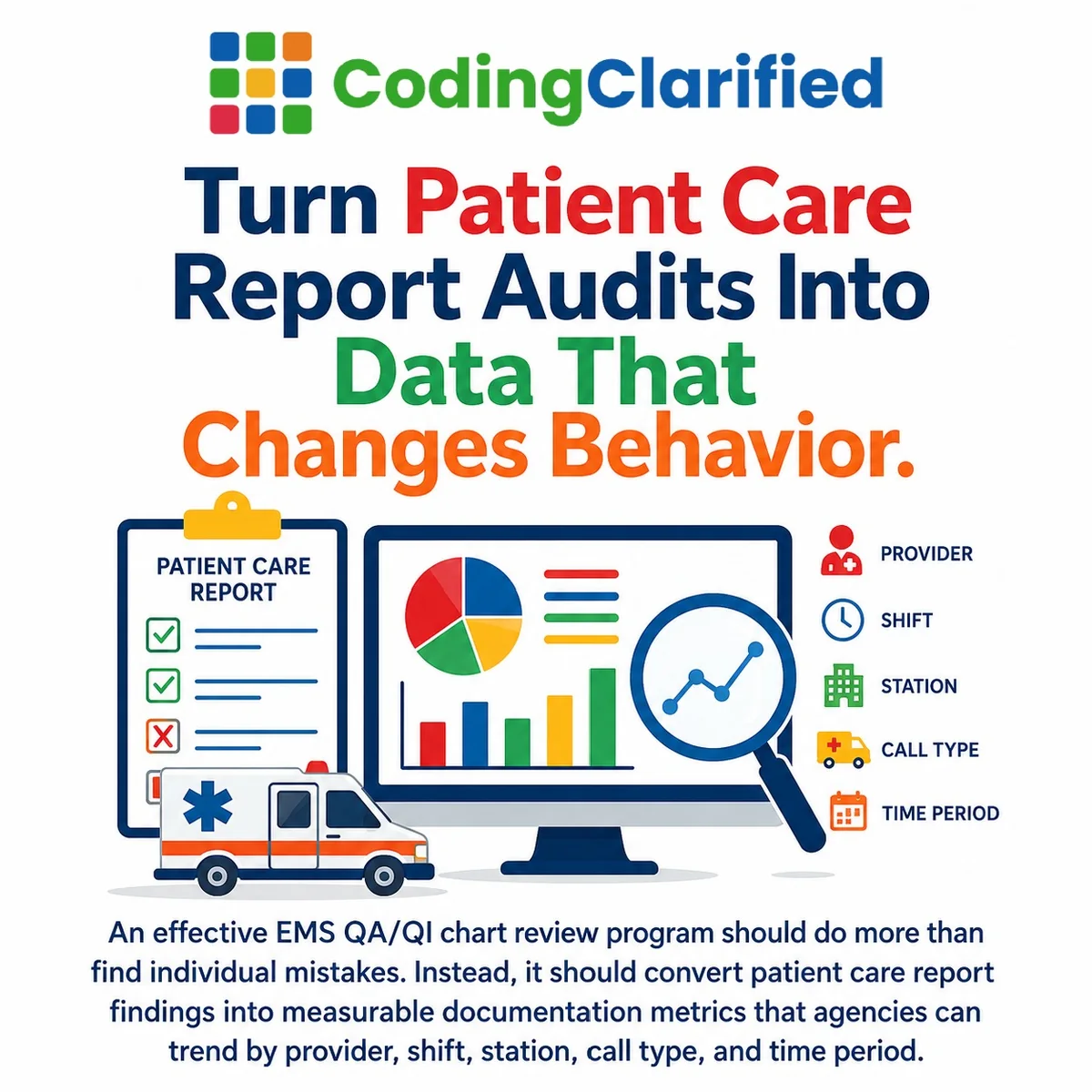
In 2026, an effective EMS QA/QI chart review program should do more than find individual mistakes. Instead, it should convert patient care report findings into measurable documentation metrics that agencies can trend by provider, shift, station, call type, and time period.
The key is surprisingly simple: score every reviewed chart against the same fixed criteria every time.
That one change turns EMS chart review from a collection of opinions into a usable dataset.
Key Takeaways: EMS QA/QI Chart Review in 2026
- EMS agencies should use fixed, written audit criteria for every patient care report review.
- Each documentation element can be scored as present, absent, or not applicable.
- Consistent scoring allows agencies to calculate documentation compliance rates instead of relying on impressions.
- Agencies can compare results by provider, crew, shift, station, transport type, or other appropriate operational categories.
- Chart audit data helps distinguish an individual coaching problem from a system-wide problem.
- Medical necessity and level-of-service support should be measured before missing documentation becomes a billing problem.
- Agencies should track amendment turnaround time and re-review pass rates to make sure the correction loop actually closes.
- Targeted education works best when agencies teach the specific documentation weaknesses their audit data identifies.
- After training, agencies should measure the same criteria again to determine whether behavior changed.
Most importantly, EMS documentation remains a significant Medicare compliance concern. CMS reports that insufficient documentation accounted for 63.5% of ambulance-service improper payments during the 2024 reporting period. Therefore, better documentation measurement can support quality, compliance, and revenue-cycle performance at the same time.
Why EMS Chart Review Needs to Change in 2026
Most EMS agencies already perform some form of chart review. However, reviewing charts does not automatically create a quality improvement program.
The problem usually starts when the review produces impressions instead of measurements.
One reviewer might focus heavily on vital signs. Another may concentrate on the narrative. Meanwhile, a third reviewer could care most about protocol compliance or medical necessity.
All three reviewers may have valid concerns. Still, if they do not evaluate charts against the same standards, leadership cannot reliably compare their findings.
Review 1,000 charts that way and you may end up with 1,000 individual judgments but very little usable trend data.
Ask the agency six months later:
- What is our lowest-performing documentation element?
- Which call types produce the most documentation gaps?
- Did last quarter’s training improve reassessment documentation?
- Are medical necessity problems increasing or decreasing?
- Does one shift have a different documentation pattern from another?
- How often do returned charts come back corrected?
Without standardized criteria, the answers often rely on memory or estimates.
A structured EMS QA/QI audit changes that.
Fixed EMS Chart Review Criteria Are the Foundation
If two reviewers evaluate the same patient care report and routinely reach very different conclusions, the agency has a consistency problem.
You cannot reliably trend opinions.
Instead, an EMS documentation audit should use a written list of elements that reviewers check on every applicable chart. Furthermore, reviewers need clear definitions for what qualifies as compliant.
An EMS PCR audit criteria set may include:
- Vital signs documented as a clinically appropriate series
- Reassessment documented after interventions when appropriate
- Intervention and reassessment times documented
- Narrative consistent with structured ePCR fields
- Timeline internally consistent
- Objective findings supporting documented conclusions
- Required fields completed
- Medical necessity elements documented
- Level-of-service support present when applicable
- Applicable protocol documentation present
- Signatures and required documentation completed
- Transport details consistent throughout the record
Next, score each element using a simple structure such as:
Present | Absent | Not Applicable
That approach reduces unnecessary subjectivity.
Rather than asking, “Was this a good chart?” the reviewer answers a much more useful question:
Was this specific required element present?
Now each chart review produces a row of data.
Over time, those rows become an EMS documentation quality dataset.
For a broader look at building a structured documentation program, read EMS Documentation Training & QA/QI in 2026: How Better Patient Care Reports Reduce Denials and Protect EMS Agencies.
The EMS QA/QI Metrics Agencies Should Track
Once reviewers score charts consistently, agencies can begin answering questions that were previously difficult to measure.
1. Documentation Element Compliance Rate
Start with the most useful metric.
For each audit criterion, calculate the percentage of applicable reviewed charts in which the element was present.
For example:
Reassessment compliance = Charts with required reassessment documented ÷ Applicable charts reviewed × 100
Suppose an agency reviews 100 charts where a reassessment should appear and finds it documented correctly in 64.
The compliance rate is 64%.
That number gives leadership a baseline. Moreover, it provides something measurable to improve.
Instead of saying, “Our crews need to document reassessments better,” leadership can say:
Reassessment documentation compliance is currently 64%, and our goal is 85% next quarter.
That is an actionable quality metric.
2. Compliance by Crew, Shift, or Station
A service-wide percentage can hide important differences.
Imagine that reassessment compliance sits at 60% across the entire agency. However, one shift scores 92% while another scores 38%.
Those numbers point to a very different problem than a uniform 60% rate.
Likewise, station-level or crew-level trends may reveal workflow, supervision, training, or technology differences. Therefore, agencies should look beneath the service-wide average when sample size and privacy considerations allow meaningful comparison.
3. Compliance by Call Type
Not every EMS encounter creates the same documentation challenges.
Emergency responses may produce different gaps from interfacility transports. Similarly, refusals, behavioral health calls, specialty care transports, and high-acuity cases may each have unique documentation risks.
Consequently, call-type analysis can tell leadership where a problem occurs rather than simply confirming that it exists.
If medical necessity documentation performs well on emergency calls but poorly on non-emergency transports, for example, the training response becomes much more specific.
4. Amendment Turnaround Time
One of the most useful EMS QA metrics is also one of the easiest to overlook.
Track the time between a chart being returned for an allowed correction and completion of the correction process.
A rising turnaround time can indicate that the QA loop is breaking down. Furthermore, delayed corrections may create problems for billing workflows and internal follow-up.
Finding a documentation problem does little good if nobody closes it.
5. Re-Review Pass Rate
When an agency returns a chart for an allowed correction, track whether the issue was actually resolved.
For example:
Re-review pass rate = Correctly resolved returned charts ÷ Returned charts re-reviewed × 100
A low pass rate may mean crews do not understand the feedback. Alternatively, the original reviewer comments may not be specific enough.
Either way, the metric identifies a problem with the correction process itself.
6. Pre- and Post-Education Compliance
EMS agencies spend significant time on continuing education and in-service training. Yet many never measure whether the training changed documentation behavior.
Structured chart review makes that possible.
First, establish a baseline for the documentation element.
Next, provide targeted education.
Then measure the same element again after a defined period, such as 30, 60, or 90 days.
If compliance moves from 58% to 87%, leadership has evidence that the intervention worked. Conversely, if performance remains at 58%, repeating the same class probably will not solve the problem.
7. Medical Necessity Documentation Support Rate
Medical necessity deserves its own measurement because documentation problems can directly affect reimbursement.
CMS states that Medicare ambulance transportation must meet medical necessity and reasonableness requirements. In general, the patient’s condition must make transportation by another method inappropriate under the applicable coverage rules. Additionally, the appropriate documentation must remain on file and be available to the Medicare contractor when requested.
Therefore, an agency can score whether each applicable PCR contains the patient-specific facts needed to support ambulance transportation.
A diagnosis alone does not necessarily explain medical necessity.
Instead, reviewers should look for the patient’s actual condition, functional limitations, risks, symptoms, monitoring needs, interventions, and other relevant facts.
See the current CMS Medicare Benefit Policy Manual, Chapter 10 – Ambulance Services for Medicare ambulance coverage guidance.
8. Level-of-Service Support Rate
Agencies can also measure whether the PCR supports the billed or reported level of ambulance service.
For example, Medicare maintains specific definitions and requirements for ground ambulance levels of service. Consequently, documentation should accurately show the patient’s condition and the services actually provided rather than simply state a billing level.
This metric gives billing and QA teams an early warning.
Instead of discovering the documentation gap after a denial, the agency identifies the pattern during routine chart review.
Why This Matters Even More for EMS Agencies in 2026
Current CMS data provides a strong reason to take ambulance documentation measurement seriously.
According to CMS’s current Ambulance Services compliance guidance, the Medicare Fee-for-Service improper payment rate for ambulance services was 13.2% for the 2024 reporting period, representing a projected $595.1 million in improper payments.
Even more important for QA teams, 63.5% of those improper payments involved insufficient documentation, while medical necessity accounted for another 27.5%.
Those numbers do not mean every documentation problem becomes a denial. Nevertheless, they show why agencies should not wait for remittance data to tell them that PCR documentation is weak.
Instead, measure the documentation upstream.
Review the current CMS Ambulance Services Compliance Tips and CMS Ambulance-Specific Manuals when developing Medicare-focused review criteria.
Reading EMS QA Data: Individual Problem or System Problem?
One of the most valuable questions an EMS QA dataset can answer is surprisingly simple:
Is this an individual problem or a system problem?
Suppose one provider repeatedly fails to document reassessment after medication administration while nearly everyone else documents it correctly.
That pattern may call for individual coaching.
However, imagine that 60% of providers across the agency miss the same element.
That is probably not 60 separate individual failures.
Instead, leadership should investigate the system.
Perhaps the ePCR field sits several screens away from the medication entry. Maybe the template does not prompt the provider to document a response. Likewise, the agency’s initial education may never have clearly explained the expectation.
A workflow problem may also exist.
Without data, leadership may respond by coaching dozens of providers individually. Unfortunately, that approach wastes time and can create unnecessary frustration.
Trend data encourages a better question:
What is making the correct behavior difficult?
That shift turns QA/QI into actual quality improvement.
Target EMS Documentation Education Instead of Retraining Everyone
Once an agency ranks its documentation weaknesses, education becomes much easier to target.
Suppose the audit shows:
- Reassessment documentation is the weakest element.
- Most failures occur on interfacility transports.
- One shift accounts for a large percentage of the misses.
- Medical necessity documentation performs well.
The agency does not need a two-hour class covering every part of PCR documentation.
Instead, trainers can build a short module on reassessment documentation during interfacility transports for the group that needs it most.
Better yet, use de-identified examples from the agency’s own charts.
Show the incomplete documentation.
Then show what the chart needed.
Finally, explain why the missing information matters clinically, operationally, and for reimbursement.
Specific training feels very different from telling an entire workforce to “document better.”
Afterward, audit the same element again.
That final step matters because education should produce measurable change, not simply attendance records.
Turn EMS QA/QI Data Into a Leadership Dashboard
Leadership does not need a complicated dashboard with dozens of charts.
Start with a few useful measures:
- Overall documentation compliance
- Five weakest documentation elements
- Medical necessity support rate
- Level-of-service support rate
- Amendment turnaround time
- Re-review pass rate
- Pre- versus post-training performance
- Major trends by call type or operational group
Then report movement over time.
For example:
Q1: Reassessment documentation — 61%
Q2: Targeted education delivered
Q3: Reassessment documentation — 84%
That story is much stronger than saying, “We reviewed 800 charts.”
The number of charts reviewed measures workload. In contrast, the change in compliance measures results.
EMS.gov has also emphasized the value of performance measures and EMS data for evaluating and improving care. National EMS quality efforts have increasingly focused on measurable indicators rather than relying only on subjective review.
Agencies can explore EMS quality resources through EMS.gov and the National EMS Quality Alliance.
Common Mistakes to Avoid With EMS QA/QI Chart Review
Changing the criteria too often. A sophisticated audit tool that changes every month can produce less useful trend data than a simple criteria set used consistently.
Making criteria subjective. “Good narrative” is difficult to score consistently. Instead, define the specific documentation elements reviewers should find.
Tracking only the number of charts reviewed. Volume shows activity, not improvement. Therefore, measure compliance rates and outcomes too.
Using QA data only for discipline. Quality data should help identify workflow, education, template, and system problems as well as individual coaching needs.
Comparing tiny samples. A few charts may not provide enough information for a meaningful provider or shift comparison. Consequently, agencies should interpret small samples carefully.
Failing to re-review corrected charts. Returning a PCR does not prove that the problem was resolved. Track the correction through completion.
Training before identifying the problem. Broad documentation classes consume staff time. Instead, use audit data to identify the exact weakness first.
Ignoring medical necessity until billing gets involved. Documentation QA can identify missing support much earlier in the revenue cycle.
Treating every documentation gap as a provider problem. When many providers fail the same criterion, investigate the system before blaming individuals.
How to Start an EMS Documentation Audit Without Expensive Software
An EMS agency does not need a sophisticated platform to start measuring chart quality.
A spreadsheet can take a service surprisingly far.
Begin with four things:
- A written criteria set
- A defined chart sample
- One consistent scoring method
- One place to record the results
For example, each row can represent one reviewed chart while columns represent the audit criteria.
Over time, calculate compliance percentages for each element. Next, compare results by month, quarter, call type, or other useful categories.
The technology matters less than consistency.
However, agencies should protect patient information and follow HIPAA, organizational security policies, and applicable privacy requirements when creating any QA/QI dataset. Furthermore, access to patient-level information should remain appropriately controlled.
Build a Closed-Loop EMS QA/QI Process
The strongest QA programs create a repeatable cycle:
Review → Score → Identify Trend → Educate or Correct → Re-Review → Measure Again
Every part matters.
Review without scoring produces anecdotes.
Scoring without action produces reports nobody uses.
Training without remeasurement produces assumptions.
Instead, close the loop.
That process allows EMS leaders to demonstrate exactly what the agency identified, what it changed, and whether the change worked.
What Measurable EMS QA/QI Gives Leadership
Structured EMS documentation data changes the quality conversation.
Instead of saying:
“We review charts.”
Leadership can say:
These were our three weakest documentation elements at the beginning of 2026. We delivered targeted education against each weakness, measured the same criteria afterward, and documented the improvement. These are the areas we’re targeting next quarter.
That is a much more useful story for an EMS chief, medical director, board, compliance officer, payer, accrediting organization, or grant funder.
Moreover, it demonstrates that the agency does not simply have a QA process.
It has a quality improvement process.
EMS Documentation Training and QA/QI Support
Coding Clarified provides EMS Documentation Training, QA/QI & Live Coaching for agencies that want to build or strengthen a measurable documentation quality program.
Support can include:
- Developing the audit scope
- Creating fixed chart-review criteria
- Conducting ongoing documentation reviews
- Building correction and re-review workflows
- Identifying trends by documentation element
- Providing targeted documentation education
- Reporting weak areas and measurable improvement
- Helping agencies build an internal QA/QI process
Coding Clarified also brings medical coding, auditing, and documentation expertise into EMS quality review. Therefore, agencies can connect clinical PCR quality with the documentation requirements that affect coding, billing, compliance, and medical necessity.
For related guidance, read EMS Documentation Training & QA/QI in 2026 and visit our Medical Coding Blog for additional documentation and compliance resources.
Final Thoughts: Stop Counting Chart Reviews and Start Measuring Improvement
The purpose of EMS QA/QI should not be to prove that someone looked at the charts.
Instead, the goal is to learn something from them.
Fixed criteria turn every PCR review into comparable data. Then that data reveals where documentation breaks down, whether the problem is individual or systemic, what education crews actually need, and whether the intervention worked.
In 2026, that distinction matters.
CMS continues to identify insufficient ambulance documentation as a major source of improper payments. At the same time, EMS leaders need measurable ways to improve clinical documentation, compliance, education, and operational performance.
You do not need an expensive dashboard to begin.
Start with the same criteria, applied the same way, every time.
Then measure what changes.
Frequently Asked Questions About EMS QA/QI Chart Review
What is an EMS QA/QI chart review?
An EMS QA/QI chart review is a structured evaluation of patient care reports against defined clinical, documentation, compliance, or operational criteria. A strong program goes beyond finding individual mistakes. Instead, it collects consistent data so an agency can identify trends and measure improvement.
What should be included in an EMS patient care report audit?
Criteria depend on agency policies, protocols, payer mix, and review goals. However, common elements include vital-sign trends, reassessments, intervention responses, timeline consistency, required fields, narrative-to-data consistency, protocol documentation, medical necessity, and level-of-service support.
How do you measure EMS documentation quality?
One practical method calculates the percentage of applicable charts that contain each required documentation element. Agencies can then compare those compliance rates over time and, when appropriate, across call types, shifts, crews, or stations.
How many EMS charts should an agency audit?
There is no single sample size that fits every EMS agency. The appropriate number depends on call volume, risk, staffing, payer mix, quality goals, and the type of analysis being performed. Therefore, agencies should create a written sampling method and apply it consistently.
Can EMS QA/QI reduce ambulance claim denials?
Documentation QA/QI can identify weaknesses that may contribute to denials, including inadequate medical necessity support and insufficient documentation. However, no audit program can guarantee payment. In 2026, CMS continues to identify insufficient documentation as a major ambulance improper-payment issue, which makes proactive review especially valuable.
How can EMS agencies tell whether documentation training worked?
Measure the targeted documentation element before training, deliver the education, and then measure the same element again after a defined period. Improvement in the compliance rate provides evidence that behavior changed. Conversely, little or no improvement may indicate that the agency needs a different training or system intervention.
What is the difference between EMS QA and QI?
Quality assurance generally focuses on whether care or documentation met established standards. Quality improvement uses the resulting information to identify patterns, change processes, educate staff, and measure whether performance improves. Therefore, chart review becomes much more valuable when QA findings feed a closed QI loop.
Where can EMS agencies find current Medicare ambulance documentation requirements?
Start with the CMS Ambulance-Specific Manuals, CMS Ambulance Services Compliance Tips, and the current Medicare Ambulance Fee Schedule. Agencies should also follow guidance from their Medicare Administrative Contractor, applicable state requirements, payer policies, medical direction, and agency protocols.
Coding Clarified LLC provides QA/QI documentation review and EMS documentation training for EMS agencies and is a U.S. Department of Labor Registered Apprenticeship sponsor and AAPC-affiliated training provider. Learn more at Coding Clarified.