Building an EMS QA/QI program does not require reviewing every patient care report or creating a complicated scoring system. In fact, the most effective program may be the one your agency can consistently maintain.
Many EMS quality programs start with good intentions. Leadership decides documentation needs attention, reviewers begin reading large numbers of patient care reports (PCRs), and crews start receiving feedback. However, within a few weeks, chart volume becomes overwhelming, findings pile up, and providers begin viewing QA/QI as surveillance rather than education.
The problem usually is not effort. Instead, it is scope and design.
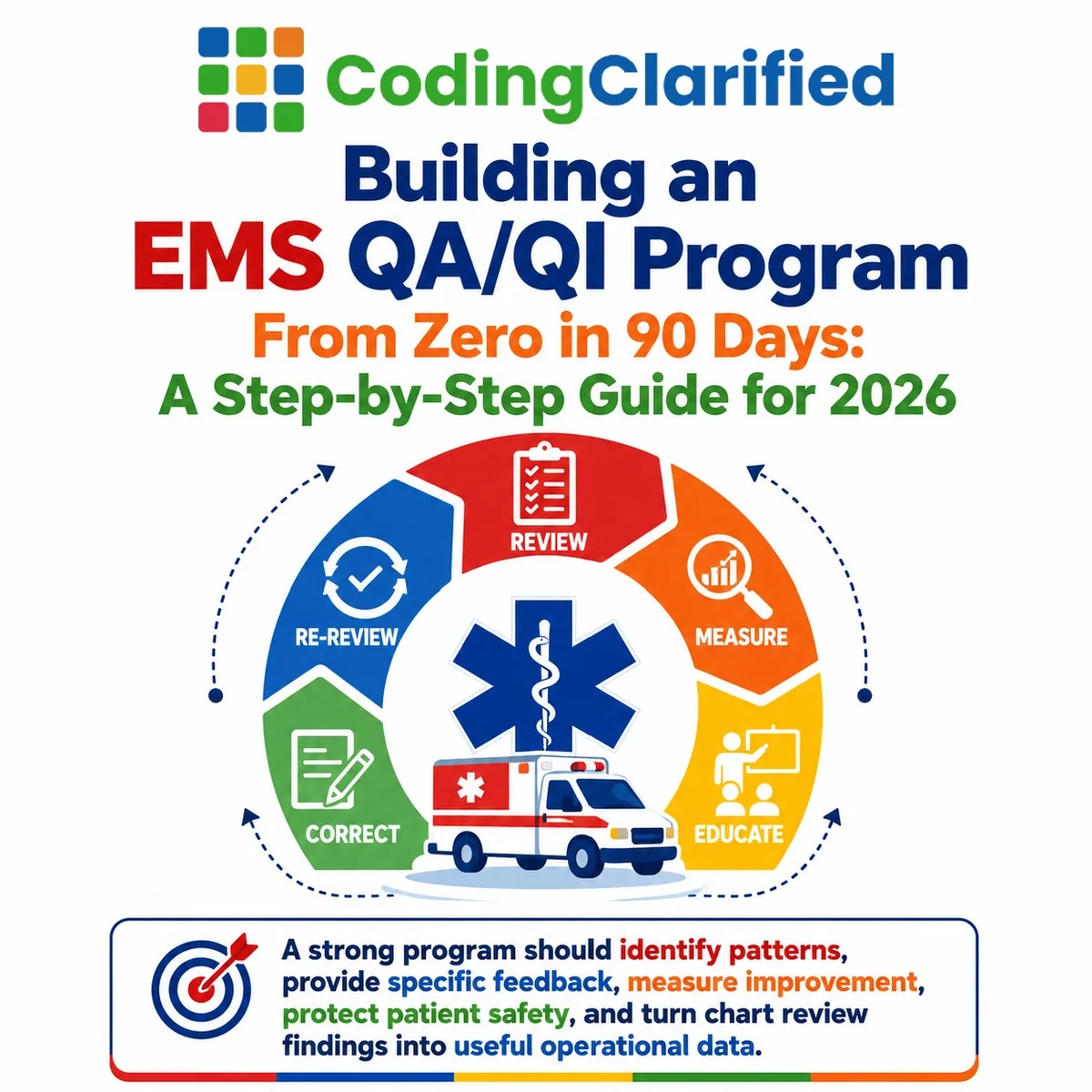
In 2026, EMS agencies need a quality assurance and quality improvement process that does more than find individual documentation errors. A strong program should identify patterns, provide specific feedback, measure improvement, protect patient safety, and turn chart review findings into useful operational data.
Here is how to build that program in 90 days.
Key Takeaways: Building an EMS QA/QI Program in 2026
An effective EMS QA/QI program should:
- Use a written and consistent chart-review criteria set.
- Review a sustainable sample instead of trying to audit every PCR.
- Establish baseline performance before beginning education.
- Separate routine documentation coaching from serious patient-safety concerns.
- Give providers specific, teachable feedback.
- Use controlled and traceable amendment procedures.
- Re-review corrected charts when appropriate.
- Track compliance rates by documentation element.
- Measure correction and amendment turnaround times.
- Look for patterns by provider, shift, station, call type, or other meaningful categories.
- Use audit findings to choose targeted education.
- Measure whether training actually changes future documentation.
- Report improvement, not simply the number of charts reviewed.
Most importantly, QA/QI should create a closed loop:
Review → Measure → Educate → Correct → Re-review → Trend → Improve
That loop turns chart auditing into quality improvement.
Why EMS Agencies Need a Structured QA/QI Program in 2026
Patient care reports sit at the intersection of clinical care, compliance, billing, risk management, education, and EMS data quality. Therefore, documentation quality should not be treated as an administrative problem that belongs only to billing.
The financial risk remains significant.
The Centers for Medicare & Medicaid Services (CMS) reports that ambulance services had a 13.2% Medicare Fee-for-Service improper payment rate for the 2024 reporting period, representing a projected $595.1 million. More importantly, insufficient documentation accounted for 63.5% of ambulance improper payments.
CMS also continues to emphasize that documentation must support both the need for ambulance transportation and the level of service billed.
Meanwhile, EMS data has value far beyond claims.
The National EMS Information System (NEMSIS) provides performance and data-quality tools designed to help agencies evaluate EMS information and use it for improvement. Consequently, incomplete or inconsistent ePCR documentation can affect not only an individual chart but also the usefulness of agency-level data.
For a deeper look at strengthening PCRs, read EMS Documentation Training & QA/QI in 2026: How Better Patient Care Reports Reduce Denials and Protect EMS Agencies.
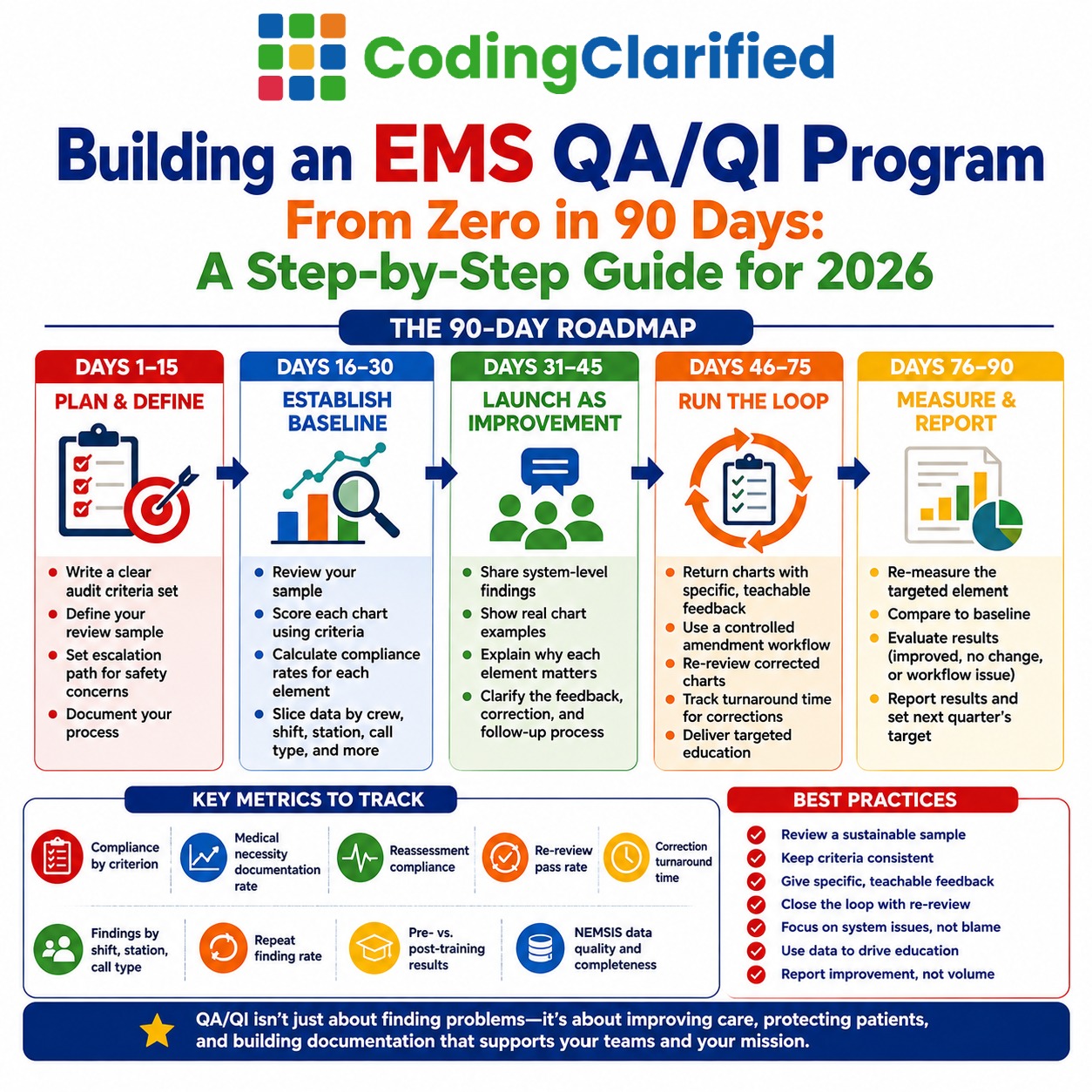
Days 1–15: Decide What Your EMS QA/QI Program Will Measure
Do not begin by reviewing hundreds of charts.
First, decide what you are measuring and write it down. Everything that follows depends on this step.
Create a Fixed PCR Audit Criteria Set
Build a short list of elements that every selected chart will be checked against. Generally, fewer than a dozen criteria makes a good starting point because reviewers can apply them consistently.
Depending on your agency, the criteria might include:
- Required vital signs and appropriate trending
- Reassessment after interventions
- Treatment response
- Narrative and structured-data consistency
- Coherent timestamps
- Objective findings supporting documented conclusions
- Required ePCR fields
- Medical necessity documentation
- Level-of-service support
- Protocol adherence
- Disposition documentation
- Required signatures or attestations
Each criterion should have a simple scoring method, such as present, absent, or not applicable.
Avoid subjective questions such as, “Was this a good chart?”
Instead, ask a measurable question: “Was a reassessment documented after the intervention when clinically appropriate?”
That difference matters because objective criteria allow two reviewers to evaluate the same PCR and reach similar conclusions.
Define Which EMS Charts Will Be Reviewed
Next, determine your audit sample.
Reviewing 100% of PCRs may sound thorough. However, if your team cannot sustain that workload, the program will eventually fail.
Instead, consider automatically reviewing higher-risk categories such as:
- High-acuity calls
- Cardiac arrests
- Refusals
- Certain ALS transports
- Specialty or critical care transports
- Specific payer categories
- Selected clinical protocols
- Complaints or flagged cases
Then add a random sample of routine PCRs.
A smaller sample reviewed consistently for 12 months provides more useful information than a massive review effort that disappears after six weeks.
Establish an Escalation Path
Routine documentation gaps and serious clinical concerns should not travel through the same workflow.
Therefore, define which findings require immediate escalation to a supervisor, clinical leader, or medical director.
For example, a missing treatment reassessment may belong in the normal QA/QI education loop. In contrast, a potential patient-safety event or serious protocol deviation may require immediate clinical review.
Separating those pathways helps preserve QA/QI as an improvement process while ensuring serious concerns receive appropriate attention.
Days 16–30: Establish Your EMS Documentation Baseline
Now review the selected sample and score the charts against your criteria.
However, do not rush into agency-wide retraining after the first few findings.
Your goal during this phase is to establish a baseline.
Calculate the compliance rate for each element. For example, you might discover:
- Vital-sign trending: 92%
- Narrative/data consistency: 89%
- Medical necessity support: 81%
- Treatment reassessment: 64%
- Response-to-treatment documentation: 58%
Suddenly, “our documentation needs improvement” becomes something actionable.
Your agency now knows exactly where the biggest gaps exist.
Break the Data Into Meaningful Groups
An agency-wide average can hide the real problem. Therefore, when the sample size and privacy considerations allow it, examine patterns by:
- Shift
- Station
- Provider
- Call type
- Protocol
- Transport category
- Level of service
- Payer category
For example, a documentation element may have 65% compliance agency-wide. Yet one shift might score 91% while another scores 39%.
Those results suggest very different solutions.
The goal is not to create a leaderboard. Instead, the goal is to determine where education, workflow changes, or additional review will have the greatest impact.
For more information about common PCR weaknesses, see 7 EMS Documentation Gaps We Find in Almost Every Patient Care Report in 2026.
Days 31–45: Introduce EMS QA/QI as Improvement, Not Punishment
How leadership introduces the program can determine whether crews participate or resist.
Start with the system-level findings.
For example:
“Here are the three documentation elements where our agency has the greatest opportunity to improve.”
That message sounds very different from:
“We reviewed your charts and found mistakes.”
Show Crews Exactly What Strong Documentation Looks Like
Generic documentation education often fails because providers cannot translate broad advice into their next PCR.
Instead, use de-identified examples from your own service when allowed.
Show:
What the chart documented → What was missing → What the standard requires → What stronger documentation would include
Concrete examples make the education relevant.
Furthermore, explain why each element matters.
A reassessment after an intervention is not simply another required field. Rather, it shows that the provider evaluated whether the intervention worked, whether the patient’s condition changed, and whether additional care was needed.
Providers are more likely to change documentation habits when they understand the clinical purpose behind the requirement.
Explain What Happens When QA Finds a Problem
Crews should know the workflow before the first chart comes back.
For routine documentation findings, define:
- How the provider receives the finding.
- What information identifies the gap.
- Whether an amendment or clarification is permitted.
- How long the provider has to respond.
- Whether the chart receives a second review.
- How the final result gets recorded.
Transparency reduces uncertainty and helps QA/QI function as education.
Days 46–75: Build the Closed-Loop EMS Chart Review Process
This phase is where QA/QI becomes more than chart reading.
Give Specific and Teachable Feedback
Never return a chart with only:
“Documentation insufficient.”
That statement identifies a problem but does not teach the provider how to correct it.
Instead, the reviewer might explain:
“Medication administration is documented at 14:10, but the PCR does not document the patient’s response or a related reassessment.”
Then identify what the standard expects.
Specific feedback gives providers something they can act on immediately.
Use a Controlled Amendment Workflow
Agencies should never encourage providers to quietly rewrite completed records.
Instead, any permitted amendment process should follow applicable laws, payer requirements, agency policy, and the capabilities of the ePCR system.
The HHS HIPAA Security Rule requires regulated entities to use audit controls for systems containing electronic protected health information and to protect ePHI against improper alteration or destruction.
Therefore, agencies should understand how their ePCR platform handles:
- Audit trails
- Version history
- User identification
- Timestamps
- Addenda
- Amendments
- Locked records
If leadership cannot explain what happens to the original entry after someone changes a completed PCR, 2026 is a good time to ask the ePCR vendor.
Re-Review Corrected Charts
When your workflow permits corrections or clarifications, determine whether the response actually resolved the finding.
Otherwise, you are tracking returned charts rather than corrected documentation.
A useful metric is:
Re-review pass rate = corrected findings that pass re-review ÷ charts re-reviewed × 100
A low pass rate may indicate that feedback is unclear or providers do not understand the documentation standard.
Track Amendment or Correction Turnaround
Measure the time between returning a chart and resolving the finding.
For example:
Average turnaround time = total days to resolution ÷ number of resolved charts
If turnaround time starts increasing, your closed loop may be breaking down.
Deliver One Targeted Training Module
Return to your baseline and identify the weakest documentation element.
Then build a short training module around that single issue.
Keep the education focused. Twenty minutes of targeted instruction based on actual audit data can be more useful than a two-hour general documentation lecture.
Additionally, send the education where the data shows it is needed instead of automatically retraining the entire organization.
Days 76–90: Measure Whether EMS QA/QI Changed Behavior
Now repeat the measurement.
Compare the targeted element with its baseline.
Suppose treatment reassessment compliance started at 58%. After focused education, the next audit period reaches 83%.
You now have evidence that the intervention changed documentation behavior.
However, not every result will improve.
Result 1: Compliance Improves
The intervention likely helped.
Continue monitoring the element while moving your primary attention to the next significant gap.
Result 2: Compliance Does Not Improve
The education may not have addressed the real problem.
Alternatively, the issue may involve workflow, policy, technology, or an ePCR design problem rather than provider knowledge.
Result 3: Compliance Improves and Then Falls Again
This result deserves close attention.
Perhaps the required field sits three screens away from the normal workflow. Maybe the template does not prompt the provider at the right point. Likewise, crews may face an operational barrier that makes the correct behavior unnecessarily difficult.
If most of the organization misses the same element, do not automatically assume you have dozens of individual performance problems.
You may have one system problem.
EMS QA/QI Metrics Agencies Should Track in 2026
A practical EMS quality dashboard does not need dozens of measures.
Start with metrics you can act on:
- Overall PCR compliance rate
- Compliance by audit criterion
- Reassessment compliance
- Medical necessity documentation rate
- Narrative/data consistency rate
- Re-review pass rate
- Average correction turnaround time
- Repeat finding rate
- Findings by call type or shift
- Pre-training versus post-training compliance
Additionally, consider data-quality measures relevant to your NEMSIS reporting.
NEMSIS provides public data-quality dashboards designed around the completeness and accuracy of submitted EMS data. Therefore, agencies should think about documentation quality not only as narrative quality but also as structured-data quality.
For a deeper strategy, read Turn Patient Care Report Audits Into Data That Changes Behavior.
Common Mistakes to Avoid When Building an EMS QA/QI Program
Trying to Review Every PCR
A review program that overwhelms the reviewers will not last.
Instead, build a risk-based sample that your team can sustain.
Constantly Changing the Audit Criteria
Changing the scoring system every month destroys your ability to compare performance over time.
Therefore, keep the core criteria stable long enough to establish meaningful trends.
Giving Vague Feedback
“Needs better documentation” is not actionable.
Name the missing element, explain the standard, and show providers what improvement looks like.
Letting Findings Sit Without Follow-Up
Returning a PCR without a correction window or follow-up process leaves the loop open.
Consequently, providers may learn that QA findings do not require action.
Treating Every Finding as a Disciplinary Problem
Quality improvement, coaching, and serious clinical investigations serve different purposes.
Keep those processes clearly defined.
Ignoring System-Level Problems
Repeated findings across many providers may signal a template, workflow, policy, or training issue.
Do not repeatedly coach individuals for a problem the system creates.
Making One Person Responsible for Everything
If only one employee knows how to conduct the reviews, the QA/QI program becomes fragile.
Cross-train reviewers early and use the same written scoring criteria.
What Should an EMS Agency Have After 90 Days?
By day 90, your agency should have:
- A written QA/QI scope
- Fixed PCR review criteria
- A sustainable sampling method
- Defined escalation rules
- Baseline compliance data
- A feedback process
- A controlled correction workflow
- Re-review procedures
- A small set of meaningful KPIs
- At least one targeted educational intervention
- Post-training results
- A short leadership report
Your first report does not need to be complicated.
Instead, answer five questions:
What did we measure?
Where were we weakest?
What did we change?
Did performance improve?
What will we target next?
That report tells leadership much more than, “We reviewed 240 charts.”
Turning EMS QA/QI Into Continuous Improvement
After the first 90 days, repeat the cycle.
Each quarter, choose the next meaningful weakness, determine why it is happening, implement an intervention, and measure the result.
Over time, your agency builds something far more useful than a collection of chart reviews.
You build evidence.
You can show where documentation started, what changed, which interventions worked, and where additional improvement is still needed.
That is the difference between quality assurance and meaningful quality improvement.
For agencies struggling with denials despite clinically appropriate transports, also read Why a Clinically Justified Ambulance Transport Still Gets Denied in 2026: EMS Medical Necessity Documentation.
EMS Documentation Training and QA/QI Support
Coding Clarified provides EMS Documentation Training, QA/QI & Live Coaching for agencies that want help building a structured program.
Services can include audit-scope development, standardized chart-review criteria, documentation audits, closed-loop feedback, trend reporting, and targeted education based on the weaknesses identified through actual PCR reviews.
Rather than simply telling an agency that its documentation needs improvement, the goal is to identify where the documentation breaks down, measure how often it happens, and determine whether the intervention changed future behavior.
That is what makes QA/QI measurable.
Frequently Asked Questions About Building an EMS QA/QI Program
What is an EMS QA/QI program?
An EMS QA/QI program uses structured review and performance data to evaluate patient care, documentation, protocol adherence, and other quality measures. Quality assurance generally identifies whether defined standards were met, while quality improvement uses those findings to improve future performance.
How many EMS patient care reports should an agency audit?
There is no single percentage that fits every EMS agency. Instead, the sample should reflect agency size, staffing, risk, call volume, regulatory requirements, and quality priorities. High-risk cases may receive automatic review, while routine calls can be evaluated through a sustainable random sample.
What should an EMS chart audit look for?
Criteria can include vital-sign trends, assessments, interventions, reassessments, treatment response, timestamps, protocol documentation, narrative consistency, required ePCR fields, medical necessity, and support for the documented level of service. Most importantly, agencies should define the criteria before beginning routine reviews.
Should EMS QA/QI review every patient care report?
Not necessarily. Reviewing every chart may be appropriate in some settings, but it can overwhelm other agencies. A sustainable, risk-based sampling process may produce better long-term quality data than attempting a 100% review that the organization cannot maintain.
Can EMS QA/QI help reduce ambulance claim denials?
It can help identify documentation weaknesses that may contribute to denials. CMS reports that insufficient documentation accounted for 63.5% of ambulance-service improper payments in its 2024 reporting period. Therefore, finding weak medical-necessity documentation and other recurring PCR gaps before billing can help agencies address important revenue-cycle risks.
How should EMS agencies handle corrections to completed PCRs?
Agencies should use a controlled process that follows applicable law, payer requirements, organizational policy, and ePCR functionality. Corrections or amendments should not hide or improperly overwrite the original record. Furthermore, organizations should understand their system’s timestamps, user attribution, audit logs, and version-history capabilities.
What are the best EMS QA/QI metrics to track?
Useful measures include compliance by audit element, medical-necessity documentation rate, reassessment compliance, re-review pass rate, correction turnaround time, repeat findings, and pre-training versus post-training performance. Agencies can also monitor NEMSIS-related completeness and data-quality measures when relevant.
Final Takeaway: Building an EMS QA/QI Program That Lasts
The best EMS QA/QI program is not the one that reads the most charts.
It is the one that consistently measures the right charts, identifies specific weaknesses, teaches providers how to improve, closes the correction loop, and proves whether behavior changed.
Start small. Keep the criteria objective. Measure your baseline. Target one problem. Then measure again.
Within 90 days, an EMS agency can move from “we need to improve documentation” to something much more useful:
Here is where we were weak. Here is what we changed. Here is what happened next.
That is a quality program.
Coding Clarified LLC provides QA/QI documentation review and training for EMS agencies and is a U.S. Department of Labor Registered Apprenticeship sponsor and AAPC-affiliated training provider. Learn more at Coding Clarified Learn more About Coding Clarified.