EMS documentation problems often look different on the surface. However, after reviewing patient care reports (PCRs) from different agencies, states, ePCR platforms, and call types, the same documentation gaps appear again and again.
That consistency is actually useful. Instead of treating every weak chart as a unique problem, EMS agencies can identify a small number of repeat documentation habits. Then, through focused QA/QI review and crew education, agencies can correct those habits before they contribute to claim denials, compliance concerns, or weak clinical records.
In 2026, this matters more than ever. CMS continues to require documentation that supports ambulance medical necessity and the level of service provided. In addition, CMS maintains specific Medicare ambulance coverage, billing, fee schedule, and compliance guidance for providers and suppliers.
Key Takeaways: Common EMS Documentation Gaps in 2026
The most common EMS documentation problems usually involve missing details rather than poor patient care. Specifically, crews may perform the correct assessment, monitoring, treatment, or reassessment but fail to clearly capture it in the PCR.
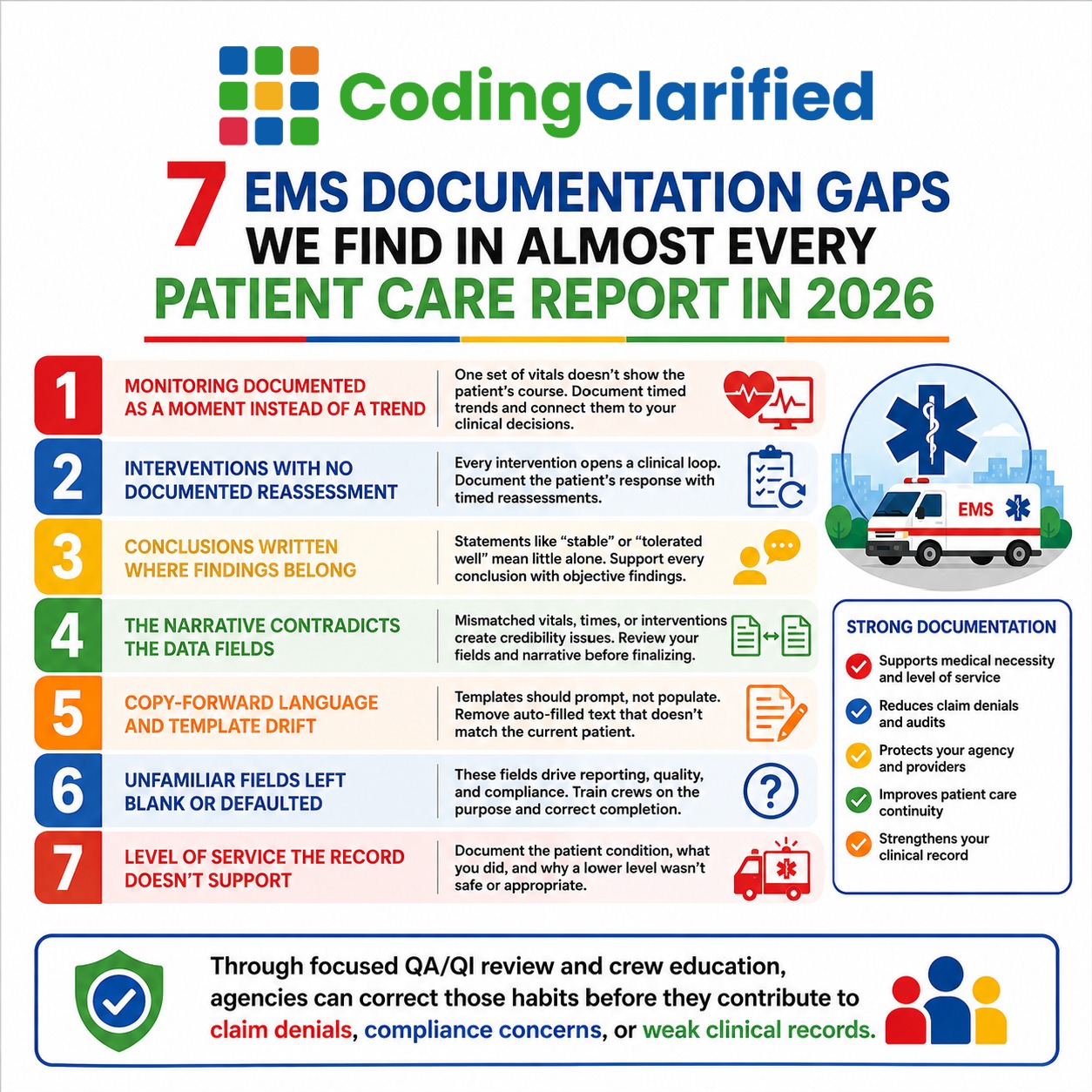
The seven documentation gaps we see repeatedly are:
- Monitoring documented as a single moment instead of a trend
- Interventions without a documented reassessment
- Conclusions without objective findings
- Conflicts between the narrative and structured ePCR fields
- Copy-forward language and template drift
- Required or unfamiliar fields left blank or defaulted
- Documentation that does not support the reported level of service
Most importantly, EMS agencies can identify these problems through consistent chart review. Then, they can provide targeted feedback and measure whether documentation improves.
For a broader guide to building that process, read EMS Documentation Training & QA/QI in 2026: How Better Patient Care Reports Reduce Denials and Protect EMS Agencies.
Why EMS Documentation Quality Matters in 2026
A patient care report is more than a narrative about what happened during a call. Instead, it serves as a clinical record, a communication tool, a source of EMS data, and, in many cases, supporting documentation for an ambulance claim.
For Medicare ambulance services, documentation becomes especially important because the record must support applicable coverage and medical necessity requirements. CMS explains that ambulance transportation generally requires a patient condition that makes transportation by other means inappropriate. Furthermore, the patient’s condition must support both the need for ambulance transportation and the applicable level of service.
Therefore, simply documenting a diagnosis or writing “patient stable” may not tell the complete story.
The PCR should show what the crew found, what they did, how the patient responded, and why the transportation and level of care were appropriate.
Here are the seven gaps we find most often.
1. Monitoring Is Documented as a Moment Instead of a Trend
What we see
One set of vital signs appears in the PCR. Sometimes there are two. However, the patient may have been monitored throughout a 30- or 40-minute transport.
Why it matters
When clinically appropriate, repeated assessments can show the patient’s course during transport. Additionally, trends may help explain why the crew continued monitoring, changed treatment, notified the receiving facility, or made another clinical decision.
One blood pressure reading tells a reviewer what the patient’s blood pressure was at that moment. In contrast, several appropriately timed readings may show whether the pressure remained stable, increased, or decreased.
Weak documentation:
BP 148/92, HR 96, RR 20, SpO2 94% RA.
Better documentation:
Document clinically appropriate timed vital signs and reassessments throughout the encounter. Then, when relevant, connect the trend to the clinical decision-making in the narrative.
For example, the narrative could explain that the patient’s blood pressure decreased across repeated assessments, symptoms changed after repositioning, or oxygen saturation improved following an intervention.
The solution is not necessarily to perform more assessments. Instead, crews need to accurately document the assessments they already perform.
2. Interventions Have No Documented Reassessment
What we see
A medication was administered. Oxygen was applied. A splint was placed.
Then the chart moves on.
Why it matters
An intervention creates a clinical question: What happened afterward?
For example, if medication was administered for pain, the record should show an appropriate reassessment of the patient’s response. Likewise, if oxygen was applied because of hypoxia, a later oxygen saturation may help show whether the intervention produced the intended response.
Weak documentation:
Administered 324 mg ASA PO.
Better documentation:
Record the administration and time. Next, document the appropriate reassessment, such as symptoms, relevant vital signs, patient response, adverse effects, or other clinically important findings.
Reassessment helps close the clinical loop.
Furthermore, it shows that the crew did not simply perform an intervention and move on without evaluating its effect.
3. Conclusions Are Written Where Objective Findings Belong
What we see
Common phrases include:
Patient stable.
Airway patent.
Neuro intact.
Tolerated well.
Why it matters
These statements communicate conclusions. However, conclusions become much stronger when the PCR also includes the observations that support them.
For example, “neuro intact” alone provides little detail about the assessment performed. Instead, the record could describe orientation, speech, motor findings, pupils, sensation, or other relevant neurological findings based on the patient’s presentation.
Likewise, “patient tolerated procedure well” does not explain what the crew observed afterward.
A stronger record may document that the patient denied increased pain, maintained the relevant vital signs, showed no new distress, and had no identified complication following the intervention.
Objective findings give meaning to the conclusion.
Therefore, crews should document what they observed first and summarize the conclusion second when needed.
4. The Narrative Contradicts the ePCR Data Fields
What we see
The narrative describes hypotension, yet the vital-sign section does not show it.
Another narrative describes a lengthy extrication, but the recorded timestamps do not support that sequence.
Elsewhere, an intervention appears in the narrative but never appears in the structured intervention fields.
Why it matters
Internal inconsistency can weaken the reliability of an otherwise strong PCR. Moreover, contradictions can create problems during billing review, QA/QI, audits, investigations, or legal review.
These problems often occur because providers complete portions of the chart at different times. Additionally, a provider may write the narrative from memory without reviewing information already entered elsewhere in the ePCR.
Fortunately, the fix can be simple.
Before finalizing the PCR, compare:
- Narrative
- Vital signs
- Assessment findings
- Medication administration
- Procedures and interventions
- Times
- Transport information
- Disposition
- Other required structured fields
A short final review can catch many inconsistencies before the report becomes part of the permanent record.
5. Copy-Forward Language and Template Drift
What we see
Nearly identical language appears across dozens of charts.
Eventually, a template carries forward a statement that does not accurately describe the patient in the current encounter.
Why it matters
Templates can improve consistency and efficiency. However, they become risky when they populate patient-specific facts instead of simply prompting providers to document them.
For example, a useful template might remind the provider to document:
- Airway
- Breathing
- Circulation
- Neurological findings
- Relevant history
- Interventions
- Reassessment
- Transport condition
In contrast, a template that automatically states that every patient had equal pupils, clear lungs, no distress, normal skin findings, and unchanged condition may create inaccurate documentation if the provider does not edit it carefully.
Consequently, templates should prompt documentation, not create clinical facts.
Agencies should periodically review templates as part of QA/QI. In addition, they should remove unnecessary default text that encourages copy-forward documentation.
6. Unfamiliar ePCR Fields Are Left Blank or Defaulted
What we see
Providers understand the clinical portions of the PCR but may not understand why certain structured fields exist.
As a result, they may skip the field, select a default answer, or choose whichever option seems closest.
Why it matters
Structured EMS information may support much more than billing. Depending on the system and data element, information can contribute to agency QA/QI, research, public-health analysis, operational planning, state reporting, and national EMS data.
Therefore, a field that crews repeatedly complete incorrectly may indicate a training problem, not simply an individual documentation problem.
A useful QA/QI program should identify fields with unusually high rates of:
- Blank responses
- “Unknown” selections
- Default values
- Conflicting responses
- Inconsistent provider interpretation
Next, training should explain both how to complete the field and why it matters.
Providers are more likely to document accurately when they understand what the information means downstream.
7. The Documentation Does Not Support the Level of Service
What we see
The claim reflects an ALS or another higher level of ambulance service. However, an outside reviewer reading the PCR may see documentation that looks like an uncomplicated transport.
Why it matters
This documentation gap can directly affect reimbursement.
CMS ambulance coverage and payment rules require the record to support applicable medical necessity requirements. Moreover, Medicare contractors may review documentation to determine whether the billed service meets coverage requirements.
For example, common ground ambulance HCPCS Level II codes include A0428 for BLS non-emergency, A0429 for BLS emergency, A0426 for ALS1 non-emergency, A0427 for ALS1 emergency, and A0433 for ALS2.
However, selecting a code does not establish medical necessity by itself.
CMS guidance makes clear that the medical record is what supports coverage. Therefore, documentation should accurately establish what happened during the encounter and why the billed service was appropriate.
A useful documentation check asks three questions:
- What was the patient’s condition and why did it require ambulance transportation?
- What assessment, monitoring, treatment, or interventions did the crew provide?
- Does the complete record support the level of service reported?
If the PCR cannot answer those questions, coders and billers may have difficulty defending the claim.
For more guidance, read Medical Coding Ambulance Services and What Is Medical Necessity in Medical Coding & Billing?.
What These Seven EMS Documentation Gaps Have in Common
These gaps do not automatically mean that poor patient care occurred. In fact, many appear in charts where providers performed appropriate assessments and interventions.
The problem is that the record does not always show the complete work.
Documentation habits often develop early. Then, time pressure, templates, inconsistent feedback, and unclear ePCR fields reinforce those habits.
A generic annual lecture telling crews to “document better” rarely identifies the exact behavior that needs to change.
Instead, EMS agencies can use a more targeted cycle:
Review → Identify → Educate → Correct → Re-review → Measure
First, review charts against consistent criteria. Next, identify the exact gap and show the provider what was missing.
Then, allow correction when agency policy and applicable rules permit it. Finally, review future charts against the same criteria to determine whether the problem actually improved.
That turns QA/QI from an inspection process into a measurable documentation improvement program.
Common EMS Documentation Mistakes to Avoid
Some documentation habits deserve special attention because they can appear harmless during a busy shift.
Avoid relying on phrases such as “stable,” “unchanged,” “tolerated well,” or “no distress” without documenting supporting observations. Additionally, do not assume that an intervention alone demonstrates its effectiveness.
Crews should also avoid:
- Entering only one set of vital signs when additional assessments were clinically performed and relevant
- Documenting treatment without the appropriate reassessment
- Allowing the narrative and structured fields to conflict
- Copying patient-specific statements from previous PCRs
- Selecting default ePCR responses without verifying accuracy
- Assuming a diagnosis alone establishes ambulance medical necessity
- Assuming a higher level of service is supported simply because an ALS provider was present
- Using vague statements where objective findings are available
- Waiting until long after the call to complete key portions of the report when contemporaneous documentation is feasible
Most importantly, crews should never add information simply because they believe a payer wants to see it. Documentation must accurately reflect the patient, assessment, treatment, transport, and events that actually occurred.
How EMS Agencies Can Find Their Biggest Documentation Gap
Every agency’s problem may be different in scale, even though the categories remain similar.
One agency may discover that 38% of audited medication charts lack a clear post-medication reassessment. Another may have excellent reassessments but repeated contradictions between narratives and structured data.
That difference matters.
Instead of telling every provider to “write better narratives,” agencies can track specific measures such as reassessment completion, vital-sign trends, medical-necessity support, contradictory data, or template use.
Over time, the agency can compare those numbers before and after training.
For agencies building a formal process, see EMS Documentation Training, QA/QI & Live Coaching. Learn more about Coding Clarified.
2026 EMS Documentation Resources
EMS agencies should regularly verify requirements against current payer, state, medical-direction, and organizational policies. For Medicare ambulance services, CMS provides dedicated ambulance resources, including the Medicare Benefit Policy Manual Chapter 10 and Medicare Claims Processing Manual Chapter 15.
The CMS Ambulance Fee Schedule and Ambulance Resources also contains current payment, regulatory, and reporting information. As of August 2026, CMS has published CY 2026 Ambulance Fee Schedule files and continues to maintain current ambulance regulations and notices.
For additional coding education, coders and billing staff can also use AAPC website alongside current payer guidance and official code sets.
Frequently Asked Questions About EMS Documentation Gaps in 2026
Quick answers to the questions EMS agencies ask most about documentation gaps.
What are the most common EMS documentation mistakes?
Common EMS documentation problems include missing reassessments, incomplete vital-sign trends, vague conclusions, contradictory ePCR data, excessive copy-forward language, incomplete structured fields, and documentation that does not clearly support medical necessity or level of service.
Additionally, agencies may discover provider-specific patterns through routine chart audits.
What should an EMS patient care report document?
A strong PCR should accurately describe the patient’s condition, relevant assessment findings, vital signs, interventions, response to treatment, reassessments, transport details, disposition, and other required information.
Furthermore, when the record supports an ambulance claim, it should provide enough patient-specific information to demonstrate applicable medical necessity and level-of-service requirements.
Why are reassessments important in EMS documentation?
Reassessments show what happened after an intervention or as the patient’s condition changed.
For example, after oxygen, medication, splinting, airway treatment, or another intervention, an appropriate reassessment can show whether the patient’s condition improved, worsened, or remained unchanged.
Can poor EMS documentation cause Medicare claim denials?
Yes. Documentation that fails to support Medicare ambulance coverage requirements can contribute to denials or improper payments.
CMS specifically reviews ambulance documentation to determine whether Medicare coverage and medical necessity requirements have been met.
Does being bed-confined automatically make an ambulance transport medically necessary?
No. CMS specifically explains that bed confinement alone does not establish medical necessity.
Instead, the patient’s medical condition and applicable Medicare requirements must support the need for ambulance transportation.
How can an EMS agency improve PCR documentation?
Start with a consistent chart-audit standard rather than general impressions. Then, identify the agency’s most frequent documentation gaps and provide focused education around those specific findings.
After training, re-audit the same measures. Consequently, the agency can determine whether documentation actually improved instead of assuming that training worked.
How often should EMS agencies review charts for documentation quality?
There is no single audit frequency that fits every EMS agency. However, reviews should occur often enough to identify trends, provide timely feedback, and measure whether corrective education produces lasting improvement.
Agencies may also increase review frequency for high-risk call types, new providers, identified documentation problems, or services with greater billing and compliance exposure.
Final Takeaway: Fix the EMS Documentation Habit, Not Just the Chart
The biggest lesson from reviewing EMS charts is simple: most recurring documentation gaps are predictable.
That makes them trainable.
Crews usually do not need another broad lecture about why documentation matters. Instead, they need specific feedback that shows exactly what is missing from their charts and what complete, accurate documentation should contain.
Consistent criteria create consistent feedback. In turn, consistent feedback creates measurable behavior change.
If your agency wants to know which of these seven problems appears most often in its PCRs, chart-review data can provide that answer. More importantly, the same data can show whether your documentation training is actually fixing it.
Coding Clarified LLC provides QA/QI documentation review and EMS documentation education for agencies. Learn more about EMS Documentation Training, QA/QI & Live Coaching.