EMS agencies know employee turnover is expensive. However, many agencies have never calculated what losing an EMT or paramedic actually costs their service.
That missing number matters.
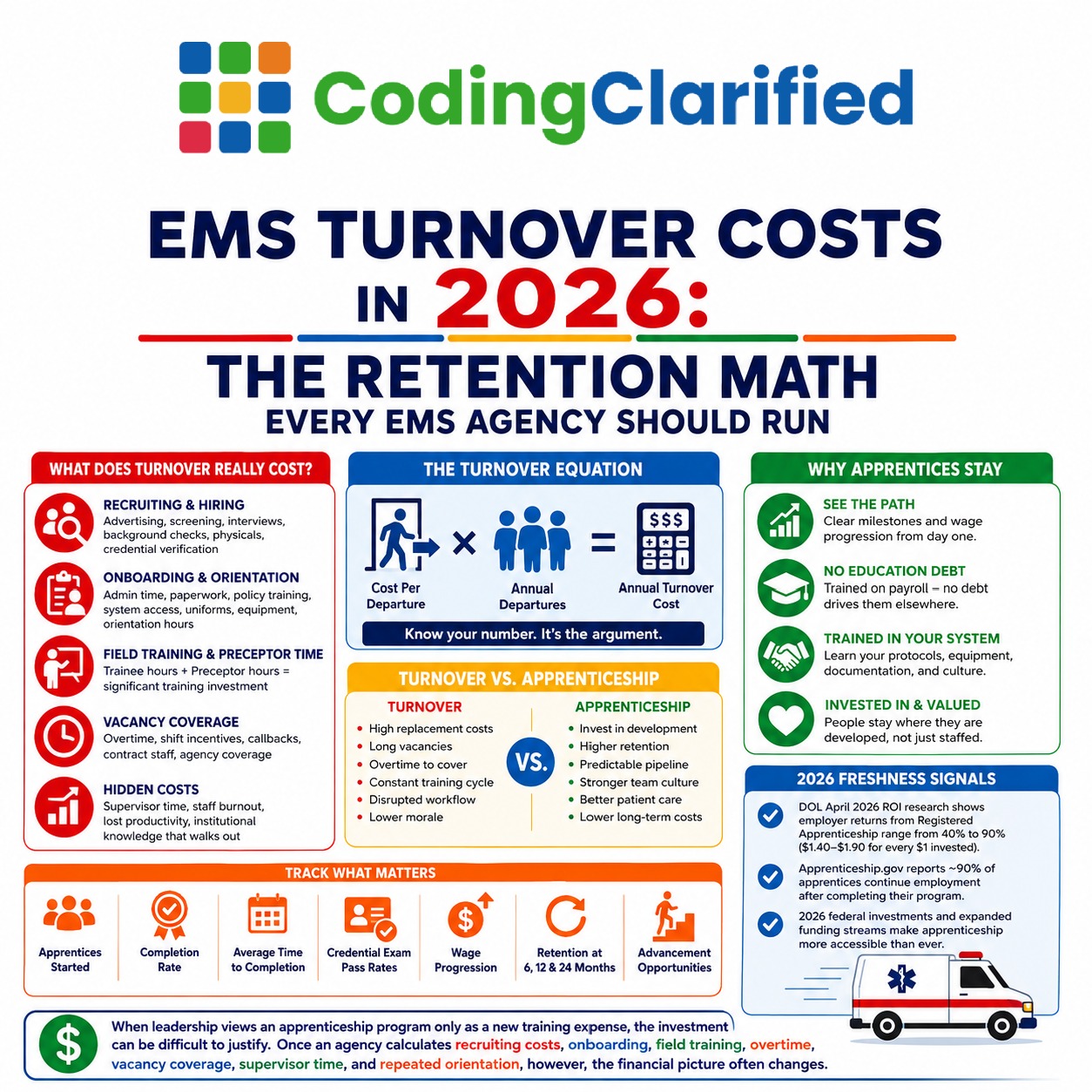
When leadership views an apprenticeship program only as a new training expense, the investment can be difficult to justify. Once an agency calculates recruiting costs, onboarding, field training, overtime, vacancy coverage, supervisor time, and repeated orientation, however, the financial picture often changes.
In 2026, that calculation has become even more important. The U.S. Department of Labor continues to expand Registered Apprenticeship, while new federal research shows that employers can receive meaningful returns from apprenticeship investments.
This guide explains how EMS leaders can calculate their own turnover costs, compare those costs with apprenticeship, measure retention, and build a business case based on their agency’s actual numbers.
Key Takeaways: EMS Turnover and Retention in 2026
- Do not rely only on an industry-wide estimate for the cost of EMS turnover. Instead, calculate the cost for your own service.
- Include recruiting, onboarding, field training, preceptor time, overtime, vacancy coverage, supervisor time, and other indirect costs.
- Calculate both cost per departure and total annual turnover cost.
- Compare conventional hiring costs with the total cost of developing an EMT or paramedic through Registered Apprenticeship.
- Measure apprentice retention against conventional hires at 6, 12, and 24 months.
- In April 2026, U.S. Department of Labor research reported that the strongest employer ROI estimates for Registered Apprenticeship ranged from 40% to 90%.
- Apprenticeship.gov reports that approximately 90% of apprentices continue employment after completing an apprenticeship.
- Registered Apprenticeship can also open access to workforce partnerships, technical assistance, and potential funding opportunities.
- Agencies should track outcomes from the first apprenticeship cohort so they can prove results to leadership, boards, workforce partners, and funders.
What Does EMS Employee Turnover Actually Cost?
You may see estimates claiming that replacing an EMT or paramedic costs a certain dollar amount. Those numbers can provide context, but they should not become your business case.
Every EMS service operates differently.
For example, one agency may have a short orientation process, while another requires weeks of supervised field training. Likewise, a rural service may struggle to fill a vacancy for months, while a large metropolitan service may maintain a larger candidate pool.
Therefore, the best EMS turnover estimate is the one built from your own payroll, recruiting, training, and staffing data.
Fortunately, you do not need an economist to calculate it. Finance, HR, operations, and training staff can usually build a useful estimate with information the agency already has.
How to Calculate EMS Turnover Cost Per Employee
Start with the costs directly connected to replacing one employee.
1. Recruiting and Hiring Costs
First, calculate what your organization spends finding the replacement.
Include expenses such as:
- Job advertising
- Recruiting events
- Applicant tracking systems
- Recruiter or HR time
- Application processing
- Interviews
- Background checks
- Drug screening
- Physical examinations
- Credential verification
- Driving-record checks
- Pre-employment testing
Some expenses may appear small individually. Nevertheless, once you multiply them across dozens of departures, they become significant.
2. EMS Onboarding Costs
Next, determine what happens after an applicant accepts the position.
Administrative onboarding may involve:
- HR processing
- Payroll setup
- Credentialing
- Scheduling
- IT access
- ePCR access
- Email accounts
- Uniforms
- Personal protective equipment
- Equipment issue
- Policy training
- Compliance training
Additionally, remember to calculate staff time.
If an HR employee spends three hours onboarding a new EMT, for example, those three hours have a cost. The same principle applies to supervisors, educators, IT staff, credentialing employees, and others involved in the process.
3. Orientation and Academy Costs
Orientation can become one of the larger replacement expenses.
Calculate:
New employee orientation hours × employee hourly wage
Then add:
Instructor hours × instructor hourly cost
After that, include materials, facilities, equipment, simulation resources, and other direct expenses when applicable.
Consequently, a multiweek EMS academy may cost substantially more than leadership realizes when everyone involved in delivering it is included.
4. Field Training and Preceptor Costs
A newly hired provider may not immediately function at the same productivity level as an experienced employee.
Therefore, calculate both sides of field training:
Trainee hours × trainee wage
plus
Preceptor hours × preceptor wage
Also consider whether the training arrangement changes unit productivity.
For instance, a crew working with a trainee may operate differently from a fully experienced crew. The exact financial effect will vary by agency, so avoid inventing a productivity number simply to make the calculation larger.
Use measurable costs whenever possible.
Calculate the Turnover Cost of Leaving an EMS Position Vacant
Replacing the employee is only part of the expense.
The vacancy itself costs money.
Suppose a paramedic position remains open for 60 days. Someone still has to staff the ambulance during those 60 days.
As a result, agencies may rely on:
- Overtime
- Shift incentives
- Mandatory callbacks
- Part-time employees
- PRN employees
- Supervisors filling operational roles
- Contract or agency staffing
- Mutual-aid arrangements
Determine your average days-to-fill for EMT and paramedic vacancies separately. Then calculate the additional coverage expense created during that period.
Overtime deserves particular attention.
If an agency repeatedly pays experienced paramedics overtime to cover vacancies, turnover can become a cycle:
Vacancy → overtime → fatigue → dissatisfaction → another departure → another vacancy
That cycle makes retention more than an HR metric. Instead, it becomes an operational and financial issue.
Do Not Forget the Hidden Costs of EMS Turnover
Some turnover expenses never appear under a line item called “turnover.”
Nevertheless, they still consume resources.
Consider the supervisory hours spent handling resignations, exit procedures, schedule changes, recruiting, interviews, orientation, and field training.
Likewise, consider what happens when an experienced paramedic leaves.
The agency may lose years of knowledge about:
- Local protocols
- Equipment
- Hospitals
- Response areas
- Documentation
- Medical direction
- Operational procedures
- Crew dynamics
- Community needs
Institutional knowledge is difficult to assign a precise dollar value. Therefore, keep it separate from your hard-cost calculation if you cannot support the estimate.
That approach actually strengthens the analysis because leadership can see which numbers are measurable and which benefits remain harder to quantify.
EMS Turnover Cost Formula
A practical starting formula is:
Recruiting + hiring + onboarding + orientation + field training + preceptor time + vacancy coverage + measurable administrative costs = cost per departure
Then calculate:
Cost per departure × annual employee departures = annual turnover cost
For example, imagine an EMS agency calculates a $14,500 average replacement cost and experiences 18 departures during the year.
$14,500 × 18 = $261,000
That service is spending approximately $261,000 per year on measurable turnover costs.
The actual number could be higher or lower. Most importantly, however, it belongs to the agency rather than coming from an unrelated national estimate.
Compare EMS Turnover Costs With Registered Apprenticeship
Once you know what turnover costs, calculate the alternative.
Registered Apprenticeship is not free training. Instead, it is a structured workforce-development model that combines paid employment, on-the-job learning, mentorship, related instruction, and progressive skill development.
Your apprenticeship calculation may include:
- Related Technical Instruction (RTI)
- Apprentice wages
- Preceptor or mentor time
- Program administration
- Credential preparation
- Equipment and uniforms
- Required testing
- Wage progression
- Other occupation-specific training costs
However, compare equivalent costs carefully.
If your agency already provides extensive field training to every new hire, do not count the entire field-training expense as a unique apprenticeship cost. Instead, identify the incremental cost created by the apprenticeship model.
That distinction produces a much more credible ROI analysis.
For a deeper explanation of the structure, read EMS Registered Apprenticeship Programs in 2026: How EMT & Paramedic Apprenticeships Actually Work.
What Does 2026 Research Say About Apprenticeship ROI?
The 2026 data gives EMS leaders another reason to examine the numbers.
The U.S. Department of Labor released an employer Registered Apprenticeship ROI review in April 2026. Although returns varied across programs and industries, the most comprehensive estimates showed an employer ROI of approximately 40% to 90%.
In practical terms, those estimates suggest employers may receive approximately $1.40 to $1.90 in benefits for each $1 invested in Registered Apprenticeship.
The Department of Labor also identified reduced turnover among the indirect benefits that can contribute to employer ROI.
Additionally, Apprenticeship.gov reports that approximately 90% of apprentices continue employment after completing an apprenticeship.
Those figures do not guarantee that an EMS agency will achieve the same result. Instead, they show why measuring an agency’s own apprentice retention and ROI makes sense.
Why Can Apprenticeship Reduce EMS Turnover?
Retention does not improve simply because someone receives the title “apprentice.”
The structure matters.
Apprentices Can See Their Career Progression
Registered Apprenticeship includes structured skill development and progressive wage increases.
Therefore, employees can see where they are going.
An apprentice may know what they earn today, which competencies they need to demonstrate, and what the next stage of wage progression looks like.
By contrast, employees who cannot see a path forward may start looking elsewhere.
Employees Earn While They Learn
Apprenticeship combines employment with training.
Consequently, workers develop skills while earning wages instead of relying entirely on an unpaid educational pathway before employment.
That distinction can help expand the candidate pool and remove barriers for people who cannot afford to stop working while completing training.
Training Matches the Employer’s Environment
An EMS apprentice develops competency inside the service.
Therefore, training can include the agency’s:
- Protocols
- Equipment
- Documentation expectations
- ePCR system
- Operational procedures
- Medical direction
- QA/QI standards
For example, documentation education can become part of structured workforce development rather than something introduced only after chart problems appear.
Agencies looking to strengthen this area can also read EMS Documentation Training & QA/QI in 2026: How Better Patient Care Reports Reduce Denials and Protect EMS Agencies.
Do Not Overlook Your EMS Preceptors
Turnover affects the employees who remain.
Each departure may mean another open shift, another orientation, another trainee, and another round of overtime.
Eventually, your most experienced providers may carry a disproportionate share of that burden.
Registered Apprenticeship can make training more structured.
Rather than telling an experienced paramedic to “train the new person,” the program can define competencies, milestones, responsibilities, and progression.
As a result, preceptors have a clearer understanding of what they need to teach and what successful completion looks like.
Track EMS Turnover and Apprentice Retention at 6, 12, and 24 Months
You cannot demonstrate ROI without data.
From your first cohort, track:
- Apprentices who start
- Apprentices who complete
- Average time to completion
- Credential exam pass rates
- Wage progression
- Retention at 6 months
- Retention at 12 months
- Retention at 24 months
- Promotion into senior positions
- Advancement into preceptor positions
- Advancement into supervisory positions
Most importantly, compare apprentices with conventionally hired employees during the same period.
If 82% of apprentices remain at 24 months while only 58% of conventional hires remain, for example, leadership has something measurable to evaluate.
Conversely, if the numbers show no retention difference, that information matters too.
The goal is not to prove apprenticeship works regardless of the evidence. The goal is to determine whether it works for your service.
2026 Funding Makes Measurement Even More Important
Federal apprenticeship policy increasingly emphasizes measurable outcomes.
In 2026, the Department of Labor announced major investments in Registered Apprenticeship expansion, including funding tied to performance and verified milestones. Employers should also explore state workforce systems and Workforce Innovation and Opportunity Act resources because available funding varies by state, program, employer, occupation, and participant.
Registered status may provide access to funding opportunities, tax credits in some jurisdictions, partnerships, and technical assistance. However, agencies should never assume that every apprentice or employer automatically qualifies for a specific funding stream.
Instead, verify eligibility with the applicable workforce board, state apprenticeship agency, federal Office of Apprenticeship, sponsor, or funding administrator.
Common Mistakes to Avoid When Calculating EMS Turnover ROI
Using a National Turnover Estimate as Your Final Number
Industry benchmarks provide context. However, your board needs to know what turnover costs your agency.
Counting Existing Training Costs Twice
If conventional hires already receive field training, separate that baseline expense from any additional apprenticeship cost.
Ignoring Overtime
Vacancy coverage can become one of the largest turnover expenses. Therefore, pull actual payroll data whenever possible.
Measuring Apprentice Completion but Not Retention
Completion is important, but retention tells leadership whether the workforce investment continues paying off.
Comparing Different Time Periods
A strong comparison uses apprentices and conventional hires from similar hiring periods. Otherwise, unusual labor-market conditions may distort the results.
Claiming Savings You Cannot Prove
Avoid inflated estimates for morale, productivity, or institutional knowledge. Instead, report those as potential indirect benefits unless you have a defensible way to measure them.
How to Present EMS Turnover and Apprenticeship ROI to Your Board
Leadership usually does not need a 40-slide presentation.
Start with four numbers:
1. Cost per departure
2. Annual departures
3. Cost per apprentice
4. Apprentice versus conventional-hire retention
Then present the conclusion clearly:
We spend approximately $X each time an employee leaves, and we experienced Y departures last year. Our measurable annual turnover cost was approximately $____. Developing an employee through our apprenticeship pathway costs approximately $Z, and our apprentice retention rate at 12 and 24 months is ____ compared with ____ for conventional hires. Based on those results, investing in employee development costs approximately ____ less/more than continuing our current replacement pattern.
That is a workforce business case.
It moves the discussion away from whether apprenticeship “sounds like a good idea” and toward measurable financial and operational outcomes.
The Bottom Line: Turnover Is Already a Training Expense
EMS agencies sometimes ask whether they can afford to invest in apprenticeship.
A better question may be:
What are we already spending to replace people?
Calculate that number first.
Then compare it with the cost of building employees through a structured Registered Apprenticeship pathway.
In 2026, the broader evidence around apprenticeship ROI, retention, and workforce development makes that comparison increasingly relevant. Still, your agency’s own numbers should drive the final decision.
If apprenticeship reduces departures, improves retention, creates a more predictable talent pipeline, and lowers repeated replacement costs, the program stops looking like another expense.
It becomes a strategy for moving money from replacing employees to developing them.
For additional workforce-development information, explore the Coding Clarified Medical Coding Apprenticeship Employer FAQs and our Medical Coding Apprenticeship FAQ.
Frequently Asked Questions About EMS Turnover and Apprenticeship in 2026
Quick answers to the questions EMS leaders ask most about turnover costs and apprenticeship ROI.
How much does it cost to replace an EMT or paramedic?
There is no single replacement cost that applies to every EMS agency. Recruiting, wages, orientation, field training, overtime, vacancy length, and staffing models vary considerably. Therefore, agencies should calculate their own cost per departure using payroll, HR, training, and scheduling data.
How do you calculate EMS employee turnover cost?
Add recruiting, hiring, onboarding, orientation, field training, preceptor time, vacancy coverage, overtime, and measurable administrative expenses. Next, divide or organize those costs by departure to determine your average replacement cost. Finally, multiply the cost per departure by your annual number of departures.
Can Registered Apprenticeship improve EMS employee retention?
It can support retention by creating structured training, mentorship, progressive wages, defined competencies, and visible career progression. Department of Labor research also identifies reduced turnover as a potential employer benefit. However, each EMS agency should measure its own apprentice retention against conventional hires.
What is the ROI of a Registered Apprenticeship Program?
A 2026 U.S. Department of Labor review found that the most comprehensive employer ROI estimates ranged from approximately 40% to 90%. In other words, those estimates suggest employers received approximately $1.40 to $1.90 in benefits for every $1 invested. Actual ROI varies significantly by employer, occupation, program design, productivity, training cost, and retention.
What EMS apprenticeship metrics should an agency track?
At minimum, track starts, completion, time to completion, credential pass rates, wage progression, and retention at 6, 12, and 24 months. Additionally, track advancement into senior provider, preceptor, FTO, or supervisory roles when appropriate.
Can EMS Registered Apprenticeship Programs receive workforce funding?
Potentially. Registered Apprenticeship can align with federal, state, and local workforce-development funding, including some WIOA resources. Nevertheless, eligibility depends on the employer, participant, occupation, location, funding source, and current program rules. Agencies should verify funding before including it in an ROI calculation.
Is apprenticeship cheaper than repeatedly hiring experienced EMS providers?
It depends on your numbers. An agency with high turnover, long vacancies, substantial overtime, and expensive orientation may find that developing and retaining apprentices costs less over time. Conversely, agencies with very low turnover may reach a different conclusion. Running the calculation allows leadership to make the decision from evidence rather than assumptions.
Authoritative EMS Turnover and Apprenticeship Resources
For current information about Registered Apprenticeship, employers can review the U.S. Department of Labor, Apprenticeship.gov, and the 2026 U.S. Department of Labor Registered Apprenticeship ROI research.
Coding Clarified LLC is a U.S. Department of Labor Registered Apprenticeship sponsor with RAPIDS-recognized occupations in Medical Coder, EMT, and Paramedic, an AAPC-affiliated training provider, and a provider of QA/QI documentation review and training for EMS agencies. Learn more at CodingClarified.com.