Key Takeaways: EMS Medical Necessity and Claim Denials in 2026
A clinically appropriate ambulance transport can still result in a denied claim when the patient care report (PCR) does not clearly support medical necessity or the level of service billed.
In 2026, EMS agencies should remember:
- The patient’s diagnosis alone does not establish medical necessity for ambulance transportation.
- Documentation should explain why the patient’s condition made transportation by other means unsafe or inappropriate.
- ALS, specialty care, and other higher levels of service require documentation that supports the patient’s condition and the services provided.
- Monitoring should appear in the record when it actually occurred and was clinically relevant.
- Interventions should connect to the clinical reason for treatment and, when appropriate, a documented reassessment.
- A physician certification statement (PCS) does not independently prove that an ambulance transport was medically necessary.
- Interfacility transfers often require especially clear documentation because the reason for ambulance transportation may not be obvious from the circumstances alone.
- EMS QA/QI programs can measure medical-necessity and level-of-service documentation before weak charts become denied claims.
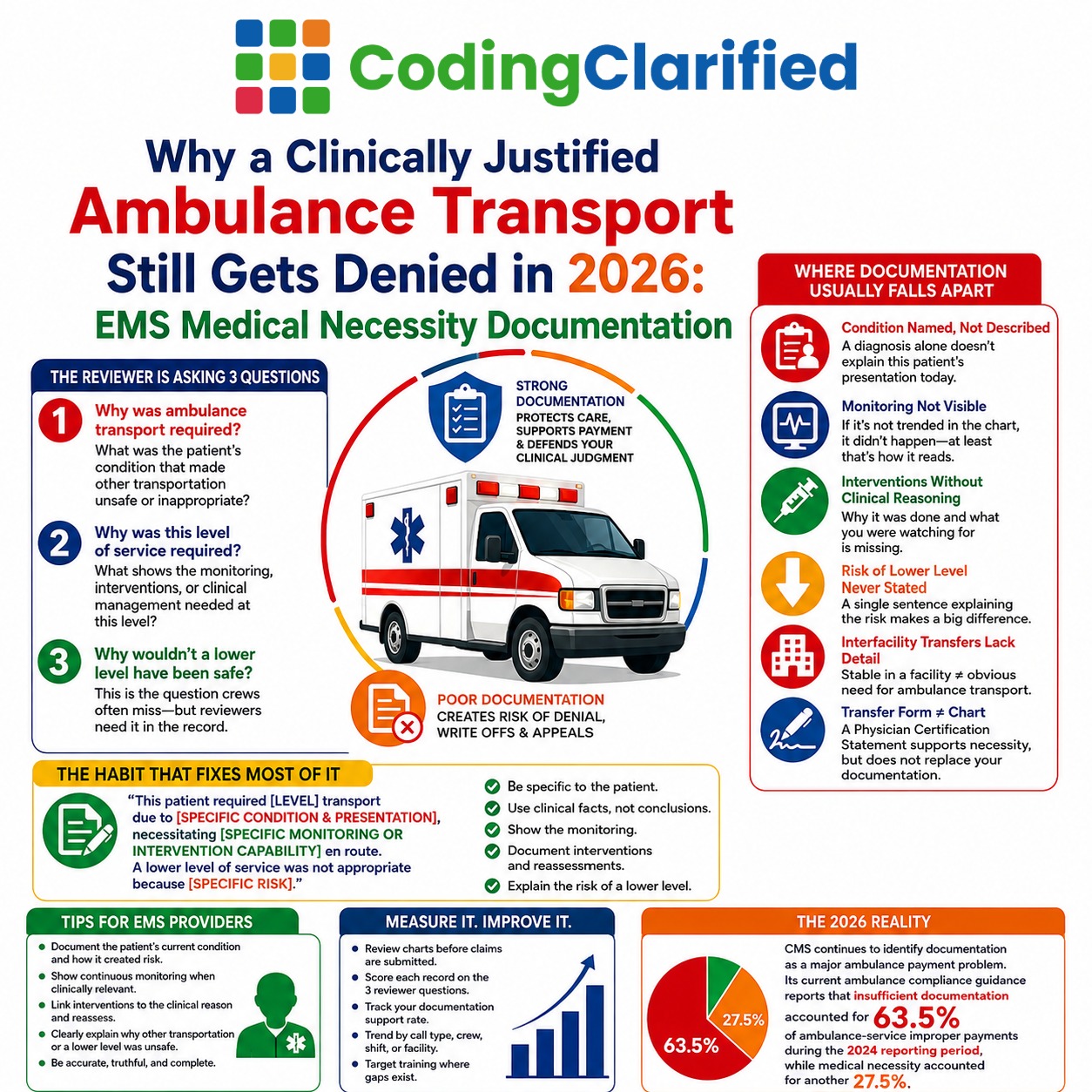
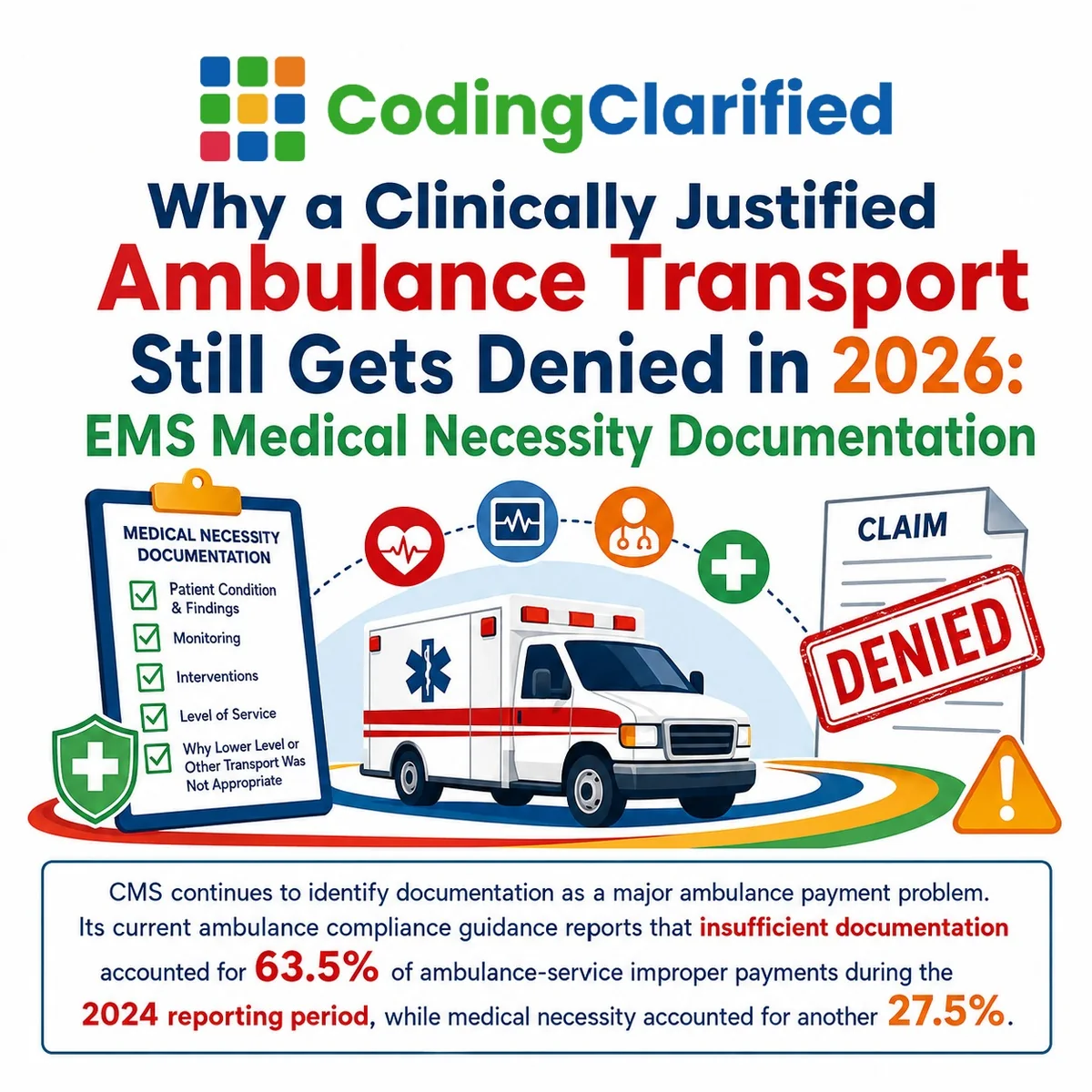
Most importantly, CMS continues to identify documentation as a major ambulance payment problem. Its current ambulance compliance guidance reports that insufficient documentation accounted for 63.5% of ambulance-service improper payments during the 2024 reporting period, while medical necessity accounted for another 27.5%.
For EMS agencies, therefore, the question is not simply whether the transport was clinically appropriate.
Can someone who was not there prove that it was appropriate by reading the PCR?
Why Does a Medically Necessary Ambulance Transport Get Denied?
The call was appropriate. The patient needed ambulance transportation. Moreover, everyone in the back of the ambulance understood why.
The receiving facility understood it, too. Likewise, the medical director could review the case and agree with the crew’s clinical decision.
Then the claim gets denied.
Few things frustrate EMS crews and billing departments more because the denial can feel like a payer is second-guessing the crew’s clinical judgment. However, many documentation-related denials are not necessarily saying that the patient did not need care.
Instead, the record may have failed to demonstrate why the ambulance transport or billed level of service was medically necessary.
That distinction matters.
CMS states that ambulance coverage depends, among other requirements, on the patient’s condition contraindicating transportation by other means. For non-emergency ambulance transportation, bed confinement may support the case in certain circumstances; however, bed confinement alone does not automatically establish medical necessity.
Consequently, an EMS crew may make the correct clinical decision and still create a vulnerable claim when the PCR does not explain that decision.
For additional guidance on Medicare ambulance coverage, agencies can review the CMS Ambulance Services Information Center and CMS Ambulance-Specific Manuals.
What Is Medical Necessity for Ambulance Transportation?
For Medicare purposes, medical necessity focuses heavily on the patient’s condition at the time of transport and whether another form of transportation would have been appropriate.
In other words, the chart should not merely answer:
What diagnosis did the patient have?
Instead, it should help answer:
What about this patient’s current condition required an ambulance?
For example, documenting “CHF” identifies a condition. However, it does not automatically explain why the patient could not safely travel by wheelchair van, private vehicle, or another transportation method.
The patient-specific findings make the difference.
Perhaps the patient had acute respiratory distress, required oxygen and ongoing assessment, experienced significant weakness, or needed cardiac monitoring because of the current presentation. Alternatively, another documented clinical condition may have made transportation by other means unsafe.
Therefore, crews should document the actual findings and risks rather than expecting a diagnosis to carry the entire medical-necessity argument.
For a broader discussion of ambulance coding and coverage, read Medical Coding Ambulance Services.
The Three Questions an Ambulance PCR Should Answer
A claims reviewer was not in the ambulance.
Months later, therefore, that reviewer may have only the documentation available to determine whether coverage requirements and the billed service are supported.
A strong EMS record should make three questions reasonably clear.
1. Why Did the Patient Require Ambulance Transportation?
Document the patient-specific clinical condition that made other transportation methods inappropriate.
For example, the chart may need to describe symptoms, functional limitations, mental status, airway concerns, hemodynamic status, oxygen requirements, positioning needs, monitoring requirements, or other relevant findings.
Simply writing “ambulance medically necessary” states a conclusion.
Conversely, documenting the clinical facts allows the reviewer to understand why it was necessary.
2. Why Did the Patient Require This Level of Service?
Next, the record should support the level of service reported.
If the transport involved ALS, for example, the PCR should accurately document the assessment, services, interventions, monitoring, or other circumstances that support the reported level under applicable rules.
Similarly, specialty care transport requires more than the words “critical patient.”
CMS describes specialty care transport as an interfacility ground ambulance transport of a critically injured or ill beneficiary whose condition requires ongoing care furnished by one or more professionals in an appropriate specialty area.
As a result, higher-level transport documentation should tell the clinical story rather than simply name the service.
3. Why Would a Lower Level or Other Transportation Have Been Inappropriate?
This question frequently disappears from EMS documentation because the answer felt obvious during the call.
Unfortunately, it may not be obvious months later.
The record should contain the patient-specific facts that demonstrate why another transportation method was contraindicated and, when relevant, why the documented level of service was necessary.
Importantly, crews should never add a canned statement simply to justify billing.
Instead, document the real clinical circumstances that existed during that specific transport.
Where EMS Medical Necessity Documentation Usually Falls Apart
The Diagnosis Is Documented, but the Patient’s Condition Is Not
“Patient has CHF.”
“History of COPD.”
“Patient with pneumonia.”
These statements may be accurate. Nevertheless, they do not necessarily establish why ambulance transportation was medically necessary on that particular day.
Thousands of patients live with chronic medical conditions without requiring ambulance transportation for every healthcare encounter.
Therefore, the PCR needs the clinical facts that made this patient, during this encounter, require an ambulance.
Monitoring Occurred but Is Barely Visible in the PCR
Suppose a crew continuously observed the patient and repeatedly reassessed the patient’s condition. Yet, the finalized PCR contains only one set of vital signs and little documentation showing what occurred afterward.
A reviewer cannot assume undocumented monitoring occurred.
Consequently, when clinically appropriate monitoring and reassessments actually happened, the record should accurately reflect them.
Never invent additional values or assessments to make a chart look complete. Instead, EMS documentation should accurately capture the care that really occurred.
An Intervention Appears Without the Clinical Reasoning
Medication administered.
Oxygen initiated.
IV established.
Cardiac monitoring performed.
Those actions tell only part of the story.
Ideally, the record should connect the relevant patient findings to the intervention and then, when clinically appropriate, document what happened afterward.
For instance:
Finding → clinical concern → intervention → reassessment
That sequence creates a much clearer picture of patient management.
Moreover, it strengthens both clinical communication and billing support.
The PCR Never Explains Why Other Transportation Was Inappropriate
This omission can create significant problems for medical-necessity review.
CMS specifically focuses ambulance coverage on the patient’s condition and whether transportation by other means was contraindicated under applicable requirements.
Accordingly, EMS documentation should contain patient-specific evidence supporting that determination rather than relying on generic wording.
Why Interfacility Transfers Need Strong Documentation
Interfacility transfers can create a unique documentation challenge.
During a 911 response, the circumstances may provide obvious context: an emergency occurred, EMS arrived, assessed the patient, provided care, and transported the patient.
In contrast, an interfacility patient may appear relatively stable when the EMS crew arrives.
The patient is already inside a healthcare facility. Additionally, nurses, physicians, and equipment may surround them.
So why does that patient need an ambulance to travel to the next facility?
The PCR should make the answer clear.
For example, the patient may require ongoing monitoring, specialized equipment, treatment during transportation, positioning that another transportation method cannot safely provide, or a level of clinical care appropriate to the patient’s condition.
Furthermore, the EMS record should document what the crew actually assessed and provided.
Do not assume that “hospital-to-hospital transfer” automatically establishes medical necessity.
A Physician Certification Statement Does Not Replace the PCR
This point deserves special attention for non-emergency ambulance transportation.
A physician certification statement may be required under specific Medicare circumstances. However, CMS states that the certification statement or signed return receipt alone does not demonstrate that ambulance transportation was medically necessary.
The ambulance provider or supplier still must satisfy the other applicable Medicare requirements.
Therefore, crews and agencies should not treat a PCS as a substitute for complete EMS documentation.
The PCR should independently and accurately describe the patient’s condition, assessment, relevant monitoring, interventions, reassessments, and transport circumstances.
For current Medicare requirements, review the CMS Ambulance Services compliance guidance.
A Simple Documentation Framework for EMS Crews
Crews do not need to write a novel to explain medical necessity.
Instead, teach providers to answer the clinical logic behind the transport:
This patient required [transport/level of care] because of [patient-specific clinical findings], requiring [actual monitoring, treatment, positioning, equipment, or capability] during transport. Transportation by another means or a lower level was inappropriate because [patient-specific clinical risk or need].
This framework is not boilerplate to paste into every PCR.
Rather, it is a thinking tool.
Every element must reflect what actually occurred.
For example, never document that continuous cardiac monitoring was required unless the patient’s condition and actual care support that statement. Likewise, do not document airway risk simply because airway language may strengthen a claim.
Accuracy always comes first.
Medical Necessity Documentation Protects More Than Reimbursement
Some EMS professionals understandably hear “medical necessity documentation” and think this belongs to the billing department.
However, the same documentation that supports a claim can also create a stronger clinical and legal record.
Consider trended assessments.
For a payer, they may help support the care provided. Meanwhile, for a medical director, they show how the patient’s condition changed throughout the encounter.
A reassessment after an intervention works the same way.
Billing staff see support for the service. Clinically, however, the reassessment shows whether the intervention worked and what the provider did next.
Therefore, strong documentation does not require crews to “write for insurance.”
It requires them to document their clinical reasoning and patient care clearly enough that another person can understand it later.
For more strategies, read EMS Documentation Training & QA/QI in 2026: How Better Patient Care Reports Reduce Denials and Protect EMS Agencies.
Finding Medical Necessity Problems Before a Claim Gets Denied
The best time to discover weak documentation is before the claim reaches a payer.
EMS agencies can incorporate medical-necessity and level-of-service support into their existing QA/QI chart-review process.
For example, score each selected PCR on three questions:
- Does the record explain why ambulance transportation was necessary?
- Does the record support the documented and billed level of service?
- Does the record contain patient-specific facts showing why another transportation method or lower level was inappropriate when applicable?
Then calculate the percentage of reviewed records that answer all applicable questions.
That number becomes a documentation support rate.
Next, agencies can trend the results by call type, crew, station, shift, receiving or sending facility, payer category, or emergency versus interfacility transport.
Suddenly, documentation becomes measurable.
Instead of discovering a pattern through denied claims months later, leadership may identify the weakness while the documentation is still recent and can address it under appropriate agency policies and amendment rules.
Turn EMS Chart Review Into Targeted Training
Agency-wide documentation retraining is not always necessary.
For instance, an audit may show that crews document 911 transports well but consistently fail to explain medical necessity on interfacility transfers.
That finding creates a narrow training target.
Alternatively, ALS documentation may contain appropriate interventions but weak reassessment documentation.
Again, leadership now knows what to teach.
Specific feedback usually provides more value than telling crews to “document more.”
Moreover, repeat audits can show whether the education actually changed documentation behavior.
Coding Clarified’s EMS Documentation Training, QA/QI & Live Coaching focuses on this type of structured approach: identify the documentation gap, provide focused education, and measure whether documentation improves.
Common Mistakes to Avoid With Ambulance Medical Necessity Documentation
Do not rely on the diagnosis alone. A diagnosis describes a condition; however, the patient’s current presentation helps establish why ambulance transportation was required.
Avoid generic medical-necessity statements. Writing “ambulance required due to medical necessity” does not explain the clinical facts supporting that conclusion.
Never document care that did not occur. More documentation is not automatically better. Instead, accurate documentation is the goal.
Do not let the PCS substitute for the PCR. The certification may support applicable requirements, but CMS makes clear that it does not independently establish medical necessity.
Avoid documenting interventions without reassessment when reassessment is clinically appropriate. Closing the clinical loop shows what happened after treatment.
Do not assume interfacility transfer equals medical necessity. Instead, document why this patient required ambulance transportation between facilities.
Never use identical medical-necessity boilerplate for every patient. Templates may prompt providers, but patient-specific facts must drive the final documentation.
Do not wait for denials to identify weak charts. QA/QI review can identify patterns much earlier.
Why This Matters Even More for EMS Agencies in 2026
CMS continues to maintain dedicated ambulance coverage, compliance, coding, and payment resources in 2026. Moreover, its Ambulance Services Information Center remains an active resource for providers and suppliers.
The Medicare Ambulance Fee Schedule also continues to govern payment for covered Medicare Part B ambulance services.
Most importantly for documentation programs, CMS’s current compliance data shows that insufficient documentation remains a major source of improper ambulance payments.
Therefore, agencies should not treat PCR quality as simply a writing issue.
It is a clinical quality, compliance, reimbursement, and risk-management issue.
Strong EMS organizations already review response times, medications, protocol compliance, airway performance, and other clinical metrics.
In 2026, medical-necessity and level-of-service documentation deserve the same measurable approach.
Final Thoughts: The Care May Be Right, but the Record Still Has to Prove It
A denied ambulance claim does not always mean the crew made the wrong clinical decision.
Sometimes the care was completely appropriate.
The problem is that the PCR never showed why.
Strong EMS documentation connects the patient’s condition to the need for ambulance transportation. Furthermore, it connects the patient’s clinical needs to the services, monitoring, and level of care actually provided.
The goal is not to teach paramedics and EMTs to write for a payer.
Instead, teach them to preserve the clinical reasoning they already use.
Then use QA/QI data to identify where that reasoning disappears from the chart.
Find the documentation gap before you find it on the remittance.
Frequently Asked Questions About EMS Medical Necessity and Ambulance Claim Denials
What makes ambulance transportation medically necessary?
For Medicare, ambulance transportation generally must meet applicable coverage requirements, including requirements related to the patient’s condition and whether transportation by other means is contraindicated. Therefore, documentation should contain patient-specific clinical facts explaining why another transportation method was inappropriate.
Can an ambulance claim be denied even when the transport was clinically appropriate?
Yes. A clinically appropriate transport may still face payment problems when the submitted documentation does not support applicable coverage, medical necessity, or level-of-service requirements. Consequently, the PCR needs to accurately demonstrate the circumstances of the transport and care provided.
Does a diagnosis prove medical necessity for an ambulance?
No. A diagnosis alone does not necessarily show why a patient required ambulance transportation. Instead, the PCR should document the patient’s current symptoms, findings, functional limitations, monitoring needs, treatment requirements, risks, or other relevant circumstances.
Does a physician certification statement prove ambulance medical necessity?
No, not by itself. CMS specifically explains that a physician or non-physician certification statement or signed return receipt alone does not demonstrate that the ambulance transport was medically necessary. Other applicable coverage requirements still must be met.
What should an EMS PCR document to support ALS transport?
The record should accurately document the patient’s condition, relevant assessments, actual ALS services or interventions, monitoring, clinical circumstances, and other information necessary to support the reported level under applicable payer requirements. Additionally, the documentation should remain consistent across the narrative and structured ePCR fields.
Why are interfacility ambulance transports vulnerable to denials?
Interfacility transports may require especially clear documentation because the need for ambulance transportation cannot simply be assumed from the transfer itself. Therefore, the PCR should explain the patient’s condition and why ambulance transportation, monitoring, equipment, treatment, positioning, or a particular level of care was necessary.
How can EMS agencies reduce medical-necessity documentation denials?
Start by reviewing PCRs against consistent criteria before claims are submitted. Next, track whether charts explain ambulance necessity, level-of-service support, relevant monitoring, interventions, and reassessments. Finally, use the results to deliver targeted crew education and then measure whether documentation improves.
Where can EMS agencies find current Medicare ambulance rules for 2026?
The Centers for Medicare & Medicaid Services maintains the CMS Ambulance Services Information Center, Ambulance-Specific Manuals, and Ambulance Services Compliance Tips. Agencies should also review guidance from their Medicare Administrative Contractor, applicable state rules, medical direction, and individual payer requirements.
Coding Clarified LLC provides EMS documentation training, QA/QI documentation review, and live coaching for EMS agencies. Coding Clarified is also a U.S. Department of Labor Registered Apprenticeship sponsor and an AAPC-affiliated training provider. Learn more at Coding Clarified Learn more About Coding Clarified.