
Medical Coding Study Tips: Why Too Many Notes in Your Manuals Can Hurt Your CPC Exam Performance
When preparing for the AAPC Certified Professional Coder (CPC) exam, many students believe that adding more notes to their CPT, ICD-10-CM, and HCPCS manuals will improve their chances of passing.
However, the opposite is often true.
Over-annotating your coding books can create confusion, slow you down, and ultimately hurt your exam performance. Therefore, understanding how to properly use notes, and what to include, is essential for success.
Why Adding Too Many Notes Can Confuse CPC Students
1. It Slows You Down During the CPC Exam
The CPC exam consists of 100 questions completed in 4 hours. Because of this, time management is critical.
When your manuals are overloaded with notes:
- You spend extra time reading instead of coding
- You hesitate while interpreting your own handwriting
- You lose valuable seconds flipping through cluttered pages
This can quickly lead to running out of time before completing the exam.
2. It Creates Information Overload
Too many notes make it difficult to identify what is truly important. As a result:
- Key guidelines become buried in unnecessary information
- Your brain must filter through excessive content
- Similar coding concepts also become harder to distinguish
This is especially problematic for areas like:
- Evaluation and Management (E/M)
- Modifiers
- ICD-10-CM guidelines
3. It Leads to Misinterpretation
Unclear or overly detailed notes can backfire. For example:
- You may forget the original purpose of the note
- Notes without context can be misleading
- You may then apply coding rules incorrectly
Even well-intentioned notes can result in incorrect code selection if they are not clear.
4. It Reduces Confidence on Exam Day
Cluttered manuals create mental clutter. Because of this:
- You second-guess your answers
- You rely too heavily on notes instead of knowledge
- You also lose confidence in your decision-making
Confidence plays a major role in exam performance, so disorganized materials can undermine it.
Why Your Notes Must Be Clear and Easy to Reference
If you choose to annotate your manuals, your notes should function as quick-reference tools—not study guides.
Therefore, effective notes should be:
- Short and concise
- Easy to scan in seconds
- Clearly tied to a specific rule or concept
- Placed exactly where you need them during the exam
If a note cannot be understood in 2–3 seconds, it is not effective for exam use.
What Notes Are Most Important for CPC Exam Success
Instead of adding excessive information, focus on high-value annotations that improve speed and accuracy.
1. Coding Guidelines and Rules
The exam tests these heavily, so they are essential:
- ICD-10-CM Official Guidelines
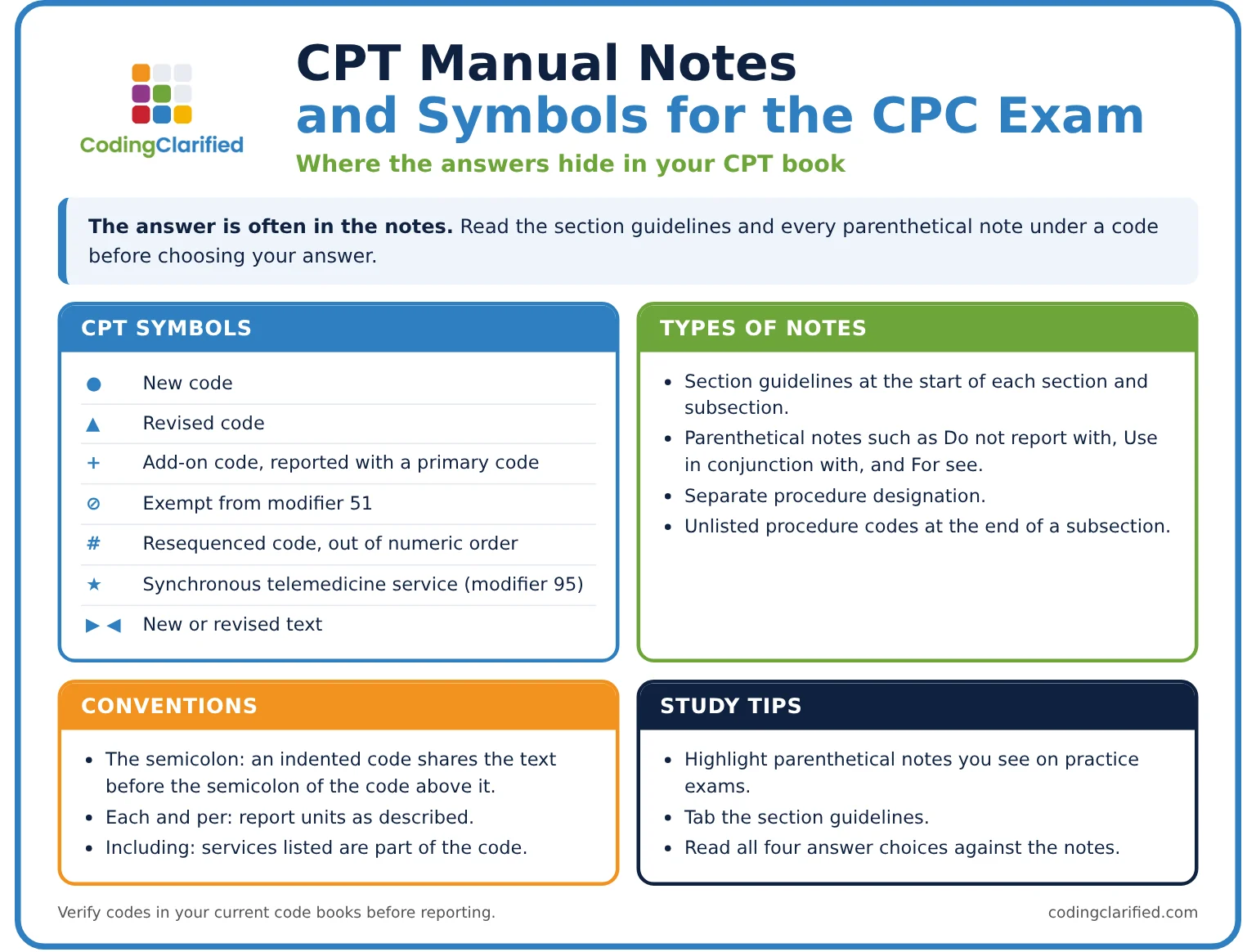
- CPT section guidelines
- Key instructional notes such as:
- Code First
- Use Additional Code
- Excludes1 and Excludes2
2. Commonly Tested CPC Concepts
Also focus on areas that frequently appear on the exam:
- Evaluation and Management (E/M) leveling
- Global surgery package rules
- Bundling and unbundling principles
- Modifier usage (e.g., 25, 59, 51, 76)
3. Tricky Code Distinctions
In addition, add notes where confusion is likely:
- Similar codes with subtle differences
- Procedures with overlapping descriptions
- Laterality or specificity reminders
4. Anatomy Reminders
Keep these simple and minimal, especially:
- Quick references for body systems
- Key anatomical locations relevant to CPT sections
5. Personal Weak Areas
Finally, personalize your notes.
If you consistently struggle with a concept:
- Add a short, targeted note
- Focus on clarity rather than quantity
What You Should Avoid Writing in Your Manuals
Also, to keep your books clean and effective, avoid:
- Long paragraphs or detailed explanations
- Copying textbook definitions
- Writing notes for concepts you already understand
- Repeating the same information across multiple sections
Best Practices for Annotating Your Coding Manuals
In addition, to maximize effectiveness:
- Use keywords instead of full sentences
- Keep your formatting consistent
- Use simple abbreviations
- Place notes logically near relevant codes
- Review and remove unnecessary notes regularly
Your goal is to create a streamlined, efficient reference tool—not a second textbook.
Coding Clarified Final Thoughts: Clean Notes Lead to Better CPC Exam Performance
Overall, your coding manuals should help you:
- Navigate quickly
- Think clearly
- Code accurately
They should not slow you down.
Strategic, well-placed notes can improve your performance—but excessive, cluttered annotations will do the opposite.
Remember:
Clear and intentional notes support success.
Too many notes create confusion and cost you valuable time on the CPC exam.
Manuals vs Ebooks for AAPC CPC exam
How To Prep Your Manuals For CPC Exam
Using Ebooks for AAPC CPC Exam
This article is part of our CPC exam prep study hub, with everything you need to prepare for and pass the CPC exam.