Ambulatory Surgery Center Medical Coding & Billing in 2026: CPT, ICD-10-CM, Modifiers & Medicare ASC Guide
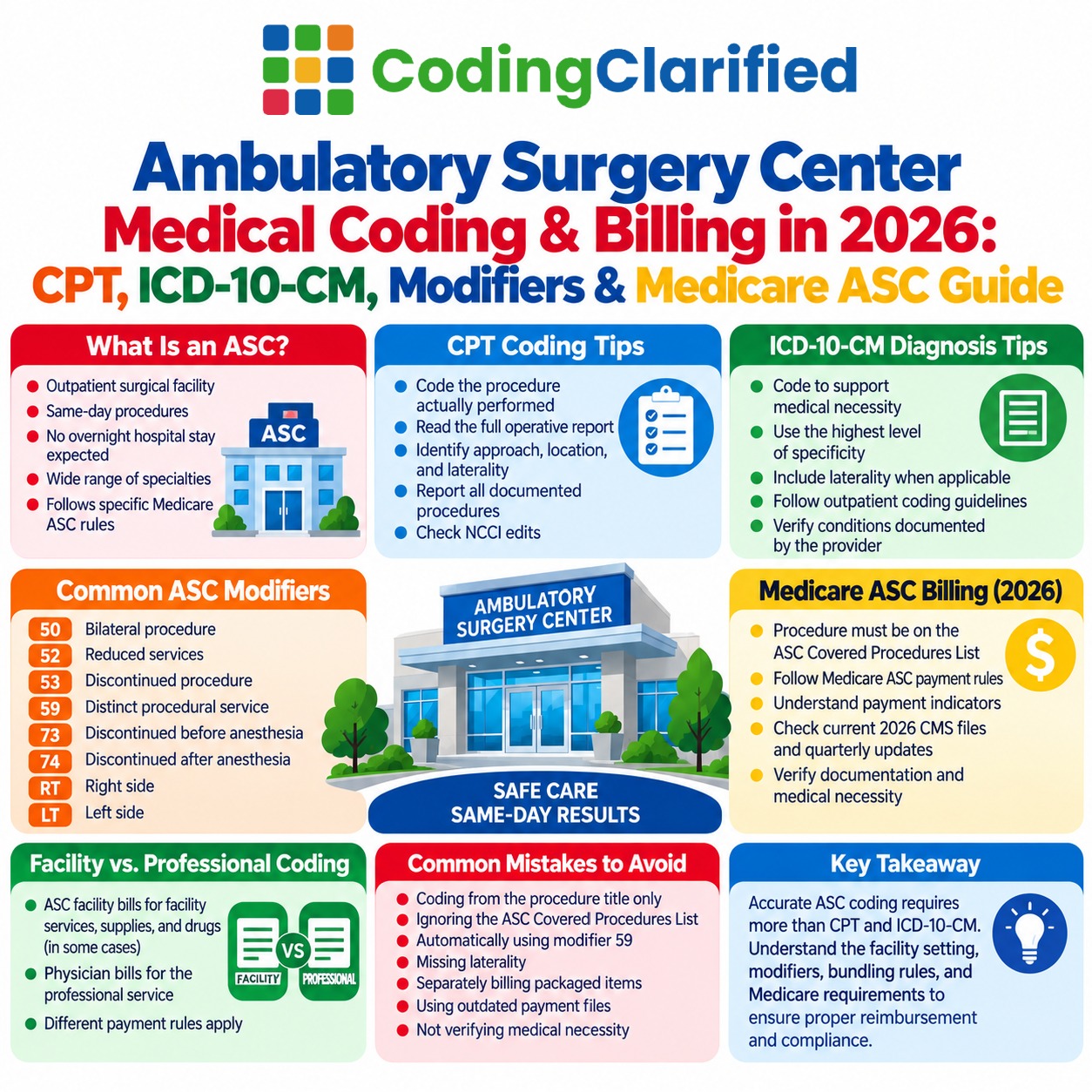
Ambulatory Surgery Center (ASC) medical coding and billing requires much more than selecting a CPT code from an operative report. Coders must understand the procedure, diagnosis, facility setting, Medicare ASC Covered Procedures List, bundling rules, modifiers, medical necessity, and payer-specific billing requirements.
In 2026, accurate ASC coding is especially important because Medicare updates ASC payment policies and approved procedures each year. In addition, quarterly HCPCS and payment updates can affect how services are reported and reimbursed.
For medical coders, billers, CPC students, and ASC staff, understanding the difference between facility coding and professional coding is one of the most important parts of ambulatory surgery coding.
Key Takeaways
- Ambulatory Surgery Centers provide same-day surgical services without an expected overnight hospital stay.
- ASC facility billing is different from physician professional billing, even when both claims involve the same procedure.
- CPT and HCPCS Level II codes identify procedures, supplies, drugs, and other reportable services, while ICD-10-CM codes establish the diagnoses and medical necessity.
- Medicare pays ASC facility charges only for procedures that meet Medicare ASC coverage and payment requirements.
- Modifiers such as 50, 52, 53, 59, 73, 74, RT, and LT may be important depending on the procedure, payer, and circumstances.
- NCCI edits must be reviewed before separately reporting procedures that may be bundled.
- The operative report is one of the most important documents for accurate ASC coding.
- Coders should verify the current 2026 Medicare ASC files rather than assuming a procedure remains covered or separately payable.
What Is an Ambulatory Surgery Center?
An Ambulatory Surgery Center is a healthcare facility that specializes in surgical and procedural services for patients who generally do not require hospitalization after the procedure.
ASCs may perform procedures in specialties such as:
- Gastroenterology
- Orthopedics
- Ophthalmology
- Pain management
- General surgery
- Podiatry
- Urology
- Gynecology
- ENT
- Dermatology
For example, an ASC may perform cataract surgery, colonoscopy, arthroscopy, carpal tunnel release, hernia repair, or other eligible outpatient procedures.
However, not every procedure that can medically be performed on an outpatient basis is automatically payable by Medicare when performed in an ASC. Medicare maintains an ASC Covered Procedures List, and coders should verify current coverage before assuming the facility service qualifies for ASC payment.
CMS updates its ASC payment information regularly. Therefore, coders should use the current CMS Ambulatory Surgical Center Payment resources when verifying Medicare requirements.
ASC Coding vs. Physician Coding: Know the Difference
One of the biggest sources of confusion in ambulatory surgery coding involves the difference between the ASC facility claim and the physician’s professional claim.
The ASC facility bills for the facility resources associated with the covered procedure. Meanwhile, the physician or qualified healthcare professional reports the professional service according to applicable professional billing rules.
For example, suppose a surgeon performs a covered arthroscopic procedure at an ASC. The surgeon may submit a professional claim for performing the surgery, while the ASC submits its own claim for the covered facility services.
Consequently, coders should never assume that the physician claim and ASC claim follow identical payment rules.
CMS explains that ASC facility services can include items such as nursing and technical services, use of the facility, certain drugs and biologicals, and other services associated with a covered ASC procedure. Physician professional services, however, are not included in the ASC facility payment.
CPT Coding for Ambulatory Surgery Centers
CPT coding begins with the actual procedure documented in the operative report.
Rather than coding from the scheduled procedure or operative title alone, read the complete operative report. The body of the report tells you what the surgeon actually performed.
A strong ASC coding workflow includes reviewing:
- Preoperative diagnosis
- Postoperative diagnosis
- Procedure performed
- Surgical approach
- Anatomical location
- Laterality
- Number of lesions, levels, joints, or sites
- Devices or implants
- Additional procedures
- Complications or discontinued procedures
For instance, a planned procedure may change after the surgeon identifies unexpected findings. Therefore, the final coding must reflect the documented service actually performed.
Our guide to coding operative reports provides additional tips for reviewing surgical documentation.
ICD-10-CM Diagnosis Coding in the ASC Setting
ICD-10-CM codes explain why the procedure was medically necessary.
Diagnosis coding must be based on the provider’s documentation and applicable outpatient ICD-10-CM guidelines. Additionally, coders should assign the highest level of supported specificity.
For example, documentation may require the coder to identify:
- Laterality
- Exact anatomical location
- Acute versus chronic condition
- Injury encounter
- Type of lesion
- Complication
- Underlying condition
- Associated manifestation
Consider a patient undergoing carpal tunnel release for documented right carpal tunnel syndrome. The appropriate diagnosis may be G56.01, Carpal tunnel syndrome, right upper limb.
However, never select a diagnosis simply because it is commonly associated with the procedure. Instead, code the documented condition and confirm it in the ICD-10-CM Tabular List.
For more information about the correct code-selection process, review Medical Coding Correctly Using CPT, ICD-10 & HCPCS.
Medical Necessity Matters
A technically correct CPT code does not automatically mean a claim will be paid.
The diagnosis must support the medical necessity of the service under the payer’s rules. Therefore, ASC coders and billers may need to review Medicare National Coverage Determinations (NCDs), Local Coverage Determinations (LCDs), and commercial payer medical policies.
Prior authorization may also be required.
As a result, accurate ASC coding includes more than matching a diagnosis with a procedure. Coders must also understand whether the payer covers the procedure in the ASC setting and whether specific documentation requirements apply.
Medicare ASC Covered Procedures List
Medicare maintains a list of procedures eligible for payment under the ASC payment system.
This point is critical: Medicare coverage of a procedure does not automatically mean Medicare will pay the ASC facility fee for that procedure.
Instead, coders and billers should verify that the procedure appears on the applicable ASC list and review its current payment status.
CMS also publishes ASC payment-rate addenda throughout the year. For example, 2026 ASC files have included January, April, and July updates. Because these files can change during the year, checking current CMS information should be part of the billing workflow.
You can review current files through the CMS ASC Payment Rates and Addenda.
2026 Medicare ASC Updates
For Calendar Year 2026, CMS finalized updates to the Hospital Outpatient Prospective Payment System and ASC Payment System.
Among the changes, CMS finalized a 2.6% ASC payment-rate update for qualifying ASCs that meet applicable quality reporting requirements.
However, payment changes are only part of the annual update. Coders and billing staff should also monitor changes to:
- ASC covered procedures
- HCPCS codes
- Payment indicators
- Drug and biological payment
- Quality reporting requirements
- Medicare coverage policies
- Quarterly payment files
CMS has also released its proposed CY 2027 OPPS/ASC rule during 2026. Therefore, organizations should monitor final 2027 changes while continuing to follow the current 2026 rules until new requirements become effective.
Common ASC Modifiers
Modifiers can significantly affect ASC reimbursement. However, coders should never add a modifier simply to bypass a denial or edit.
Modifier 50 — Bilateral Procedure
Modifier 50 may identify a bilateral procedure when appropriate. Still, payer requirements vary, so verify how the payer expects bilateral procedures to be reported.
Modifiers RT and LT
RT indicates the right side, while LT indicates the left side.
These modifiers are especially important when laterality affects claim processing. However, more specific anatomical HCPCS modifiers may be required for certain fingers, toes, or eyelids.
Our 2026 Anatomical Modifiers Guide explains these distinctions in greater detail.
Modifier 59 — Distinct Procedural Service
Modifier 59 may identify a procedure or service that is distinct from another service performed during the same encounter when the documentation and applicable rules support separate reporting.
Nevertheless, modifier 59 should not be used automatically to override an NCCI edit.
Modifier 52 — Reduced Services
Modifier 52 may be appropriate when a service is partially reduced or eliminated at the physician’s discretion, depending on the circumstances and payer instructions.
Modifiers 73 and 74
These modifiers are particularly important in outpatient facility coding when a procedure is discontinued.
Modifier 73 generally applies to certain discontinued outpatient hospital/ASC procedures before anesthesia administration, while modifier 74 generally applies when the procedure is discontinued after anesthesia administration or after the procedure has begun, subject to applicable billing requirements.
The documentation should clearly explain why the procedure was discontinued and at what point it stopped.
For a broader review, see our CPT Medical Modifiers Guide.
NCCI Edits and Bundling
ASC coders must understand bundling.
The National Correct Coding Initiative (NCCI) contains edits designed to prevent improper reporting of code combinations. Therefore, two CPT codes documented in the operative report are not necessarily separately billable.
Before reporting multiple procedures, ask:
- Is one procedure included in another?
- Does an NCCI edit exist?
- Is a modifier permitted?
- Does the documentation support a truly distinct service?
- Does the payer follow Medicare NCCI rules or different guidelines?
Additionally, never append modifier 59 simply because the billing system generates an edit.
Documentation must support the modifier.
ASC Supplies, Drugs, and Implants
Another challenging area involves determining whether supplies, drugs, implants, and other items are included in the ASC payment or separately payable.
CMS includes many items and services within the ASC facility payment. For example, certain supplies and drugs are packaged into the payment for the covered surgical procedure.
Meanwhile, some ancillary services may qualify for separate payment under Medicare rules.
Therefore, billing teams must check the applicable HCPCS code, ASC payment indicator, current payment file, and payer policy before separately billing an item.
Simply having a charge on the patient’s account does not mean the item can be separately reimbursed.
Place of Service for Ambulatory Surgery Centers
For professional claims, Place of Service 24 identifies an Ambulatory Surgical Center.
This detail matters because place of service can affect payment and claim processing. Additionally, an incorrect POS can create denials or reimbursement problems.
Coders should distinguish a true ASC from a physician office or hospital outpatient department. Although all may provide outpatient services, their billing and payment systems differ.
A Simple ASC Coding Workflow
A consistent process helps prevent missed codes and billing errors.
First, confirm the patient’s payer and the actual site of service. Next, review the complete operative report rather than relying only on the procedure title.
Then:
- Identify the documented diagnoses.
- Assign and verify ICD-10-CM codes.
- Identify every procedure actually performed.
- Assign CPT/HCPCS codes.
- Review CPT instructions and parenthetical notes.
- Check NCCI edits.
- Determine whether modifiers are required.
- Verify Medicare ASC eligibility or the commercial payer’s facility policy.
- Review medical necessity and authorization requirements.
- Confirm units, laterality, and claim details before submission.
Finally, perform a last documentation-to-claim comparison. This simple check can catch laterality errors, missed procedures, incorrect modifiers, and diagnosis linkage problems before the claim leaves the facility.
Common Mistakes to Avoid in ASC Medical Coding
Coding from the procedure title alone: The scheduled procedure may not match what actually happened. Therefore, always review the complete operative note.
Confusing physician and facility billing: The ASC facility claim and surgeon’s professional claim follow different payment rules. Consequently, avoid copying the professional claim without reviewing facility requirements.
Ignoring the ASC Covered Procedures List: A valid CPT code does not guarantee Medicare ASC facility payment.
Automatically using modifier 59: An edit does not automatically justify a modifier. Instead, confirm that the documentation and coding rules support a distinct service.
Missing laterality: Right versus left can affect both CPT/HCPCS modifier reporting and ICD-10-CM diagnosis selection.
Separately billing packaged items: Many services, supplies, and drugs may already be included in the ASC payment.
Using outdated payment files: Medicare ASC files can receive quarterly updates. Thus, use current 2026 information.
Failing to verify medical necessity: Correct procedure coding alone cannot fix a diagnosis that does not support coverage.
CPC Student Tips for Ambulatory Surgery Coding
CPC students should remember that an ASC patient is still an outpatient.
Therefore, apply outpatient diagnosis coding principles unless the question specifically tells you otherwise.
Also, pay close attention to words such as bilateral, right, left, discontinued, separate site, different lesion, multiple procedures, diagnostic, therapeutic, and converted. These details often change the correct coding answer.
When answering CPC-style questions, do not jump directly to the code choices. Instead, identify the procedure, anatomical site, approach, extent, and modifiers before comparing the answers.
Most importantly, read CPT guidelines and parenthetical notes. The correct answer often depends on an instruction near the code rather than the code description alone.
Why Accurate ASC Coding Matters
Ambulatory surgery coding sits at the intersection of clinical documentation, CPT, ICD-10-CM, HCPCS, payer policy, and reimbursement.
Accurate coding helps ASCs reduce denials, prevent inappropriate unbundling, support medical necessity, and receive proper payment for covered services. Furthermore, strong coding protects the facility during audits and compliance reviews.
As outpatient surgery continues to expand, ASC coding skills remain valuable for medical coders who want to work in surgical coding, facility coding, revenue cycle management, or specialized outpatient settings.
For additional background on outpatient coding, read our Medical Coding Outpatient Guide.
Frequently Asked Questions About ASC Medical Coding and Billing
What is ASC medical coding?
ASC medical coding is the process of assigning CPT, HCPCS Level II, and ICD-10-CM codes to services provided in an Ambulatory Surgery Center. In addition, coders review modifiers, payer requirements, bundling edits, medical necessity, and ASC coverage rules.
What is the difference between ASC billing and physician billing?
ASC billing reports the facility services associated with the surgical encounter. Physician billing, however, reports the professional services performed by the surgeon, anesthesiologist, or other eligible professional. Therefore, the two claims may contain related procedure information but follow different reimbursement rules.
Does Medicare cover every surgery performed in an ASC?
No. Medicare maintains an ASC Covered Procedures List for procedures eligible for ASC facility payment. Therefore, always verify the current CMS ASC files rather than assuming that every outpatient surgical procedure qualifies.
What place of service code is used for an ASC?
For professional claims, Place of Service 24 represents an Ambulatory Surgical Center. However, coders should always verify payer-specific claim requirements.
What modifiers are commonly used in ASC coding?
Common modifiers can include 50, 52, 53, 59, 73, 74, RT, LT, and applicable anatomical modifiers. However, the correct modifier depends on the procedure, documentation, claim type, and payer policy.
What is the difference between modifiers 73 and 74?
Modifier 73 generally identifies certain discontinued outpatient hospital/ASC procedures before anesthesia administration. In contrast, modifier 74 generally identifies qualifying procedures discontinued after anesthesia administration or after the procedure has started. Documentation should clearly establish the circumstances and timing.
Do ASC coders need to check NCCI edits?
Yes. NCCI edits help identify code combinations that generally should not be reported together. However, some edits permit a modifier when documentation supports a legitimate distinct service, so coders must review the individual circumstances rather than automatically unbundling codes.
What should ASC coders review in 2026?
ASC coders should use the current CPT, HCPCS Level II, and ICD-10-CM code sets while monitoring CMS ASC payment files, quarterly updates, NCCI edits, coverage policies, and payer-specific requirements. Additionally, because CMS issued the proposed CY 2027 OPPS/ASC rule in July 2026, coding and billing teams should monitor upcoming changes while continuing to apply current 2026 rules.
Coding Clarified Final Takeaway
Successful Ambulatory Surgery Center coding in 2026 requires more than knowing CPT and ICD-10-CM codes. Coders must connect the operative documentation to the correct procedure and diagnosis codes while also understanding ASC coverage, bundling, modifiers, facility billing, medical necessity, and payer requirements.
Above all, verify rather than assume. Read the complete operative report, check the current code books, review NCCI edits, confirm ASC eligibility, and follow the payer’s billing rules. That process creates cleaner claims, stronger compliance, and more accurate reimbursement.