Family Practice Medical Coding & Billing in 2026: CPT, ICD-10-CM, E/M, Preventive Care & AAPC CFPC Certification Guide
Family practice medical coding covers one of the widest ranges of services in professional medical coding. During a single day, a family medicine coder may handle preventive exams, chronic disease management, acute illnesses, injections, minor procedures, laboratory services, EKGs, Medicare wellness visits, and follow-up care.
Therefore, family practice coders need much more than basic CPT and ICD-10-CM knowledge. They must understand Evaluation and Management (E/M) coding, medical necessity, modifiers, preventive services, payer rules, HCPCS Level II, and documentation requirements.
For experienced coders who want to demonstrate specialty knowledge, AAPC also offers the Certified Family Practice Coder (CFPC™) credential. In 2026, the CFPC exam tests the real-world coding skills needed to work in family medicine.
This guide explains family practice medical coding and billing in 2026, common CPT and ICD-10-CM coding situations, Medicare issues, common mistakes, and how to prepare for the AAPC CFPC certification exam.
Key Takeaways: Family Practice Medical Coding & CFPC Certification
- Family practice coding combines E/M, preventive medicine, minor procedures, injections, diagnostic services, HCPCS Level II, and ICD-10-CM diagnosis coding.
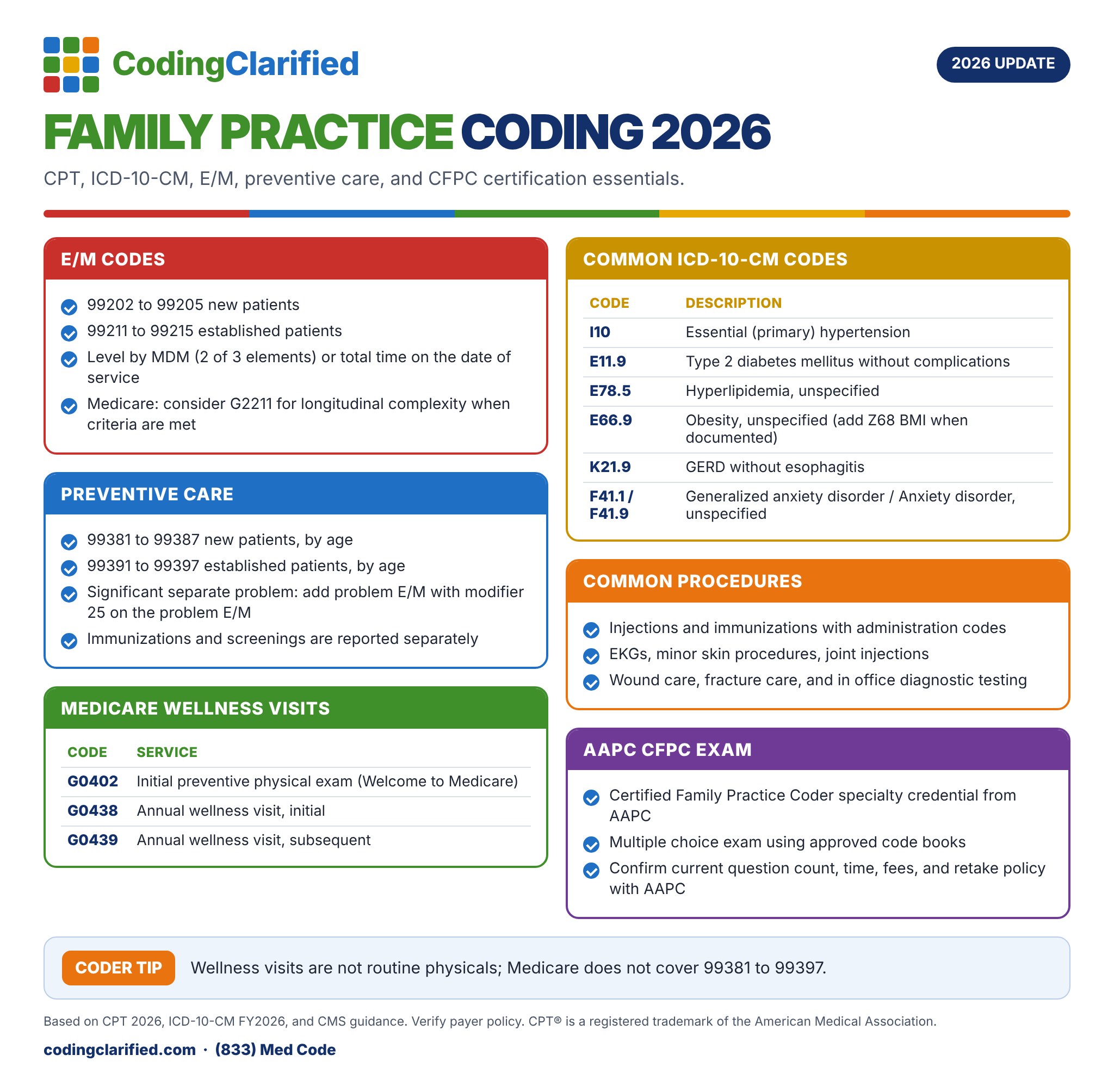
- Office/outpatient E/M codes 99202–99205 and 99211–99215 are among the most important CPT codes for family medicine coders.
- E/M levels may generally be selected using medical decision making (MDM) or total time when the applicable CPT requirements are met.
- Preventive visits and problem-oriented E/M services may sometimes be reported together when documentation supports a significant, separately identifiable problem-oriented service.
- Family practices frequently code chronic conditions such as hypertension, diabetes, COPD, asthma, obesity, and hyperlipidemia.
- Medicare preventive services do not always follow the same rules as CPT preventive medicine services.
- In 2026, CMS continues to recognize HCPCS G2211 for qualifying visit complexity situations.
- The AAPC CFPC exam contains 100 multiple-choice questions and allows four hours for completion.
- A score of 70% or higher is required to pass the CFPC exam.
- AAPC recommends that CFPC candidates have at least two years of coding experience in the specialty.
- CFPC candidates should be comfortable with CPT, ICD-10-CM, HCPCS Level II, modifiers, Medicare rules, E/M, and real family practice documentation.
What Is Family Practice Medical Coding?
Family practice medical coding converts the services and diagnoses documented by family physicians and other qualified healthcare professionals into standardized codes used for billing, reimbursement, reporting, and healthcare data.
Unlike a narrow specialty, family medicine treats patients across many age groups and for many different conditions. Consequently, coders may move from pediatric respiratory infections to adult hypertension, preventive exams, diabetes management, joint injections, and minor skin procedures during the same workday.
That variety makes family practice coding both interesting and challenging. In addition, coders must determine not only what happened during the encounter but also whether the documentation supports the reported level of service and whether payer-specific rules apply.
Coders who are still developing their general coding foundation may also want to review our AAPC CPC Certification Guide for 2026.
Common CPT Codes Used in Family Practice
No short list can cover every service performed in family medicine. However, several code families appear frequently.
Office and Outpatient E/M Services
New patient office/outpatient E/M codes include:
99202, 99203, 99204, and 99205
Established patient office/outpatient E/M codes include:
99211, 99212, 99213, 99214, and 99215
For most physician and qualified healthcare professional office/outpatient visits, code selection centers on medical decision making or total time when the requirements for time-based coding are met.
Therefore, coders should become comfortable evaluating the three MDM elements:
- Number and complexity of problems addressed
- Amount and/or complexity of data reviewed and analyzed
- Risk of patient management
Do not choose an E/M level simply because several diagnoses appear on the claim. Instead, determine which conditions were actually addressed and how they affected the provider’s work.
CMS maintains current Medicare E/M guidance through its Evaluation and Management Visits resources.
Preventive Medicine Services
Family practices frequently provide annual preventive examinations. CPT preventive medicine codes vary based on the patient’s age and whether the patient is new or established.
These include the 99381–99387 range for new patients and 99391–99397 for established patients.
However, preventive coding becomes more complicated when the provider also evaluates a separate medical problem.
For example, an established patient may arrive for a preventive examination but also require significant evaluation and management of uncontrolled hypertension. When the documentation supports a significant, separately identifiable problem-oriented service, the appropriate office E/M code may also be reportable with modifier -25.
Never add a problem-oriented E/M automatically simply because the note lists chronic conditions. The documentation must support work beyond the normal preventive service.
Medicare Wellness Visits Are Different From Routine Physicals
One of the biggest family practice billing mistakes is treating a Medicare Annual Wellness Visit (AWV) as if it were the same as a routine CPT preventive physical.
They are not interchangeable.
Medicare uses HCPCS codes for qualifying wellness services, including G0438 for the initial Annual Wellness Visit and G0439 for a subsequent Annual Wellness Visit.
Additionally, the Initial Preventive Physical Examination, commonly called the Welcome to Medicare visit, has its own Medicare requirements and uses HCPCS G0402.
Therefore, coders must identify exactly which service the provider performed rather than simply coding an “annual physical” from the appointment description.
Family Practice ICD-10-CM Coding
Diagnosis coding in family medicine can range from straightforward acute conditions to complex patients with several chronic diseases.
Common examples include:
- Essential hypertension — I10
- Type 2 diabetes mellitus without complications — E11.9
- Hyperlipidemia, unspecified — E78.5
- Obesity, unspecified — E66.9
- Gastroesophageal reflux disease without esophagitis — K21.9
- Generalized anxiety disorder — F41.1
However, recognizing a familiar code is only the beginning. Coders must follow the ICD-10-CM Official Guidelines for Coding and Reporting, instructional notes, combination-code rules, manifestation rules, and required additional codes.
For example, diabetes coding often requires more detail than simply assigning E11.9. If the provider documents a diabetic complication, coders should determine whether ICD-10-CM provides a combination code that captures both diabetes and the complication.
Likewise, avoid coding a diagnosis from a medication list alone. Instead, code from the provider’s documentation and follow the applicable outpatient coding guidelines.
Acute and Chronic Conditions in the Same Family Practice Visit
Family medicine patients commonly present with more than one issue.
For example, a patient may have stable hypertension and diabetes but schedule an appointment because of an acute respiratory complaint. Another patient may present for medication management while also discussing a new symptom.
Consequently, coders must identify which conditions were evaluated, assessed, treated, or otherwise addressed during that encounter.
The problem list alone does not determine the diagnoses reported for the visit. Similarly, copying every historical diagnosis onto every claim can create inaccurate coding and compliance problems.
Minor Procedures in Family Medicine
Family practice coding is not limited to office visits.
Depending on the practice, physicians may perform services such as:
- Venipuncture
- Injections and immunizations
- EKGs
- Lesion removal
- Foreign body removal
- Wound care
- Fracture care
- Joint injections
- Incision and drainage
- Diagnostic testing
AAPC specifically identifies ancillary and minor surgical procedures as areas of family practice coding knowledge for the CFPC credential.
Therefore, CFPC candidates should not focus only on E/M coding. They should also know how to read procedure documentation, identify bundling issues, apply modifiers correctly, and recognize when multiple procedures require additional review.
Modifier -25 in Family Practice
Modifier -25 is especially important in primary care because procedures and E/M services often occur on the same date.
The modifier tells the payer that a significant, separately identifiable E/M service was performed by the same physician or qualified healthcare professional on the same day as another procedure or service.
However, modifier -25 should never serve as a tool to force separate payment.
Documentation must demonstrate that the E/M work went beyond the work already included in the procedure or other service. Therefore, coders should review the complete encounter rather than relying on the presence of two charges.
G2211 and Family Practice Coding in 2026
HCPCS G2211 remains especially relevant to primary care in 2026.
CMS uses G2211 as an add-on code related to visit complexity associated with office/outpatient E/M services when the requirements are met. CMS began separate payment for G2211 with office/outpatient E/M codes 99202–99205 and 99211–99215 in 2024.
Furthermore, CMS has continued to update its guidance surrounding G2211. Family practice coders should review current CMS rules rather than relying on older training materials because payment policy continues to evolve.
For 2026 Medicare guidance, use the CMS Physician Fee Schedule resources.
What Is the AAPC CFPC Certification?
CFPC stands for Certified Family Practice Coder. AAPC designed the specialty credential for coders who work with family practice and general medicine services.
The certification measures a coder’s ability to apply CPT, ICD-10-CM, HCPCS Level II, modifiers, healthcare regulations, E/M guidelines, Medicare billing rules, ancillary services, and minor procedure coding within family medicine.
In other words, the CFPC goes beyond basic code lookup. Candidates need to interpret real clinical documentation and determine how coding guidelines apply to common family practice encounters.
AAPC recommends the certification for experienced family practice coders and strongly recommends at least two years of specialty experience before attempting the examination.
Review the current requirements directly through AAPC’s Certified Family Practice Coder CFPC exam information.
AAPC CFPC Exam Format in 2026
As of 2026, AAPC lists the CFPC exam as:
- 100 multiple-choice questions
- 4 hours to complete
- 70% minimum passing score
- Open code book
- Available through at-home live remote proctoring or a testing center
- One exam attempt: $325
- Two exam attempts: $399
Candidates may use approved CPT, ICD-10-CM, and HCPCS Level II resources under AAPC’s current exam rules. AAPC highly recommends current-year books because code sets change annually.
The exam allows about 2.4 minutes per question. Therefore, knowing where to find information quickly can matter almost as much as knowing the coding concepts.
AAPC also offers a 2026 CFPC study guide and specialty exam preparation resources.
What Should You Study for the CFPC Exam?
Start with E/M because office visits form a major part of family practice coding. However, do not make the mistake of studying E/M alone.
Strong CFPC preparation should include CPT coding, ICD-10-CM diagnosis coding, HCPCS Level II, modifiers, preventive services, Medicare rules, injections, EKGs, minor surgery, fracture care, and other services commonly performed in a primary care office.
Additionally, practice reading complete medical records. Specialty certification questions may require you to separate relevant information from distracting documentation.
Students who want additional test preparation strategies can review our AAPC CPC Practice Exams in 2026 guide and our 16-Week CPC Medical Coding Study Plan.
CPC Student Tips for Learning Family Practice Coding
CPC students can use family medicine scenarios to build stronger overall coding skills even if they are not ready for the CFPC exam.
First, practice identifying the reason for the encounter before opening a code book. Next, determine what the provider actually did and which diagnoses affected the service.
Then, separate preventive services, problem-oriented E/M work, procedures, drugs, supplies, and diagnostic tests. This approach makes complicated encounters easier to understand.
Finally, verify your codes rather than trusting memory. A familiar-looking CPT or ICD-10-CM code can still be wrong because of a guideline, instructional note, modifier rule, or documentation detail.
For additional exam preparation, see our Complete 2026 AAPC CPC Exam Breakdown.
Common Mistakes to Avoid in Family Practice Medical Coding
Coding Every Diagnosis on the Problem List
Do not automatically report every historical condition. Instead, determine which conditions meet the reporting requirements for the encounter.
Automatically Billing an E/M With Every Preventive Visit
A chronic condition appearing in the note does not automatically justify a separate E/M service. Documentation must support significant, separately identifiable work when separate reporting is appropriate.
Confusing Medicare Wellness Visits With Routine Physicals
Medicare AWVs have specific requirements and HCPCS codes. Therefore, verify whether the documentation supports G0438, G0439, G0402, another service, or a combination of separately reportable services.
Misusing Modifier -25
Never append modifier -25 simply because the billing system rejects two services. Instead, verify that the documentation supports a separate E/M service.
Choosing E/M Levels From Diagnosis Count Alone
Four diagnoses do not automatically equal high MDM. Instead, evaluate the actual problems addressed, data, and risk.
Ignoring Payer-Specific Rules
CPT guidance, Medicare policy, and commercial payer requirements may differ. Consequently, always verify the rules that apply to the patient’s payer and service.
2026 Family Practice Coding Updates Matter
Family practice coders must stay current because coding and reimbursement rules change every year.
In 2026, CMS continues to publish updated Physician Fee Schedule information, E/M guidance, and G2211 resources. Medicare payment files also reflect 2026 policy changes, including different Physician Fee Schedule conversion factors for qualifying APM participants and non-qualifying clinicians.
Additionally, CPT, HCPCS Level II, and ICD-10-CM change on regular update cycles. Therefore, coders should verify current code sets and payer guidance rather than relying on an old cheat sheet.
The CMS Physician Fee Schedule Look-Up Tool can also help coders research Medicare payment information, RVUs, and applicable payment policies.
Is the CFPC Certification Worth Considering?
The CFPC credential can help demonstrate focused knowledge in family practice coding, particularly for coders who already work in primary care or general medicine.
However, it should be viewed as a specialty credential rather than a substitute for learning core coding principles. Strong CPT, ICD-10-CM, HCPCS Level II, E/M, modifier, and compliance skills remain essential.
For coders who spend their workday coding family medicine, the certification provides a way to document specialty expertise. Furthermore, preparing for the exam can strengthen knowledge in areas that directly affect everyday family practice coding.
Frequently Asked Questions About Family Practice Medical Coding and the CFPC Exam
What does CFPC stand for in medical coding?
CFPC stands for Certified Family Practice Coder. AAPC offers the specialty certification to demonstrate coding knowledge related to family medicine and general practice services.
How many questions are on the AAPC CFPC exam in 2026?
The 2026 CFPC exam contains 100 multiple-choice questions. Candidates have four hours to complete the examination, which provides an average of about 2.4 minutes per question.
What score do you need to pass the CFPC exam?
AAPC requires an overall score of at least 70%. Therefore, candidates need at least 70 correct answers out of 100 questions.
Is the CFPC exam open book?
Yes. AAPC permits approved CPT, ICD-10-CM, and HCPCS Level II coding resources under its current exam rules. However, rules for notes, tabs, books, electronic devices, and testing materials apply, so candidates should check AAPC’s current requirements before exam day.
Do I need experience before taking the CFPC exam?
AAPC strongly recommends at least two years of experience in the specialty before sitting for a specialty certification exam. The CFPC is a high-level specialty examination, so new CPC students may benefit from building a strong coding foundation and gaining family practice experience first.
What coding should I know for the CFPC exam?
Candidates should understand family practice E/M services, preventive medicine, ICD-10-CM, HCPCS Level II, modifiers, Medicare rules, ancillary services, injections, EKGs, minor procedures, fracture care, and other services commonly performed in family medicine.
What are the most important CPT codes for family practice coders?
Office/outpatient E/M codes 99202–99205 and 99211–99215 are especially important. However, family practice coders also work with preventive medicine codes 99381–99387 and 99391–99397, as well as many procedure, injection, vaccine, laboratory, diagnostic, and minor surgery codes.
What is the difference between CPC and CFPC certification?
The CPC is a broad professional coding credential covering many areas of physician coding. In contrast, the CFPC is a specialty credential focused on family practice coding. Therefore, a coder may earn a CPC first and later pursue the CFPC to demonstrate deeper specialty knowledge.
Final Thoughts: Family Practice Medical Coding and CFPC Certification in 2026
Family practice medical coding requires coders to understand a broad range of services. On one claim, you may code a routine office E/M service. On another, you may need to evaluate preventive care, chronic disease management, injections, diagnostic testing, or a minor procedure.
Therefore, successful family practice coders learn to look beyond individual code numbers. They understand documentation, medical necessity, E/M rules, modifiers, payer policies, and how CPT, ICD-10-CM, and HCPCS Level II work together.
The CFPC certification gives experienced family practice coders an opportunity to demonstrate that specialty knowledge. In 2026, candidates should prepare for a 100-question, four-hour exam that requires both coding knowledge and efficient code-book navigation.
Most importantly, build your skills through real scenarios. Learn why a code is correct, identify why the other choices are wrong, and verify current guidelines whenever rules change.
Family medicine covers a little bit of almost everything. As a result, becoming strong in family practice coding can build some of the most versatile skills a professional medical coder can develop.