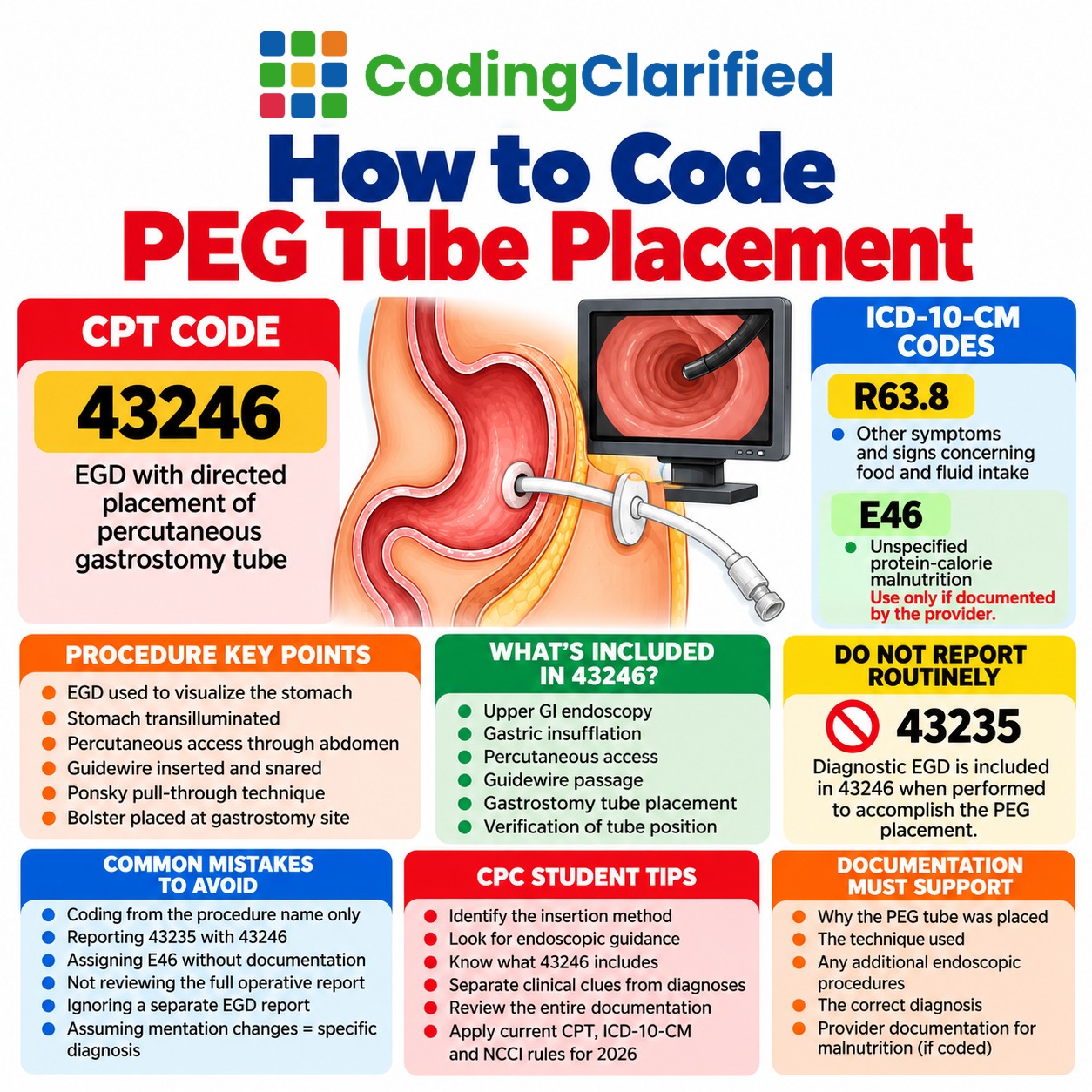

How to Code PEG Tube Placement in 2026: CPT 43246 and ICD-10-CM Case Study
Medical coders often encounter percutaneous endoscopic gastrostomy (PEG) tube placement when patients cannot meet their nutritional needs by mouth. To code PEG placement correctly, you need to identify the insertion method, review the endoscopic technique, determine which services CPT bundles together, and select a diagnosis that the provider actually documents.
In this 2026 medical coding case study, a 73-year-old patient cannot maintain adequate caloric intake and has markedly decreased albumin stores. His care team recommends a PEG tube for nutritional supplementation. During the procedure, the physicians use endoscopic visualization, gastric transillumination, a guidewire, a snare, and the Ponsky pull technique.
These details point to CPT 43246.
The diagnosis requires more caution. Although the documentation shows nutritional concerns, the operative note does not specifically diagnose protein-calorie malnutrition. Therefore, coders should not automatically assign E46 based only on poor intake and decreased albumin.
Key Takeaways
- Report CPT 43246 for the documented EGD with directed percutaneous gastrostomy tube placement.
- Do not automatically add diagnostic EGD code 43235 because 43246 includes the endoscopic work necessary for PEG placement.
- Consider R63.8 when the provider documents problems with food or caloric intake but does not establish a more specific diagnosis.
- Do not assign E46 solely from poor caloric intake, decreased albumin, or other clinical indicators.
- Query the provider when the record suggests malnutrition but lacks a clear diagnosis.
- Determine exactly how the physician inserted the gastrostomy tube before choosing a CPT code.
- Verify current CPT, ICD-10-CM, NCCI, and payer rules for 2026 dates of service.
For additional medical coding education and case studies, visit the Coding Clarified Medical Coding Blog.
PEG Tube Placement Medical Coding Scenario
COMPLICATIONS: None.
HISTORY: The patient is a 73-year-old male who was admitted to the hospital with some mentation changes. He was unable to sustain enough caloric intake and had markedly decreased albumin stores. After discussion with the patient and the son, they agreed to place a PEG tube for nutritional supplementation.
PROCEDURE: After informed consent was obtained, the patient was brought to the endoscopy suite. He was placed in the supine position and was given IV sedation by the Anesthesia Department. An EGD was performed from above by Dr. X. The stomach was transilluminated and an optimal position for the PEG tube was identified using the single poke method. The skin was infiltrated with local and the needle and sheath were inserted through the abdomen into the stomach under direct visualization. The needle was removed and a guidewire was inserted through the sheath. The guidewire was grasped from above with a snare by the endoscopist. It was removed completely and the Ponsky PEG tube was secured to the guidewire.
The guidewire and PEG tube were then pulled through the mouth and esophagus and snug to the abdominal wall. There was no evidence of bleeding. Photos were taken. The Bolster was placed on the PEG site. A complete dictation for the EGD will be done separately by Dr. X. The patient tolerated the procedure well and was transferred to recovery room in stable condition. He will be started on tube feedings in 6 hours with aspiration precautions and dietary to determine his nutritional goal.
What CPT Code Should You Report for PEG Tube Placement?
For this case, report:
CPT 43246 — EGD with directed placement of percutaneous gastrostomy tube
Several details support 43246.
First, the physician uses upper GI endoscopy to visualize the stomach. Next, the team transilluminates the stomach and selects the appropriate insertion site. The physician then passes a needle and sheath through the abdominal wall and into the stomach under direct visualization.
After that, the physician passes a guidewire through the sheath. The endoscopist captures the guidewire with a snare and brings it out through the mouth. Finally, the team attaches the Ponsky PEG tube to the guidewire and pulls the tube into position.
Together, these steps describe an endoscopically directed percutaneous gastrostomy.
AAPC provides additional information about CPT 43246 and upper GI endoscopy coding in its CPT coding resources.
Why Does CPT 43246 Fit This Procedure?
Never select a gastrostomy code simply because the physician writes “PEG tube” in the operative report. Instead, identify the technique.
This operative report gives coders several important clues:
- EGD
- Gastric transillumination
- Percutaneous abdominal access
- Direct visualization
- Guidewire placement
- Snare retrieval
- Ponsky PEG tube
- Pull-through technique
- External bolster placement
Each detail helps establish the method.
Most importantly, the physicians use the endoscope to guide the percutaneous gastrostomy tube placement. That combination directs the coder to 43246.
This technique differs from open, laparoscopic, radiologic, and other gastrostomy methods. Therefore, always read the full operative report before selecting the CPT code.
Should You Also Report CPT 43235 for the EGD?
Generally, no.
CPT 43235 describes diagnostic upper GI endoscopy. In this case, however, the physician uses endoscopy as an essential part of the PEG placement.
CPT 43246 already describes an EGD with directed percutaneous gastrostomy placement. Therefore, do not automatically add 43235 simply because the operative note states that the physician performed an EGD.
Doing so may unbundle services.
Instead, ask a simple question:
Did the physician perform the EGD only to accomplish the PEG placement, or did the physician perform another distinct and medically necessary endoscopic service?
If the physician documents an additional procedure, such as a biopsy or another therapeutic service, review CPT instructions and current NCCI edits. Then, determine whether the documentation supports separate reporting.
CMS provides current Medicare coding and NCCI resources through its National Correct Coding Initiative.
What ICD-10-CM Diagnosis Fits This PEG Tube Case?
The diagnosis requires careful review.
The operative note tells us that the patient cannot sustain enough caloric intake. It also documents markedly decreased albumin stores and the need for nutritional supplementation.
However, the physician does not specifically diagnose malnutrition in the provided note.
Based on the documentation available, coders may consider:
R63.8 — Other symptoms and signs concerning food and fluid intake
The exact diagnosis selection should reflect the complete medical record and the provider’s documentation.
More importantly, do not turn a clinical indicator into a diagnosis.
Poor intake and decreased albumin may alert the clinical team to a nutritional problem. However, those findings alone do not allow the coder to diagnose protein-calorie malnutrition.
For more ICD-10-CM education, explore the Coding Clarified Medical Coding Blog.
Should You Code E46 for Protein-Calorie Malnutrition?
Do not automatically report E46.
ICD-10-CM E46 identifies unspecified protein-calorie malnutrition. The operative note, however, never states that diagnosis.
A coder cannot diagnose malnutrition from:
- Low albumin
- Poor oral intake
- Weight loss
- Reduced calorie consumption
- Feeding-tube placement
- Dietitian findings alone when coding rules require provider documentation
Instead, review the entire medical record.
Another physician may document malnutrition elsewhere in the chart. If so, use the appropriate ICD-10-CM code when the documentation and applicable coding guidelines support it.
If the clinical evidence strongly suggests malnutrition but the provider never establishes the diagnosis, consider a compliant provider query according to your organization’s policy.
This distinction protects coding accuracy and prevents coders from making clinical diagnoses.
Why Doesn’t Low Albumin Automatically Mean Malnutrition?
Low albumin provides clinical information, but it does not automatically establish protein-calorie malnutrition for coding purposes.
Many clinical conditions can affect laboratory values. Therefore, coders should not interpret a lab result and create a diagnosis.
Instead, let the provider establish the condition.
For example, the physician could document mild, moderate, or severe protein-calorie malnutrition after evaluating the patient’s complete clinical picture. The coder would then select the ICD-10-CM code that matches that documented diagnosis.
Without that documentation, do not jump directly to E46.
This point makes the case especially useful for CPC students because exam questions often test the difference between a documented diagnosis and a clinical clue.
Should You Code the Patient’s Mentation Changes?
The history also mentions “some mentation changes.”
Do not assume a more specific condition from that phrase.
For example, the documentation does not establish:
- Encephalopathy
- Delirium
- Dementia
- Altered mental status
- Confusion due to a specific disease
Instead, review the complete chart for the provider’s final diagnosis.
The PEG procedure primarily addresses the patient’s inability to maintain adequate caloric intake. Therefore, the vague mention of mentation changes does not provide enough information to assign a specific neurologic diagnosis from this operative report alone.
Does the Separate EGD Report Matter?
Yes.
The operative note states that Dr. X will dictate a separate EGD report. Consequently, the coder should review that report before finalizing the claim.
The separate report could document additional findings or services. For instance, Dr. X might identify a lesion, obtain a biopsy, treat bleeding, or perform another medically necessary intervention.
Still, a separate report does not automatically justify 43235.
Instead, determine what the physician actually did.
If the EGD only provided the visualization necessary for the PEG placement, 43246 captures the procedure. If Dr. X performs another distinct service, review the CPT guidelines, documentation, and NCCI edits before adding another code.
What If Two Physicians Participate in PEG Tube Placement?
This case also raises an important real-world question.
The note says Dr. X performs the EGD “from above.” Another physician appears to handle the abdominal portion of the procedure.
When two physicians participate in a single PEG placement, do not automatically divide the procedure into a diagnostic EGD for one physician and a separate gastrostomy procedure for the other.
Instead, review each physician’s documentation and role.
Depending on the circumstances and payer requirements, modifier 62 may become relevant when two surgeons act as co-surgeons and each performs a distinct part of one reportable procedure.
However, never add modifier 62 simply because two physicians appear in the documentation. Confirm that both providers meet the modifier requirements and that the payer recognizes co-surgery for the procedure.
AAPC offers additional education through its medical coding resources.
What About the Anesthesia Service?
The Anesthesia Department provides IV sedation in this scenario.
A separately billing anesthesia professional follows anesthesia coding rules and uses the anesthesia record to support the service. Therefore, the surgeon or endoscopist should not automatically add a separate anesthesia code to the procedure claim.
Instead, review who provided the anesthesia and what the anesthesia record documents.
Anesthesia coding may require details such as time, provider type, medical direction, qualifying circumstances, and patient status.
For additional help, see our Medical Coding Anesthesia Guide.
Professional Coding vs. Inpatient Facility Coding
The patient received care in the hospital, which creates another important distinction for coders.
Physicians generally report their professional procedures with CPT/HCPCS. Therefore, 43246 applies when the question asks for the physician’s CPT procedure code.
The inpatient hospital facility uses ICD-10-PCS for inpatient procedures.
Consequently, a coder working on the facility claim would analyze the operative report under ICD-10-PCS rules rather than simply assigning 43246.
CPC students should watch for this distinction on exams and practice cases.
When a question specifically asks for a CPT code, stay in the CPT code set unless the question tells you otherwise.
2026 Coding Answer for This PEG Tube Case
For the CPT-focused scenario, the coding answer is:
Procedure: CPT 43246 — EGD with directed placement of a percutaneous gastrostomy tube.
Diagnosis to consider: ICD-10-CM R63.8 — Other symptoms and signs concerning food and fluid intake.
Possible provider query: Clarify whether the patient has protein-calorie malnutrition when the clinical documentation supports a query.
Do not automatically report: CPT 43235 for the EGD used to accomplish the PEG placement.
Do not automatically report: ICD-10-CM E46 based solely on decreased albumin and inadequate caloric intake.
Always review the complete medical record before finalizing the diagnosis codes.
Common Mistakes to Avoid
Mistake #1: Coding From the Procedure Name
Do not see “PEG tube” and immediately choose a code.
Instead, read the operative technique. Determine whether the physician used endoscopic, open, laparoscopic, radiologic, or another method.
Mistake #2: Reporting CPT 43235 With CPT 43246
Do not automatically report 43235 with 43246.
The endoscopy used to direct the PEG placement forms part of 43246. Therefore, look for a truly separate endoscopic service before considering another code.
Mistake #3: Diagnosing Malnutrition From Low Albumin
Never convert decreased albumin into E46 on your own.
Instead, code the provider’s diagnosis. If the record contains strong clinical indicators but lacks a clear diagnosis, follow your organization’s query process.
Mistake #4: Assuming Mentation Changes Mean Encephalopathy
The phrase “mentation changes” does not automatically establish encephalopathy, dementia, delirium, or another neurologic condition.
Review the complete record and code the diagnosis that the provider documents.
Mistake #5: Ignoring a Separate Procedure Report
Always review the separately dictated EGD report before finalizing the coding.
Additional findings or procedures may affect the final code assignment.
CPC Student Tips for PEG Tube Coding
When you encounter a PEG question on the CPC exam, first identify the approach and technique.
Look for words such as “EGD,” “transillumination,” “percutaneous,” “guidewire,” “snare,” and “PEG.” Those terms help you identify 43246 quickly.
Next, determine whether CPT already combines the diagnostic scope and therapeutic procedure into one code. In this case, it does.
Then, examine the diagnosis separately.
Do not allow a clinical clue to become a diagnosis unless the provider documents the condition. For example, low albumin may support a query, but it does not automatically support E46.
Finally, read the entire question before choosing your answer. One sentence near the end of an operative report can completely change the code.
For more CPC exam preparation, read our AAPC CPC Certification Guide for 2026.
2026 PEG Tube Coding Checklist
Before coding a PEG placement, ask:
- Did the physician use an endoscope?
- Did the physician access the stomach percutaneously?
- Does the operative report document endoscopic guidance?
- Does 43246 describe the complete procedure?
- Did the physician perform another distinct endoscopic service?
- What diagnosis does the provider actually document?
- Am I trying to diagnose a condition from laboratory values?
- Does the record support a provider query?
- Did another physician perform part of the procedure?
- Have I checked current 2026 CPT, ICD-10-CM, NCCI, and payer rules?
Following this process helps coders avoid both overcoding and undercoding.
Frequently Asked Questions About PEG Tube Medical Coding
What CPT code reports PEG tube placement in 2026?
Report CPT 43246 when the physician performs an EGD with directed placement of a percutaneous gastrostomy tube and the documentation supports the complete service.
Does CPT 43246 include the EGD?
Yes. 43246 describes the upper GI endoscopy with directed PEG placement. Therefore, do not automatically add diagnostic EGD code 43235 for the endoscopy required to complete the PEG procedure.
Can you bill CPT 43235 and CPT 43246 together?
Do not routinely report 43235 with 43246 for the same endoscopic work. However, if the physician performs another distinct, medically necessary endoscopic service, review the documentation, CPT instructions, NCCI edits, and payer rules.
What diagnosis code fits inadequate caloric intake?
Depending on the complete documentation, R63.8 may apply when the provider documents a problem involving food or fluid intake without establishing a more specific diagnosis. Always base the final code on the complete record.
Can a coder assign E46 for low albumin?
No. A coder should not assign E46 solely because a patient has decreased albumin or poor caloric intake. The provider must establish the diagnosis of protein-calorie malnutrition before the coder reports the appropriate malnutrition code.
Is CPT 43246 correct for every gastrostomy tube?
No. The placement method determines the correct CPT code. Endoscopic, open, laparoscopic, and radiologically guided gastrostomy procedures may require different codes.
Can two physicians bill for PEG tube placement?
Possibly, depending on their roles, documentation, payer requirements, and applicable modifier rules. When two physicians perform distinct portions of one PEG procedure, review whether co-surgeon rules and modifier 62 apply rather than automatically splitting the service into unrelated CPT codes.
What Should Coders Remember About This PEG Tube Case?
Focus on the documented technique.
The EGD, gastric transillumination, percutaneous access, guidewire, snare retrieval, and Ponsky pull method support CPT 43246.
At the same time, separate the procedure coding from the diagnosis coding. The documentation clearly supports PEG placement, but it does not clearly diagnose protein-calorie malnutrition.
Therefore, do not automatically assign E46.
Instead, code the condition the provider documents, review the complete record, and send a compliant query when the documentation requires clarification.
For 2026 claims, always verify current CPT, ICD-10-CM, NCCI, CMS, and payer guidance before submitting the final codes.
Final Coding Summary
CPT: 43246 — EGD with directed placement of percutaneous gastrostomy tube
ICD-10-CM to consider from the supplied documentation: R63.8 — Other symptoms and signs concerning food and fluid intake
Do not automatically add: 43235
Do not automatically assign: E46 without provider documentation of protein-calorie malnutrition
This case offers an important coding lesson: code what the documentation establishes, not what the clinical indicators appear to suggest.
That approach improves accuracy, supports compliant claims, and helps medical coders handle PEG tube cases with confidence in 2026.