Quick answer: Coders report anesthesia services with CPT codes 00100 to 01999, chosen by the procedure or body area, along with ICD-10-CM codes that show medical necessity. Physical status modifiers P1 to P6 describe the patient’s risk, and providers report actual anesthesia minutes, which most payers convert to units of 15 minutes each. Also, document start and end times and follow each payer’s rules.
How Do Anesthesia Coding and Billing Work?
Anesthesia coding makes sure providers receive correct payment for the anesthesia care they give during procedures and surgeries. Anesthesia has its own codes and rules, so coders and billers need to know the details. This post covers the key principles, common billing rules, and tips for clean claims.
What Is Anesthesia Coding?
Anesthesia coding refers to the process of assigning the correct codes to anesthesia services provided to patients. These services can range from local anesthesia for minor procedures to general anesthesia for major surgeries. Specifically, anesthesia coding uses CPT (Current Procedural Terminology) codes and ICD-10-CM diagnosis codes. It also has its own rules for time, modifiers, and physical status.
What Are the Key Parts of Anesthesia Coding?
CPT Codes for Anesthesia Services
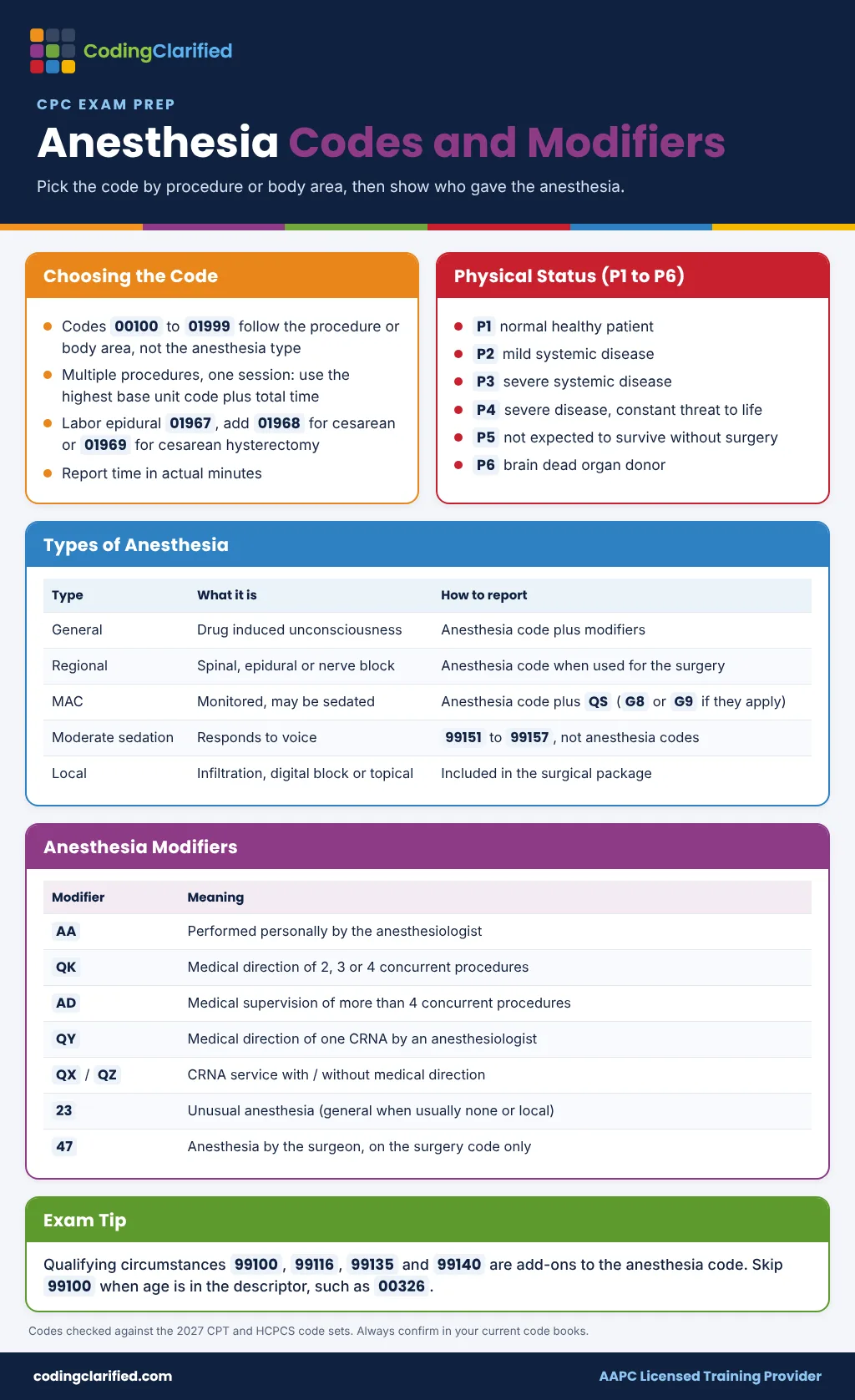
The CPT code for anesthesia services is typically a five-digit code, starting with a “0” (e.g., 00100-01999). These codes correspond to the procedure or body area, not the type of anesthesia used. For example:
- 00100-01999: Anesthesia codes for various surgical procedures
- 01916: Anesthesia for diagnostic arteriography/venography
- 00840: Anesthesia for intraperitoneal procedures in lower abdomen including laparoscopy, not otherwise specified
Each anesthesia code matches a procedure or surgical site. Therefore, choose it based on the surgery the patient is having.
Physical Status Modifiers (P1-P6)
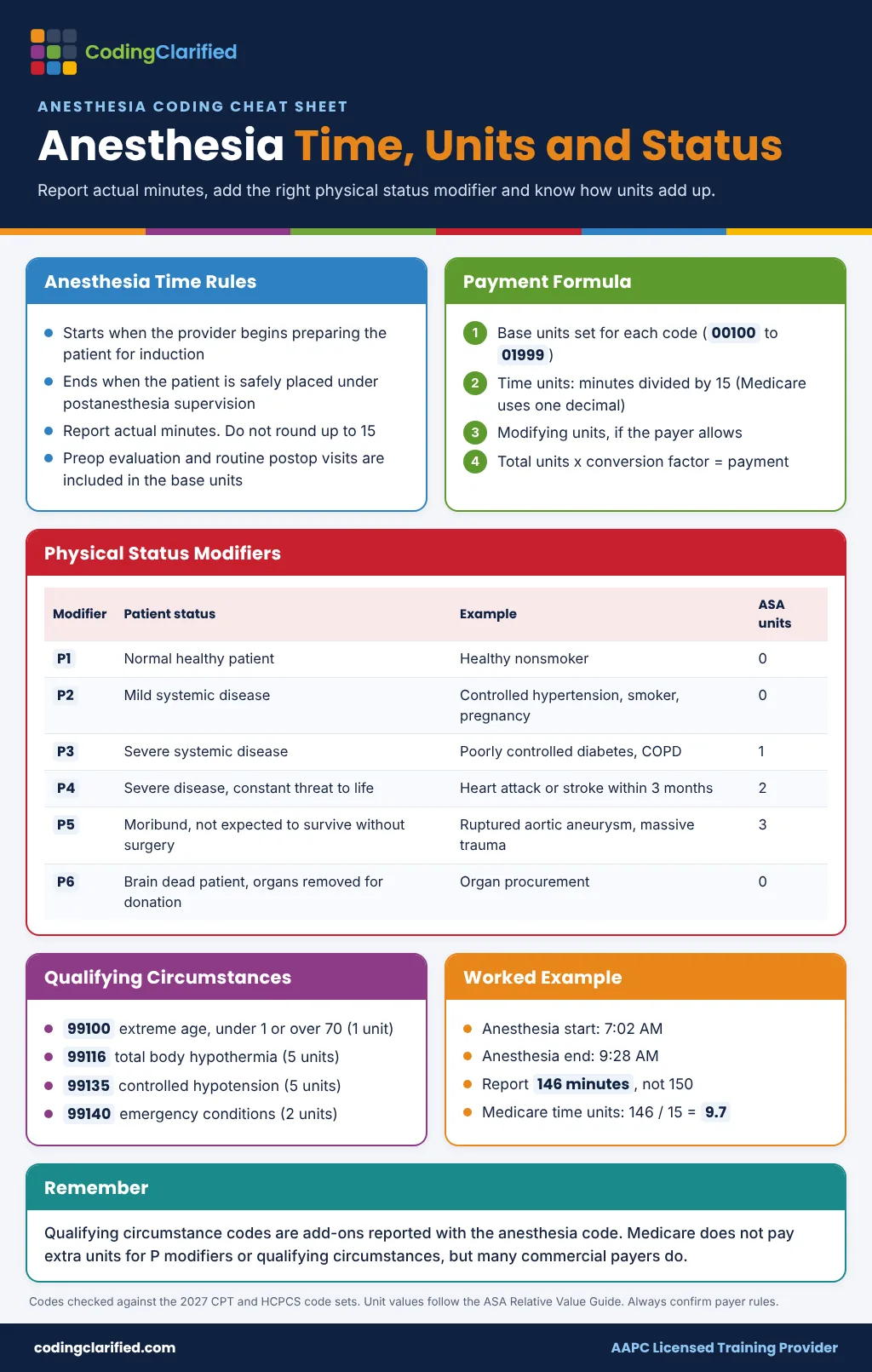
These modifiers describe the patient’s overall health and how it affects anesthesia risk. Coders add these modifiers to the anesthesia code to help reflect the patient’s physical condition. The six physical status modifiers are:
- P1: A normal healthy patient
- P2: A patient with mild systemic disease
- P3: A patient with severe systemic disease
- P4: A patient with severe systemic disease that is a constant threat to life
- P5: A patient who is not expected to survive without the operation
- P6: A declared brain-dead patient whose organs are being removed for donation
In short, they show how complex and risky the anesthesia was, which can affect payment.
Time-Based Billing
Providers generally bill anesthesia services based on the time spent providing anesthesia care. Time starts when the anesthesia provider begins preparing the patient for induction in the operating room or an equivalent area. It ends when the patient is safely placed under postanesthesia supervision, for example in the PACU. Providers report the actual minutes, and payers typically convert them to 15-minute units.
Basic rule: Report actual anesthesia minutes. Many payers then convert them to time units, and each unit usually equals 15 minutes.
Example: If the provider administers anesthesia for 60 minutes, that equals four time units.
Add-on Codes for Special Services
Some anesthesia services have add-on codes. For example, 01967 is the base code for neuraxial labor analgesia or anesthesia for a planned vaginal delivery. If a cesarean delivery follows, add 01968. If a cesarean hysterectomy follows, add 01969. Always report add-on codes with their base code and never alone.
Which ICD-10-CM Codes Go With Anesthesia Services?
Each claim also needs ICD-10-CM codes for the condition that required anesthesia. For instance:
- If a patient is undergoing surgery due to appendicitis, list the diagnosis code for appendicitis (e.g., K35.80 for acute appendicitis).
- If the patient receives anesthesia due to a trauma-related condition, include the relevant trauma codes.
The diagnosis code links the service to the patient’s condition. It also shows the anesthesia was medically necessary.
What Are the Main Anesthesia Billing Rules?
Proper billing for anesthesia services is essential for avoiding delays in payment or claim denials. Below are some important anesthesia billing guidelines:
Correct Coding for Procedure and Anesthesia Type
Make sure the anesthesia code matches the procedure performed. For example, different types of surgeries (e.g., orthopedic, abdominal, or cardiovascular) require specific anesthesia codes. Verify that the anesthesia service corresponds to the correct surgical procedure.
Modifiers
- Modifier 23: Unusual anesthesia. For example, use it when a patient needs general anesthesia for a procedure that usually needs no anesthesia or only local anesthesia.
- Modifier 47: Indicates that the surgeon, rather than an anesthesiologist, administered the anesthesia (rarely used but necessary in some situations).
- Modifier AA: Indicates that the anesthesiologist personally performed the anesthesia services.
- Modifier QK: Indicates medical direction of two, three, or four concurrent anesthesia procedures by a physician.
Using the correct modifiers ensures correct claim processing and maximum reimbursement. CPT Modifiers CPT Medical Modifiers
Anesthesia Time Calculation
Accurately documenting the time spent administering anesthesia is crucial for proper billing. Count anesthesia time from when the provider begins preparing the patient for induction until the patient is safely placed under postanesthesia supervision. Report the actual minutes, and follow each payer’s rules for converting minutes to units. Note that the 8-minute rule applies to timed therapy codes, not anesthesia: Medicare 8 Minute Rule
Documentation and Medical Necessity
Adequate documentation is key for anesthesia billing. The provider should document the type of anesthesia, the time, the patient’s physical status, and any special services, such as extra monitoring or special equipment. The medical record must support the medical necessity of anesthesia for the procedure.
Billing for Multiple Anesthesia Providers
Sometimes more than one anesthesia provider takes part, such as a CRNA supervised by an anesthesiologist. The providers may then split or share the service. Document each provider’s role. Use the right modifier to show whether the anesthesiologist or the CRNA provided the main care.
How Can You Code Anesthesia Accurately?
Ensure Proper Documentation of Anesthesia Time
Record the anesthesia start and end times so time-based billing is correct. Failure to document time accurately can result in denied claims or under-reimbursement.
Always Use the Correct Physical Status Modifier
Choose the correct modifier based on the patient’s health condition. This modifier provides insight into the complexity of the anesthesia and ensures appropriate reimbursement for the risk involved.
Review the Anesthesia Procedure and Diagnosis Codes
Double-check the procedure and diagnosis before you pick the anesthesia code. Anesthesia codes are specific to the type of surgery and the patient’s condition.
Avoid Upcoding or Downcoding
Never overestimate or underestimate the anesthesia time or complexity. Both upcoding and downcoding can lead to problems with reimbursements and audits. Stick to the exact number of units based on time spent providing anesthesia care. Bundling and Upcoding Medical Coding Bundling and Upcoding
Stay Up-to-Date on Changes
Codes and rules change. Therefore, watch for CPT and ICD-10 updates and payer-specific requirements.
Know the Payer Guidelines
Insurers and government programs like Medicare may have their own anesthesia billing rules. Ensure you are familiar with payer-specific requirements to avoid denials or underpayment.
Anesthesia coding takes attention to detail and a solid grasp of both the clinical and billing sides. Use accurate codes, the right physical status modifiers, and clear time records. This helps you receive correct payment and avoid denials. Follow these tips to keep anesthesia claims accurate and paid on time.
ASA asahq.org: Anesthesia Payment Basics Series 2 Anesthesia Coding Resources