
Updated October 2026 for FY2027. This guide reflects the FY2027 ICD-10-CM code set and Official Guidelines, effective October 1, 2026. However, the sequela rules did not change for FY2027.
Quick answer: A sequela is a residual condition that remains after the acute phase of an illness or injury has ended. ICD-10-CM usually needs two codes: the residual condition first (the problem being treated now), then the sequela code for the original cause. For injuries, the sequela code is the original injury code with 7th character S, for example G44.309 (post-traumatic headache) followed by S06.0X0S (concussion, sequela). Some categories, such as I69 for stroke, are combination codes that report the cause and the residual in one code.
New to medical coding? See how our CPC Training gets you certified.
What is a sequela in medical coding?
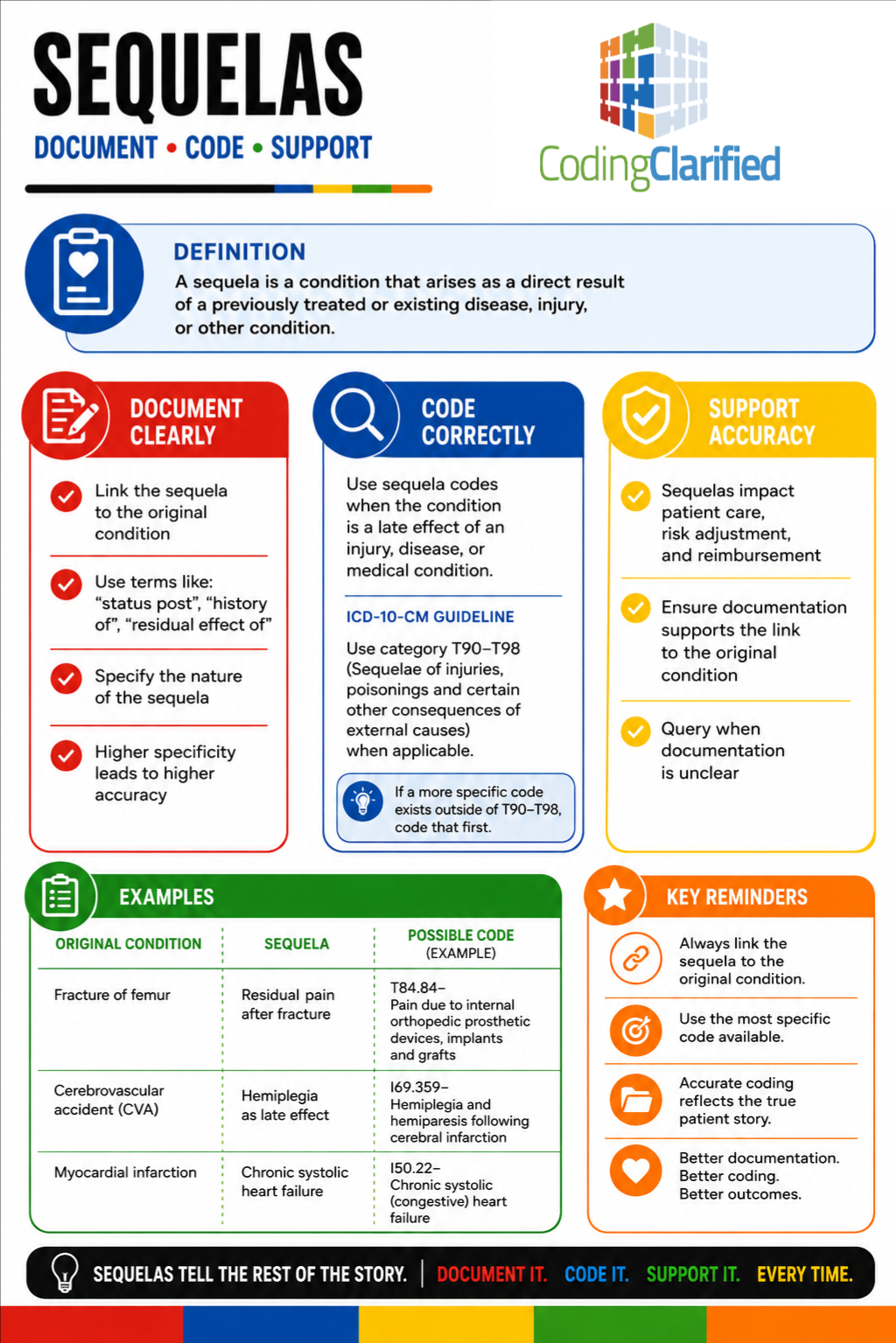
Medical coding sequela, also called late effects, means coding a residual condition produced after the acute phase of an illness or injury has ended. The original problem is no longer active, but it left something behind that is now being evaluated or treated.
- Stroke sequela: residual weakness, hemiplegia or speech problems after a stroke that is no longer acute.
- Injury sequela: chronic headaches after a healed concussion, or a scar after a healed burn or laceration.
- Infectious disease sequela: residual paralysis after polio.
There is no time limit. A residual can appear right after the acute phase, such as an infarction, or months or years later, such as a scar.
How do you code a sequela in ICD-10-CM?
Section I.B.10 of the FY2027 ICD-10-CM Official Guidelines sets the rule:
- Code the residual condition first. This is the condition that is present now, such as a headache, scar or contracture.
- Add the sequela code second. This code also identifies the original illness or injury that caused it.
There are two exceptions. Do not use two codes when the sequela code has been expanded to include the manifestation (a combination code such as the I69 stroke codes), or when the Tabular List instructs a different order, such as a sequela code followed by a manifestation code.
How does the 7th character S work for injuries?
For injuries, poisonings and other conditions in Chapter 19, the sequela is identified by adding the 7th character S to the original injury code. Therefore, the S goes on the injury code, not on the residual condition.
Example: A patient has persistent post-traumatic headaches from a concussion without loss of consciousness that has healed.
- G44.309: Post-traumatic headache, unspecified, not intractable (residual, coded first)
- S06.0X0S: Concussion without loss of consciousness, sequela (cause, coded second)
Note that S06.9X9S is “unspecified intracranial injury with loss of consciousness of unspecified duration, sequela.” It is not a general code for every brain injury sequela, so always select the injury code that matches the documented original injury.
How do you code sequela of a stroke?
Category I69 (sequelae of cerebrovascular disease) uses combination codes, so one code reports both the type of stroke and the residual deficit. For example, I69.351 is hemiplegia and hemiparesis following cerebral infarction affecting the right dominant side.
Do not add I63 (cerebral infarction) to an I69 code for an old stroke. Instead, I63 codes are for a current, acute stroke. The only time both are reported is when the patient has a new acute stroke and also has deficits from an earlier one. When the patient had a stroke with no residual deficits, use Z86.73 (personal history of TIA and cerebral infarction without residual deficits) instead.
Which ICD-10-CM categories describe sequelae?
| Category | Description |
|---|---|
| 7th character S (Chapter 19) | Sequela of an injury, poisoning or other external cause condition |
| I69 | Sequelae of cerebrovascular disease (stroke) |
| B90 to B94 | Sequelae of infectious and parasitic diseases, such as B91 sequelae of poliomyelitis |
| E64 | Sequelae of malnutrition and other nutritional deficiencies |
| E68 | Sequelae of hyperalimentation |
| G09 | Sequelae of inflammatory diseases of the central nervous system |
| O94 | Sequelae of complication of pregnancy, childbirth and the puerperium |
How is a sequela different from an active condition?
Use a sequela code only when the original condition is no longer in its acute phase. If the patient is still receiving active treatment for the injury, use 7th character A. If the injury is healing and the visit is routine follow up care, use 7th character D. When the condition has fully resolved and left no residual, however, a personal history code may apply instead.
What should coders check before billing for a sequela?
- Documentation of the history: the record should identify the original illness or injury and connect it to the current residual.
- The current residual: the specific condition being treated now, coded to the highest specificity.
- Multiple sequelae: if the original condition left more than one residual, code each residual that is evaluated or treated, followed by the sequela code.
- Medical necessity: the documentation should support the services provided for the residual condition.
- Procedure modifiers: sequela affects diagnosis coding, but procedures for a residual condition may still need modifiers. See our CPT Medical Modifiers guide.
Frequently asked questions
Which code goes first for a sequela?
The residual condition goes first, followed by the sequela code for the original cause, unless the sequela code is a combination code or the Tabular List instructs otherwise.
Is there a time limit for coding a sequela?
No. A sequela code can be used any time after the acute phase has ended, whether the residual appears right away or years later.
Do I code I63 with I69 for an old stroke?
No. I69 codes report the residual deficits of a prior stroke. Report I63 only when the patient also has a current acute stroke.
Where does the 7th character S go?
On the original injury code, not on the code for the residual condition.
What is the difference between 7th characters A, D and S?
A is for active treatment, D is for routine healing or recovery care after active treatment, and S is for residual conditions that remain after the injury has healed.
Related Coding Clarified guides
- Initial, Subsequent and Sequela Encounters
- ICD-10 Codes for Concussion and Post-Concussion Syndrome
- What Is a Manifestation Code in Medical Coding
- Medical Coding Reference Library
- AMA: 2023 E/M Descriptors and Guidelines
Ready to code like this for a living?
Coding Clarified’s AAPC licensed CPC program takes you from beginner to certified, with an internship and a job board for graduates.
You may qualify for WIOA funding in 30+ states. Check your eligibility.