
HCPCS modifiers are two-character codes that add detail to a procedure or supply code without changing its meaning. They tell the payer where a service happened, who performed it, whether a patient signed a waiver, or how the supplier provided a piece of equipment. Therefore, for a new coder, learning the most common HCPCS modifiers is one of the fastest ways to prevent denials and pass the modifier questions on the CPC exam.
In this guide, you will see how HCPCS modifiers work, walks through the main groups you will see in practice, and ends with a quick reference table you can keep open while you code.
What Are HCPCS Modifiers?
The Healthcare Common Procedure Coding System (HCPCS) has two levels. Level I is CPT, which the American Medical Association maintains. In contrast, CMS maintains Level II, which covers supplies, drugs, durable medical equipment, ambulance services, and other items CPT does not describe.
Also, each level has its own modifiers. CPT modifiers are two digits, such as 25, 59, or 26 (see our CPT modifiers guide). By comparison, HCPCS Level II modifiers are two letters or a letter and a number, such as GA, LT, or F1. In addition, Level II modifiers are not limited to Level II codes. In fact, you will often append them to CPT codes, for example RT on a knee procedure or GA on a lab test.
You can find the official list in the annual HCPCS release on the CMS HCPCS page. However, CMS updates it every quarter, so always confirm a modifier against the current file.
Why HCPCS Modifiers Matter for Payment
In practice, a missing or wrong modifier is one of the most common reasons a clean claim turns into a denial. For example, a claim for a right foot procedure with no laterality modifier may come back unpaid. Likewise, you can bill the patient for a service they were warned about only if the ABN modifier is on the claim.
Modifiers also carry compliance weight, because appending a modifier tells the payer that the record supports it. If an auditor cannot find that support in the documentation, the payer can take the payment back. Our guide on who is responsible for coding and billing errors covers that risk in more detail.
Anatomic HCPCS Modifiers
To begin, anatomic modifiers identify the exact body part. As a result, they are common on surgery, radiology, and podiatry claims.
- LT and RT: Left side and right side, respectively.
- E1 to E4: Eyelids. E1 upper left, E2 lower left, E3 upper right, E4 lower right.
- FA and F1 to F9: Fingers. For example, FA is the left thumb and F1 to F4 are the left second through fifth digits. F5 is the right thumb and F6 to F9 are the right second through fifth digits.
- TA and T1 to T9: Toes. Likewise, TA is the left great toe and T1 to T4 are the left second through fifth toes. T5 is the right great toe and T6 to T9 are the right second through fifth toes.
- LC, LD, LM, RC, RI: Coronary arteries, specifically the left circumflex, left anterior descending, left main, right coronary, and ramus intermedius.
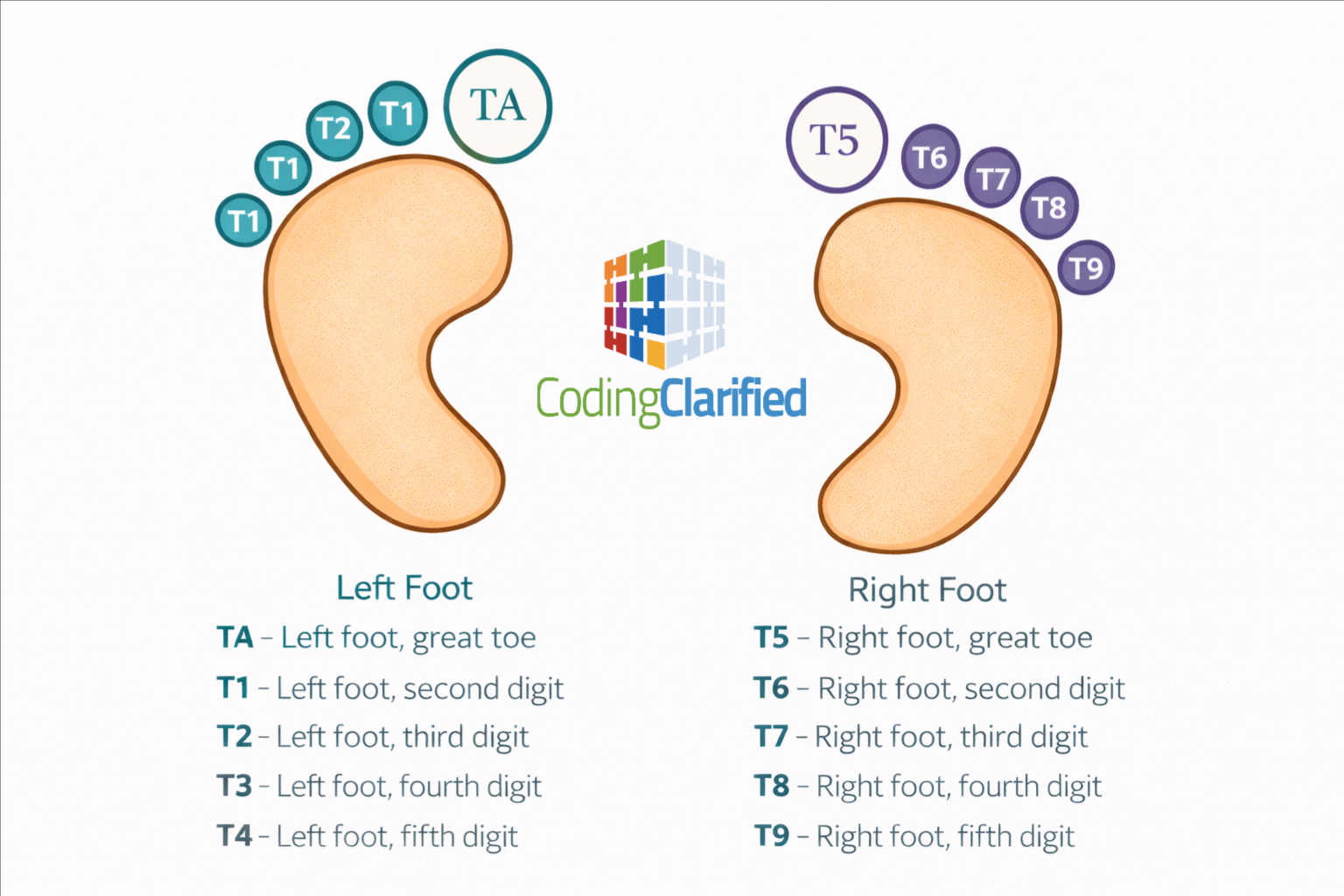
For diagrams of every finger, toe, and eyelid modifier, see our anatomical modifiers guide.
ABN and Liability HCPCS Modifiers
An Advance Beneficiary Notice (ABN, form CMS-R-131) warns a Medicare patient that a service may not be covered. Then, these four modifiers tell Medicare whether a notice was given and why.
- GA: Waiver of liability statement issued as required by payer policy. Use it when a signed ABN is on file for a service you expect Medicare to deny as not reasonable and necessary. So, if Medicare denies the line, the patient is responsible.
- GX: Notice of liability issued, voluntary under payer policy. Similarly, use it when you gave a voluntary ABN for a service Medicare never covers.
- GY: Item or service statutorily excluded, or does not meet the definition of any Medicare benefit. Because of this, you do not need an ABN.
- GZ: Item or service expected to be denied as not reasonable and necessary, and the provider gave no ABN. Consequently, the provider cannot bill the patient if Medicare denies it.
Keep in mind that the ABN stays in the patient record. However, you do not send it with the claim, so the documentation must be ready if the payer asks for it.
Anesthesia HCPCS Modifiers
Next, anesthesia claims need a modifier that shows who provided the service and whether an anesthesiologist directed a CRNA.
- AA: Anesthesia services performed personally by an anesthesiologist.
- AD: Medical supervision by a physician of more than four concurrent anesthesia procedures.
- QK: Medical direction of two, three, or four concurrent procedures involving qualified individuals.
- QY: Similarly, medical direction of one CRNA by an anesthesiologist.
- QX: CRNA service with medical direction by a physician.
- QZ: By contrast, CRNA service without medical direction by a physician.
- QS: Monitored anesthesia care service.
- G8 and G9: Monitored anesthesia care for a deep, complex, or markedly invasive procedure (G8), or for a patient with a history of a severe cardiopulmonary condition (G9).
Ambulance HCPCS Modifiers
Ambulance claims use a two-letter modifier built from origin and destination codes. First, the opening letter shows where the trip started. Then, the second letter shows where it ended. For example, RH means residence to hospital, and SH means scene of an accident to hospital.
- D: Diagnostic or therapeutic site other than P or H.
- E: Residential, domiciliary, or custodial facility (not a skilled nursing facility).
- G: Hospital-based ESRD facility.
- H: Hospital.
- I: Site of transfer between types of ambulance, such as an airport or helicopter pad.
- J: Freestanding ESRD facility.
- N: Skilled nursing facility, as opposed to E.
- P: Physician office.
- R: Residence.
- S: Scene of an accident or acute event.
- X: Intermediate stop at a physician office on the way to the hospital. Use X only as a destination code.
In addition, two more modifiers apply to hospital-based ambulance services. QN means the provider of services furnished the ambulance service directly. QM means the provider arranged the service with another ambulance company. Finally, GM reports multiple patients on one ambulance trip.
Of course, origin and destination modifiers only work when the run report supports them. Read our guide on why a clinically justified ambulance transport still gets denied to see how documentation drives EMS payment.
DMEPOS HCPCS Modifiers
Durable medical equipment, prosthetics, orthotics, and supplies (DMEPOS) claims use modifiers to show how the supplier provided an item and whether it meets coverage rules.
- NU, RR, UE: New equipment, rental, and used equipment.
- KX: Requirements specified in the medical policy have been met.
- RA: Replacement of a DME, orthotic, or prosthetic item.
- RB: In comparison, replacement of a part of a DME, orthotic, or prosthetic item furnished as part of a repair.
- K0 to K4: Lower extremity prosthesis functional levels, from K0 (no ability to walk) to K4 (high activity).
- KF: Item the FDA designates as a Class III device.
Drug Wastage and J Modifiers
For instance, Medicare requires a wastage modifier on drugs from single-dose containers.
- JW: Drug amount discarded and not administered to any patient. Also, report the discarded units on a separate line.
- JZ: In other words, zero drug amount discarded.
On the other hand, coders sometimes confuse JW and JZ with J1, J2, and J3. Those three belong to the Medicare Part B Drug Competitive Acquisition Program (CAP). Since that program is not currently operating, you will rarely see them on a claim today.
Other HCPCS Modifiers Coders Should Know
- GC: Service performed in part by a resident under the direction of a teaching physician.
- GE: On the other hand, service performed by a resident without the presence of a teaching physician under the primary care exception.
- XE, XP, XS, XU: More specific options than CPT modifier 59. Separate encounter, separate practitioner, separate structure, and unusual non-overlapping service.
- Q5 and Q6: Services by a substitute physician under a reciprocal billing arrangement (Q5) or a fee-for-time arrangement (Q6).
- PO and PN: Excepted (PO) and non-excepted (PN) services at an off-campus provider-based hospital department.
- TC: Technical component. Meanwhile, the matching professional component uses CPT modifier 26. Learn more in Modifier 26 vs TC.
- AI: Principal physician of record.
- AS: Physician assistant, nurse practitioner, or clinical nurse specialist services for assistant at surgery.
HCPCS Modifiers Quick Reference Table
| Modifier | Meaning | Group |
|---|---|---|
| LT / RT | Left side / right side | Anatomic |
| FA, F1 to F9 | Specific finger | Anatomic |
| TA, T1 to T9 | Specific toe | Anatomic |
| GA | ABN on file, required by payer policy | Liability |
| GX | Voluntary notice of liability issued | Liability |
| GY | Statutorily excluded or not a Medicare benefit | Liability |
| GZ | Expected denial, no ABN on file | Liability |
| AA | Anesthesia personally performed by anesthesiologist | Anesthesia |
| QZ | CRNA without medical direction | Anesthesia |
| RH, SH, etc. | Ambulance origin and destination | Ambulance |
| QM / QN | Ambulance under arrangement / furnished directly | Ambulance |
| NU / RR / UE | New / rental / used equipment | DMEPOS |
| KX | Medical policy requirements met | DMEPOS |
| JW / JZ | Drug wasted / no drug wasted | Drugs |
| GC | Resident with teaching physician | Teaching |
| XE, XP, XS, XU | Distinct procedural service | Other |
| TC | Technical component | Other |
Tips for Using HCPCS Modifiers Correctly
- Start with the documentation. Before anything else, confirm the record supports the modifier before you append it.
- Check the payer. After that, remember that Medicare, Medicaid, and commercial plans do not always accept the same modifiers, so review the payer policy.
- Order matters. Generally, list payment modifiers before informational modifiers unless the payer instructs otherwise.
- Use the current file. CMS adds and deletes HCPCS modifiers every quarter, so an old cheat sheet can be wrong.
- Do not stack modifiers to force payment. After all, every modifier is a statement about the service, and auditors treat it that way.
Learn HCPCS Modifiers the Right Way
Above all, the CPC exam tests modifiers, and you will use them on nearly every claim you touch as a coder. At Coding Clarified, students practice HCPCS modifiers on real-world cases in our online, instructor-guided medical coding training. Otherwise, if you are new to the field, start with our overview of what medical coding is and how to get started.