Modifier 26 vs TC in 2026: Professional and Technical Component Medical Coding Guide
Understanding Modifier 26 vs TC is essential for medical coders who work with radiology, diagnostic testing, cardiology, pathology, and other services that may contain both professional and technical components.
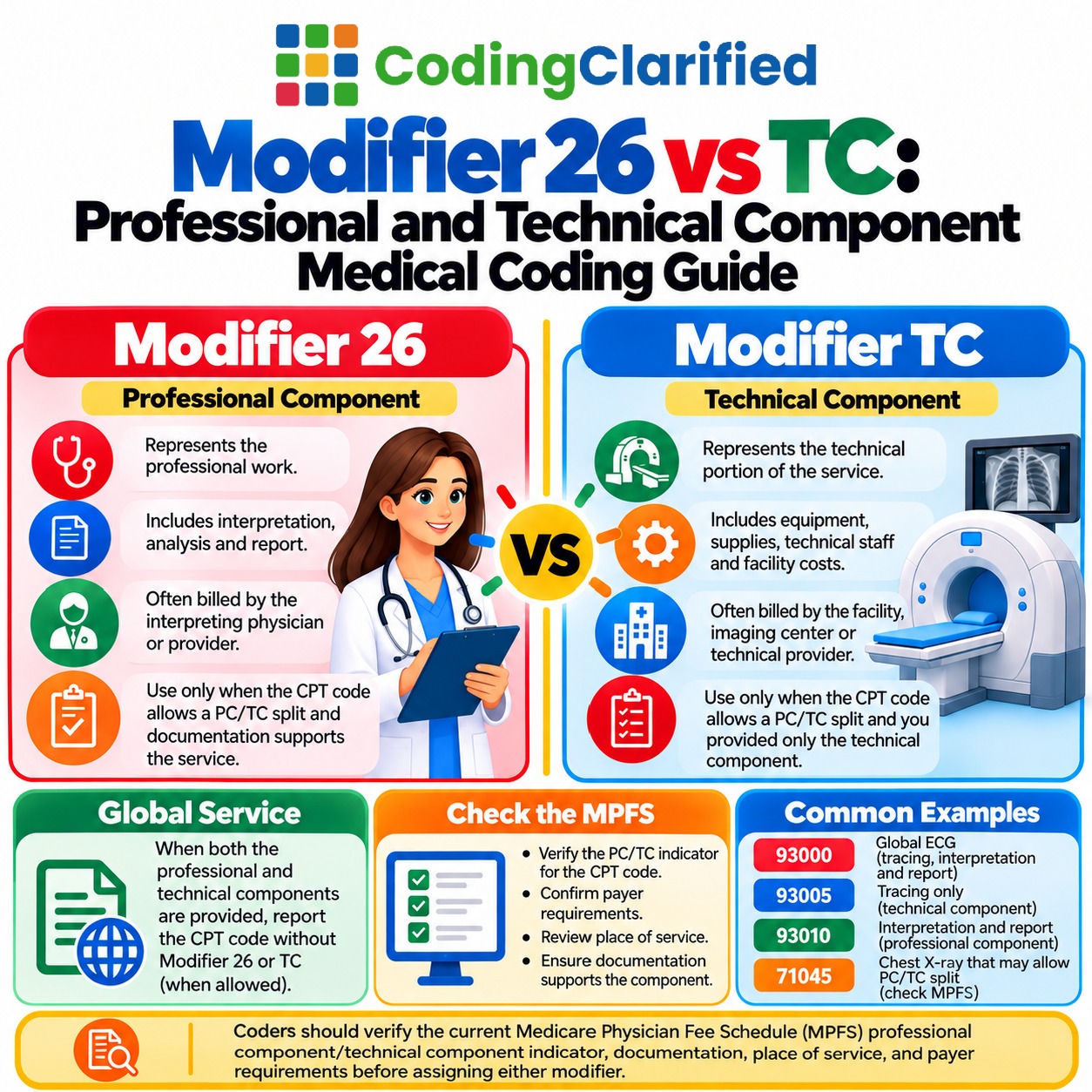
In simple terms, Modifier 26 identifies the professional component, while Modifier TC identifies the technical component. However, coders cannot automatically add these modifiers to every diagnostic procedure. Instead, you must determine whether the CPT code can actually be divided into professional and technical components.
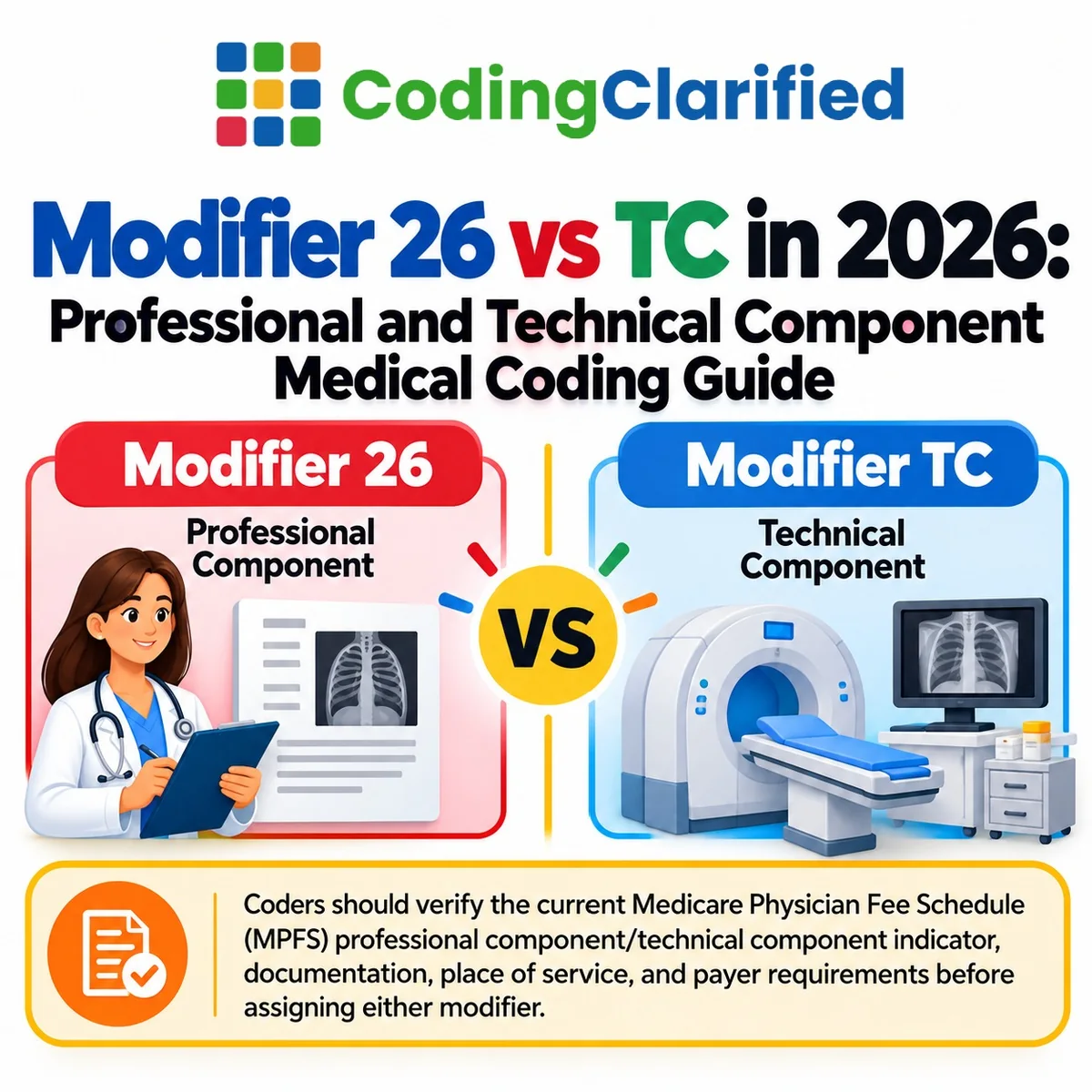
For 2026, coders should verify the current Medicare Physician Fee Schedule (MPFS) professional component/technical component indicator, documentation, place of service, and payer requirements before assigning either modifier.
Key Takeaways: Modifier 26 vs TC in 2026
- Modifier 26 reports the professional component of an eligible service.
- Modifier TC reports the technical component of an eligible service.
- The professional component commonly includes physician interpretation and a written report.
- The technical component generally includes equipment, supplies, technologist or technician services, and related technical costs.
- When one entity provides both eligible components, the CPT code may generally be reported globally without Modifier 26 or TC.
- Not every CPT code accepts Modifier 26 or TC.
- For Medicare, check the current MPFS PC/TC indicator before splitting a service.
- A PC/TC indicator of 1 generally identifies a diagnostic test or radiology service that can be divided into professional and technical components.
- Codes that already describe only the professional or technical portion generally should not receive another 26 or TC modifier.
- In 2026, always verify current payer rules instead of relying only on how a service was billed in previous years.
What Are Professional and Technical Components in Medical Coding?
Some diagnostic procedures include two distinct parts.
The professional component (PC) represents the provider’s professional work. Depending on the service, this may include supervision, interpretation of the test, analysis of the findings, and preparation of the report.
Meanwhile, the technical component (TC) represents the resources needed to perform the test. For example, these costs can include equipment, supplies, technical staff, and the space needed to perform the procedure.
When both portions are included in one eligible CPT code, the service is often called the global service.
This use of the word “global” should not be confused with a surgical global period. In this situation, global simply means that both the professional and technical components of the diagnostic service are being reported together.
AAPC also explains that Medicare and many other payers divide certain services, such as radiology procedures, into professional and technical components.
For more background on modifiers and CPT coding, review the AAPC Medical Coding Modifiers Guide.
What Is Modifier 26?
Modifier 26 — Professional Component identifies the professional portion of an eligible procedure when that portion is billed separately.
For example, a hospital may perform an imaging study using its equipment and staff. A radiologist then interprets the study and prepares the report.
If the radiologist is reporting only the professional portion, Modifier 26 may be appended to the eligible CPT code.
The professional component can include:
- Physician or qualified provider work
- Interpretation of the diagnostic study
- Analysis of the findings
- Preparation of the required report
- Professional supervision when included in the service
However, Modifier 26 does not simply mean “a physician was involved.” Instead, the underlying CPT code must allow the professional and technical components to be reported separately.
CMS identifies Modifier 26 as the professional component within its Medicare Physician Fee Schedule resources.
What Is Modifier TC?
Modifier TC — Technical Component identifies only the technical portion of an eligible service.
The technical component may include:
- Equipment
- Supplies
- Technologist or technician services
- Equipment maintenance
- Practice expenses associated with performing the test
- Other technical resources needed to complete the service
For example, an imaging center may provide the scanner, supplies, and technologist for an MRI. However, an outside radiologist may interpret the study.
When appropriate under the payer’s rules, the entity reporting only the technical portion uses Modifier TC.
Therefore, the basic distinction is easy to remember:
26 = professional work
TC = technical resources
Still, knowing those definitions is only the first step. The coder must also confirm that the specific CPT code can be split.
Modifier 26 vs TC: Quick Comparison
| Component | Modifier 26 | Modifier TC |
|---|---|---|
| Meaning | Professional component | Technical component |
| Commonly represents | Interpretation and report | Equipment, supplies and technical staff |
| Often billed by | Interpreting physician/provider | Facility, imaging center or eligible supplier |
| Used on every diagnostic code? | No | No |
| MPFS verification needed? | Yes | Yes |
| Global service? | No | No |
When the same billing entity provides both components and global billing is allowed, the eligible CPT code is generally reported without Modifier 26 or TC.
What Is Global Billing?
Global billing occurs when the billing entity is entitled to report both the professional and technical portions of a service.
For example, imagine a physician practice owns the imaging equipment, employs the technical staff, performs the eligible diagnostic study, and provides the interpretation and report.
When all applicable requirements are met, the practice may report the CPT code without Modifier 26 or TC.
The unmodified code represents the complete or global service.
CMS provides an MPFS pricing example showing that an eligible code without a modifier represents both the professional and technical components, while separate lines with 26 and TC represent the individual components.
Coders should still verify payer requirements because Medicare and commercial payer billing rules may differ.
How Do You Know Whether Modifier 26 or TC Is Allowed?
This is one of the most important steps in professional and technical component coding.
Do not decide based only on the procedure description.
Instead, check the Medicare Physician Fee Schedule PC/TC indicator or the applicable payer’s coding and payment rules.
CMS uses PC/TC indicators to explain whether a procedure can be divided into professional and technical components.
PC/TC Indicator 0
Indicator 0 generally represents physician services that cannot be divided into professional and technical components.
Examples can include visits and surgical procedures.
Therefore, Modifiers 26 and TC do not apply.
PC/TC Indicator 1
Indicator 1 generally identifies diagnostic tests or radiology services that have both professional and technical components.
These services may allow Modifier 26 or TC when only one component is being reported.
The global service generally includes both portions.
PC/TC Indicator 2
Indicator 2 identifies professional-component-only codes.
Because the code already represents the professional component, Modifier 26 or TC should not be added.
PC/TC Indicator 3
Indicator 3 identifies technical-component-only codes.
Again, the code itself already describes the technical service. Therefore, Modifiers 26 and TC do not apply.
CMS maintains additional PC/TC indicators for other types of services, so coders should review the complete current indicator definitions when needed.
Use the CMS Professional Component and Technical Component Indicator Guide to verify the current Medicare definitions.
Modifier 26 and TC Example: Radiology
Radiology is one of the easiest ways to understand these modifiers.
Suppose a patient receives a diagnostic imaging study at a hospital.
The hospital supplies:
- Imaging equipment
- Technical staff
- Supplies
- Space and technical resources
Meanwhile, a radiologist provides the professional interpretation and report.
When the CPT code supports a PC/TC split and all billing requirements are met, the professional claim may report the eligible CPT code with Modifier 26.
The technical portion is reported according to the facility’s applicable billing rules.
For more detailed imaging guidance, see our Radiology Medical Coding and Billing Guidelines 2026.
Modifier 26 and TC Example: ECG Coding
ECG coding provides another useful lesson because some CPT codes already describe a specific component.
For example:
- 93000 represents a complete ECG service that includes tracing, interpretation, and report.
- 93005 represents the tracing portion only.
- 93010 represents interpretation and report only.
Therefore, you would not automatically append TC to 93005 or Modifier 26 to 93010 simply because one is technical and the other is professional.
The code descriptions already separate the components.
CMS specifically identifies 93010 as an example of a professional-component-only code and 93005 as an example of a technical-component-only code.
This distinction is important for both CPC students and working coders.
Place of Service Matters
Before assigning Modifier 26 or TC, determine where the service occurred and who supplied each part of the service.
For example, a physician interpreting hospital imaging generally does not own the hospital’s equipment or employ its imaging staff. Consequently, the physician may be entitled to report only the professional component when the CPT code and payer rules support separate component billing.
On the other hand, an office may provide both the equipment and professional interpretation. In that situation, global billing may apply.
However, ownership of equipment alone does not automatically establish the right to bill a technical component in every setting.
Facility, ASC, hospital outpatient, and payer-specific payment rules can affect billing.
For more information about facility coding, read our Ambulatory Surgery Center Medical Coding and Billing Guide 2026 and Outpatient Medical Coding Guidelines 2026.
2026 Coding Tip: Check the Current MPFS
Coding rules, payment files, and CPT/HCPCS information can change. Therefore, a workflow that worked in a previous year should not automatically be carried into 2026.
Before billing Medicare, verify:
- The current CPT or HCPCS code.
- The 2026 MPFS status of the code.
- The PC/TC indicator.
- The component actually provided.
- The place of service.
- Documentation supporting the service.
- Current Medicare Administrative Contractor or payer requirements.
CMS’s Physician Fee Schedule tools can help coders verify whether an eligible procedure has separate global, professional, and technical payment information.
Review the CMS Physician Fee Schedule Search Guidance for additional information.
For a broader look at this year’s changes, see our 2026 CPT Updates and CMS Changes for 2026.
Documentation Requirements for Modifier 26
When reporting a professional component, documentation should support the professional service performed.
Depending on the procedure and payer, this commonly includes a clear interpretation and report.
A brief note that a provider “reviewed” a test may not automatically support separately reporting the professional component. Instead, coders should verify the documentation requirements for the specific service and payer.
Additionally, the record should support medical necessity and the services actually reported.
Good documentation protects the provider, supports accurate reimbursement, and reduces audit risk.
Common Mistakes to Avoid
Adding Modifier 26 to Every Interpretation
An interpretation does not automatically mean Modifier 26 is appropriate.
First, determine whether the CPT code allows a professional/technical split. Then confirm that the documentation supports the professional service.
Adding TC to Every Test Performed in an Office
The fact that equipment was used does not automatically mean TC applies.
Instead, verify the PC/TC indicator and payer rules.
Adding 26 or TC to Component-Only Codes
Some CPT codes already represent only the professional or technical component.
For example, 93010 already represents interpretation and report, while 93005 represents the tracing portion.
Adding another component modifier would be incorrect.
Billing Globally When Only One Component Was Provided
Reporting an eligible global code without 26 or TC can indicate that both components are being billed.
Therefore, do not submit the global service when the billing provider or entity is entitled to report only one component.
Confusing Global Billing With a Global Surgical Period
These are different concepts.
Global billing in PC/TC coding means reporting both the professional and technical portions of a diagnostic service. A global surgical package, meanwhile, relates to services included in payment for certain surgical procedures.
Ignoring Place of Service
Facility and non-facility billing rules can differ.
Consequently, always check the setting before deciding who can report each component.
Assuming Last Year’s Rules Still Apply
Coding and payment information can change annually or during the year.
For that reason, use current 2026 CPT, HCPCS, CMS, and payer resources.
CPC Student Tips for Modifier 26 vs TC
Modifier questions become much easier when you focus on who did what.
For CPC exam questions, ask yourself:
Who provided the equipment and technical resources?
That points toward the technical component.
Next ask:
Who interpreted the study and prepared the report?
That points toward the professional component.
Then ask:
Does the code actually allow the service to be split?
This final question is critical.
A simple memory trick is:
26 = Provider’s professional portion
TC = Technical costs
No modifier = Both components, when global reporting is appropriate
However, do not memorize that shortcut without learning the exceptions. Some CPT codes already describe a professional-only or technical-only service.
Also, read the full CPT descriptor carefully. Words such as “interpretation and report,” “tracing only,” or similar component language can completely change the answer.
Practical Modifier 26 vs TC Coding Checklist
Before submitting a claim, ask:
- Does this CPT code have separate professional and technical components?
- What is the current PC/TC indicator?
- Who performed the technical portion?
- Who performed the professional portion?
- Is there a separate interpretation and report when required?
- What is the place of service?
- Is the billing entity reporting only the portion it provided?
- Does the payer follow Medicare rules or have different requirements?
- Does the documentation support the billed component?
- Am I using current 2026 coding and payment information?
Following this process is much safer than adding modifiers based only on habit.
Frequently Asked Questions About Modifier 26 and TC
What is the difference between Modifier 26 and Modifier TC?
Modifier 26 identifies the professional component of an eligible service, while Modifier TC identifies the technical component. The professional portion generally includes provider interpretation and reporting. In contrast, the technical portion generally represents equipment, supplies, staff, and related technical resources.
When should Modifier 26 be used?
Use Modifier 26 when the billing provider reports only the professional component of an eligible procedure. However, first confirm that the CPT code supports separate professional and technical component billing and that the documentation supports the professional work.
When should Modifier TC be used?
Modifier TC may be used when the billing entity reports only the technical component of an eligible service. Nevertheless, payer, facility, and place-of-service rules must also be reviewed.
Do I use Modifier 26 when a radiologist interprets an X-ray?
It may be appropriate when the radiologist reports only the professional component of an eligible radiology service and the documentation supports the interpretation and report. Still, verify the CPT code’s PC/TC status and payer requirements before billing.
Can Modifier 26 and TC be used on every CPT code?
No. Many CPT codes cannot be divided into professional and technical components. CMS uses the MPFS PC/TC indicator to identify how Medicare treats these services.
What does it mean when a CPT code is billed without Modifier 26 or TC?
For a code that supports professional and technical components, reporting the code without either modifier generally represents the global service. In other words, the billing entity is reporting both components when permitted.
Should Modifier 26 be added to a professional-component-only CPT code?
No. If the CPT code already describes only the professional component, adding Modifier 26 is generally unnecessary and incorrect. For example, 93010 already represents ECG interpretation and report.
What should coders check for Modifier 26 and TC in 2026?
Coders should review the current CPT/HCPCS code, CMS MPFS PC/TC indicator, place of service, documentation, payer policy, and which entity provided each component. In addition, check current 2026 payment files rather than relying on older billing patterns.
Final Thoughts
Understanding Modifier 26 vs TC starts with a simple concept: Modifier 26 represents the professional component, while Modifier TC represents the technical component.
Accurate coding, however, requires more than memorizing those definitions.
In 2026, coders should verify whether the CPT code can be divided, identify who performed each component, review the place of service, confirm documentation, and check current payer requirements.
Most importantly, never add 26 or TC automatically.
When you understand the service first and verify the current coding rules second, professional and technical component billing becomes much easier to manage.