Medical coding and billing errors can lead to denied claims, lost revenue, payer refunds, audits, and, in serious cases, legal penalties. However, one question often causes confusion: Who is actually responsible when a medical coding or billing error occurs?
Is it the medical coder who selected the code? Is it the biller who submitted the claim? Or, is it the physician or healthcare organization whose name appears on the claim?
The answer depends on what happened, who participated, and whether the mistake was an innocent error or involved knowing, reckless, or intentional conduct. Nevertheless, healthcare providers and organizations generally carry significant responsibility for claims submitted under their names and billing numbers. Coders, billers, managers, third-party billing companies, and others can also face consequences depending on their conduct and role.
In 2026, this issue deserves even more attention. Federal enforcement continues to focus on inaccurate diagnosis reporting, unsupported services, improper reimbursement, and the failure to correct known coding problems. Therefore, every medical coder, biller, provider, and compliance professional should understand where responsibility begins and how organizations can reduce their risk.
Important: This article provides educational information about medical coding and billing compliance. It is not legal advice. Organizations facing a potential compliance violation should consult qualified healthcare legal counsel.
Key Takeaways: Responsibility for Medical Coding and Billing Errors
- An accidental coding or billing error is not automatically healthcare fraud.
- Healthcare providers and organizations are generally responsible for ensuring claims submitted under their billing information are accurate and supported.
- Medical coders and billers still have professional responsibilities to follow coding rules, documentation, payer requirements, and employer compliance policies.
- Third-party billing or coding companies do not automatically remove the provider’s responsibility for submitted claims.
- Repeatedly ignoring known errors can create much greater compliance risk than promptly identifying and correcting a mistake.
- Overpayments must be investigated and handled according to applicable federal and payer requirements.
- Upcoding, unbundling, unsupported diagnosis coding, billing for services not provided, and altering codes only to obtain payment can create serious compliance concerns.
- Internal audits, staff education, documentation improvement, and a strong compliance program can reduce both financial and legal risk.
- In 2026, government enforcement actions continue to show why accurate diagnosis and procedure reporting matters.
Is a Medical Coding or Billing Error the Same as Fraud?
No. This distinction is extremely important.
People sometimes hear about the False Claims Act and assume that every incorrect claim represents fraud. However, federal guidance recognizes a difference between an innocent billing mistake and conduct involving a higher level of knowledge or intent.
The HHS Office of Inspector General (OIG) has explained that healthcare professionals can make billing errors through inadvertence or negligence. In general, an erroneous payment resulting from an innocent error must be corrected and the improperly received funds returned. Fraud and False Claims Act liability involve additional legal standards.
Therefore, discovering one incorrect code should not automatically cause panic. Instead, the organization should determine what happened, whether other claims could have the same problem, and what corrective action is required.
For example, suppose a coder accidentally assigns the wrong procedure code because two similar services were documented. Once the mistake is discovered, the organization can review the record, correct the claim when appropriate, determine whether similar claims were affected, and address any resulting overpayment.
Conversely, repeatedly selecting higher-paying codes despite documentation showing that the services do not qualify can create a much different compliance issue.
Who Is Responsible for Medical Coding Errors?
Responsibility may involve several people or organizations because healthcare claims pass through multiple steps before reaching the payer.
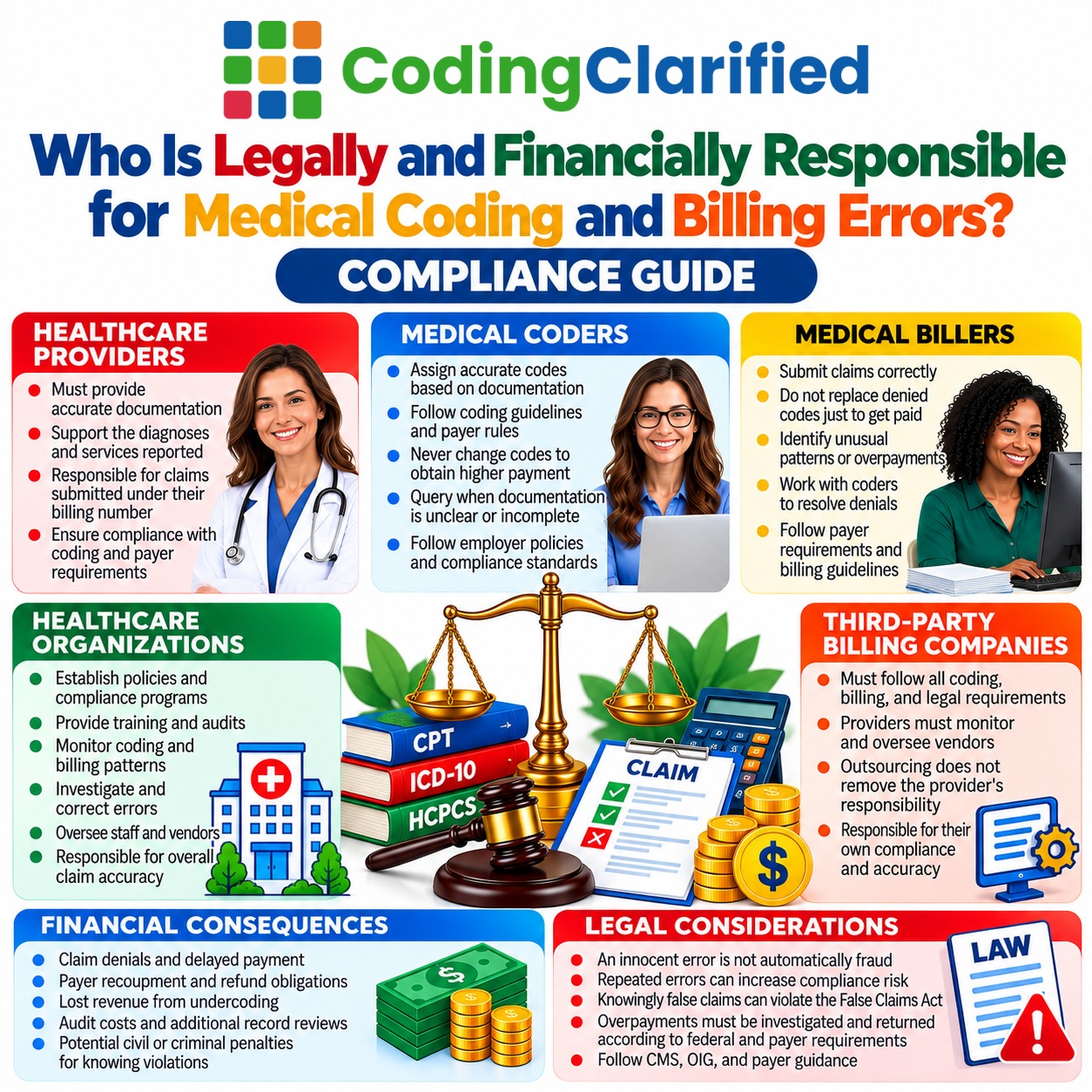
Healthcare Providers
Physicians and other healthcare providers have a major responsibility because their documentation supports the services and diagnoses reported on claims.
The OIG explains that when a claim for services provided to a Medicare or Medicaid beneficiary is submitted, the claim represents that the provider earned the requested payment and complied with applicable billing requirements. Moreover, OIG identifies upcoding, billing for services not rendered, billing for medically unnecessary services, and certain other improper billing practices as compliance concerns.
Consequently, providers cannot simply assume that hiring a coder eliminates their responsibility.
Clear documentation is one of the strongest protections against coding errors. Furthermore, providers should answer legitimate coder queries and avoid asking coding staff to report services or diagnoses that the medical record does not support.
Medical Coders
Medical coders have a professional duty to assign codes based on the medical record, official coding guidelines, applicable payer rules, and current code sets.
Coders should never change a diagnosis or procedure code simply because another code pays more.
Likewise, a coder should not report a diagnosis because a provider “probably meant” it. When documentation is unclear, conflicting, incomplete, or insufficient, the coder should follow the organization’s query process instead of making an unsupported assumption.
Our guide to Medical Coding Compliance explains additional steps coders can take to reduce compliance risks.
Although employers usually handle ordinary employee mistakes through quality review, education, and corrective processes, a coder who knowingly participates in improper billing may face more serious employment, certification, civil, or potentially legal consequences depending on the circumstances.
Medical Billers
Medical billers work with information that ultimately becomes part of the claim. Therefore, they also play an important compliance role.
A biller should not replace a denied diagnosis or procedure code with another code merely to force a claim through the payer’s system. Instead, coding-related denials should return to qualified coding staff for review when necessary.
For a closer look at these different roles, see our Medical Coder vs. Medical Biller in 2026 guide.
Additionally, billers should recognize unusual patterns, repeated denials, overpayments, duplicate payments, and other warning signs. These issues may point to a larger problem that needs investigation.
Healthcare Organizations and Practices
Hospitals, physician practices, clinics, health systems, and other healthcare entities need systems that support accurate claims.
An organization should not rely entirely on one coder or biller to prevent every possible mistake. Instead, leadership should create policies, provide training, perform audits, monitor billing patterns, and respond when staff identify potential problems.
The OIG recommends important compliance elements such as internal monitoring and auditing, written standards, training, open communication, appropriate corrective action, and designated compliance responsibility.
Therefore, compliance works best as an organizational process rather than an individual task.
Third-Party Coding and Billing Companies
Outsourcing coding or billing does not mean a healthcare practice can ignore claim accuracy.
Providers should carefully monitor vendors, review reports, establish clear contractual expectations, and investigate unusual coding or reimbursement patterns. Meanwhile, third-party companies and their employees must follow applicable coding, billing, contractual, and legal requirements.
Simply saying, “Our billing company submitted it,” does not automatically resolve the provider organization’s compliance responsibility.
What Are the Financial Consequences of Coding and Billing Errors?
Even when an error does not rise to the level of fraud, it can become expensive.
An incorrect claim may cause a denial, delayed reimbursement, payer recoupment, refund obligation, administrative costs, or lost revenue. Furthermore, repeated errors may trigger broader audits that require staff to review many additional records.
Undercoding also has financial consequences. If documentation supports a service but the organization consistently reports a lower-paying code, legitimate revenue may be lost.
For example, E/M services require correct application of current coding rules and supporting documentation. Our 2026 E/M Coding Guide explains MDM, time, E/M levels, and common coding mistakes.
Ultimately, accurate coding is not about maximizing or minimizing reimbursement. It is about reporting the service correctly.
What Happens When a Practice Discovers an Overpayment?
Discovering an overpayment should trigger action rather than being ignored.
CMS rules require applicable Medicare overpayments to be reported and returned within required timeframes. In addition, current rules can allow the 60-day deadline to be suspended for up to 180 days while an organization conducts a timely, good-faith investigation into related overpayments arising from the same or a similar cause.
Therefore, practices should have a written process for escalating potential overpayments.
A compliance response may include identifying the affected claim, reviewing the documentation, determining the root cause, checking whether similar claims contain the same error, calculating the financial impact, correcting claims when appropriate, returning applicable overpayments, documenting corrective actions, and educating staff.
For significant concerns, organizations should involve compliance leadership and qualified healthcare legal counsel.
When Can a Coding Error Become a False Claims Act Concern?
The federal False Claims Act addresses knowingly false or fraudulent claims. Importantly, “knowingly” can include actual knowledge, deliberate ignorance, or reckless disregard rather than requiring only direct proof of intentional fraud.
Consider the difference between these two situations.
A coder accidentally reports an unsupported code, the error is discovered during an audit, and the organization promptly investigates and corrects it.
Now consider an organization that repeatedly receives audit findings showing unsupported higher-level coding but continues the same billing practice without meaningful correction.
Those situations create very different compliance concerns.
Consequently, organizations should pay close attention to repeated errors, audit findings, employee complaints, payer warnings, and unusual billing trends.
Why Coding Responsibility Matters Even More in 2026
Recent enforcement activity provides an important 2026 reminder.
In January 2026, Kaiser Permanente affiliates agreed to pay $556 million to resolve False Claims Act allegations involving allegedly invalid diagnosis codes submitted in connection with Medicare Advantage payments.
Additionally, in October 2026, the Department of Justice announced a $1.44 million settlement with AIDS Healthcare Foundation involving allegations that false or invalid diagnosis codes were submitted or were not deleted to prevent inflated Medicare Advantage payments.
These are allegations resolved through settlements rather than examples proving that every coding mistake creates liability. Nevertheless, they demonstrate an important compliance lesson: organizations must pay attention not only to how codes enter the system but also to what happens after potentially inaccurate information is discovered.
CMS also emphasizes that an improper payment does not automatically mean fraud. Improper payments can include overpayments, underpayments, or payments for which sufficient information was unavailable to determine whether payment was proper.
That distinction matters.
How Medical Coding Audits Reduce Legal and Financial Risk
Regular coding audits can catch problems before they become widespread.
A prospective audit reviews claims before submission. Conversely, a retrospective audit examines claims after billing. Organizations can also conduct focused audits when a particular provider, modifier, service, diagnosis, or coding pattern creates concern.
Our guide to Medical Coding Audits explains how internal and external audits can identify upcoding, undercoding, unbundling, documentation problems, and other compliance risks.
However, performing an audit is only the first step.
Organizations must act on the results. If an audit repeatedly identifies the same problem and no corrective action follows, the audit has not solved the underlying compliance risk.
Common Mistakes to Avoid
Ignoring a Known Coding Error
Finding an error and doing nothing can make the situation worse. Instead, follow the organization’s compliance and escalation process.
Changing Codes Just to Get a Claim Paid
A denied claim does not give staff permission to select a different diagnosis or procedure without documentation support. Review the reason for the denial and correct only legitimate errors. Our Medical Coding and Billing Denials guide explains this process in more detail.
Assuming the Coder Is Solely Responsible
Coding accuracy involves documentation, coding, billing, claim submission, compliance, and organizational oversight. Therefore, responsibility does not automatically stop with the coder.
Assuming Software or AI Removes Human Responsibility
AI, encoders, EHR edits, and claim scrubbers can help identify problems. However, technology can also make incorrect suggestions.
Human review remains essential in 2026.
Using Outdated Coding Information
CPT, ICD-10-CM, HCPCS Level II, NCCI edits, payer policies, and Medicare requirements change. Consequently, current resources and ongoing education are necessary.
Failing to Look for a Pattern
One error may reveal a much larger problem. If a mistake resulted from a template, software setting, provider habit, or internal policy, other claims may contain the same error.
CPC Student Tips: Coding Accuracy Is About More Than Passing the Exam
CPC students naturally focus on finding the correct answer during exam preparation. However, workplace coding adds another layer: compliance responsibility.
First, develop the habit of coding only what the documentation supports. Next, learn when a provider query is appropriate rather than filling in missing information yourself.
Additionally, remember that reimbursement should never determine your code selection.
For example, if two codes reimburse differently, the question is not, “Which code pays more?” Instead, ask, “Which code accurately represents the documented service?”
Finally, become comfortable speaking up professionally. A supervisor, provider, or coworker may occasionally ask you to code something you believe the documentation does not support. Verify the rule, explain your concern, document the issue according to company policy, and use the organization’s compliance process when needed.
A strong coder protects the integrity of the medical record as well as the revenue cycle.
How Healthcare Organizations Can Prevent Coding and Billing Errors
Prevention requires more than hiring experienced coders.
Organizations should establish clear coding policies, maintain current resources, educate providers and staff, monitor denial trends, perform routine audits, track overpayments, and create a safe process for employees to report concerns.
Moreover, management should investigate patterns instead of treating every error as an isolated event.
The OIG’s compliance guidance provides a useful framework that includes auditing, written standards, education, communication, corrective action, and accountability.
For official guidance, healthcare professionals can also use resources from Centers for Medicare & Medicaid Services (CMS), the HHS Office of Inspector General (OIG), AAPC, and the U.S. Department of Justice.
Final Thoughts: Who Is Ultimately Responsible for Coding and Billing Accuracy?
Medical coding and billing compliance is a shared responsibility.
Coders must accurately translate documentation into codes. Billers must submit claims correctly and respond appropriately to denials and payment issues. Providers must document the services they perform and support the diagnoses and services reported. Meanwhile, healthcare organizations must build systems that promote accurate claims, detect errors, and correct problems.
Most importantly, an honest coding mistake does not automatically equal fraud.
What happens after the error is discovered, however, matters greatly.
In 2026, healthcare organizations should treat coding accuracy as both a financial priority and a compliance responsibility. Strong documentation, qualified coding staff, ongoing education, routine audits, and prompt corrective action can protect reimbursement while reducing unnecessary legal risk.
Frequently Asked Questions About Legal and Financial Responsibility for Coding Errors
Is a medical coder legally responsible for coding errors?
A medical coder can have professional and employment responsibility for accurate coding. However, legal responsibility depends on the facts, including the coder’s actions, knowledge, employment arrangement, and applicable laws. An accidental mistake is different from knowingly participating in false billing. Therefore, serious concerns should be evaluated by the organization’s compliance team and legal counsel.
Is the physician responsible if a medical coder makes a mistake?
A coder’s mistake does not automatically mean the physician personally committed wrongdoing. However, providers and healthcare organizations have important responsibilities for claims submitted for their services. Consequently, practices should maintain effective coding, auditing, education, and compliance processes rather than relying solely on individual coders.
Can a medical coder go to jail for a coding mistake?
An ordinary accidental coding error generally does not equal criminal fraud. Criminal cases involve much higher legal standards and facts showing criminal conduct. Nevertheless, knowingly participating in a fraudulent billing scheme can have serious consequences.
Who pays back the insurance company when a claim was overpaid?
The party that received the payment generally must address the overpayment according to the payer’s rules and applicable law. Internally, an organization may investigate whether an employee, contractor, system, or process caused the error. However, a provider cannot simply keep an identified overpayment because someone else made the original coding mistake.
What should a coder do after discovering an incorrect claim?
Follow the organization’s correction and compliance process immediately. Document the issue, notify the appropriate supervisor or compliance contact, and determine whether other claims may contain the same problem. Furthermore, never conceal or quietly change information simply to make the issue disappear.
Can a billing company be responsible for incorrect claims?
Yes, depending on the facts, a billing company or other party involved in causing false claims may face responsibility for its own conduct. However, outsourcing billing does not automatically remove the healthcare provider’s compliance responsibilities. Therefore, providers should monitor outside vendors and maintain appropriate oversight.
What is the best way to prevent coding and billing liability?
Use accurate documentation, qualified coding staff, current coding resources, routine internal audits, compliance education, claim monitoring, and a clear process for reporting errors. Most importantly, investigate identified problems promptly and correct them appropriately rather than ignoring repeated warning signs.