Key Takeaways
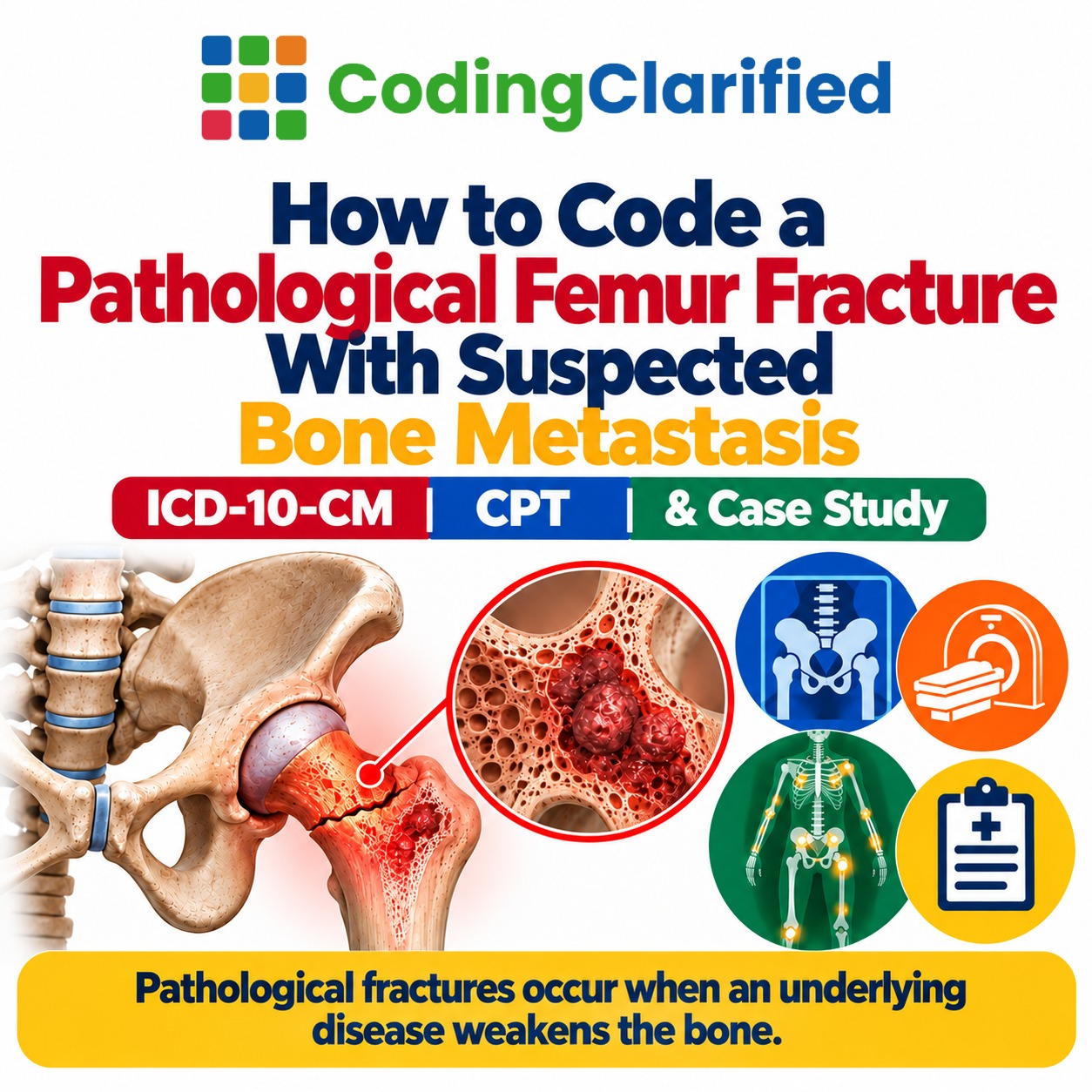
- A pathological fracture occurs when an underlying disease weakens a bone, allowing it to fracture with little or no trauma.
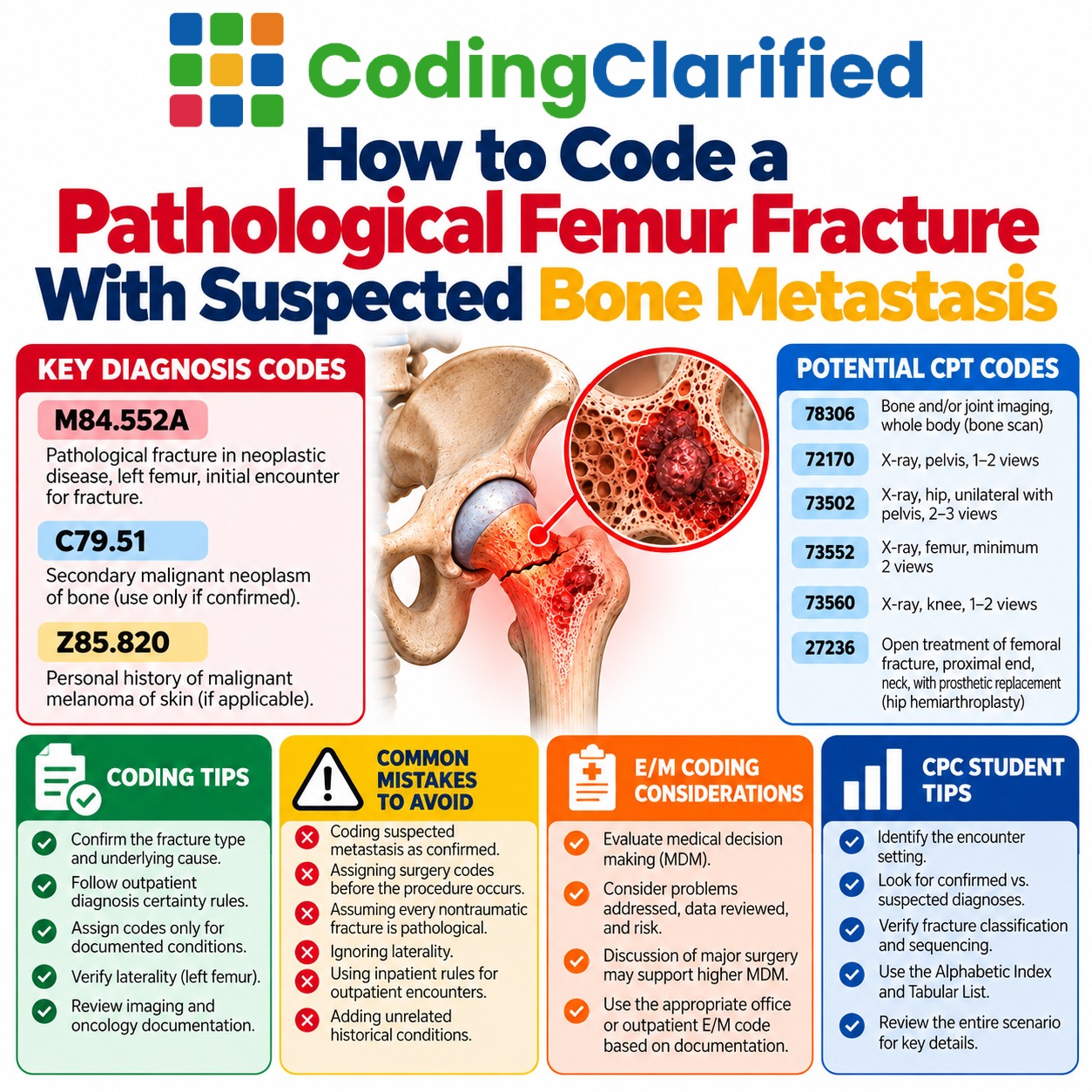
- M84.552A represents a pathological fracture in neoplastic disease, left femur, initial encounter for fracture, when documentation confirms the condition.
- C79.51 identifies secondary malignant neoplasm of bone, but outpatient coders cannot assign it based solely on suspected metastasis.
- A history of malignant melanoma does not automatically establish active melanoma or metastatic cancer.
- Planned diagnostic imaging and hip hemiarthroplasty do not support procedure billing until the services occur.
- For services beginning October 1, 2026, coders must use the FY 2027 ICD-10-CM guidelines and applicable code set.
Why Pathological Femur Fracture Coding Can Be Complicated
Pathological femur fractures present unique challenges for medical coders, especially when a patient has a history of cancer. Unlike traumatic fractures, pathological fractures occur when an underlying disease weakens the bone.
In addition, the documentation may describe suspected cancer, planned imaging, and possible surgery without confirming the final diagnosis. Therefore, coders must carefully distinguish established conditions from diagnoses that require further investigation.
This case study examines a 53-year-old female with a probable pathological fracture of the left proximal femur and a history of malignant melanoma.
We will review potential ICD-10-CM codes, CPT procedures, diagnosis sequencing, documentation requirements, and common mistakes. Additionally, we will explain how CPC students can approach similar orthopedic coding scenarios.
Medical Coding Case Study: Suspected Pathological Fracture of the Left Proximal Femur
Original Clinical Scenario
LABS: Have been reviewed.
ASSESSMENT:
The patient is a 53-year-old female with probable pathological fracture of the left proximal femur.
DISCUSSION AND PLAN:
Nature and course of the diagnosis has been discussed with the patient. Based on her presentation without any history of obvious fall or trauma and past history of malignant melanoma, this appears to be a pathological fracture of the left proximal hip.
At the present time, I would recommend obtaining a bone scan and repeat x-rays, which will include AP pelvis, femur, hip including knee.
She denies any pain elsewhere. She does have a past history of back pain and sciatica, but at the present time, this appears to be a metastatic bone lesion with pathological fracture.
I have discussed the case with Dr. X and recommended oncology consultation.
With the above fracture and presentation, she needs a left hip hemiarthroplasty versus calcar hemiarthroplasty, cemented type.
Indication, risk, and benefits of left hip hemiarthroplasty has been discussed with the patient, which includes, but not limited to bleeding, infection, nerve injury, blood vessel injury, dislocation early and late, persistent pain, leg length discrepancy, myositis ossificans, intraoperative fracture, prosthetic fracture, need for conversion to total hip replacement surgery, revision surgery, DVT, pulmonary embolism, risk of anesthesia, need for blood transfusion, and cardiac arrest.
She understands above and is willing to undergo further procedure. The goal and the functional outcome have been explained.
Further plan will be discussed with her once we obtain the bone scan and the radiographic studies. We will also await for the oncology feedback and clearance.
Thank you very much for allowing me to participate in the care of this patient. I will continue to follow up.
Important Documentation Findings
Several details affect coding accuracy:
- The physician describes the fracture as probable.
- The patient reports no obvious fall or trauma.
- Her medical history includes malignant melanoma.
- The physician suspects metastatic bone disease.
- Additional imaging and oncology consultation remain pending.
- The physician recommends possible left hip hemiarthroplasty.
Although the clinical findings raise concern for a cancer-related fracture, the documentation does not establish every diagnosis needed for definitive outpatient coding.
Step 1: Identify the Type of Femur Fracture
A pathological fracture occurs when an underlying condition weakens the bone. Common causes include osteoporosis, malignancy, metabolic bone disease, and other disorders affecting bone strength.
In this case, the physician suspects that metastatic cancer caused the left femur fracture. However, the outpatient documentation describes the fracture as probable and does not confirm its underlying cause.
ICD-10-CM Code for Pathological Fracture in Neoplastic Disease
M84.552A — Pathological fracture in neoplastic disease, left femur, initial encounter for fracture.
This code applies when the provider confirms a pathological fracture caused by neoplastic disease and the patient receives active fracture treatment.
The seventh character A identifies active treatment. Consequently, it does not necessarily mean the patient’s first appointment.
Coding Tip: Do not assign M84.552A simply because the patient has a cancer history and no reported trauma. The provider must establish the neoplastic cause under the applicable diagnosis certainty rules.
Step 2: Determine Whether Bone Metastasis Is Confirmed
The physician suspects that malignant melanoma has spread to the patient’s bone. Nevertheless, suspected metastasis is not equivalent to confirmed metastatic disease.
ICD-10-CM Code for Secondary Malignant Neoplasm of Bone
C79.51 — Secondary malignant neoplasm of bone.
Coders use this diagnosis when the documentation supports metastatic cancer involving bone.
For example, the treating provider may establish the diagnosis after reviewing imaging, pathology, oncology findings, and other clinical evidence.
However, this scenario describes a suspected metastatic lesion and recommends additional testing. Therefore, an outpatient coder should not assign C79.51 based solely on the current assessment.
How Does the History of Malignant Melanoma Affect Coding?
Z85.820 — Personal history of malignant melanoma of skin.
This code may apply when the record confirms a previous cutaneous melanoma that has been eradicated, with no current disease at that site and no further treatment directed there.
However, the physician only documents a past history of malignant melanoma. Consequently, the coder should verify the original cancer site, current disease status, and treatment history.
A previous cancer diagnosis does not automatically justify an active malignancy code.
Step 3: Apply the 2026 Outpatient Coding Guidelines
One of the most important lessons in this scenario involves uncertain diagnoses.
Under the ICD-10-CM outpatient coding guidelines, coders cannot report diagnoses described as probable, suspected, questionable, or similar terms as confirmed conditions.
Instead, they report the highest degree of certainty supported by the encounter, such as established diagnoses, signs, symptoms, or abnormal findings.
For this patient, the physician suspects both a pathological fracture and metastatic bone disease. Therefore, the coder must review the complete record for confirmed findings before selecting the first-listed diagnosis.
If subsequent imaging confirms a fracture but does not establish its cause, the coder should use the documented fracture classification and seek clarification when needed.
For additional examples of diagnosis certainty, sequencing, and outpatient procedures, read our Outpatient Medical Coding Guidelines 2026: ICD-10-CM, CPT, E/M & Billing Tips.
How Do Inpatient Coding Rules Differ?
Inpatient hospital discharge coding allows certain uncertain diagnoses documented at discharge to be coded as though established. However, this rule does not apply to ordinary outpatient consultations.
Additionally, an inpatient diagnosis must meet the applicable reporting requirements, and the coder must review the final discharge documentation.
If this patient enters the hospital for surgical treatment, the inpatient facility coding process may differ from the original orthopedic consultation.
Our Inpatient Medical Coding Guidelines 2026: ICD-10-CM, ICD-10-PCS, DRGs & Principal Diagnosis explain these differences, including principal diagnosis selection and inpatient procedure coding.
For official guidance, consult the CMS ICD-10-CM Coding Resources.
Step 4: Understand Diagnosis Sequencing for Neoplasm-Related Fractures
When documentation confirms a pathological fracture caused by neoplastic disease, sequencing depends on the primary focus of treatment.
If the encounter focuses on treating the fracture, the pathological fracture code generally comes first, followed by the appropriate neoplasm code.
Conversely, when treatment focuses primarily on the neoplasm, the neoplasm code generally takes priority.
| Treatment Focus | General Coding Sequence |
|---|---|
| Treatment of confirmed neoplasm-related fracture | M84.552A, followed by the appropriate neoplasm code |
| Treatment directed primarily at confirmed bone metastasis | C79.51, followed by the appropriate fracture code |
| Outpatient evaluation of suspected metastatic fracture | Report confirmed conditions or findings; clarify uncertain diagnoses |
These examples assume the provider establishes the relevant diagnoses. Furthermore, coders must follow all applicable Tabular List instructions.
Important: The current outpatient note does not support automatically assigning both M84.552A and C79.51.
Step 5: Review Imaging and Diagnostic Procedure Coding
The physician recommends a bone scan and several radiographic studies to evaluate the fracture and possible metastatic disease.
These tests may help identify the fracture location, evaluate skeletal involvement, and guide treatment decisions.
Potential CPT Codes for Imaging
| CPT Code | Description |
|---|---|
| 78306 | Bone and/or joint imaging, whole body |
| 72170 | Radiologic examination, pelvis, 1 or 2 views |
| 73502 | Radiologic examination, hip, unilateral, with pelvis when performed, 2–3 views |
| 73552 | Radiologic examination, femur, minimum 2 views |
| 73560 | Radiologic examination, knee, 1 or 2 views |
These codes represent possible imaging services rather than confirmed procedures.
For example, the actual bone scan protocol determines the appropriate nuclear medicine code. Similarly, the radiology report must support the anatomical area and number of views.
Additionally, coders must evaluate overlapping imaging, bundling rules, and payer policies.
CPC Student Tip: A physician’s recommendation for imaging does not establish that the service occurred. Always verify completed procedures before assigning CPT codes.
For official CPT information, visit the American Medical Association CPT Resources.
Step 6: Understand Hip Hemiarthroplasty CPT Coding
A hip hemiarthroplasty replaces the femoral head while preserving the natural acetabulum, or hip socket.
Surgeons may perform this procedure for selected femoral neck fractures, including certain pathological fractures.
In this scenario, the physician discusses a cemented left hip hemiarthroplasty versus a calcar-replacing option. However, the final procedure remains undecided.
Potential CPT Code for Hip Hemiarthroplasty
27236 — Open treatment of femoral fracture, proximal end, neck, internal fixation or prosthetic replacement.
This code may apply when the surgeon performs qualifying open treatment of a femoral neck fracture with prosthetic replacement.
However, the documentation must identify the exact fracture anatomy and completed surgical technique.
For example, fractures involving other regions of the proximal femur may require different procedure codes. Likewise, complex oncologic reconstruction may require additional coding review.
Important: The physician only discusses surgery in this scenario. Therefore, coders cannot report 27236 as a completed service.
If the patient undergoes surgery during an inpatient hospital admission, the facility generally uses ICD-10-PCS, while the surgeon reports the professional procedure using CPT.
Step 7: Evaluate the Orthopedic Consultation and E/M Coding
The physician reviews laboratory results, evaluates a serious orthopedic problem, recommends imaging, communicates with another physician, and discusses major surgery.
These activities may support substantial medical decision making. However, coders must evaluate the documentation against the applicable E/M requirements.
For office and outpatient E/M services, medical decision making considers three elements:
- Number and complexity of problems addressed.
- Amount and complexity of data reviewed or analyzed.
- Risk of complications, morbidity, or mortality associated with patient management.
For example, the documented decision regarding major surgery may affect the risk element. Additionally, qualifying discussions with another physician may contribute to the data element.
Nevertheless, the coder must establish the encounter setting, patient status, and supporting documentation before selecting a specific E/M code.
For a detailed explanation of MDM, time-based coding, and E/M levels, read our Evaluation and Management Coding Explained Simply: 2026 Guide to MDM, Time & E/M Levels.
Step 8: Know When to Query the Provider
Provider clarification plays an important role when documentation contains uncertain or incomplete diagnoses.
In this case, the coder may need clarification regarding the fracture classification, underlying cause, and melanoma status.
Important questions include:
- Has imaging confirmed a fracture of the left proximal femur?
- Is the fracture traumatic, pathological, or another documented type?
- Has the provider established a relationship between the fracture and neoplastic disease?
- Is bone metastasis confirmed or still under investigation?
- Does the patient have active melanoma or a personal history of the disease?
- What is the precise anatomical location of the fracture?
Additionally, the coder should review oncology findings, radiology results, and any subsequent operative report.
Accurate medical record abstraction helps coders identify the information needed for compliant code selection.
Our Medical Record Abstraction in 2026: How to Abstract EHR Documentation for Accurate Medical Coding provides practical strategies for reviewing clinical notes, identifying reportable diagnoses, and reducing documentation-related coding errors.
Common Mistakes to Avoid
1. Coding Suspected Metastasis as Confirmed
The physician suspects metastatic bone disease. However, outpatient coders cannot automatically report C79.51 without sufficient diagnostic confirmation.
2. Assuming Every Nontraumatic Fracture Is Pathological
The absence of a fall does not independently establish a pathological fracture. Instead, the provider must document the diagnosis appropriately.
3. Assigning Surgery Codes Before Surgery Occurs
The physician recommends hemiarthroplasty, but the record does not document a completed operation. Therefore, assigning 27236 would be premature.
4. Ignoring Laterality
The patient has a suspected left femur fracture. Consequently, coders must preserve laterality when selecting the appropriate diagnosis.
5. Treating Historical Melanoma as Active Cancer
A history of melanoma does not automatically support an active malignancy diagnosis. Coders should verify the disease status before assigning a code.
6. Confusing Initial Encounter With First Visit
The seventh character A generally represents active fracture treatment. It does not simply identify the first time the patient sees a physician.
7. Coding Unrelated Historical Conditions
The patient reports previous back pain and sciatica. However, these conditions should not automatically appear on the claim unless they meet the applicable reporting requirements.
8. Applying Inpatient Rules to Outpatient Encounters
Inpatient and outpatient uncertain-diagnosis rules differ. Therefore, coders must identify the setting before applying diagnosis coding guidelines.
CPC Student Tips: How to Solve This Coding Scenario
Complex orthopedic cases frequently test several coding concepts simultaneously. Therefore, CPC students should follow a consistent approach.
First, identify the encounter setting. Determine whether the question describes outpatient evaluation, inpatient care, or completed surgery.
Next, identify confirmed diagnoses. Pay attention to terms such as probable, suspected, and appears.
Then, evaluate the fracture classification. Determine whether the provider confirms a traumatic fracture, pathological fracture, or another condition.
Afterward, review the cancer documentation. Distinguish active malignancy, secondary malignancy, and personal history.
Finally, verify the code in the Tabular List. Check laterality, encounter characters, sequencing instructions, and applicable guidelines.
For additional CPC preparation, explore our How to Approach a Long Medical Coding Exam Scenario in 2026: CPC Exam Strategy, Time Management & Case Study Tips.
This guide explains how to recognize important documentation, eliminate incorrect answers, and manage time during lengthy exam questions.
Final Coding Analysis: What Codes Apply to This Scenario?
The most important conclusion is that the outpatient documentation does not yet establish a confirmed neoplasm-related pathological fracture.
The physician suspects metastatic disease associated with the patient’s melanoma history. However, further imaging and oncology evaluation remain pending.
Potential Codes After Appropriate Confirmation
| Code | When It May Apply |
|---|---|
| M84.552A | Confirmed pathological fracture in neoplastic disease, left femur, during active fracture treatment |
| C79.51 | Confirmed secondary malignant neoplasm of bone |
| Z85.820 | Documented personal history of malignant melanoma of skin meeting history-code requirements |
| 27236 | Completed qualifying open treatment of a proximal femoral neck fracture with prosthetic replacement |
These are educational code possibilities, not a finalized claim.
The current scenario lacks enough confirmed documentation to determine a complete, defensible outpatient diagnosis code set.
Additionally, coders should verify the current code set and applicable payer policies before submitting claims.
Frequently Asked Questions About Pathological Femur Fracture Coding
1. What is the ICD-10-CM code for a pathological fracture of the left femur due to cancer?
M84.552A identifies a pathological fracture in neoplastic disease, left femur, initial encounter for fracture. However, the documentation must establish the neoplastic cause and support the appropriate treatment-phase character.
2. Can coders report suspected bone metastasis in outpatient coding?
No. Outpatient coders cannot report suspected metastatic disease as a confirmed diagnosis. Instead, they must code established conditions, signs, symptoms, or findings supported by the documentation.
3. What ICD-10-CM code represents secondary malignant neoplasm of bone?
C79.51 represents secondary malignant neoplasm of bone. Coders use this code when the record establishes metastatic bone cancer under the applicable coding rules.
4. Which diagnosis should be sequenced first for a cancer-related pathological fracture?
When the encounter focuses on fracture treatment, the appropriate M84.5- code generally takes priority. Conversely, when treatment primarily targets the neoplasm, the neoplasm code generally comes first.
5. What CPT code is used for hip hemiarthroplasty?
27236 may apply to qualifying open treatment of a proximal femoral neck fracture with prosthetic replacement. However, the completed operative report must support the selected procedure code.
6. Does a history of melanoma automatically establish metastatic bone cancer?
No. A history of melanoma raises clinical concern but does not confirm metastasis. Therefore, coders need appropriate provider documentation before assigning a secondary malignancy code.
7. Can coders bill for imaging or surgery that the physician only recommends?
No. Recommended services do not establish completed procedures. Consequently, coders must verify that imaging or surgery occurred before assigning the related CPT codes.
8. Why is this case important for CPC exam preparation?
This scenario tests diagnosis certainty, fracture classification, cancer coding, laterality, sequencing, and procedure selection. Additionally, it reinforces the importance of reading the entire medical record rather than coding from isolated terms.
Conclusion
Pathological femur fracture coding requires careful evaluation of the fracture type, underlying disease, treatment focus, and encounter setting.
In this case, the physician suspects metastatic bone disease in a patient with a history of malignant melanoma. However, the current documentation does not establish every diagnosis needed for definitive outpatient coding.
Accurate coding requires more than recognizing a likely condition. Instead, coders must verify the documentation, follow official guidelines, and assign only supported diagnoses and procedures.
By applying these principles, CPC students and working medical coders can improve coding accuracy, reduce claim errors, and strengthen their understanding of complex orthopedic and oncology cases.
Authoritative Medical Coding References
- CMS — ICD-10-CM and ICD-10-PCS Code Sets and Official Guidelines
- American Medical Association — CPT Coding Resources
- AAPC — Medical Coding Education and Resources
2026 Coding Update: For encounters beginning October 1, 2026, use the FY 2027 ICD-10-CM code set, effective through September 30, 2027. Always verify codes and guidelines for the date of service.
Educational Disclaimer: This article provides medical coding education. Final code assignment requires complete clinical documentation, current official coding guidelines, and applicable payer requirements.
With Suspected Bone Metastasis in 2026: ICD-10-CM, CPT & Case Study
Author: Janine Mothershed CPC, CPC-I
SEO Title: Pathological Femur Fracture Coding in 2026: ICD-10-CM, CPT & Bone Metastasis Case Study
Meta Description: Learn how to code a suspected pathological femur fracture with possible bone metastasis in 2026. Includes ICD-10-CM, CPT, sequencing, and CPC exam tips.
Suggested URL Slug: pathological-femur-fracture-coding-2026
Key Takeaways
- A pathological fracture occurs when an underlying disease weakens a bone, allowing it to fracture with little or no trauma.
- M84.552A represents a pathological fracture in neoplastic disease, left femur, initial encounter for fracture, when documentation confirms the condition.
- C79.51 identifies secondary malignant neoplasm of bone, but outpatient coders cannot assign it based solely on suspected metastasis.
- A history of malignant melanoma does not automatically establish active melanoma or metastatic cancer.
- Planned diagnostic imaging and hip hemiarthroplasty do not support procedure billing until the services occur.
- For services beginning October 1, 2026, coders must use the FY 2027 ICD-10-CM guidelines and applicable code set.
Introduction: Why Pathological Femur Fracture Coding Can Be Complicated
Pathological femur fractures present unique challenges for medical coders, especially when a patient has a history of cancer. Unlike traumatic fractures, pathological fractures occur when an underlying disease weakens the bone.
In addition, the documentation may describe suspected cancer, planned imaging, and possible surgery without confirming the final diagnosis. Therefore, coders must carefully distinguish established conditions from diagnoses that require further investigation.
This case study examines a 53-year-old female with a probable pathological fracture of the left proximal femur and a history of malignant melanoma.
We will review potential ICD-10-CM codes, CPT procedures, diagnosis sequencing, documentation requirements, and common mistakes. Additionally, we will explain how CPC students can approach similar orthopedic coding scenarios.
Medical Coding Case Study: Suspected Pathological Fracture of the Left Proximal Femur
Original Clinical Scenario
LABS: Have been reviewed.
ASSESSMENT:
The patient is a 53-year-old female with probable pathological fracture of the left proximal femur.
DISCUSSION AND PLAN:
Nature and course of the diagnosis has been discussed with the patient. Based on her presentation without any history of obvious fall or trauma and past history of malignant melanoma, this appears to be a pathological fracture of the left proximal hip.
At the present time, I would recommend obtaining a bone scan and repeat x-rays, which will include AP pelvis, femur, hip including knee.
She denies any pain elsewhere. She does have a past history of back pain and sciatica, but at the present time, this appears to be a metastatic bone lesion with pathological fracture.
I have discussed the case with Dr. X and recommended oncology consultation.
With the above fracture and presentation, she needs a left hip hemiarthroplasty versus calcar hemiarthroplasty, cemented type.
Indication, risk, and benefits of left hip hemiarthroplasty has been discussed with the patient, which includes, but not limited to bleeding, infection, nerve injury, blood vessel injury, dislocation early and late, persistent pain, leg length discrepancy, myositis ossificans, intraoperative fracture, prosthetic fracture, need for conversion to total hip replacement surgery, revision surgery, DVT, pulmonary embolism, risk of anesthesia, need for blood transfusion, and cardiac arrest.
She understands above and is willing to undergo further procedure. The goal and the functional outcome have been explained.
Further plan will be discussed with her once we obtain the bone scan and the radiographic studies. We will also await for the oncology feedback and clearance.
Thank you very much for allowing me to participate in the care of this patient. I will continue to follow up.
Important Documentation Findings
Several details affect coding accuracy:
- The physician describes the fracture as probable.
- The patient reports no obvious fall or trauma.
- Her medical history includes malignant melanoma.
- The physician suspects metastatic bone disease.
- Additional imaging and oncology consultation remain pending.
- The physician recommends possible left hip hemiarthroplasty.
Although the clinical findings raise concern for a cancer-related fracture, the documentation does not establish every diagnosis needed for definitive outpatient coding.
Step 1: Identify the Type of Femur Fracture
A pathological fracture occurs when an underlying condition weakens the bone. Common causes include osteoporosis, malignancy, metabolic bone disease, and other disorders affecting bone strength.
In this case, the physician suspects that metastatic cancer caused the left femur fracture. However, the outpatient documentation describes the fracture as probable and does not confirm its underlying cause.
ICD-10-CM Code for Pathological Fracture in Neoplastic Disease
M84.552A — Pathological fracture in neoplastic disease, left femur, initial encounter for fracture.
This code applies when the provider confirms a pathological fracture caused by neoplastic disease and the patient receives active fracture treatment.
The seventh character A identifies active treatment. Consequently, it does not necessarily mean the patient’s first appointment.
Coding Tip: Do not assign M84.552A simply because the patient has a cancer history and no reported trauma. The provider must establish the neoplastic cause under the applicable diagnosis certainty rules.
Step 2: Determine Whether Bone Metastasis Is Confirmed
The physician suspects that malignant melanoma has spread to the patient’s bone. Nevertheless, suspected metastasis is not equivalent to confirmed metastatic disease.
ICD-10-CM Code for Secondary Malignant Neoplasm of Bone
C79.51 — Secondary malignant neoplasm of bone.
Coders use this diagnosis when the documentation supports metastatic cancer involving bone.
For example, the treating provider may establish the diagnosis after reviewing imaging, pathology, oncology findings, and other clinical evidence.
However, this scenario describes a suspected metastatic lesion and recommends additional testing. Therefore, an outpatient coder should not assign C79.51 based solely on the current assessment.
How Does the History of Malignant Melanoma Affect Coding?
Z85.820 — Personal history of malignant melanoma of skin.
This code may apply when the record confirms a previous cutaneous melanoma that has been eradicated, with no current disease at that site and no further treatment directed there.
However, the physician only documents a past history of malignant melanoma. Consequently, the coder should verify the original cancer site, current disease status, and treatment history.
A previous cancer diagnosis does not automatically justify an active malignancy code.
Step 3: Apply the 2026 Outpatient Coding Guidelines
One of the most important lessons in this scenario involves uncertain diagnoses.
Under the ICD-10-CM outpatient coding guidelines, coders cannot report diagnoses described as probable, suspected, questionable, or similar terms as confirmed conditions.
Instead, they report the highest degree of certainty supported by the encounter, such as established diagnoses, signs, symptoms, or abnormal findings.
For this patient, the physician suspects both a pathological fracture and metastatic bone disease. Therefore, the coder must review the complete record for confirmed findings before selecting the first-listed diagnosis.
If subsequent imaging confirms a fracture but does not establish its cause, the coder should use the documented fracture classification and seek clarification when needed.
For additional examples of diagnosis certainty, sequencing, and outpatient procedures, read our Outpatient Medical Coding Guidelines 2026: ICD-10-CM, CPT, E/M & Billing Tips.
How Do Inpatient Coding Rules Differ?
Inpatient hospital discharge coding allows certain uncertain diagnoses documented at discharge to be coded as though established. However, this rule does not apply to ordinary outpatient consultations.
Additionally, an inpatient diagnosis must meet the applicable reporting requirements, and the coder must review the final discharge documentation.
If this patient enters the hospital for surgical treatment, the inpatient facility coding process may differ from the original orthopedic consultation.
Our Inpatient Medical Coding Guidelines 2026: ICD-10-CM, ICD-10-PCS, DRGs & Principal Diagnosis explain these differences, including principal diagnosis selection and inpatient procedure coding.
For official guidance, consult the CMS ICD-10-CM Coding Resources.
Step 4: Understand Diagnosis Sequencing for Neoplasm-Related Fractures
When documentation confirms a pathological fracture caused by neoplastic disease, sequencing depends on the primary focus of treatment.
If the encounter focuses on treating the fracture, the pathological fracture code generally comes first, followed by the appropriate neoplasm code.
Conversely, when treatment focuses primarily on the neoplasm, the neoplasm code generally takes priority.
| Treatment Focus | General Coding Sequence |
|---|---|
| Treatment of confirmed neoplasm-related fracture | M84.552A, followed by the appropriate neoplasm code |
| Treatment directed primarily at confirmed bone metastasis | C79.51, followed by the appropriate fracture code |
| Outpatient evaluation of suspected metastatic fracture | Report confirmed conditions or findings; clarify uncertain diagnoses |
These examples assume the provider establishes the relevant diagnoses. Furthermore, coders must follow all applicable Tabular List instructions.
Important: The current outpatient note does not support automatically assigning both M84.552A and C79.51.
Step 5: Review Imaging and Diagnostic Procedure Coding
The physician recommends a bone scan and several radiographic studies to evaluate the fracture and possible metastatic disease.
These tests may help identify the fracture location, evaluate skeletal involvement, and guide treatment decisions.
Potential CPT Codes for Imaging
| CPT Code | Description |
|---|---|
| 78306 | Bone and/or joint imaging, whole body |
| 72170 | Radiologic examination, pelvis, 1 or 2 views |
| 73502 | Radiologic examination, hip, unilateral, with pelvis when performed, 2–3 views |
| 73552 | Radiologic examination, femur, minimum 2 views |
| 73560 | Radiologic examination, knee, 1 or 2 views |
These codes represent possible imaging services rather than confirmed procedures.
For example, the actual bone scan protocol determines the appropriate nuclear medicine code. Similarly, the radiology report must support the anatomical area and number of views.
Additionally, coders must evaluate overlapping imaging, bundling rules, and payer policies.
CPC Student Tip: A physician’s recommendation for imaging does not establish that the service occurred. Always verify completed procedures before assigning CPT codes.
For official CPT information, visit the American Medical Association CPT Resources.
Step 6: Understand Hip Hemiarthroplasty CPT Coding
A hip hemiarthroplasty replaces the femoral head while preserving the natural acetabulum, or hip socket.
Surgeons may perform this procedure for selected femoral neck fractures, including certain pathological fractures.
In this scenario, the physician discusses a cemented left hip hemiarthroplasty versus a calcar-replacing option. However, the final procedure remains undecided.
Potential CPT Code for Hip Hemiarthroplasty
27236 — Open treatment of femoral fracture, proximal end, neck, internal fixation or prosthetic replacement.
This code may apply when the surgeon performs qualifying open treatment of a femoral neck fracture with prosthetic replacement.
However, the documentation must identify the exact fracture anatomy and completed surgical technique.
For example, fractures involving other regions of the proximal femur may require different procedure codes. Likewise, complex oncologic reconstruction may require additional coding review.
Important: The physician only discusses surgery in this scenario. Therefore, coders cannot report 27236 as a completed service.
If the patient undergoes surgery during an inpatient hospital admission, the facility generally uses ICD-10-PCS, while the surgeon reports the professional procedure using CPT.
Step 7: Evaluate the Orthopedic Consultation and E/M Coding
The physician reviews laboratory results, evaluates a serious orthopedic problem, recommends imaging, communicates with another physician, and discusses major surgery.
These activities may support substantial medical decision making. However, coders must evaluate the documentation against the applicable E/M requirements.
For office and outpatient E/M services, medical decision making considers three elements:
- Number and complexity of problems addressed.
- Amount and complexity of data reviewed or analyzed.
- Risk of complications, morbidity, or mortality associated with patient management.
For example, the documented decision regarding major surgery may affect the risk element. Additionally, qualifying discussions with another physician may contribute to the data element.
Nevertheless, the coder must establish the encounter setting, patient status, and supporting documentation before selecting a specific E/M code.
For a detailed explanation of MDM, time-based coding, and E/M levels, read our Evaluation and Management Coding Explained Simply: 2026 Guide to MDM, Time & E/M Levels.
Step 8: Know When to Query the Provider
Provider clarification plays an important role when documentation contains uncertain or incomplete diagnoses.
In this case, the coder may need clarification regarding the fracture classification, underlying cause, and melanoma status.
Important questions include:
- Has imaging confirmed a fracture of the left proximal femur?
- Is the fracture traumatic, pathological, or another documented type?
- Has the provider established a relationship between the fracture and neoplastic disease?
- Is bone metastasis confirmed or still under investigation?
- Does the patient have active melanoma or a personal history of the disease?
- What is the precise anatomical location of the fracture?
Additionally, the coder should review oncology findings, radiology results, and any subsequent operative report.
Accurate medical record abstraction helps coders identify the information needed for compliant code selection.
Our Medical Record Abstraction in 2026: How to Abstract EHR Documentation for Accurate Medical Coding provides practical strategies for reviewing clinical notes, identifying reportable diagnoses, and reducing documentation-related coding errors.
Common Mistakes to Avoid
1. Coding Suspected Metastasis as Confirmed
The physician suspects metastatic bone disease. However, outpatient coders cannot automatically report C79.51 without sufficient diagnostic confirmation.
2. Assuming Every Nontraumatic Fracture Is Pathological
The absence of a fall does not independently establish a pathological fracture. Instead, the provider must document the diagnosis appropriately.
3. Assigning Surgery Codes Before Surgery Occurs
The physician recommends hemiarthroplasty, but the record does not document a completed operation. Therefore, assigning 27236 would be premature.
4. Ignoring Laterality
The patient has a suspected left femur fracture. Consequently, coders must preserve laterality when selecting the appropriate diagnosis.
5. Treating Historical Melanoma as Active Cancer
A history of melanoma does not automatically support an active malignancy diagnosis. Coders should verify the disease status before assigning a code.
6. Confusing Initial Encounter With First Visit
The seventh character A generally represents active fracture treatment. It does not simply identify the first time the patient sees a physician.
7. Coding Unrelated Historical Conditions
The patient reports previous back pain and sciatica. However, these conditions should not automatically appear on the claim unless they meet the applicable reporting requirements.
8. Applying Inpatient Rules to Outpatient Encounters
Inpatient and outpatient uncertain-diagnosis rules differ. Therefore, coders must identify the setting before applying diagnosis coding guidelines.
CPC Student Tips: How to Solve This Coding Scenario
Complex orthopedic cases frequently test several coding concepts simultaneously. Therefore, CPC students should follow a consistent approach.
First, identify the encounter setting. Determine whether the question describes outpatient evaluation, inpatient care, or completed surgery.
Next, identify confirmed diagnoses. Pay attention to terms such as probable, suspected, and appears.
Then, evaluate the fracture classification. Determine whether the provider confirms a traumatic fracture, pathological fracture, or another condition.
Afterward, review the cancer documentation. Distinguish active malignancy, secondary malignancy, and personal history.
Finally, verify the code in the Tabular List. Check laterality, encounter characters, sequencing instructions, and applicable guidelines.
For additional CPC preparation, explore our How to Approach a Long Medical Coding Exam Scenario in 2026: CPC Exam Strategy, Time Management & Case Study Tips.
This guide explains how to recognize important documentation, eliminate incorrect answers, and manage time during lengthy exam questions.
Final Coding Analysis: What Codes Apply to This Scenario?
The most important conclusion is that the outpatient documentation does not yet establish a confirmed neoplasm-related pathological fracture.
The physician suspects metastatic disease associated with the patient’s melanoma history. However, further imaging and oncology evaluation remain pending.
Potential Codes After Appropriate Confirmation
| Code | When It May Apply |
|---|---|
| M84.552A | Confirmed pathological fracture in neoplastic disease, left femur, during active fracture treatment |
| C79.51 | Confirmed secondary malignant neoplasm of bone |
| Z85.820 | Documented personal history of malignant melanoma of skin meeting history-code requirements |
| 27236 | Completed qualifying open treatment of a proximal femoral neck fracture with prosthetic replacement |
These are educational code possibilities, not a finalized claim.
The current scenario lacks enough confirmed documentation to determine a complete, defensible outpatient diagnosis code set.
Additionally, coders should verify the current code set and applicable payer policies before submitting claims.
Frequently Asked Questions About Pathological Femur Fracture Coding
1. What is the ICD-10-CM code for a pathological fracture of the left femur due to cancer?
M84.552A identifies a pathological fracture in neoplastic disease, left femur, initial encounter for fracture. However, the documentation must establish the neoplastic cause and support the appropriate treatment-phase character.
2. Can coders report suspected bone metastasis in outpatient coding?
No. Outpatient coders cannot report suspected metastatic disease as a confirmed diagnosis. Instead, they must code established conditions, signs, symptoms, or findings supported by the documentation.
3. What ICD-10-CM code represents secondary malignant neoplasm of bone?
C79.51 represents secondary malignant neoplasm of bone. Coders use this code when the record establishes metastatic bone cancer under the applicable coding rules.
4. Which diagnosis should be sequenced first for a cancer-related pathological fracture?
When the encounter focuses on fracture treatment, the appropriate M84.5- code generally takes priority. Conversely, when treatment primarily targets the neoplasm, the neoplasm code generally comes first.
5. What CPT code is used for hip hemiarthroplasty?
27236 may apply to qualifying open treatment of a proximal femoral neck fracture with prosthetic replacement. However, the completed operative report must support the selected procedure code.
6. Does a history of melanoma automatically establish metastatic bone cancer?
No. A history of melanoma raises clinical concern but does not confirm metastasis. Therefore, coders need appropriate provider documentation before assigning a secondary malignancy code.
7. Can coders bill for imaging or surgery that the physician only recommends?
No. Recommended services do not establish completed procedures. Consequently, coders must verify that imaging or surgery occurred before assigning the related CPT codes.
8. Why is this case important for CPC exam preparation?
This scenario tests diagnosis certainty, fracture classification, cancer coding, laterality, sequencing, and procedure selection. Additionally, it reinforces the importance of reading the entire medical record rather than coding from isolated terms.
Conclusion
Pathological femur fracture coding requires careful evaluation of the fracture type, underlying disease, treatment focus, and encounter setting.
In this case, the physician suspects metastatic bone disease in a patient with a history of malignant melanoma. However, the current documentation does not establish every diagnosis needed for definitive outpatient coding.
Accurate coding requires more than recognizing a likely condition. Instead, coders must verify the documentation, follow official guidelines, and assign only supported diagnoses and procedures.
By applying these principles, CPC students and working medical coders can improve coding accuracy, reduce claim errors, and strengthen their understanding of complex orthopedic and oncology cases.
Authoritative Medical Coding References
- CMS — ICD-10-CM and ICD-10-PCS Code Sets and Official Guidelines
- American Medical Association — CPT Coding Resources
- AAPC — Medical Coding Education and Resources
2026 Coding Update: For encounters beginning October 1, 2026, use the FY 2027 ICD-10-CM code set, effective through September 30, 2027. Always verify codes and guidelines for the date of service.
Educational Disclaimer: This article provides medical coding education. Final code assignment requires complete clinical documentation, current official coding guidelines, and applicable payer requirements.