
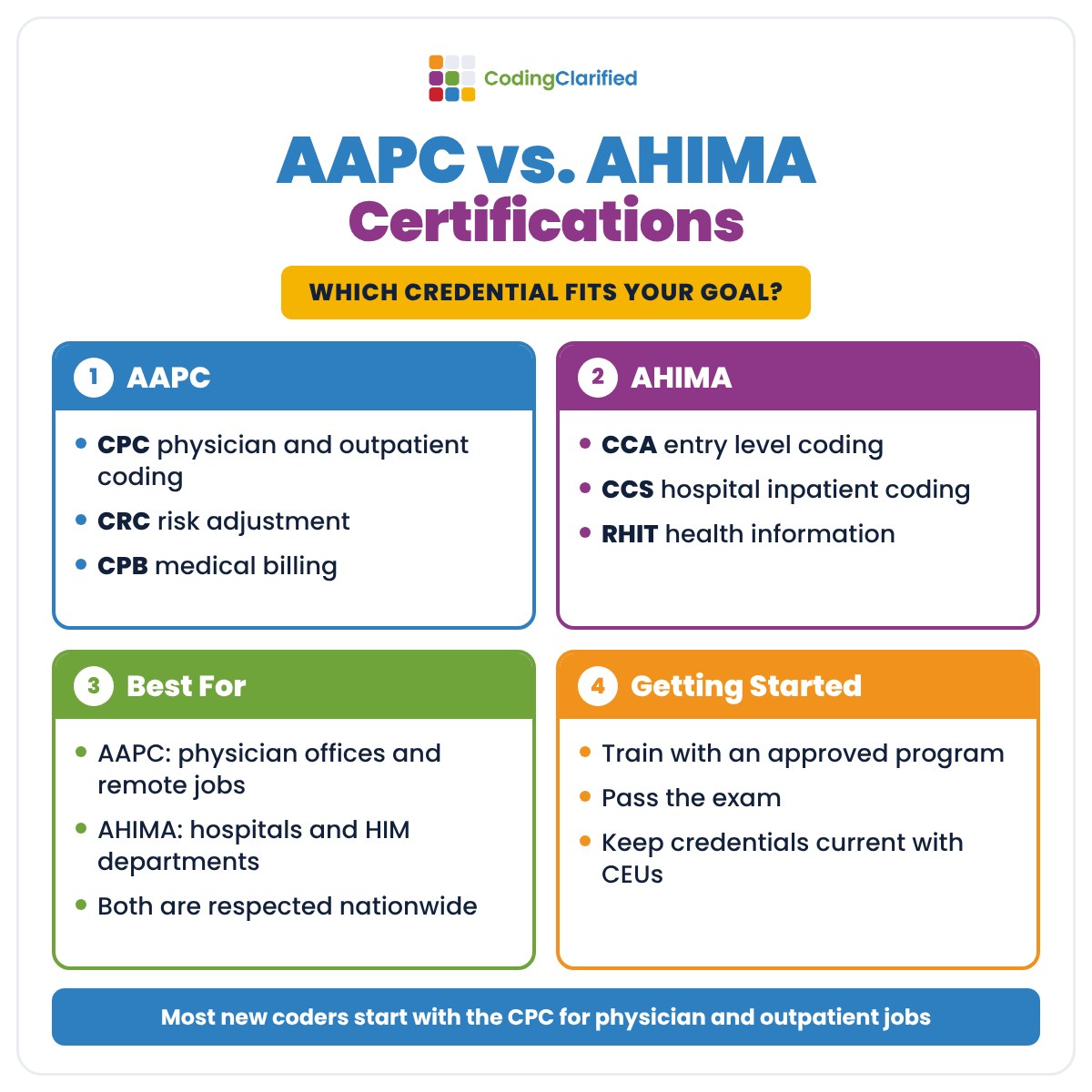

Quick Answer: The most requested medical coding certification for new coders is the Certified Professional Coder (CPC) from AAPC. It covers physician and outpatient coding, which is where most coding jobs are. AHIMA offers the Certified Coding Associate (CCA) as an entry level credential and the Certified Coding Specialist (CCS) for experienced hospital coders. For most people starting out, the CPC is the right first certification.
New to medical coding? See how our CPC Training gets you certified.
Janine Mothershed CPC, CPC-I
A medical coding certification proves to employers that you can read medical documentation and assign accurate diagnosis and procedure codes. Most coding employers require one. Two organizations award the certifications employers look for: the American Academy of Professional Coders (AAPC) and the American Health Information Management Association (AHIMA).
This 2027 guide explains the main medical coding certifications, how AAPC and AHIMA compare, which certification to get first, and how to get certified.
Medical Coding Certifications Compared
| Certification | Awarded by | Best for | Exam |
|---|---|---|---|
| CPC (Certified Professional Coder) | AAPC | New coders; physician office and outpatient coding | 100 questions, 4 hours, open code book |
| CCA (Certified Coding Associate) | AHIMA | Entry level coders in hospital or outpatient settings | 105 questions (90 scored), 2 hours |
| CCS (Certified Coding Specialist) | AHIMA | Experienced coders working hospital inpatient records | Advanced exam; coding experience recommended |
| COC, CIC, CPMA and specialty credentials | AAPC | Coders adding a specialty after the CPC | Varies by credential |
Always confirm current exam details with AAPC website or AHIMA website before you schedule.
What Is the AAPC Certification?
The AAPC offers multiple certifications, including the Certified Professional Coder (CPC) credential, which is widely recognized in the industry as the core credential to obtain. To earn the CPC, candidates pass a 100 question exam with a 4 hour time limit. The exam covers medical coding guidelines, anatomy, physiology, medical terminology, and healthcare regulations. Candidates may use their current year CPT, ICD-10-CM, and HCPCS Level II code books during the exam.
AAPC also offers specialty certifications such as Certified Outpatient Coder (COC), Certified Inpatient Coder (CIC), and Certified Professional Medical Auditor (CPMA). AAPC certifications focus primarily on physician and outpatient coding but cover a broad range of coding specialties.
What Is the AHIMA Certification?
AHIMA provides the Certified Coding Associate (CCA) and Certified Coding Specialist (CCS) credentials, among others. The CCA is an entry level credential. Candidates need a high school diploma, and AHIMA recommends coding training or coding experience before testing. The CCS is designed for experienced coders seeking advanced proficiency, especially in hospital inpatient coding. AHIMA also offers the Certified Coding Specialist Physician based (CCS-P) and the Certified Documentation Improvement Practitioner (CDIP). For more detail, see How to Get a CCS Certification.
Both organizations test on the same code sets, depending on the credential: ICD-10-CM for diagnoses, CPT for outpatient procedures, ICD-10-PCS for inpatient hospital procedures, and HCPCS Level II for supplies, drugs, and services.
What Is the Difference Between AHIMA and AAPC Certifications?
The key difference between AAPC and AHIMA certifications is their focus. AAPC certifications concentrate on physician and outpatient coding, including physician office visits, ambulatory surgery centers, and outpatient hospital services. AHIMA certifications cover both outpatient and inpatient coding, which suits coders working in hospitals and long term care facilities.
Both are widely recognized. However, employer preference varies by setting. Physician practices and outpatient employers often ask for the CPC, while hospital inpatient coding jobs often ask for the CCS.
Which Medical Coding Certification Should You Get First?
For most new coders, the CPC is the best first certification. Physician and outpatient coding makes up the largest share of coding jobs, and the CPC is the credential those employers list most often. After you earn the CPC, you can add a specialty credential such as risk adjustment, auditing, or inpatient coding as your career grows.
Choose an AHIMA credential first if you already know you want to work in hospital inpatient coding, or if a specific employer requires it.
How to Get Your Medical Coding Certification
- Complete a medical coding training program. Choose a program that covers anatomy, medical terminology, ICD-10-CM, CPT, and HCPCS Level II, and that prepares you for the exam you plan to take.
- Schedule the CPC exam through AAPC. The exam can be taken in person or online with a proctor.
- Pass the exam. Practice with timed exams and learn to navigate your code books quickly.
- Remove the apprentice designation. New CPC holders earn the CPC-A. Coding experience removes the “A.” Under AAPC’s rules, an 80 hour coding course counts as one year and Practicode counts as the other, so Coding Clarified students can remove the A after the course and Practicode. Our HCC internship then adds real work experience. Learn more in What Is CPC-A Certification.
How Long Does It Take to Get Certified?
Coding Clarified’s CPC program is online and instructor guided, with 4 months of course access. Plan on 12 to 15 study hours per week.
Can You Get Medical Coding Certification Paid For?
Yes, in many cases. Coding Clarified is an approved training provider for WIOA funding in 30+ states, and scholarships and financing are available. See Scholarships and Grants to check your options.
What Are the Benefits of AHIMA or AAPC Certifications for Medical Coders?
AAPC and AHIMA certifications open doors to careers in medical coding, billing, auditing, and healthcare compliance. Advanced certifications let coders specialize in areas such as anesthesia, cardiology, orthopedics, and risk adjustment. Certified coders may also move into leadership roles, such as coding manager or compliance officer, with the potential for higher salaries.
Frequently Asked Questions About Medical Coding Certification
What is the best medical coding certification for beginners?
The Certified Professional Coder (CPC) from AAPC is the most common first certification. It focuses on physician and outpatient coding, where most entry level jobs are.
Is the CPC exam open book?
Yes. You may use your current year CPT, ICD-10-CM, and HCPCS Level II code books during the exam.
How many questions are on the CPC exam?
The CPC exam has 100 multiple choice questions, and you have 4 hours to complete it.
What does CPC-A mean?
CPC-A means you passed the CPC exam but have not yet met AAPC’s experience requirement. The apprentice designation is removed once you document qualifying experience.
Can I get a medical coding certification online?
Yes. You can complete your training online, and the CPC exam can be taken online with a proctor or in person at a testing site.
What is the difference between the CPC and the CCS?
The CPC from AAPC focuses on physician and outpatient coding. The CCS from AHIMA focuses on hospital coding, including inpatient ICD-10-PCS procedure coding, and is aimed at experienced coders.
Ready to get your medical coding certification?
Coding Clarified’s AAPC licensed CPC program takes you from beginner to certified, with an internship and a job board for graduates.
You may qualify for WIOA funding in 30+ states. Check your eligibility.