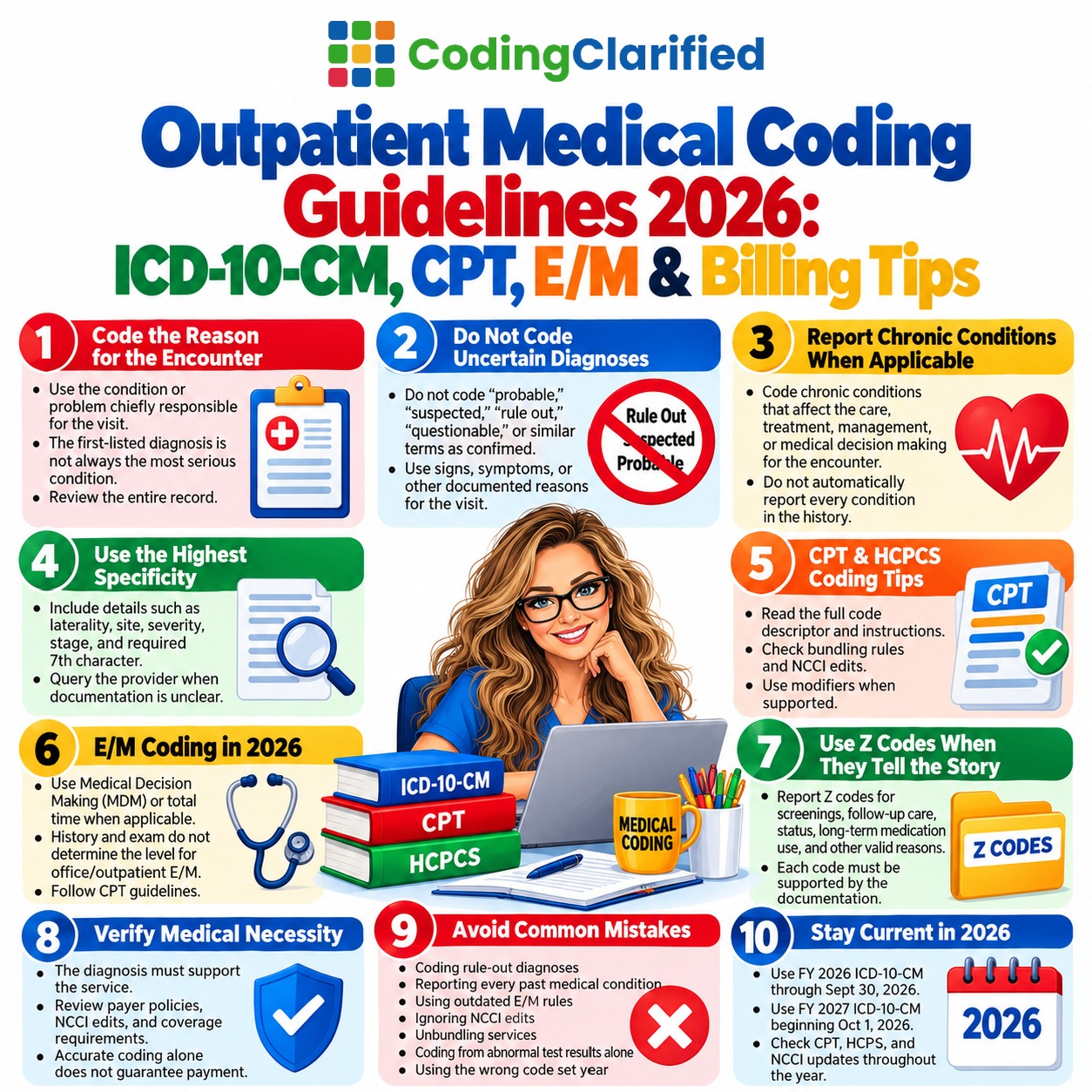
Outpatient Medical Coding Guidelines 2026: ICD-10-CM, CPT, E/M & Billing Tips
Updated for 2026
Outpatient medical coding requires more than simply finding a diagnosis and procedure code. Coders must understand ICD-10-CM outpatient guidelines, CPT rules, HCPCS Level II, Evaluation and Management (E/M) coding, modifiers, National Correct Coding Initiative (NCCI) edits, medical necessity, and payer-specific requirements.
In addition, outpatient coders must know one rule that separates outpatient coding from inpatient coding: uncertain diagnoses are generally not coded as confirmed in the outpatient setting.
Whether you work in a physician office, emergency department, hospital outpatient department, urgent care clinic, ambulatory surgery center, or diagnostic facility, the following 2026 outpatient coding tips can help improve accuracy and reduce claim problems.
Key Takeaways: Outpatient Medical Coding in 2026
- Outpatient coders use ICD-10-CM for diagnoses and generally use CPT and HCPCS Level II for procedures, services, drugs, supplies, and equipment.
- Never code a diagnosis documented as “probable,” “suspected,” “questionable,” “rule out,” “compatible with,” or similar uncertain language as though it were confirmed in the outpatient setting.
- Instead, code the signs, symptoms, abnormal findings, or other documented reason for the encounter when no definitive diagnosis exists.
- Review the entire encounter, not simply the chief complaint or final assessment.
- Report chronic conditions when they affect the care, treatment, management, or medical decision making for the encounter.
- Use the highest level of ICD-10-CM specificity supported by the documentation.
- For most office and other outpatient E/M services, code selection relies on medical decision making (MDM) or total time, when applicable.
- Check CPT instructions, NCCI edits, modifier requirements, medical necessity, and payer policies before finalizing a claim.
- Beginning October 1, 2026, coders must use the FY 2027 ICD-10-CM code set and applicable Official Guidelines for encounters on or after that date.
What Is Outpatient Medical Coding?
Outpatient coding applies to healthcare services provided without a formal inpatient admission. However, the term “outpatient” covers many different settings.
For example, outpatient coders may work with documentation from:
- Physician offices
- Hospital outpatient departments
- Emergency departments
- Urgent care centers
- Ambulatory surgery centers
- Imaging centers
- Laboratories
- Therapy facilities
- Same-day surgery departments
- Observation services
Although these settings share many diagnosis coding principles, billing and procedure coding rules may differ. Therefore, coders must identify the setting, provider, payer, and type of claim before applying the correct rules.
Outpatient coding commonly involves three code sets. ICD-10-CM reports diagnoses and reasons for encounters. CPT reports many physician and other professional services and procedures. Finally, HCPCS Level II reports many supplies, drugs, equipment, ambulance services, and other items or services not represented by CPT.
2026 Outpatient ICD-10-CM Coding Guidelines
Code the Reason for the Encounter First
For outpatient services, select the diagnosis, condition, problem, or other reason chiefly responsible for the services provided as the first-listed diagnosis.
However, the first-listed diagnosis is not always the patient’s most serious lifelong medical condition. Instead, sequencing depends on the reason for that specific encounter and applicable ICD-10-CM instructions.
For example, a patient may have diabetes, hypertension, and COPD but visit an orthopedic clinic for evaluation of acute knee pain. The coder should not automatically sequence diabetes first simply because it is a significant chronic disease.
Therefore, always ask:
Why did the patient receive the service today?
That question often provides the starting point for correct outpatient sequencing.
For additional guidance, review our Medical Coding Sequencing Guide.
Do Not Code “Rule Out” Diagnoses as Confirmed
This is one of the most important outpatient coding rules.
In the outpatient setting, do not code diagnoses documented as:
- Probable
- Suspected
- Questionable
- Rule out
- Compatible with
- Consistent with
- Working diagnosis
- Other similar terms indicating uncertainty
Instead, report the highest degree of certainty known for that encounter. Consequently, that may mean coding symptoms, signs, abnormal test results, or another documented reason for the visit.
Example
A patient presents with chest pain. The provider documents:
“Chest pain, rule out acute myocardial infarction.”
The coder should not assign an acute myocardial infarction diagnosis solely from that statement. Instead, the documented chest pain may be reported, such as R07.9, when supported by the complete record and applicable guidelines.
This rule is especially important for CPC and COC students because exam questions often test the difference between inpatient and outpatient uncertain-diagnosis rules.
Code Signs and Symptoms When Appropriate
Signs and symptoms may be coded when the provider has not established a definitive diagnosis.
For example, nausea, dizziness, abdominal pain, fatigue, or shortness of breath may represent the patient’s reportable diagnosis when the evaluation does not establish the underlying cause.
However, once the provider establishes a definitive diagnosis, signs and symptoms that are routinely associated with that condition generally are not separately reported unless guidelines provide otherwise.
Therefore, avoid automatically coding every symptom mentioned in the chart.
Report Chronic Conditions That Affect the Encounter
Chronic diseases can remain reportable across multiple outpatient encounters when they receive treatment or affect patient management.
Common examples include:
- Diabetes mellitus
- Hypertension
- COPD
- Asthma
- Chronic kidney disease
- Heart failure
However, do not automatically report every condition copied into the patient’s past medical history.
Instead, review whether the condition is current and whether the documentation supports reporting it for that encounter. Active treatment may include medication management, assessment, monitoring, referrals, diagnostic testing, or consideration during medical decision making.
This distinction helps prevent both undercoding and unsupported diagnosis reporting.
Review the Entire Medical Record
One of the biggest outpatient coding mistakes is reading only the assessment and plan.
Important coding information may appear elsewhere in the record. Therefore, depending on the encounter, review:
- Chief complaint
- History of present illness
- Assessment and plan
- Medication list
- Orders
- Laboratory information
- Imaging documentation
- Procedure or operative notes
- Pathology information
- Anesthesia documentation
- Relevant past medical history
- Provider documentation
- Discharge information
In addition, distinguish current conditions from historical diagnoses, copied-forward information, resolved conditions, and incidental findings.
For a deeper explanation of this workflow, read Medical Record Abstraction in 2026: How to Abstract EHR Documentation for Accurate Medical Coding.
Use the Highest Supported ICD-10-CM Specificity
ICD-10-CM coding requires coders to report codes to the highest level of specificity supported by documentation.
Depending on the diagnosis, this may include:
- Laterality
- Anatomical location
- Severity
- Stage
- Episode of care
- Type
- Cause
- Associated manifestation
- Required seventh character
Never stop at a category when a complete billable code is required.
Likewise, do not assume specificity that the provider did not document. Query the appropriate provider when clarification is necessary and permitted under your organization’s policies.
Do Not Code Diagnoses From Up or Down Arrows Alone
Coders may encounter laboratory values or documentation containing arrows indicating that a value is high or low.
However, an abnormal value does not automatically establish a diagnosis.
For example, a high glucose result does not independently allow a coder to diagnose diabetes. Similarly, an abnormal laboratory result should not be translated into a clinical condition unless the documentation and applicable coding rules support doing so.
Therefore, code from documented diagnoses, signs, symptoms, and reportable findings rather than making a clinical interpretation.
Use Z Codes When They Tell the Full Story
Z codes can provide important information about why a patient received care or circumstances affecting treatment.
Depending on the documentation, Z codes may identify:
- Screening encounters
- Follow-up care
- Personal history
- Family history
- Long-term medication use
- Status conditions
- Aftercare
- Preventive services
- Preprocedural examinations
For example, long-term medication use may be relevant when a patient receives ongoing treatment for a chronic condition.
However, do not add Z codes simply to make a claim appear more complete. Each reported code must be supported by the documentation and applicable coding rules.
CPT and HCPCS Coding for Outpatient Services
Diagnosis coding explains why the patient received care. CPT and HCPCS coding generally explains what service, procedure, supply, drug, or item was provided.
Before selecting a procedure code, identify:
- What service was performed?
- Where was it performed?
- Who performed it?
- What technique or approach was used?
- Was the service unilateral or bilateral?
- Were multiple procedures performed?
- Does CPT bundle part of the service into another code?
- Does a modifier apply?
- Does the payer have additional rules?
Most importantly, read the complete CPT descriptor, parenthetical instructions, section guidelines, and applicable notes rather than selecting a code based only on a familiar keyword.
Outpatient E/M Coding in 2026
Outpatient E/M coding remains a major area for physician-office coders in 2026.
For office and other outpatient E/M services, history and physical examination remain medically important. However, they generally do not determine the E/M level.
Instead, eligible office/outpatient E/M services are selected based on:
- Medical Decision Making (MDM), or
- Total time on the date of the encounter, when the code and circumstances allow time-based selection.
MDM evaluates three main elements:
- Number and complexity of problems addressed
- Amount and/or complexity of data reviewed and analyzed
- Risk of complications and/or morbidity or mortality of patient management
Therefore, coders should not count history or exam elements using outdated E/M leveling methods for office/outpatient services.
For a complete explanation, read our Evaluation and Management (E/M) Guidelines for 2026.
Understand Outpatient Modifiers
Modifiers provide additional information about a service without changing the basic CPT or HCPCS code definition.
Common outpatient modifiers include:
Modifier 25 — May identify a significant, separately identifiable E/M service performed by the same physician or qualified healthcare professional on the same day as another procedure or service.
Modifier 59 — May identify a distinct procedural service when appropriate.
Modifier 50 — May identify a bilateral procedure when applicable under the code and payer rules.
However, a modifier should never be added merely to force a claim through an edit.
Instead, documentation must support the circumstances represented by the modifier. Additionally, payer rules can affect how specific modifiers should be reported.
Review our CPT Medical Modifiers Guide for additional examples.
Check NCCI Edits Before Billing
The Centers for Medicare & Medicaid Services maintains the National Correct Coding Initiative to promote correct coding and reduce improper payments.
NCCI Procedure-to-Procedure edits identify certain code combinations that generally should not be reported together unless specific circumstances support separate reporting.
In addition, Medically Unlikely Edits help identify potentially incorrect units of service.
Therefore, coders should never assume that two individually valid CPT or HCPCS codes can automatically be billed together.
Review the documentation, CPT instructions, NCCI edits, modifier indicators, and payer requirements before reporting separate services.
CMS publishes the current Medicare NCCI information and policy resources.
Medical Necessity Matters
A procedure can be coded correctly and still fail payer requirements.
Why?
The diagnosis must support the medical necessity of the service under applicable coverage rules.
Therefore, outpatient coders should understand the relationship between diagnosis coding and procedure coding. Depending on the payer and service, review National Coverage Determinations, Local Coverage Determinations, payer medical policies, and other coverage requirements when applicable.
Never add an unsupported diagnosis merely to obtain payment.
Instead, code the medical record accurately and address documentation problems through compliant processes.
2026 Outpatient Coding Updates Coders Should Know
Medical coding does not remain static throughout the year.
For encounters through September 30, 2026, coders must use the applicable FY 2026 ICD-10-CM files and guidelines based on the date of service. Beginning October 1, 2026, the FY 2027 ICD-10-CM code set and Official Guidelines apply to applicable encounters.
Meanwhile, CPT changes generally take effect each January, while HCPCS and Medicare systems may receive quarterly updates.
Hospital outpatient coders should also remain aware of Medicare OPPS updates, the Integrated Outpatient Code Editor, and changes affecting Ambulatory Payment Classifications.
Consequently, a coding reference from January may not contain every update relevant later in the year. Always verify the effective date before applying a code, edit, or payer policy.
Common Mistakes to Avoid in Outpatient Coding
1. Coding a Rule-Out Diagnosis as Confirmed
Do not treat “probable,” “suspected,” or “rule out” diagnoses as confirmed outpatient diagnoses. Instead, code to the highest level of certainty supported for that encounter.
2. Coding Only the Chief Complaint
The chief complaint is only one part of the encounter. Therefore, review the entire record for supported diagnoses and services.
3. Reporting Every Past Medical Condition
A long problem list does not mean every diagnosis belongs on the claim. Instead, determine whether the condition is current and reportable under the applicable guidelines.
4. Using Outdated E/M Rules
Do not level office/outpatient E/M services by counting history and exam elements. Instead, apply current MDM or time rules when applicable.
5. Automatically Using Modifier 25 or 59
Neither modifier exists simply to bypass an edit. Documentation must support separate reporting.
6. Unbundling Services
A procedure may include components that should not be separately reported. Therefore, review CPT guidelines and NCCI edits before billing multiple services.
7. Coding From Test Results Without Support
Coders should not independently diagnose a patient based on laboratory values, imaging findings, medication use, or arrows indicating abnormal results.
8. Ignoring Effective Dates
Using a valid code from the wrong code-set year can still produce an incorrect claim. Therefore, always match the code set to the applicable date of service.
CPC Student Tips for Outpatient Coding Questions
Outpatient coding questions appear throughout CPC exam preparation because they test both ICD-10-CM and CPT concepts.
First, identify the setting. If the scenario takes place in a physician office, clinic, ED, or another outpatient environment, immediately remember the outpatient uncertain-diagnosis rule.
Next, ask why the patient was seen. This step helps identify the likely first-listed diagnosis.
Then, separate confirmed diagnoses from symptoms, history, uncertain diagnoses, and incidental information.
After that, identify the service or procedure actually performed. Look for the anatomy, approach, technique, number of sites, and any details that change CPT selection.
Finally, check modifiers and bundling rules before choosing your answer.
For long CPC scenarios, avoid reading every sentence with equal weight. Instead, identify the reason for the encounter, diagnosis, procedure, anatomy, and important coding clues first. Our guide to How to Approach a Long Medical Coding Exam Scenario provides a step-by-step strategy.
A Simple Outpatient Coding Workflow
Use this sequence when reviewing an outpatient encounter:
Step 1: Identify the outpatient setting and payer.
Step 2: Determine the main reason for the encounter.
Step 3: Review the entire documentation.
Step 4: Separate confirmed diagnoses from uncertain diagnoses, symptoms, history, and incidental information.
Step 5: Assign the first-listed ICD-10-CM diagnosis.
Step 6: Capture additional reportable conditions and applicable Z codes.
Step 7: Identify all procedures and services performed.
Step 8: Verify CPT and HCPCS codes using current code-set instructions.
Step 9: Review modifiers, NCCI edits, units, medical necessity, and payer requirements.
Step 10: Perform a final documentation-to-code comparison before submitting the claim.
This workflow helps coders avoid focusing only on individual codes. More importantly, it encourages a complete review of the encounter.
Frequently Asked Questions About Outpatient Medical Coding
What is the main difference between inpatient and outpatient diagnosis coding?
One of the most important differences involves uncertain diagnoses. In inpatient coding, specific uncertain diagnoses documented at discharge may be coded as though they exist when applicable guidelines are met. However, outpatient coders generally report signs, symptoms, abnormal findings, or another reason for the encounter instead of coding “probable,” “suspected,” or “rule out” diagnoses as confirmed.
Can you code a suspected diagnosis in the outpatient setting?
Generally, no. Outpatient coders should not report diagnoses described as probable, suspected, questionable, rule out, compatible with, consistent with, or similar uncertain terms as confirmed. Instead, code to the highest degree of certainty known for the encounter.
Should chronic conditions be coded at every outpatient visit?
Not automatically. However, chronic conditions may be reported when they are current and affect treatment, assessment, monitoring, management, or medical decision making. Always follow ICD-10-CM guidelines and the documentation for the specific encounter.
Can outpatient coders code signs and symptoms?
Yes. Signs and symptoms may be appropriate when the provider has not established a definitive diagnosis. However, symptoms routinely associated with a confirmed diagnosis generally are not separately reported unless guidelines support separate coding.
How are office E/M levels selected in 2026?
For eligible office and other outpatient E/M services, the level generally depends on Medical Decision Making or total time on the date of the encounter. History and examination remain clinically necessary when appropriate, but they generally do not determine the office/outpatient E/M level.
What coding systems do outpatient medical coders use?
Outpatient coders commonly use ICD-10-CM for diagnosis coding, CPT for many procedures and professional services, and HCPCS Level II for certain drugs, supplies, equipment, and services. The exact coding and payment methodology depends on the setting and payer.
When do the FY 2027 ICD-10-CM codes take effect?
FY 2027 ICD-10-CM changes take effect October 1, 2026. Therefore, outpatient coders should verify the date of service and use the appropriate code set and guidelines for that date.
What are the best resources for outpatient coding rules?
Start with the official ICD-10-CM Guidelines, the current AMA CPT Professional codebook and guidelines, CMS manuals and NCCI resources, HCPCS Level II references, and payer-specific policies. AAPC educational resources can also help coders build practical outpatient coding skills.
Final Thoughts
Accurate outpatient medical coding in 2026 depends on much more than code lookup.
Successful coders understand why the patient received care, what the provider documented, which conditions affected the encounter, what services were actually performed, and which coding and payer rules apply.
Most importantly, remember the core outpatient principle: code what is known and documented—do not turn uncertainty into a confirmed diagnosis.
As coding systems continue to change, build a routine that includes reviewing annual and quarterly updates, current ICD-10-CM guidelines, CPT instructions, NCCI edits, CMS policies, and payer requirements. Doing so can improve coding accuracy, strengthen compliance, and reduce preventable claim denials.
Authoritative Resources
- CMS ICD-10-CM Coding Resources
- CMS Medicare Claims Processing Manual
- CMS National Correct Coding Initiative
- CMS Integrated Outpatient Code Editor
- AAPC website
- Coding Clarified Medical Coding Blog