The 2027 CPT updates bring hundreds of changes that medical coders, billers, physicians, auditors, and healthcare organizations need to prepare for before January 1, 2027.
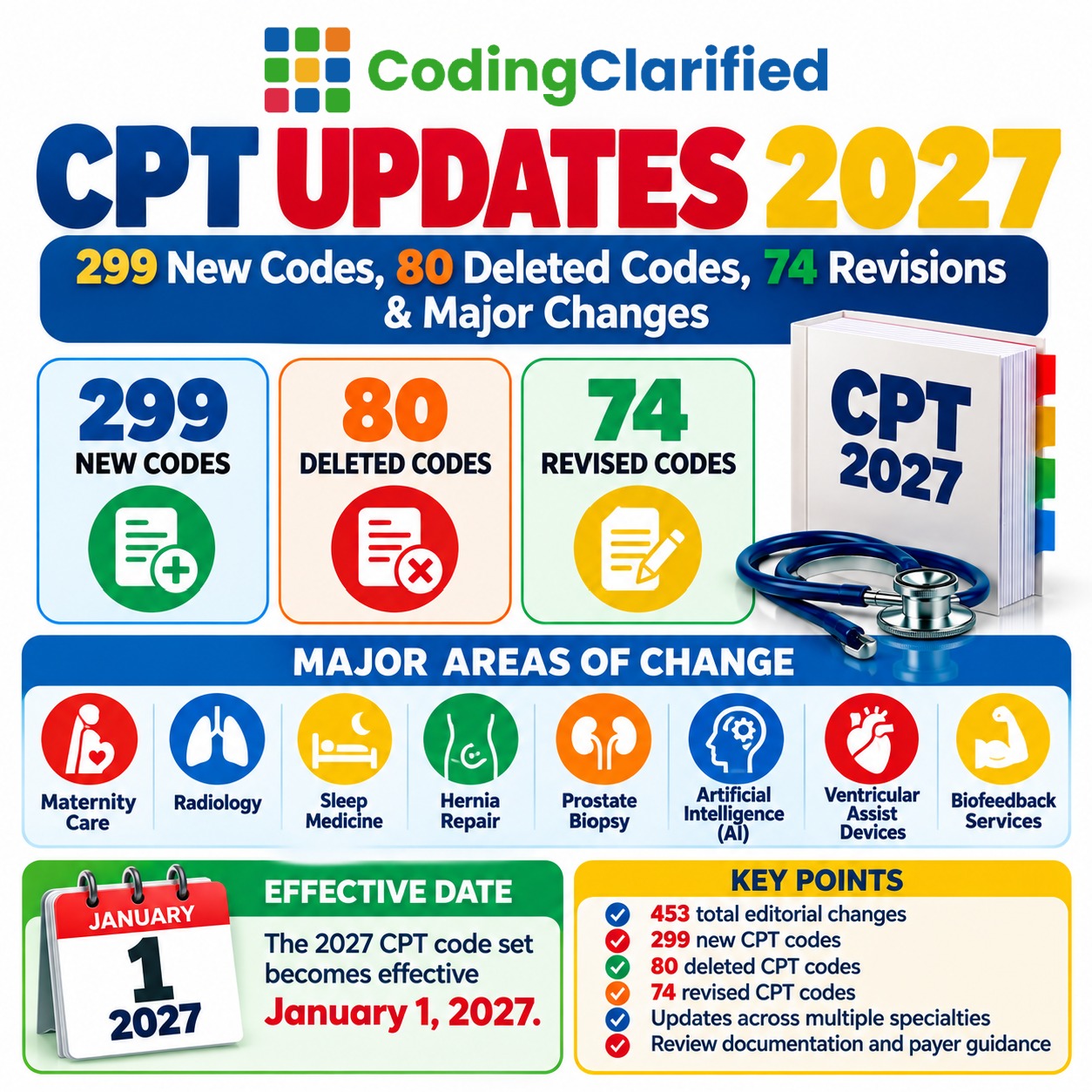
The American Medical Association (AMA) released the CPT 2027 code set in September 2026. According to the AMA, the new code set contains 453 total editorial changes, including 299 new CPT codes, 74 revised codes, and 80 deleted codes. The 2027 CPT code set becomes effective January 1, 2027.
Several specialties receive important updates. However, maternity care receives one of the largest structural changes. Other major areas include radiology, sleep medicine, hernia repair, prostate biopsy, biofeedback, ventricular assist devices, and artificial intelligence services.
For medical coders, simply knowing the number of new codes is not enough. Instead, coders need to understand which codes were deleted, which guidelines changed, and how documentation must support the new code structure.
This guide breaks down the major CPT changes for 2027 in simple terms and explains what coding professionals should do before the new year.
Key Takeaways: CPT Updates for 2027
- The 2027 CPT code set becomes effective January 1, 2027.
- AMA reports 453 total editorial changes.
- There are 299 new CPT codes.
- There are 74 revised CPT codes.
- There are 80 deleted CPT codes.
- Major changes affect maternity care, radiology, sleep medicine, hernia repair, prostate biopsy, biofeedback, and ventricular assist device procedures.
- The 2027 code set adds 10 new AI-related CPT codes, bringing the total number of AI-related CPT codes to 43.
- Traditional global maternity coding receives a major restructuring.
- Antepartum and postpartum care will rely more heavily on E/M reporting.
- Coders should update EHR systems, charge masters, encounter forms, coding software, payer edits, and internal coding education before January 1.
- Medicare payment and coverage rules should be checked separately from CPT code changes.
- Coders should use the official 2027 CPT codebook and current payer guidance when assigning codes.
How Many CPT Code Changes Are There for 2027?
According to the AMA’s September 2026 announcement, CPT 2027 includes:
299 new codes
74 revised codes
80 deleted codes
453 total editorial changes
In addition, the complete CPT 2027 code set contains more than 11,740 codes.
These numbers matter because annual CPT updates can affect far more than code selection. For example, organizations may need to update claim edits, prior authorization lists, EHR templates, fee schedules, coding software, and provider documentation.
Therefore, coding departments should not wait until January to review the changes.
The official AMA CPT resources are available through the American Medical Association CPT resource center.
When Do the 2027 CPT Codes Take Effect?
The annual CPT 2027 code set becomes effective January 1, 2027.
This date differs from the FY 2027 ICD-10-CM update, which became effective October 1, 2026.
That difference often causes confusion for new coders.
In simple terms:
FY 2027 ICD-10-CM: Effective October 1, 2026
CPT 2027: Effective January 1, 2027
Therefore, coders must always verify the correct code set based on the date of service.
For the diagnosis-side changes, review our ICD-10-CM 2027 Updates: 190 New Codes, Deleted Codes, Revised Codes & Key Changes.
Major CPT 2027 Maternity Care Changes
One of the biggest CPT changes for 2027 involves maternity care.
For decades, obstetric coding has relied heavily on global maternity packages. Beginning January 1, 2027, CPT moves toward phase-specific maternity reporting.
As a result, antepartum care, labor management, delivery, and postpartum care will be reported more separately.
The AMA reports that the maternity update includes:
- 12 new codes
- 17 deleted codes
- 6 revised codes
- New and revised maternity guidelines
This change better reflects modern maternity care, where multiple clinicians or groups may participate in a patient’s pregnancy, labor, delivery, and postpartum care.
Global Maternity CPT Codes Deleted for 2027
Several familiar maternity codes will be deleted, including:
59400
59409
59410
59425
59426
59430
59510
59514
59515
59525
59610
59612
59614
59618
59620
59622
59050
These deletions mean coders who work in OB/GYN cannot simply carry their 2026 coding workflows into 2027.
For more background on obstetric coding, review our OB/GYN Medical Coding and Billing Guide.
New CPT Codes for Labor Management in 2027
CPT 2027 introduces four labor management codes:
59080 — Initial-day labor management, straightforward
59081 — Initial-day labor management, complex
59082 — Subsequent-day labor management, straightforward
59083 — Subsequent-day labor management, complex
These codes create a clearer way to report labor management based on the day of care and clinical complexity.
However, coders must carefully review the CPT guidelines before choosing between straightforward and complex labor management. Documentation will need to support the required elements.
For example, maternal or fetal conditions requiring additional management may affect whether labor management qualifies as complex.
New Delivery Codes for CPT 2027
CPT 2027 also changes how vaginal and cesarean deliveries are reported.
New codes include:
59431 — Vaginal delivery
59432 — Vaginal delivery after previous cesarean delivery
59502 — Primary cesarean delivery
59503 — Repeat cesarean delivery
The new structure separates delivery services from the traditional global package model.
In addition, CPT adds codes for certain other maternity services, including repair of third- and fourth-degree lacerations or episiotomies and certain procedures performed with cesarean delivery.
Consequently, OB/GYN coders should review the complete new maternity guidelines rather than simply replacing one old code with one new code.
Antepartum and Postpartum Care Changes
Another major change involves prenatal and postpartum care.
Beginning in 2027, antepartum care will generally be reported per encounter using the appropriate E/M service, depending on the setting and circumstances.
Postpartum care will also move away from the traditional bundled postpartum codes. Instead, applicable E/M coding rules will generally apply.
This makes E/M knowledge especially important for OB/GYN coders in 2027.
For a refresher, see our Evaluation and Management Coding Explained Simply: 2026 Guide to MDM, Time & E/M Levels.
Hernia Repair CPT Changes for 2027
Hernia coding also receives important updates.
According to the AMA, CPT 2027 adds nine new codes involving diaphragmatic hernia repair. The expanded structure provides options for traumatic and non-traumatic conditions and different surgical approaches, including open, laparoscopic, and thoracoscopic procedures.
Therefore, coders should pay close attention to operative reports.
Documentation may need to clearly identify:
- Type of hernia
- Traumatic versus non-traumatic condition
- Surgical approach
- Procedures performed
- Additional reportable services
As always, coders should code from the complete operative report rather than relying only on the procedure title.
Radiology CPT Updates for 2027
Radiology is another important area of change.
The 2027 CPT code set contains new and revised radiology codes and a new table related to head and neck magnetic resonance angiography.
Because imaging technology continues to evolve, radiology coders should carefully review new descriptors, guidelines, parenthetical instructions, and bundling rules.
In addition, remember that a new CPT code does not automatically answer questions about professional and technical component billing.
For more guidance, see our Modifier 26 vs TC: Professional and Technical Component Medical Coding Guide.
New Sleep Medicine CPT Codes for 2027
Sleep medicine also receives notable CPT changes.
The AMA reports six new codes for unattended sleep studies. These codes reflect newer sleep-testing technology, including services that may take place outside traditional sleep centers.
This change is important because home and unattended sleep testing have continued to expand.
However, coders should not assume that every sleep study meets the requirements of a new code. Instead, documentation must identify the technology, monitoring performed, service provided, and other details required by the CPT descriptor and guidelines.
In addition, payer coverage requirements may differ from CPT reporting rules.
Prostate Biopsy CPT Changes
Prostate biopsy coding receives updated codes and guidelines for 2027.
The changes aim to better represent current biopsy techniques while improving reporting specificity.
Therefore, urology coders should review the new CPT structure before coding 2027 prostate biopsy procedures.
Procedure documentation should clearly describe the technique and services performed. Additionally, coders should review bundling instructions and payer policies before separately reporting related services.
Biofeedback CPT Changes for 2027
Biofeedback services also receive a redesigned code structure.
For 2027, CPT introduces a time-based reporting structure that more closely reflects how biofeedback training is delivered.
Time-based coding requires careful documentation.
Consequently, providers should document the service and applicable time requirements clearly. Coders should then compare that documentation with the current CPT guidelines before assigning a code.
Never round time or assume that a threshold was met when the documentation does not support it.
Ventricular Assist Device CPT Updates
The CPT 2027 update also includes changes involving ventricular assist device procedures.
According to the AMA, the update includes new and revised guidelines plus three new codes involving left ventricular assist devices.
These services can involve complex clinical and surgical scenarios. Therefore, coders working in cardiovascular surgery should carefully review the 2027 CPT guidelines and operative documentation.
Do not rely on a previous-year code simply because the procedure sounds similar.
Artificial Intelligence Continues to Expand in CPT
Artificial intelligence remains a growing area within CPT.
CPT 2027 adds 10 new AI-related codes, bringing the total number of AI-related CPT codes to 43.
Additionally, the AMA updated its Taxonomy for Artificial Intelligence in Medical Services and Procedures.
This continued growth shows how quickly CPT is adapting to new technology.
Still, the presence of AI in a service does not automatically mean that an AI-related CPT code should be reported. Coders must verify the exact service, code requirements, documentation, and payer rules.
CPT Changes vs. Medicare Payment Changes
A CPT code and Medicare payment policy are not the same thing.
The AMA maintains CPT, while CMS establishes Medicare payment policies through programs such as the Medicare Physician Fee Schedule.
CMS released the CY 2027 Medicare Physician Fee Schedule Proposed Rule in July 2026. However, proposed rules should not be treated as final policy.
Therefore, coders and billing teams should monitor the final CY 2027 Medicare Physician Fee Schedule when CMS releases it.
Official Medicare updates can be reviewed through the Centers for Medicare & Medicaid Services.
Coding professionals can also use AAPC for coding education and industry updates.
How Medical Coding Teams Should Prepare for CPT 2027
Preparation should begin before January 1.
First, identify the CPT changes that affect your organization’s highest-volume specialties. Next, review deleted codes and determine which workflows, templates, or charge items use them.
Then update:
- EHR and practice management systems
- Charge masters
- Encounter forms
- Coding software
- Fee schedules
- Prior authorization workflows
- Claim edits
- Provider templates
- Coding policies
- Internal education materials
Additionally, test your billing systems before January whenever possible.
A technically correct new CPT code can still create claim problems when software, payer edits, or authorization systems have not been updated.
Common Mistakes to Avoid With the 2027 CPT Updates
Using deleted CPT codes after January 1, 2027. Always verify that the code remains active for the date of service.
Assuming a new code is automatically covered. CPT describes services, but payer coverage and reimbursement requirements still apply.
Ignoring revised guidelines. Sometimes the code remains familiar while the instructions around it change.
Continuing old global maternity workflows. The 2027 maternity restructure requires significant changes to coding processes.
Using old encounter forms or favorites lists. Saved codes in an EHR may remain visible even after they become invalid.
Ignoring documentation changes. New specificity often requires better documentation.
Confusing CPT and ICD-10 effective dates. FY 2027 ICD-10-CM began October 1, 2026, while CPT 2027 begins January 1, 2027.
CPC Student Tips for Learning the 2027 CPT Changes
If you are studying for the CPC exam, do not try to memorize all 299 new codes.
Instead, understand how annual CPT changes work.
Look for the symbols used in the CPT codebook to identify new, revised, and resequenced codes. Additionally, read the section guidelines and parenthetical notes before selecting a code.
Most importantly, practice using the current codebook.
A good coding workflow is:
Documentation → CPT Index → code range → full descriptor → guidelines and notes → final code selection
CPC students should also understand the difference between CPT, HCPCS Level II, and ICD-10-CM updates.
That knowledge will help both on certification exams and in real-world coding.
Why the CPT 2027 Changes Matter
The 2027 update is not simply a list of new numbers.
Instead, it reflects changes in medicine itself.
Modern maternity care often involves teams of healthcare professionals. Meanwhile, artificial intelligence, advanced imaging, sleep testing, cardiovascular technology, and newer surgical techniques continue to change how care is delivered.
CPT must evolve with those services.
For coders, however, every change creates a practical question:
Does the documentation support the code?
That question should remain at the center of code selection in 2027.
Frequently Asked Questions About the CPT 2027 Updates
When do the 2027 CPT codes take effect?
The annual CPT 2027 code set becomes effective January 1, 2027. Coders should use the CPT code set that applies to the date of service and verify payer-specific requirements.
How many new CPT codes are there for 2027?
The AMA reports 299 new CPT codes for 2027. In addition, there are 74 revisions and 80 deletions, creating 453 total editorial changes.
What are the biggest CPT changes for 2027?
Major changes affect maternity care, diaphragmatic hernia repair, radiology, sleep medicine, prostate biopsy, biofeedback, ventricular assist device procedures, and AI-related medical services.
Are the global maternity CPT codes changing in 2027?
Yes. CPT 2027 makes a major change to maternity reporting. Many traditional global maternity codes, including 59400, 59510, 59610, and 59618, are deleted. New phase-specific reporting separates antepartum care, labor management, delivery, and postpartum care.
Are there new CPT codes for labor management in 2027?
Yes. New labor management codes include 59080, 59081, 59082, and 59083. The code selected depends on factors such as the day of labor management and whether the management meets straightforward or complex criteria.
Are there new CPT codes for artificial intelligence in 2027?
Yes. CPT 2027 adds 10 new AI-related codes, bringing the total number of AI-related CPT codes to 43. Coders should still verify each code’s requirements and payer rules before reporting an AI-related service.
Is CPT 2027 the same as the FY 2027 ICD-10-CM update?
No. They are different code sets with different effective dates. FY 2027 ICD-10-CM became effective October 1, 2026, while CPT 2027 becomes effective January 1, 2027.
Where can medical coders find the official CPT 2027 updates?
The AMA is the official source for CPT codes and publishes the CPT code set, annual changes, guidelines, and educational resources. Coders should use the current CPT 2027 Professional Edition or other authorized CPT resources for final code assignment. Medicare coding, coverage, and payment information should also be verified through CMS.
Final Thoughts
CPT 2027 brings a significant annual update with 299 new codes, 74 revised codes, and 80 deleted codes.
However, the numbers alone do not tell the full story.
The maternity care restructure represents a major workflow change, while updates involving radiology, sleep medicine, AI, hernia repair, biofeedback, prostate biopsy, and cardiovascular procedures reflect how quickly healthcare continues to evolve.
Start preparing before January 1, 2027.
Review the codes that affect your specialty, update internal systems, educate providers, check documentation requirements, and watch for payer-specific guidance.
Most importantly, never assume that last year’s code is still correct.
Always code from the documentation and verify the current CPT guidelines for the date of service.