ICD-10-CM 2027 Updates: 190 New Codes, Deleted Codes, Revised Codes & Key Changes
The FY 2027 ICD-10-CM updates took effect October 1, 2026, bringing important diagnosis coding changes that medical coders, billers, providers, clinical documentation specialists, and healthcare organizations need to know.
The FY 2027 code set is used for patient encounters and discharges occurring October 1, 2026 through September 30, 2027.
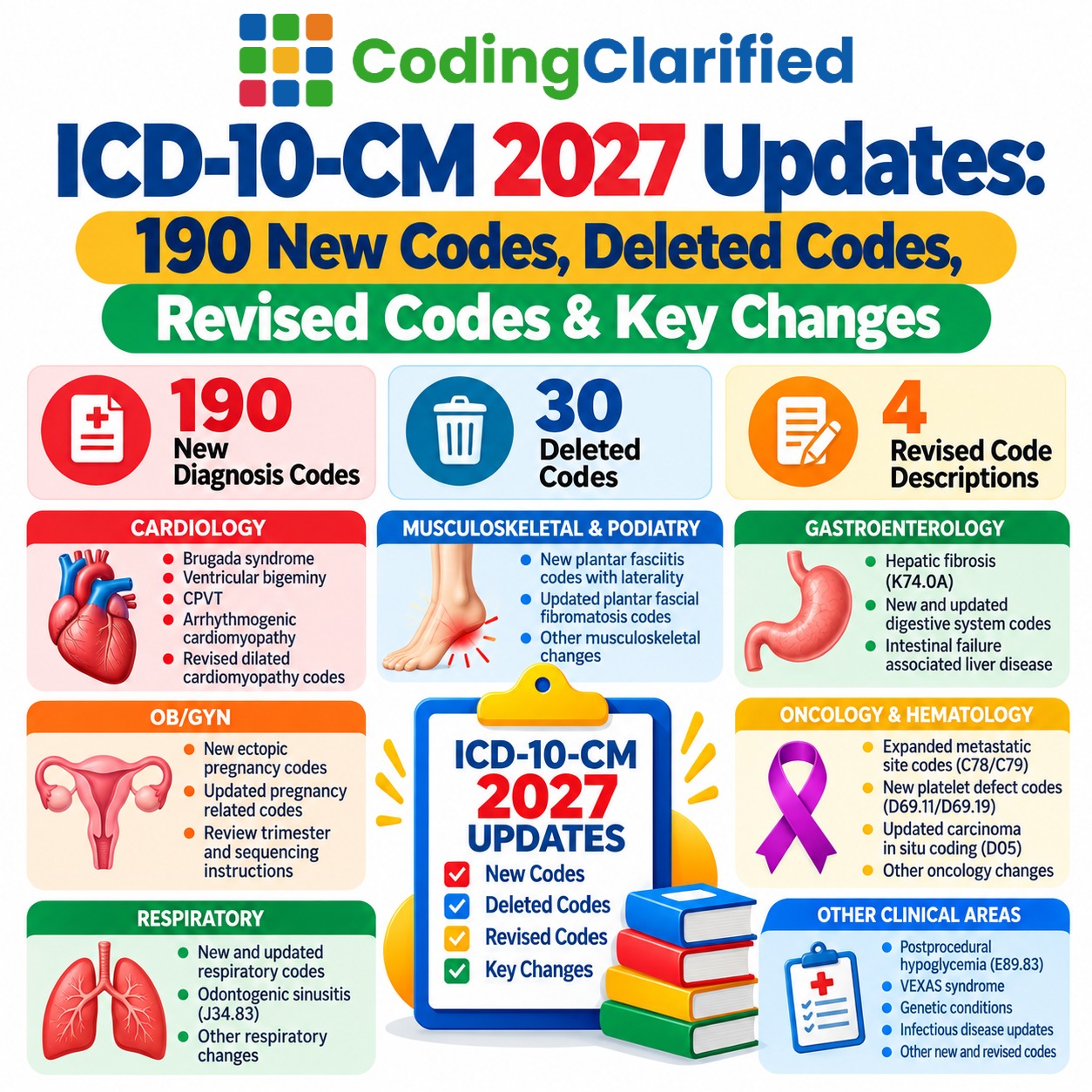
Although the FY 2027 update is smaller than some previous annual updates, it includes significant changes affecting cardiology, musculoskeletal conditions, podiatry, gastroenterology, respiratory conditions, obstetrics, oncology, hematology, and other specialties.
Among the headline changes are 190 new diagnosis codes, 30 deleted codes, and 4 revised code descriptions.
For medical coders, the number of changes is only part of the story. Several commonly encountered diagnoses now have greater specificity, including new options for laterality, disease subtype, anatomic site, and clinical characteristics.
Key Takeaways
- FY 2027 ICD-10-CM became effective October 1, 2026.
- The FY 2027 code set remains applicable through September 30, 2027.
- The update includes 190 new diagnosis codes.
- There are 30 deleted codes.
- There are 4 revised code descriptions.
- Cardiology receives new codes for several inherited and rhythm-related conditions.
- Plantar fasciitis now has new codes that identify laterality.
- New codes address conditions including postprocedural hypoglycemia, odontogenic sinusitis, hepatic fibrosis, VEXAS syndrome, and additional pregnancy conditions.
- Coders must review deleted codes, new instructional notes, laterality requirements, and documentation specificity before submitting claims.
- Always verify codes in the FY 2027 ICD-10-CM Tabular List, Alphabetic Index, and Official Guidelines for Coding and Reporting before final code assignment.
The official FY 2027 files and coding guidelines are available from CMS.
When Did the 2027 ICD-10-CM Codes Take Effect?
The FY 2027 ICD-10-CM code set became effective on October 1, 2026.
That means dates of service through September 30, 2026, generally use the applicable FY 2026 code set, while encounters beginning October 1, 2026, use the FY 2027 codes.
CMS states that the FY 2027 ICD-10-CM files apply to discharges and patient encounters occurring from October 1, 2026 through September 30, 2027.
This effective date is extremely important. A diagnosis code that was valid on September 30 may be deleted, converted to a non-billable parent category, or replaced with more specific choices beginning October 1.
FY 2027 ICD-10-CM Changes at a Glance
New diagnosis codes: 190
Deleted codes: 30
Revised code descriptions: 4
Effective date: October 1, 2026
Valid through: September 30, 2027
CMS provides the official code files, Addendum, conversion table, Tabular List, Alphabetic Index, and coding guidelines that should be used for final coding decisions.
Major Cardiology ICD-10-CM Changes for 2027
Cardiology is one of the areas receiving important new specificity for FY 2027.
Several conditions that previously required less-specific cardiomyopathy or arrhythmia codes now have dedicated diagnosis codes.
Examples include:
- I47.22 — Catecholaminergic polymorphic ventricular tachycardia (CPVT)
- I49.81 — Brugada syndrome
- I49.82 — Ventricular bigeminy
- I42.81 — Arrhythmogenic cardiomyopathy
FY 2027 also expands dilated cardiomyopathy coding. The I42.0 category now allows additional specificity, including:
- I42.00 — Dilated cardiomyopathy, unspecified
- I42.01 — Familial-genetic dilated cardiomyopathy
- I42.09 — Other dilated cardiomyopathy
These changes are particularly important because documentation may now support a much more specific diagnosis than the coder could previously report.
Coding Tip
Do not automatically carry forward an older cardiomyopathy or arrhythmia code simply because it was used on previous encounters.
Review the current provider documentation and verify the diagnosis in the FY 2027 code set.
A documented genetic or specific arrhythmogenic condition may now have its own code.
Plantar Fasciitis Gets New Laterality Codes
One of the most practical FY 2027 changes for podiatry, orthopedics, primary care, and outpatient coding involves plantar fasciitis.
Beginning October 1, 2026, plantar fasciitis moves into the new M67.A- category.
The new structure includes:
- M67.A01 — Plantar fasciitis, right foot
- M67.A02 — Plantar fasciitis, left foot
- M67.A09 — Plantar fasciitis, unspecified foot
This is a significant documentation change because coders can now identify the affected side.
Why Laterality Matters
If the provider documents “plantar fasciitis of the right foot,” the coder should not default to an unspecified-foot code when a right-foot code is available.
Providers and coding teams should make sure clinical templates capture laterality.
Remember: More code specificity requires more documentation specificity.
Plantar Fascial Fibromatosis Also Changes
Plantar fascial fibromatosis receives additional specificity as well.
FY 2027 includes:
- M72.20 — Plantar fascial fibromatosis, unspecified foot
- M72.21 — Plantar fascial fibromatosis, right foot
- M72.22 — Plantar fascial fibromatosis, left foot
The previous code structure therefore should not simply be carried forward without reviewing the FY 2027 changes.
This is another example of why coders should never rely solely on memorized codes from the previous year.
New Odontogenic Sinusitis Codes
FY 2027 adds greater specificity for odontogenic sinusitis, which originates from a dental or odontogenic source.
The new J34.83- category includes options based on the affected sinus:
- J34.830 — Odontogenic sinusitis, maxillary sinus
- J34.831 — Odontogenic sinusitis, ethmoid sinus
- J34.832 — Odontogenic sinusitis, frontal sinus
- J34.833 — Odontogenic sinusitis, sphenoid sinus
- J34.839 — Odontogenic sinusitis, unspecified
This change makes the specific sinus clinically important for code assignment.
Coders should review documentation carefully instead of stopping at J34.83, because that category requires a more specific child code for reporting.
New Postprocedural Hypoglycemia Codes
Another notable FY 2027 addition involves postprocedural hypoglycemia.
The new category includes:
- E89.830 — Post bariatric hypoglycemia
- E89.838 — Other postprocedural hypoglycemia
The parent E89.83 represents postprocedural hypoglycemia following a procedure but requires additional characters for reportable code assignment.
This is especially relevant for coders working with bariatric surgery patients and other postoperative care.
Documentation Tip
Coders should not assume that hypoglycemia occurring after a procedure is automatically a postprocedural complication.
Code assignment must be supported by provider documentation establishing the condition and its relationship to the procedure when required by ICD-10-CM guidelines.
Hepatic Fibrosis Receives Additional Specificity
Liver disease coding also receives an important addition.
FY 2027 introduces:
K74.0A — Hepatic fibrosis, moderate fibrosis
The code includes moderate hepatic fibrosis and stage F2 hepatic fibrosis.
For gastroenterology and hepatology coders, this makes documentation of fibrosis stage increasingly important.
Rather than documenting only “hepatic fibrosis,” providers should capture the level or stage when clinically known and appropriate.
Additional New and Expanded Clinical Concepts
The FY 2027 ICD-10-CM update extends well beyond cardiology and musculoskeletal coding.
Other areas affected include conditions such as:
- VEXAS syndrome
- Ectopic pregnancy
- Hepatic fibrosis
- Intestinal failure-associated liver disease
- Pediatric hypertrophic pyloric stenosis
- Pelvic abscess
- Osteomyelitis
- Plantar fascial fibromatosis
- Postprocedural nipple ischemia and necrosis
- Loeys-Dietz syndrome
- Lynch syndrome
- Other inherited neoplasm predisposition syndromes
- Toxic effects of certain chemicals and substances
- Abnormal gadolinium levels in the blood
The breadth of these changes demonstrates why even coders who rarely work in cardiology or podiatry need to review the annual update.
Oncology and Hematology Changes
FY 2027 also contains changes relevant to oncology and hematology coding.
These include additional specificity involving metastatic disease and platelet disorders, among other conditions.
For example, new coding options address qualitative platelet defects, allowing more precise reporting of certain platelet abnormalities.
Changes also affect areas of neoplasm coding, including carcinoma in situ and inherited cancer-predisposition syndromes.
For coders working in oncology, it is especially important to review the C, D, and applicable genetic-condition categories in the FY 2027 Tabular List rather than relying on previous-year code selections.
Pregnancy and Obstetric Coding Updates
Obstetrics is another area affected by the FY 2027 changes.
New and revised concepts include additional coding options involving ectopic pregnancy and other pregnancy-related conditions.
Because Chapter 15 coding includes strict sequencing and trimester rules, coders should verify both the new codes and their accompanying instructional notes.
The FY 2027 Official Guidelines continue to contain a dedicated section for pregnancy, childbirth, and the puerperium under O00-O9A.
For additional OB/GYN coding guidance, see our guide:
Do Not Overlook ICD-10-CM Instructional Note Changes
Annual ICD-10-CM updates involve more than adding and deleting codes.
Coders must also review changes involving:
- Excludes1 notes
- Excludes2 notes
- Code first instructions
- Use additional code instructions
- Includes notes
- Inclusion terms
- Code descriptions
- Laterality
- Required characters
- New subcategories
- Revised sequencing instructions
These changes can alter how codes are used even when a familiar diagnosis remains in the code set.
For example, FY 2027 includes changes involving Tabular List instructions affecting certain gait and unsteadiness concepts, including R26.81.
This is why searching only a list of “new codes” is not enough.
What Should Medical Coders Do for the FY 2027 Update?
Every coding department should have a formal annual ICD-10-CM update process.
Start by reviewing the official FY 2027 files and identifying changes that affect your specialty.
Next, update:
- Encoder and coding software
- EHR diagnosis pick lists
- Provider templates
- Billing systems
- Charge capture tools
- Coding cheat sheets
- Internal policies
- Education materials
- Claim edits
- Documentation prompts
Deleted codes should be end-dated appropriately, not simply erased from historical records. Older codes may still be needed when reviewing or adjusting claims for dates of service before October 1, 2026.
At the same time, systems should prevent deleted FY 2026 codes from being used incorrectly for applicable FY 2027 dates of service.
Watch for Unspecified Codes
Several FY 2027 changes demonstrate the continued movement toward greater specificity.
Plantar fasciitis is an excellent example.
When documentation identifies the right or left foot, use the appropriate laterality-specific code rather than the unspecified option.
However, coders should never infer clinical details that are not documented merely to select a more specific code.
If required information is missing and organizational policy permits, a provider query may be appropriate.
Common Mistakes With New ICD-10-CM Codes
1. Using a Deleted Code After September 30, 2026
A code that worked yesterday may not work today. Always verify the code set applicable to the date of service.
2. Automatically Mapping an Old Code to a New Code
A one-to-one replacement does not always exist. Review the documentation, Alphabetic Index, Tabular List, and instructional notes.
3. Missing Laterality
New codes such as those for plantar fasciitis make right-versus-left documentation more important.
4. Reporting a Non-Billable Parent Category
Some new categories require additional characters. For example, J34.83 and E89.83 lead to more specific reportable choices.
5. Coding From Memory
Annual updates are exactly why coding from memory is risky.
6. Ignoring Tabular List Instructions
Finding a diagnosis in the Alphabetic Index is only the beginning. Always verify the code in the Tabular List.
7. Forgetting the Effective Date
FY 2027 codes generally apply beginning October 1, 2026, not January 1, 2027.
CPC Student Tip: Know How Annual ICD-10-CM Updates Work
If you are studying for the CPC exam or preparing for your first medical coding job, annual code updates are an important part of professional coding.
You do not need to memorize every new diagnosis code.
Instead, learn the process:
Index → Tabular List → instructional notes → documentation → final code
Also remember that ICD-10-CM is updated according to the federal fiscal year. That is why the 2027 ICD-10-CM code set begins October 1, 2026, rather than January 1, 2027.
If you are preparing for certification, our CPC Certification Guide explains the CPC certification process and exam preparation in more detail:
https://codingclarified.com/ultimate-medical-coding-aapc-cpc-certification-guide/
You can also review our guide for those beginning a medical coding career:
https://codingclarified.com/what-is-medical-coding-and-how-do-i-get-certified/
Why the FY 2027 ICD-10-CM Changes Matter
Even though 190 new diagnosis codes may sound small compared with the entire ICD-10-CM code set, the real impact depends on which codes changed.
A single deleted high-volume diagnosis code can affect thousands of claims.
Likewise, adding laterality to a frequently reported condition can require changes to:
- Provider documentation
- EHR templates
- Coding workflows
- Claim edits
- Staff education
- Billing software
That is why annual ICD-10-CM preparation should focus not only on the number of new codes but also on how those changes affect everyday coding.
Frequently Asked Questions About the 2027 ICD-10-CM Updates
When did the 2027 ICD-10-CM codes become effective?
The FY 2027 ICD-10-CM code set became effective October 1, 2026.
How long are the FY 2027 ICD-10-CM codes in effect?
The FY 2027 diagnosis code files apply to patient encounters and discharges from October 1, 2026 through September 30, 2027.
How many new ICD-10-CM codes are there for FY 2027?
The FY 2027 update includes 190 new diagnosis codes, along with 30 deleted codes and 4 revised code descriptions.
Did plantar fasciitis coding change in 2027?
Yes. FY 2027 introduces the M67.A- category for plantar fasciitis, including laterality-specific options such as M67.A01 for the right foot and M67.A02 for the left foot.
Are there new cardiology codes for 2027?
Yes. New or expanded options include codes for Brugada syndrome, ventricular bigeminy, CPVT, arrhythmogenic cardiomyopathy, and more specific types of dilated cardiomyopathy.
Do I need to memorize all 190 new codes?
No. Professional coders should know how to identify relevant changes and correctly use the current Alphabetic Index, Tabular List, coding guidelines, encoder, and other approved coding resources.
Can I continue using a deleted code if it was previously correct?
Not for an encounter occurring after the code’s applicable termination date. Always select the code valid for the date of service and supported by the documentation.
Where Can I Find the Official FY 2027 ICD-10-CM Files?
CMS provides the FY 2027 code descriptions, Addendum, conversion table, Tabular List and Alphabetic Index, POA-exempt codes, and Official Guidelines for Coding and Reporting.
Official CMS ICD-10 information:
https://www.cms.gov/medicare/coding-billing/icd-10-codes
Coding Clarified Final Thoughts
The FY 2027 ICD-10-CM update is effective October 1, 2026 through September 30, 2027, and medical coders should begin using the new code set for applicable encounters immediately.
With 190 new diagnosis codes, 30 deleted codes, and 4 revised descriptions, this year’s update may be smaller than some previous revisions, but several changes affect diagnoses seen frequently in everyday coding.
Cardiology coders should pay particular attention to new genetic and arrhythmia codes. Podiatry and orthopedic coders should review the new plantar fasciitis and plantar fascial fibromatosis options. Other specialties should review changes involving postprocedural hypoglycemia, odontogenic sinusitis, hepatic fibrosis, pregnancy, hematologic conditions, genetic syndromes, and other newly expanded diagnoses.
Most importantly, don’t simply replace an old code with a new one based on a crosswalk.
Review the documentation. Check the Alphabetic Index. Verify the Tabular List. Read all instructional notes. Confirm that the code is valid for the date of service.
Those steps remain the foundation of accurate ICD-10-CM coding, no matter how many codes change each year.