Laparoscopic Roux-en-Y gastric bypass coding can look complicated because the operative report contains many individual surgical steps. The surgeon may divide the stomach, create a gastric pouch, divide the small bowel, construct two anastomoses, close mesenteric defects, perform an intraoperative endoscopy, and test the new connection for leaks.
However, medical coders should not assign a separate CPT code for every step.
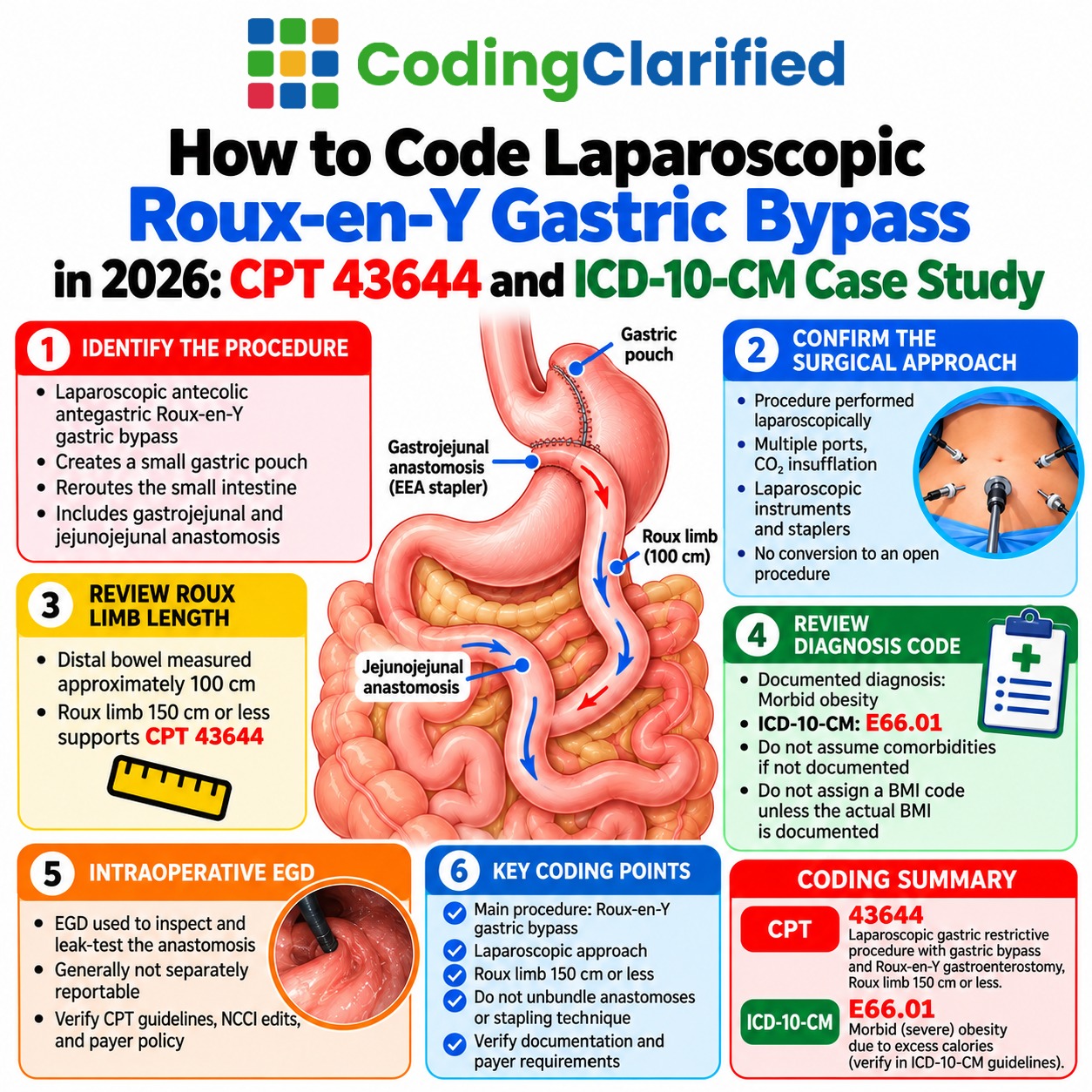
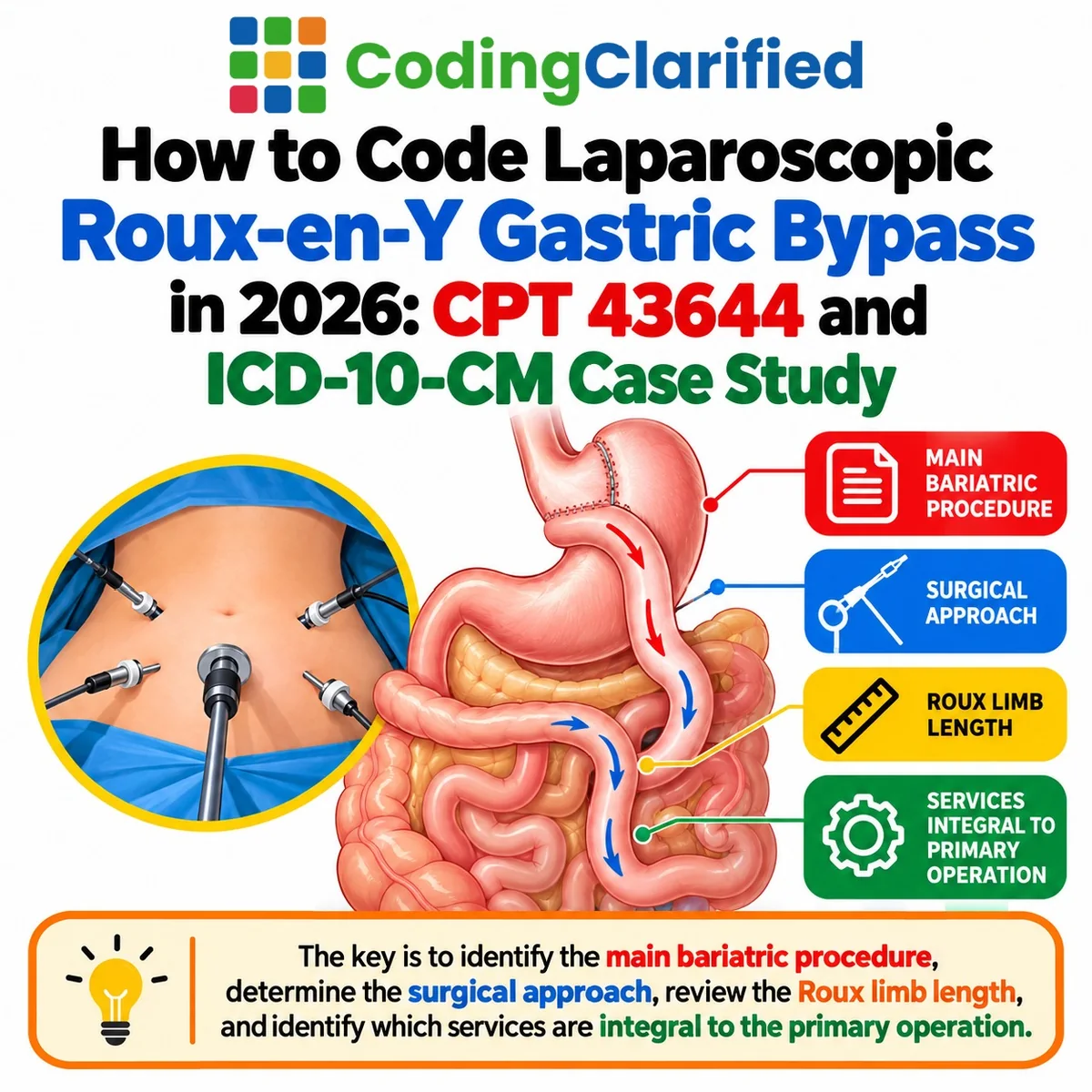
Instead, the key is to identify the main bariatric procedure, determine the surgical approach, review the Roux limb length, and identify which services are integral to the primary operation.
In this 2026 medical coding case study, a 30-year-old female with documented morbid obesity undergoes a laparoscopic antecolic, antegastric Roux-en-Y gastric bypass. The surgeon documents a Roux limb of approximately 100 cm and creates the gastrojejunal anastomosis with an EEA stapler.
For this case, the primary procedure supports CPT 43644.
Key Takeaways
- The procedure is performed laparoscopically, not through an open approach.
- The surgeon performs a Roux-en-Y gastric bypass.
- The documented Roux limb measures approximately 100 cm.
- A Roux limb of 150 cm or less points coders toward CPT 43644 rather than a code describing a more extensive intestinal reconstruction.
- The diagnosis is documented as morbid obesity.
- ICD-10-CM E66.01 may be appropriate when documentation and the applicable ICD-10-CM Index and Tabular List support morbid obesity due to excess calories.
- Do not assign a BMI code from the patient’s appearance, bariatric surgery status, or the diagnosis of morbid obesity. The actual BMI must be documented.
- Do not invent obesity-related comorbidities simply because they commonly occur in bariatric patients.
- The intraoperative EGD performed to inspect and leak-test the newly created anastomosis is generally considered part of completing and evaluating the surgical procedure rather than automatically separately reportable.
- Always verify CPT, NCCI edits, payer policy, and the ICD-10-CM code set applicable to the date of service before submitting a claim.
Laparoscopic Gastric Bypass Coding Scenario
Medical Specialty: Bariatric Surgery / General Surgery
Preoperative Diagnosis: Morbid obesity
Postoperative Diagnosis: Morbid obesity
Procedure: Laparoscopic antecolic antegastric Roux-en-Y gastric bypass with EEA anastomosis
Anesthesia: General anesthesia with endotracheal intubation
Clinical History
The patient is a 30-year-old female who has been higher weight for many years. She has attempted several diets without lasting success. After attending a bariatric surgery seminar and discussing the risks and benefits of surgery, she elects to proceed with Roux-en-Y gastric bypass.
Operative Summary
The surgeon establishes laparoscopic access through multiple abdominal ports. After identifying the transverse colon and ligament of Treitz, the surgeon measures approximately 40 cm of small bowel and divides it.
Next, the surgeon measures the distal bowel approximately 100 cm. A side-to-side anastomosis is created between the Roux limb and the biliopancreatic limb. The mesenteric defect is then closed.
The omentum is divided to allow the Roux limb to travel in an antecolic position.
Afterward, the surgeon dissects the proximal stomach and creates a small gastric pouch with surgical staplers. An anvil is positioned in the gastric pouch, and an EEA stapler is passed through the Roux limb.
The surgeon joins the Roux limb to the gastric pouch and fires the stapler, creating an end-to-side gastrojejunal anastomosis.
Additional sutures reinforce the anastomosis.
Finally, an EGD scope is passed through the esophagus and into the gastric pouch. The pouch is insufflated with air to test the anastomosis. No leak or bleeding is identified, and the scope passes easily through the anastomosis.
The patient tolerates the operation without complications.
Step 1: Identify the Main Surgical Procedure
The first step is to ignore the temptation to code every technical action described in the operative report.
Ask one question first:
What operation did the surgeon actually perform?
The answer is a laparoscopic Roux-en-Y gastric bypass.
That immediately narrows the CPT search.
AAPC’s CPT information places 43644 within laparoscopic procedures of the stomach and describes a laparoscopic gastric restrictive procedure involving gastric bypass and Roux-en-Y gastroenterostomy when the Roux limb is 150 cm or less.
For additional bariatric coding education, see our Medical Coding Bariatric Surgery guide.
Step 2: Confirm the Laparoscopic Approach
Approach matters greatly when coding gastric bypass surgery.
The operative report repeatedly documents laparoscopic access, including:
- Veress needle placement
- CO2 insufflation
- multiple laparoscopic ports
- laparoscopic instruments
- laparoscopic stapling
- laparoscopic visualization
Therefore, an open gastric bypass code would not describe this procedure.
The surgeon completes the procedure laparoscopically without documenting conversion to an open operation.
That distinction leads us toward CPT 43644.
Step 3: Determine the Roux Limb Length
This detail is especially important.
The operative report states that the surgeon runs the distal bowel down approximately 100 cm before creating the anastomosis.
CPT 43644 describes laparoscopic gastric bypass with Roux-en-Y gastroenterostomy when the Roux limb is 150 cm or less.
Because this operative report documents approximately 100 cm, the limb length fits within the description for 43644.
CPT 43644
43644 — Laparoscopic surgical gastric restrictive procedure with gastric bypass and Roux-en-Y gastroenterostomy, Roux limb 150 cm or less.
Therefore, 43644 is the primary CPT code supported by this operative report.
The distinction matters because CPT 43645 describes gastric bypass involving additional small-intestine reconstruction designed to limit absorption. Coders should not choose 43645 merely because the operative report describes small-bowel division and reconstruction. Those steps are expected when constructing the standard Roux-en-Y bypass described by 43644.
Step 4: Understand the Anastomoses
A Roux-en-Y gastric bypass involves more than simply making the stomach smaller.
The surgeon creates a gastric pouch and reroutes the small intestine.
In this case, the operative report describes the construction of the Roux limb and two important connections.
First, the surgeon creates the jejunojejunostomy with a side-to-side stapled technique. Then, the surgeon connects the Roux limb to the gastric pouch with an EEA stapler, creating the gastrojejunal anastomosis.
These details confirm the type of operation.
However, coders should not separately report each anastomosis just because the surgeon describes each one in detail. They are components of the Roux-en-Y gastric bypass represented by the primary procedure code.
This is an important lesson for long operative reports: more surgical steps do not necessarily mean more CPT codes.
Step 5: Does the Antecolic and Antegastric Technique Change the CPT Code?
No separate CPT code is selected simply because the surgeon describes the bypass as antecolic and antegastric.
Those terms describe the route of the Roux limb.
In an antecolic approach, the Roux limb passes in front of the transverse colon rather than through a defect created in the transverse mesocolon.
Likewise, the surgeon’s detailed technique helps confirm what happened during the operation, but it does not automatically create an additional separately reportable service.
For coding purposes, focus on the complete procedure described by 43644.
Step 6: Is the EEA Anastomosis Separately Coded?
The operative report states that the surgeon passes an EEA stapler through the Roux limb and connects it to the anvil positioned in the gastric pouch.
This creates the gastrojejunal anastomosis.
Do not assign another CPT code merely because an EEA stapler was used.
The stapling technique is part of constructing the gastric bypass. Therefore, the coder should not unbundle the anastomosis from 43644 simply because the operative note gives a detailed description of how it was created.
The same concept applies to the other routine components necessary to complete the bypass.
Step 7: Can the Intraoperative EGD Be Separately Reported?
This is one of the most important questions in this case.
After constructing the gastrojejunal anastomosis, the surgeon passes an EGD scope into the gastric pouch. Air insufflation allows the surgeon to check the new anastomosis for leakage.
The operative note states:
- no air leak was seen
- the scope passed easily through the anastomosis
- no bleeding was seen
In this context, the endoscopy functions as an intraoperative integrity and leak test of the newly created surgical anatomy.
Coders should not automatically report a separate diagnostic EGD code simply because an endoscope appears in the operative report.
Instead, review current CPT instructions, NCCI edits, payer rules, and the purpose of the endoscopy. When endoscopy is performed as part of completing, testing, or evaluating the surgical procedure, separate reporting may not be appropriate.
This is a classic example of why coding from keywords alone can result in unbundling.
Step 8: Code the Morbid Obesity Diagnosis
The preoperative and postoperative diagnoses both state:
Morbid obesity.
For ICD-10-CM coding, E66.01 represents morbid (severe) obesity due to excess calories when supported by the documentation and applicable ICD-10-CM coding instructions.
ICD-10-CM E66.01
E66.01 — Morbid (severe) obesity due to excess calories
However, coders should always verify the Alphabetic Index and Tabular List rather than assigning a code solely from memory.
This becomes especially important in 2026 because ICD-10-CM now contains obesity-class codes in subcategory E66.81-. The official ICD-10-CM guidelines state that obesity-class codes require provider documentation of the obesity class.
Therefore, do not automatically change documented “morbid obesity” to “class 3 obesity.”
If the provider specifically documents class 3 obesity, review the more specific obesity-class coding instructions that apply to the date of service.
For a broader discussion, see our Medical Coding for Obesity in 2026 guide.
Step 9: Should We Add a BMI Code?
Not from the scenario as written.
ICD-10-CM provides adult BMI codes in category Z68.-, but the case does not give us the patient’s actual BMI.
That means we should not guess one.
Morbid obesity does not authorize the coder to assume that the patient’s BMI is 40, 45, 50, or any other value.
For example, codes such as Z68.41, Z68.42, Z68.43, Z68.44, and Z68.45 identify specific BMI ranges. However, none can be selected accurately without the documented BMI.
If the complete medical record contains a documented BMI, assign the appropriate BMI code according to current ICD-10-CM guidelines and payer requirements.
This distinction also appears in our Medical Coding for a Weight Loss Evaluation in 2026 guide.
Step 10: Do Not Invent a Comorbidity
Bariatric patients frequently have conditions such as:
- hypertension
- obstructive sleep apnea
- type 2 diabetes
- hyperlipidemia
- osteoarthritis
- gastroesophageal reflux disease
However, this operative report does not document any of those conditions.
Therefore, we cannot add them simply because they are common among patients undergoing bariatric surgery.
This rule becomes particularly important when reviewing medical necessity.
Some payer policies require a specific BMI plus one or more obesity-related comorbidities before bariatric surgery qualifies for coverage. A coverage requirement, however, does not give the coder permission to create a diagnosis that is absent from the record.
Instead, review the complete chart and payer policy. If required clinical information is missing or unclear, follow the organization’s compliant query process.
Final Coding Summary
Based on the documentation supplied in this case:
CPT: 43644 — Laparoscopic gastric restrictive procedure with gastric bypass and Roux-en-Y gastroenterostomy, Roux limb 150 cm or less
ICD-10-CM: E66.01 — Morbid (severe) obesity due to excess calories, when confirmed through the applicable ICD-10-CM Index and Tabular List
BMI code: Not assignable from the supplied scenario because no BMI is documented.
Additional comorbidities: None should be assumed from the information provided.
Separate EGD: Do not automatically separately report the intraoperative endoscopy used to inspect and leak-test the newly created anastomosis. Verify current CPT, NCCI, and payer rules before separate reporting.
2026 Freshness Check: Important ICD-10-CM Date Change
Medical coders need to pay close attention to the date of service when coding cases in late 2026.
CMS states that the FY 2026 ICD-10-CM files apply to encounters through September 30, 2026. The FY 2027 ICD-10-CM files become effective for encounters beginning October 1, 2026.
Therefore, a procedure performed on September 30, 2026, and one performed on October 1, 2026, cross an ICD-10-CM fiscal-year boundary.
The FY 2027 guidelines continue to address obesity-class coding. In particular, the official guidelines state that obesity class must be documented by the provider before assigning codes from subcategory E66.81-. They also state that when both class 3 obesity and morbid obesity are documented, the class 3 obesity code is assigned because it is more specific.
Consequently, coders should verify the current-year code set rather than relying on an older bariatric surgery coding example.
Medical Necessity and Bariatric Surgery Coverage
Correct CPT and ICD-10-CM coding does not automatically establish insurance coverage.
CMS and commercial payers may have specific medical necessity requirements for bariatric procedures. These requirements can involve the patient’s BMI, documented obesity-related comorbidities, type of bariatric operation, and other clinical criteria.
For example, CMS Medicare coverage resources address bariatric surgery for qualifying patients with morbid obesity and related conditions.
Therefore, always distinguish two questions:
What codes accurately describe the documented service?
and
Does the patient’s record meet the payer’s coverage requirements?
Those are related questions, but they are not the same.
Coders should never alter diagnosis coding simply to make a case satisfy a payer policy.
Common Mistakes to Avoid
Mistake 1: Coding Every Surgical Step Separately
A long operative report may contain dozens of actions. However, CPT 43644 represents a complete Roux-en-Y gastric bypass procedure.
Do not automatically assign additional codes for routine bowel division, gastric pouch creation, stapling, anastomoses, mesenteric closure, or other integral work.
Mistake 2: Choosing an Open Gastric Bypass Code
The surgeon clearly performs this operation laparoscopically.
Therefore, an open gastric bypass code would not accurately describe the approach.
Mistake 3: Choosing 43645 Because the Small Bowel Was Reconstructed
Roux-en-Y gastric bypass naturally requires intestinal division and anastomosis.
In this case, the documented Roux limb is approximately 100 cm, which fits the 150-cm-or-less description associated with 43644.
Mistake 4: Separately Coding the EEA Anastomosis
The EEA stapler is a technique used to construct the gastrojejunal anastomosis.
It does not automatically represent a second separately reportable procedure.
Mistake 5: Automatically Coding the Intraoperative EGD
The surgeon uses the endoscope to inspect and leak-test the newly constructed anastomosis.
Do not automatically unbundle an endoscopic code without checking whether separate reporting is supported.
Mistake 6: Guessing the BMI
The patient has morbid obesity, but the operative report does not provide an actual BMI.
Never choose a Z68.- code by estimating the patient’s BMI from the diagnosis.
Mistake 7: Adding Common Bariatric Comorbidities
Diabetes, hypertension, and sleep apnea may commonly accompany obesity, but none are documented in this scenario.
Code the record, not the typical patient.
CPC Student Tips for Gastric Bypass Coding
Long bariatric operative reports make excellent CPC exam practice because they test your ability to separate important coding details from surgical detail that does not change the code.
When you encounter a gastric bypass question, first identify the approach. Is the operation laparoscopic or open?
Next, determine exactly which bariatric procedure was performed. Look for Roux-en-Y gastric bypass, sleeve gastrectomy, adjustable gastric banding, revision, removal, or another procedure.
Then, pay attention to measurements. In a Roux-en-Y case, the documented Roux limb length can help distinguish the appropriate gastric bypass code.
After that, review the diagnosis documentation independently. Do not let your knowledge of the procedure cause you to assume diagnoses that the provider never documented.
Finally, watch for bundled work. Surgical case questions often contain descriptions of closure, irrigation, visualization, leak testing, stapling, and other technical steps to see whether you incorrectly code every line.
For more help with lengthy CPC scenarios, see How to Approach a Long Medical Coding Exam Scenario in 2026.
Authoritative Resources for Bariatric Surgery Coding
Coders should verify current coding and coverage information before finalizing a bariatric surgery claim.
Useful resources include:
- AAPC website for coding education and CPT coding resources
- CMS ICD-10 for official ICD-10-CM files and guidelines
- CMS Medicare Coverage Database for National Coverage Determinations, Local Coverage Determinations, and related billing articles
- The current AMA CPT Professional code book for official CPT descriptors, instructions, and parenthetical notes
Because payer policies can differ, coders should also review the patient’s individual insurance requirements before assuming a procedure meets medical necessity criteria.
Frequently Asked Questions About Laparoscopic Gastric Bypass Coding
What CPT code is used for laparoscopic Roux-en-Y gastric bypass?
CPT 43644 describes a laparoscopic gastric restrictive procedure with gastric bypass and Roux-en-Y gastroenterostomy when the Roux limb is 150 cm or less.
In this case, the surgeon documents an approximately 100-cm Roux limb. Therefore, 43644 fits the documented procedure.
What is the difference between CPT 43644 and 43645?
CPT 43644 describes laparoscopic gastric bypass with Roux-en-Y gastroenterostomy when the Roux limb is 150 cm or less.
CPT 43645, however, describes laparoscopic gastric bypass with small-intestine reconstruction to limit absorption.
Coders should review the complete operative report rather than selecting 43645 simply because small-bowel reconstruction appears in the documentation.
What ICD-10-CM code is used for morbid obesity?
ICD-10-CM E66.01 represents morbid (severe) obesity due to excess calories when supported by the documentation and applicable coding instructions.
However, ICD-10-CM now also includes obesity-class codes in E66.81-. If the provider specifically documents an obesity class, review the current guidelines and code set for the date of service before assigning the final diagnosis.
Can a coder assign a BMI code when the patient has morbid obesity?
Only when the BMI itself is documented and the applicable coding requirements are met.
Do not infer a BMI simply because the physician documents morbid obesity. The coder must select the appropriate Z68.- code from the actual documented BMI.
Is an intraoperative EGD separately billable during gastric bypass?
Not automatically.
When the surgeon performs endoscopy to inspect the newly constructed anatomy or perform an intraoperative leak test, coders need to determine whether that work is integral to the primary procedure. Always check current CPT instructions, NCCI edits, payer policy, and the specific circumstances before reporting another endoscopy code.
Can the gastrojejunal anastomosis be coded separately?
Generally, the anastomosis is part of constructing the Roux-en-Y gastric bypass represented by 43644.
Therefore, coders should not assign a separate code simply because the surgeon uses an EEA stapler to create the connection.
Does bariatric surgery automatically prove medical necessity?
No.
Correct procedure coding and insurance coverage are separate issues. Medicare and commercial insurers may require specific BMI levels, obesity-related comorbidities, prior treatment, documentation, authorization, or other criteria.
Therefore, always review the applicable payer policy rather than assuming that 43644 and an obesity diagnosis guarantee coverage.
What is the most important CPC exam clue in this gastric bypass case?
The strongest clues are laparoscopic approach + Roux-en-Y gastric bypass + approximately 100-cm Roux limb.
Together, those details direct the coder toward CPT 43644. The many additional operative details explain how the surgeon performed the operation, but they do not necessarily create additional separately reportable CPT services.
Final Takeaway
This laparoscopic gastric bypass case demonstrates why medical coders must learn to read an operative report as a complete surgical story rather than as a list of individual billable actions.
The surgeon performs a laparoscopic antecolic, antegastric Roux-en-Y gastric bypass with an approximately 100-cm Roux limb. Therefore, the documentation supports CPT 43644.
For diagnosis coding, the record documents morbid obesity, making ICD-10-CM E66.01 a code to verify against the applicable Index and Tabular List. However, the supplied documentation does not give us a BMI or specific obesity-related comorbidity, so we should not invent either one.
Most importantly, do not let the length of the operative report lead to overcoding. Identify the primary procedure, understand what it includes, code only documented diagnoses, and verify current CPT, ICD-10-CM, NCCI, CMS, and payer guidance before submitting the claim.