ICD-10-CM, BMI, CPT®, HCPCS, and Documentation Guidelines
Key Takeaways
- Accurate obesity coding starts with complete provider documentation—not BMI values alone.
- ICD-10-CM obesity codes should reflect the provider’s documented diagnosis.
- BMI codes from category Z68.- are secondary diagnosis codes and should be reported only when appropriate.
- Documentation must clearly identify obesity, higher weight body, morbid obesity, severe obesity, or other weight-related conditions.
- Medical necessity drives coverage for obesity counseling, weight management, and bariatric surgery.
- Proper code sequencing helps reduce claim denials and supports correct reimbursement.
- Coding guidelines continue to evolve in 2026, making annual codebook updates essential for every medical coder.
Accurate obesity medical coding supports quality reporting, risk adjustment, and reimbursement. Obesity continues to be one of the most commonly documented chronic conditions in healthcare. As more patients seek treatment for obesity, diabetes, cardiovascular disease, sleep apnea, and metabolic disorders, medical coders must accurately assign diagnosis and procedure codes that reflect the provider’s documentation.
Understanding Obesity Medical Coding
Moreover, obesity coding affects reimbursement, quality reporting, risk adjustment, prior authorizations, and medical necessity. Because of this, documentation must clearly support every diagnosis code assigned.
Whether you are preparing for the CPC® exam or working in a physician office, hospital, or specialty clinic, understanding obesity coding is an essential skill in 2026.
Why Accurate Obesity Coding Matters
Correct coding does much more than ensure payment.
Accurate coding also helps providers:
- Demonstrate medical necessity
- Support risk adjustment programs
- Improve quality reporting
- Reduce insurance denials
- Document chronic disease management
- Track patient outcomes
- Support preventive healthcare initiatives
Furthermore, obesity frequently affects treatment decisions. Physicians often modify medications, anesthesia plans, surgical approaches, imaging studies, and follow-up care because of obesity-related risks.
What Is Considered Obesity?
Healthcare providers generally classify weight using the patient’s Body Mass Index (BMI).
Although BMI helps classify weight status, medical coders should never assign an obesity diagnosis solely from the BMI value.
Instead, the provider must document the diagnosis.
Common classifications include:
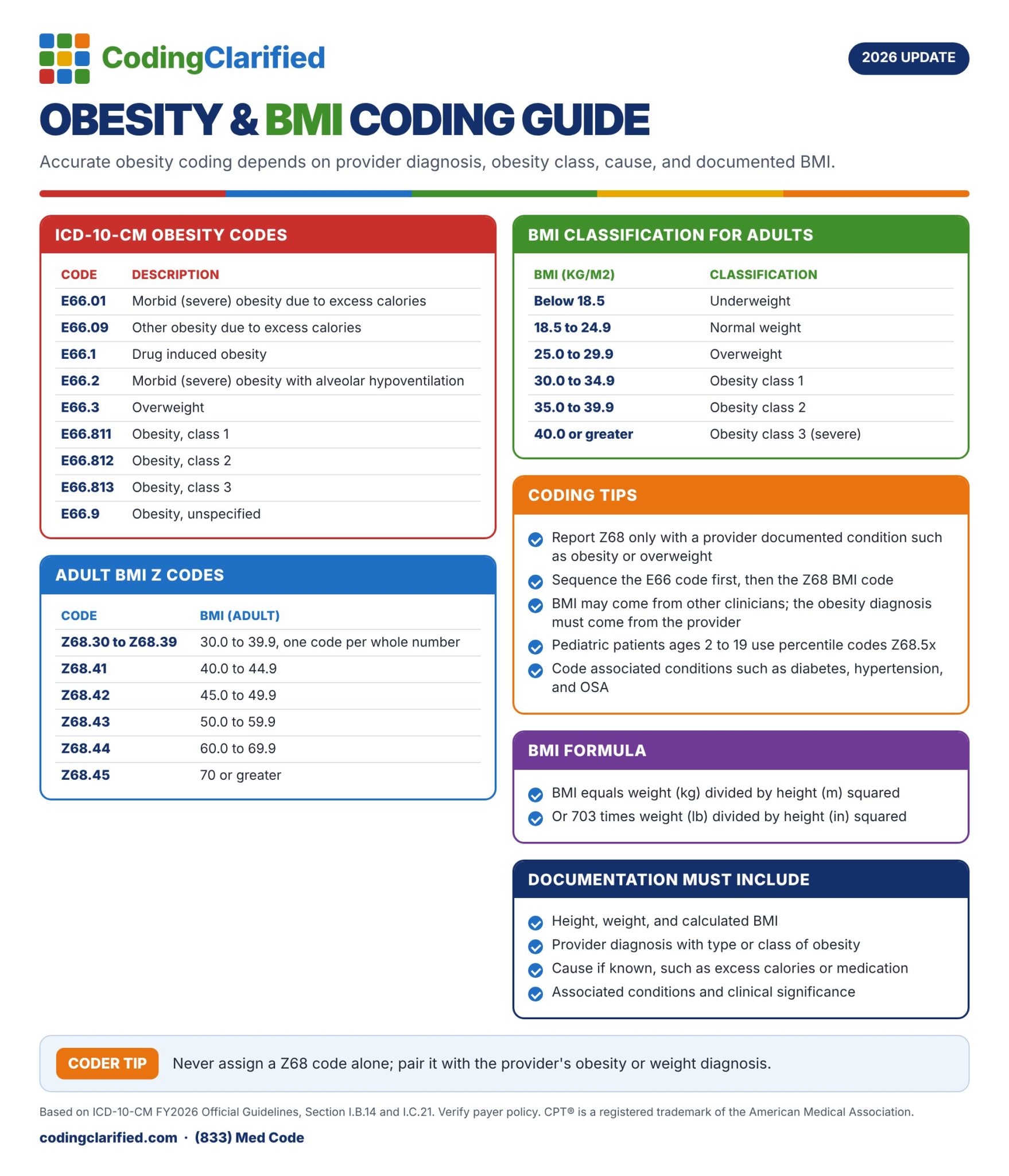
| BMI | Classification |
|---|---|
| Below 18.5 | Underweight |
| 18.5–24.9 | Healthy weight |
| 25.0–29.9 | higher weight body |
| 30.0–34.9 | Obesity Class I |
| 35.0–39.9 | Obesity Class II |
| 40.0 and above | Severe (Class III) obesity |
Even if the BMI falls within an obesity range, coders must follow provider documentation when assigning diagnosis codes.
ICD-10-CM Codes for Obesity
The provider’s documentation determines which diagnosis code should be assigned.
Some of the most common obesity diagnosis codes include:
| ICD-10-CM Code | Description |
|---|---|
| E66.811 | Obesity, Class 1 |
| E66.812 | Obesity, Class 2 |
| E66.813 | Obesity, Class 3 |
| E66.01 | Morbid (severe) obesity due to excess calories |
| E66.09 | Other obesity due to excess calories |
| E66.1 | Drug-induced obesity |
| E66.2 | Morbid (severe) obesity with alveolar hypoventilation |
| E66.3 | Higher weight body |
| E66.8 | Other obesity |
| E66.9 | Obesity, unspecified |
Always verify the code description in the current year’s ICD-10-CM code book before assigning a diagnosis.
Understanding BMI Codes (Z68.-)
BMI codes frequently confuse new medical coders.
Category Z68.- identifies the patient’s Body Mass Index but does not diagnose obesity.
Instead, BMI codes provide additional clinical information after the provider documents obesity or higher weight body.
Examples include:
| ICD-10-CM Code | Description |
|---|---|
| Z68.30 | BMI 30.0–30.9 |
| Z68.35 | BMI 35.0–35.9 |
| Z68.41 | BMI 40.0–44.9 |
| Z68.42 | BMI 45.0–49.9 |
| Z68.43 | BMI 50.0–59.9 |
| Z68.44 | BMI 60.0–69.9 |
| Z68.45 | BMI 70 or greater |
These codes should be reported as secondary diagnoses when supported by documentation and coding guidelines.
Can Coders Assign BMI Codes Without Physician Documentation?
Yes—but only under specific circumstances.
According to the ICD-10-CM Official Guidelines for Coding and Reporting, BMI values may come from clinicians other than the patient’s physician, such as:
- Registered nurses
- Dietitians
- Nutritionists
- Other qualified healthcare professionals
However, the provider must still document the associated diagnosis, such as obesity or higher weight body.
For example:
Correct
Provider documents:
Obesity due to excess calories
Nurse documents:
BMI 42.7
Codes assigned:
- E66.09
- Z68.41
Incorrect
Nurse documents:
BMI 42.7
Provider does not document obesity.
In this situation, the coder should not assign an obesity diagnosis code based only on the BMI.
Documentation Requirements for Obesity Coding
Strong documentation leads to accurate coding.
Providers should clearly document:
- Obesity
- Morbid obesity
- Severe obesity
- Higher weight body
- Drug-induced obesity
- Childhood obesity
- BMI when clinically appropriate
- Obesity-related complications
- Medical necessity for treatment
Additionally, providers should identify any associated conditions that affect patient care.
Examples include:
- E11.9 Type 2 diabetes mellitus
- I10 Essential hypertension
- G47.33 Obstructive sleep apnea
- E78.5 Hyperlipidemia
- M17.11 Unilateral primary osteoarthritis, right knee
Complete documentation strengthens coding accuracy while supporting reimbursement.
Sequencing Obesity Diagnosis Codes
Diagnosis sequencing depends on the reason for the encounter.
For example:
Office Visit for Obesity Management
Primary diagnosis:
E66.09
Secondary diagnosis:
Z68.41
Additional diagnoses:
Any obesity-related conditions treated during the visit.
Visit for Knee Pain Caused by Obesity
Primary diagnosis:
Condition chiefly responsible for the encounter
Secondary diagnosis:
E66.09
Additional diagnosis:
Z68.41
Correct sequencing tells the payer why the patient received treatment while also reporting obesity as a contributing condition.
CPC Student Tip
Remember this simple exam rule:
BMI does not equal obesity.
The provider documents the diagnosis.
The BMI supports the diagnosis.
Many CPC® exam questions test this concept because it reflects an important ICD-10-CM guideline.
CPT® Coding for Obesity Management
After assigning the correct diagnosis codes, coders must select the appropriate procedure codes based on the services the provider performed and documented.
Treatment for obesity may include:
- Evaluation and Management (E/M) services
- Intensive Behavioral Therapy (IBT)
- Medical nutrition therapy
- Weight-loss counseling
- Bariatric surgery
- Medication administration
- Follow-up visits
- Telehealth services when payer guidelines allow
Documentation should always support the level of service reported.
Evaluation and Management (E/M) Coding
Many obesity visits begin with a standard office visit. In these cases, providers evaluate the patient’s overall health, discuss weight-related conditions, review laboratory results, and develop a treatment plan.
Depending on the documentation and medical decision-making, common office visit codes may include:
- 99202–99205 – New patient office visits
- 99211–99215 – Established patient office visits
Medical decision-making should support the selected E/M level. Time may also determine code selection when documented appropriately.
Typical documentation includes:
- BMI review
- Weight history
- Comorbid conditions
- Dietary assessment
- Exercise habits
- Medication review
- Treatment goals
- Follow-up plan
Intensive Behavioral Therapy (IBT) for Obesity
One of the most frequently tested obesity services involves Medicare’s Intensive Behavioral Therapy benefit.
The primary CPT® code is:
- G0447 – Face-to-face behavioral counseling for obesity, approximately 15 minutes
This HCPCS Level II code applies to eligible Medicare beneficiaries who meet coverage requirements.
Generally, Medicare covers G0447 when:
- BMI is 30 or greater
- Counseling occurs in a qualified primary care setting
- The provider follows Medicare’s frequency requirements
- Documentation demonstrates progress toward weight-loss goals
Providers should review current Medicare guidance because frequency limits and coverage policies may change.
Medical Nutrition Therapy (MNT)
Some patients receive nutritional counseling from a registered dietitian or other qualified nutrition professional.
Common CPT® codes include:
- 97802 – Initial assessment and intervention, individual
- 97803 – Reassessment and intervention
- 97804 – Group nutrition therapy
Documentation should include:
- Nutrition assessment
- Dietary recommendations
- Treatment goals
- Time spent
- Patient education
- Follow-up recommendations
Medical necessity remains essential for reimbursement.
Preventive Counseling Services
Patients without a diagnosed illness may receive preventive counseling related to healthy lifestyle choices.
Depending on the encounter, providers may report:
- 99401–99404 – Preventive medicine counseling, individual
- 99411–99412 – Preventive medicine counseling, group
These services differ from obesity treatment visits because they focus on prevention rather than managing an established diagnosis.
Always verify payer policies before reporting preventive counseling services.
Bariatric Surgery CPT® Codes
Patients with severe obesity sometimes qualify for bariatric surgery after conservative treatment has failed.
Several CPT® codes commonly appear in bariatric coding.
Examples include:
| CPT® Code | Procedure |
|---|---|
| 43644 | Laparoscopic Roux-en-Y gastric bypass |
| 43645 | Gastric bypass with small intestine reconstruction |
| 43770 | Laparoscopic gastric band placement |
| 43775 | Laparoscopic sleeve gastrectomy |
| 43842 | Vertical banded gastroplasty |
Because these procedures involve complex coding rules, coders should carefully review the operative report.
Documentation should identify:
- Surgical approach
- Procedure performed
- Revision versus primary surgery
- Intraoperative findings
- Complications
- Medical necessity
HCPCS Codes Used During Obesity Treatment
Although diagnosis and CPT® codes receive most of the attention, HCPCS Level II codes also play an important role.
Depending on the payer and services provided, coders may report HCPCS codes for:
- Injectable medications
- Medical supplies
- Durable medical equipment
- Certain biological products
- Medicare-specific services
Always verify the current HCPCS manual because new codes and deleted codes are released annually.
Weight-Loss Medications
Medical management has expanded significantly in recent years. Consequently, providers now prescribe anti-obesity medications more frequently than ever before.
When medications are administered in the office, coding may include:
- Appropriate HCPCS drug code
- Administration CPT® code, when applicable
- Diagnosis supporting medical necessity
If the patient self-administers the medication at home, providers generally do not report an in-office administration code.
Coverage varies considerably among commercial insurers and government payers, so coders should verify payer-specific requirements.
GLP-1 Medications and Coding Updates for 2026
GLP-1 receptor agonists and dual GLP-1/GIP medications continue to transform obesity treatment in 2026. While these medications have expanded treatment options for patients with obesity, they do not change the fundamental medical coding rules. Coders should continue assigning diagnosis and procedure codes based on the provider’s documentation, medical necessity, and the services performed—not simply because a patient is taking a GLP-1 medication.
Common medications prescribed for chronic weight management include:
- Wegovy
- Zepbound
- Saxenda
Several GLP-1 medications are also approved for treating other conditions, such as type 2 diabetes. Therefore, coders must carefully review the provider’s documentation to determine the appropriate diagnosis for the encounter.
Coding Tips for GLP-1 Therapy
When coding visits involving GLP-1 medications:
- Continue reporting the documented obesity diagnosis, such as E66.01, E66.09, E66.811, E66.812, E66.813, or E66.9, as supported by the provider’s documentation and the current ICD-10-CM code set.
- Report the appropriate Z68.- BMI code when ICD-10-CM guidelines permit.
- Code any documented obesity-related comorbidities, including diabetes, hypertension, obstructive sleep apnea, or hyperlipidemia.
- Report the appropriate E/M, counseling, or nutrition therapy service performed during the encounter.
- If the medication is administered in the office, report the applicable HCPCS drug code and any administration code supported by the documentation.
- If the patient self-administers the medication at home, do not report an in-office drug administration service unless one was actually provided.
Documentation Remains the Key
Documentation should clearly support:
- The obesity diagnosis
- BMI
- Medical necessity
- Comorbid conditions
- Counseling provided
- Medication management
- Patient response to therapy
- Follow-up plan
Although GLP-1 medications have become more common, coders should remember that the medication itself does not establish the diagnosis. Instead, the provider must document obesity or another reportable condition before assigning the appropriate ICD-10-CM code.
Medicare and Commercial Coverage in 2026
Coverage for GLP-1 medications continues to evolve. Beginning in July 2026, CMS launched the Medicare GLP-1 Bridge demonstration, allowing eligible Medicare beneficiaries access to certain GLP-1 medications under specific program requirements. Commercial insurers also continue to expand coverage, although many plans still require prior authorization and documentation of BMI, obesity-related comorbidities, and previous weight-loss attempts. Because coverage varies significantly among payers, coders and billers should always verify the patient’s individual plan requirements before claim submission.
Documentation for Weight-Loss Treatment
Clear documentation supports accurate coding and helps reduce denials.
Providers should document:
- Current weight
- Height
- BMI
- Obesity diagnosis
- Comorbid conditions
- Previous weight-loss attempts
- Diet recommendations
- Exercise recommendations
- Behavioral counseling
- Medication management
- Follow-up plan
Furthermore, providers should describe how obesity affects the patient’s health and treatment decisions.
Obesity and Medical Necessity
Medical necessity remains one of the most common reasons obesity-related claims are denied.
For example, simply documenting obesity may not justify additional testing or procedures.
Instead, documentation should explain why the service was medically necessary.
Examples include:
- Severe obesity affecting anesthesia risk
- Obesity contributing to joint pain
- Obesity complicating diabetes management
- Obesity worsening obstructive sleep apnea
- Obesity increasing cardiovascular risk
Specific documentation creates a stronger connection between the diagnosis and the services provided.
Medicare Coverage Considerations
Medicare provides coverage for certain obesity-related services when all coverage requirements are met.
Coverage may include:
- Intensive Behavioral Therapy using G0447
- Physician office visits
- Certain laboratory testing
- Bariatric surgery for qualified beneficiaries
- Nutrition services under specific circumstances
However, not every obesity-related service qualifies for reimbursement. Therefore, coders should review the applicable National Coverage Determinations (NCDs), Local Coverage Determinations (LCDs), and Medicare Administrative Contractor (MAC) policies before submitting claims.
Commercial Insurance Considerations
Commercial insurance plans often follow different coverage rules than Medicare.
For instance, one payer may cover nutrition counseling, while another may require prior authorization. Likewise, coverage for weight-loss medications and bariatric procedures varies significantly between plans.
Before coding these services, verify:
- Prior authorization requirements
- Medical necessity criteria
- Covered diagnosis codes
- Benefit limitations
- Documentation requirements
- Frequency limits
Taking these steps can prevent unnecessary claim delays and denials.
Coding Example
Scenario
A 46-year-old established patient visits her primary care physician for obesity management. The provider documents obesity due to excess calories with a BMI of 42.3. During the visit, the physician reviews laboratory results, discusses diet and exercise, provides 15 minutes of intensive behavioral counseling, and schedules a follow-up appointment.
Possible Codes
ICD-10-CM
- E66.09 – Other obesity due to excess calories
- Z68.41 – Body Mass Index (BMI) 40.0–44.9, adult
HCPCS
- G0447 – Face-to-face behavioral counseling for obesity, approximately 15 minutes
If a separately identifiable E/M service is performed beyond the counseling requirements and supported by documentation, an appropriate office visit code may also be reportable according to payer guidelines.
Common Mistakes to Avoid
Even experienced medical coders can make mistakes when coding obesity-related encounters. Fortunately, recognizing these common errors can improve coding accuracy and reduce claim denials.
Assigning an Obesity Diagnosis from BMI Alone
The BMI value does not establish the diagnosis of obesity. Instead, the provider must document obesity, higher weight body, or another applicable diagnosis before assigning an obesity code.
Reporting a BMI Code as the Primary Diagnosis
Category Z68.- contains supplemental information. Therefore, BMI codes generally accompany the obesity diagnosis rather than serve as the primary diagnosis.
Using an Unspecified Code When Documentation Is More Specific
Whenever documentation supports a more detailed diagnosis, report the most specific ICD-10-CM code available. Avoid relying on E66.9 (Obesity, unspecified) when the provider identifies the type or cause of obesity.
Forgetting Associated Conditions
Obesity often exists alongside other chronic diseases. Consequently, coders should also report documented conditions such as:
- E11.9 – Type 2 diabetes mellitus without complications
- I10 – Essential (primary) hypertension
- G47.33 – Obstructive sleep apnea (adult)
- E78.5 – Hyperlipidemia, unspecified
- M17.11 – Unilateral primary osteoarthritis, right knee
Always follow ICD-10-CM coding guidelines and payer-specific reporting requirements.
Missing Documentation for Medical Necessity
Insurance carriers frequently deny obesity-related services when documentation does not explain why the service was medically necessary. Therefore, ensure the provider clearly documents the patient’s condition, treatment plan, and clinical reasoning.
CPC Student Tips
If you are studying for the CPC® exam, obesity coding is a topic worth mastering because it combines ICD-10-CM guidelines, CPT®, HCPCS Level II, and documentation concepts.
Keep these tips in mind:
- Read the entire coding scenario before selecting a diagnosis code.
- Verify every code in the Tabular List after locating it in the Alphabetic Index.
- Never assign obesity from BMI alone.
- Remember that Z68.- codes provide additional information and usually accompany an obesity diagnosis.
- Review the Official ICD-10-CM Guidelines for BMI reporting.
- Watch for terms such as “due to excess calories,” “drug-induced,” or “with alveolar hypoventilation,” as they affect code selection.
- Practice sequencing diagnosis codes based on the reason for the encounter.
- Stay current with annual ICD-10-CM, CPT®, and HCPCS updates.
Building strong coding habits now will help you both on the CPC® exam and in daily coding practice.
2026 Coding Best Practices
Medical coding continues to evolve, and obesity coding is no exception. In 2026, coders should focus on complete documentation, annual coding updates, and payer-specific guidance.
Best practices include:
- Verify all codes in the current year’s code books.
- Follow the ICD-10-CM Official Guidelines for Coding and Reporting.
- Review Medicare National Coverage Determinations (NCDs) and Local Coverage Determinations (LCDs) when applicable.
- Confirm commercial payer policies before reporting counseling or weight-management services.
- Query the provider whenever documentation lacks the specificity needed for accurate code assignment.
- Support every diagnosis and procedure with clear clinical documentation.
Following these practices helps improve claim accuracy, reimbursement, and compliance.
Related Coding Clarified Articles
Continue building your coding knowledge with these related resources from Coding Clarified:
- Coronary Artery Disease (CAD) Medical Coding
- Medical Coding for Pressure Ulcers
- Medical Coding GLP-1 Medications
- Medical Coding Bariatric Surgery
- Coding Clarified Blog