Dermatology medical coding can look simple until you start reviewing the details. A dermatologist may evaluate several lesions, biopsy one, destroy another, excise a third, and provide treatment for an unrelated skin condition during the same visit. Therefore, accurate coding depends on knowing exactly what was done to each lesion and why.
In 2026, coders also need to understand current CPT guidelines, ICD-10-CM diagnosis selection, National Correct Coding Initiative (NCCI) edits, modifier rules, and payer requirements. Most importantly, the documentation must support every code reported.
This guide explains common dermatology CPT and ICD-10-CM coding concepts, including skin biopsies, lesion removal, destruction, excisions, Mohs surgery, repairs, E/M services, and common coding mistakes.
Key Takeaways
- Dermatology procedure coding depends heavily on the type of procedure, number of lesions, anatomical location, lesion size, diagnosis, and documentation.
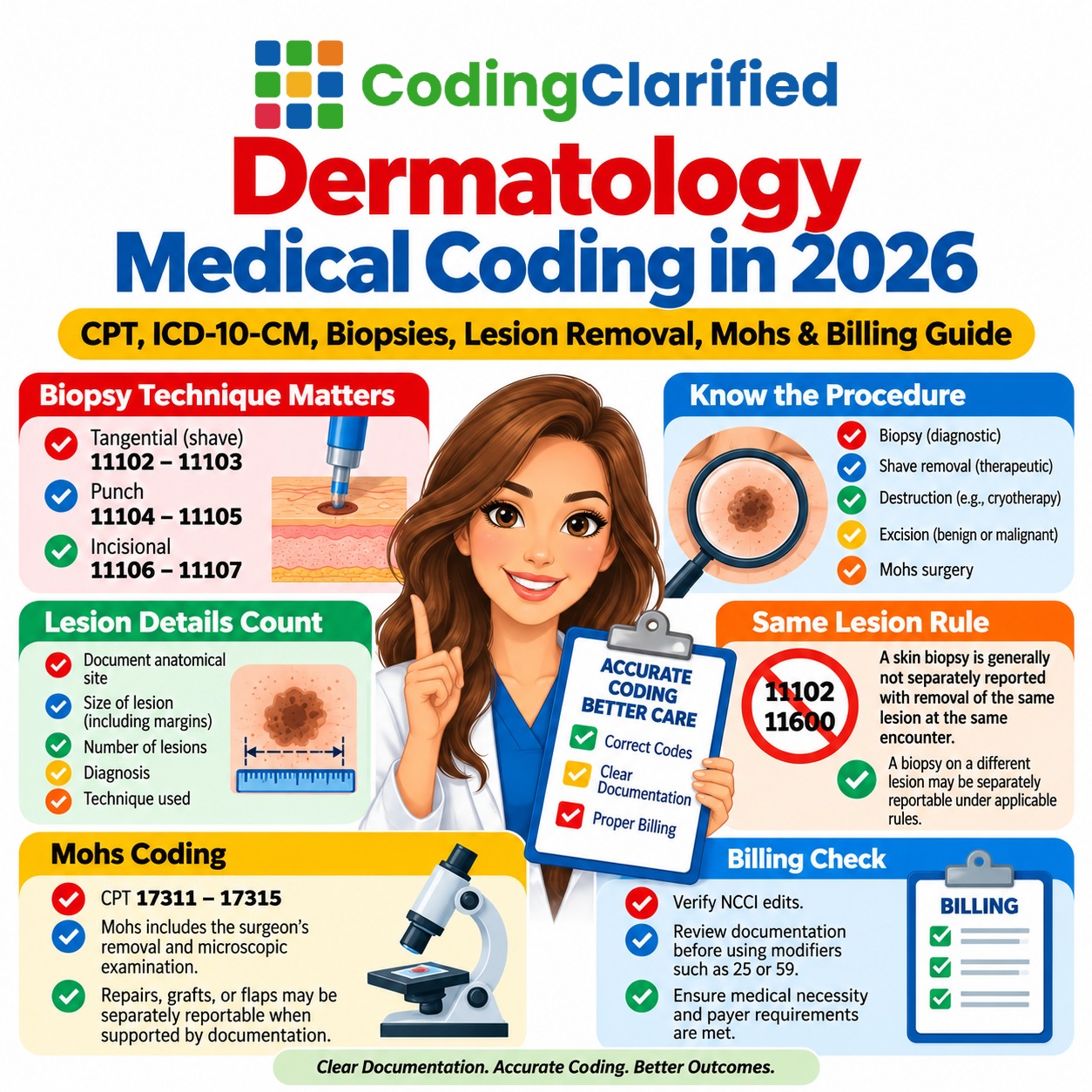
- Skin biopsy codes differ based on technique. Common families include 11102–11103 for tangential biopsy, 11104–11105 for punch biopsy, and 11106–11107 for incisional biopsy.
- Do not confuse a diagnostic biopsy with shaving a lesion for treatment.
- Benign and malignant lesion excisions use different CPT code families.
- For excision coding, documentation should support the lesion location and the excised diameter, including margins.
- Destruction codes are different from excision and biopsy codes.
- Mohs micrographic surgery has specific coding requirements because the physician serves as both surgeon and pathologist.
- A separate E/M service on the same date as a dermatology procedure requires documentation supporting a significant, separately identifiable service when applicable.
- CMS NCCI edits and payer policies should always be checked before reporting multiple procedures together.
- Never choose a diagnosis only because it gets a claim paid. Code the condition supported by the medical record.
What Is Dermatology Medical Coding?
Dermatology coding is the process of assigning CPT, HCPCS Level II, and ICD-10-CM codes to services involving the skin, hair, nails, and related structures. Although dermatology practices provide routine office visits, they also perform many procedures.
For example, coders may encounter biopsies, lesion destruction, excisions, repairs, injections, nail procedures, acne treatment, wart treatment, and skin cancer surgery. As a result, dermatology coding requires both diagnosis and surgical coding knowledge.
The 2026 CMS NCCI Policy Manual places many dermatologic procedures within the integumentary system and includes guidance for biopsy, lesion removal, repair, tissue transfer, Mohs micrographic surgery, and related services. Therefore, coders should not rely only on a CPT code description when several services occur during the same encounter.
Students who are still learning CPT organization may also find our AAPC CPC Certification Guide for 2026 helpful.
Skin Biopsy Coding in 2026
A skin biopsy removes tissue for diagnostic examination. However, the correct CPT code depends on the technique used.
Tangential Skin Biopsy
A tangential biopsy removes tissue using a technique such as a shave, scoop, saucerization, or curette technique when performed for diagnostic histopathologic examination.
Common codes include:
- 11102 — first lesion
- 11103 — each additional lesion
The key word is diagnostic. For example, AAPC describes 11102 as a tangential biopsy of a single skin lesion.
Punch Biopsy
A punch biopsy uses a punch tool to obtain a cylindrical tissue sample. Common CPT codes include:
- 11104 — first lesion
- 11105 — each additional lesion
AAPC notes that 11104 represents a punch biopsy of one skin lesion.
Incisional Biopsy
An incisional biopsy involves cutting into a lesion to obtain a tissue sample without removing the entire lesion.
Common codes include:
- 11106 — first lesion
- 11107 — each additional lesion
Consequently, coders should never select the biopsy code from the word “biopsy” alone. Instead, read the procedure note and determine the actual technique.
Biopsy vs. Shave Removal: Know the Difference
One of the most common dermatology coding errors involves confusing a tangential biopsy with shave removal.
A biopsy is performed primarily to obtain tissue for diagnostic examination. In contrast, shave removal is intended to remove a lesion therapeutically.
Shave removal codes fall within 11300–11313, with code selection based on anatomical location and lesion diameter. Therefore, the physician’s intent and documentation matter.
For example, a note that simply states “lesion shaved” may not provide enough information. The coder needs to know whether the physician sampled the lesion for diagnosis or removed it as treatment.
Coding Benign Skin Lesion Excisions
Benign lesion excisions generally fall within CPT code range 11400–11446. However, the correct code depends on two major factors:
- Anatomical location
- Excised diameter
An excision differs from a biopsy because the physician removes the lesion rather than merely sampling it.
Additionally, the measurement used for excision coding is not simply the lesion size. The excised diameter includes the lesion plus the margins required for complete excision.
For example, suppose a lesion measures 1.0 cm and the physician removes a 0.2 cm margin on each side. The total excised diameter would be 1.4 cm.
That measurement can change the CPT code. Therefore, documentation of both lesion size and margins is extremely important.
Coding Malignant Skin Lesion Excisions
Malignant skin lesion excisions generally use CPT codes 11600–11646.
Again, code selection depends on:
- anatomical location,
- excised diameter,
- and documented malignancy.
For example, 11606 describes excision of a malignant lesion from the trunk, arms, or legs when the excised diameter is greater than 4.0 cm.
Coders should carefully review pathology and the medical record before choosing between benign and malignant lesion code families. Additionally, payer requirements may affect when a claim should be submitted if pathology is pending.
Common ICD-10-CM Codes in Dermatology
Dermatology practices use a wide range of ICD-10-CM codes. Therefore, the diagnosis should always match the provider’s documentation rather than the coder’s assumptions.
Common examples include:
- L57.0 — Actinic keratosis
- L82.1 — Other seborrheic keratosis
- L82.0 — Inflamed seborrheic keratosis
- L91.0 — Hypertrophic scar
- L70.0 — Acne vulgaris
- L30.9 — Dermatitis, unspecified
- L40.9 — Psoriasis, unspecified
- B07.9 — Viral wart, unspecified
- D22.9 — Melanocytic nevi, unspecified
- D48.5 — Neoplasm of uncertain behavior of skin
- D49.2 — Neoplasm of unspecified behavior of bone, soft tissue, and skin
Specificity matters. For skin cancers, for example, ICD-10-CM frequently requires the coder to identify the type and anatomical site.
Furthermore, do not automatically assign D48.5 simply because pathology is pending. “Uncertain behavior” has a specific meaning and is not the same as a lesion whose behavior has not yet been established. When documentation does not establish the behavior, review the ICD-10-CM guidelines and documentation carefully before assigning the diagnosis.
Coding Destruction of Skin Lesions
Destruction means the physician destroys lesion tissue rather than surgically excising it. Techniques may include electrosurgery, cryosurgery, laser treatment, chemical treatment, or other approved methods.
One common example involves destruction of premalignant lesions such as actinic keratoses.
Common CPT codes include:
- 17000 — first premalignant lesion
- 17003 — second through 14th lesions, each
- 17004 — 15 or more lesions
Meanwhile, destruction of benign lesions may involve codes such as 17110 or 17111, depending on the number of lesions and the service performed.
The diagnosis is important because CPT separates certain destruction services based on the nature of the lesion. Consequently, coders should verify both the procedure and documented diagnosis.
Mohs Micrographic Surgery Coding
Mohs micrographic surgery is commonly used to treat certain skin cancers while preserving as much healthy tissue as possible.
Unlike a standard excision, Mohs surgery involves removing tissue in stages and examining the tissue microscopically. The same physician performs both the surgical removal and microscopic examination required by the Mohs procedure.
Common Mohs codes include:
- 17311
- 17312
- 17313
- 17314
- 17315
For example, 17311 applies to the first stage for qualifying anatomical sites and includes up to five tissue blocks. Additional codes may apply depending on the number of stages, anatomical location, and number of tissue blocks.
AAPC describes 17311 as Mohs micrographic surgery in which a malignant lesion is removed in stages with histopathologic assessment to evaluate the margins.
CMS also provides specific NCCI guidance for Mohs services. Therefore, coders should review current CPT instructions and NCCI edits before separately reporting biopsies, pathology, repairs, or other services associated with the Mohs encounter.
Can You Bill a Biopsy and Lesion Removal Together?
Sometimes, but not automatically.
CMS states that lesion-removal codes include obtaining tissue by biopsy from the same lesion during the same encounter. Therefore, skin biopsy codes 11102–11107 generally should not be separately reported with removal of that same lesion.
However, a biopsy may be separately reportable when performed on a different lesion. CMS also recognizes specific circumstances involving a biopsy followed by a more extensive procedure when the biopsy result leads to the decision to proceed with that procedure.
This rule is especially important in dermatology because multiple lesions are often evaluated and treated during one visit.
Repairs After Dermatology Procedures
Another common challenge involves coding closure after lesion excision.
Simple repair is generally included in the excision and is not separately reported. However, an intermediate or complex repair may be separately reportable when documentation and CPT guidelines support it.
Coders should look for:
- wound length,
- anatomical location,
- type of repair,
- layers closed,
- debridement when relevant,
- and other documentation supporting the repair classification.
Never assume a repair is complex merely because the procedure note is lengthy. Instead, match the documented work to the CPT definition.
Dermatology E/M Services and Modifier 25
A patient may receive an office or outpatient E/M service and a procedure during the same visit. However, the presence of both services does not automatically justify reporting both.
A separate E/M service must meet the requirements for reporting an E/M service in addition to the procedure. When appropriate, modifier 25 may identify a significant, separately identifiable E/M service performed by the same physician or qualified healthcare professional on the same day as a procedure.
For instance, evaluating an unrelated rash while also treating a wart may support a separate E/M service when the documentation supports the work.
Conversely, the routine evaluation needed to decide to perform a minor procedure generally should not be separated simply to generate another charge. Therefore, documentation remains essential.
Modifier 59 and Distinct Dermatology Procedures
Modifier 59 may be appropriate when procedures that would normally be bundled are truly distinct under applicable coding rules.
A distinct service might involve a separate lesion, separate anatomical site, separate encounter, or another circumstance recognized by CPT, CMS, or the payer.
However, modifier 59 should never be added merely because a claim edit appears. First, determine why the edit exists. Then, verify that the medical record supports an allowed exception.
CMS emphasizes that NCCI edits do not represent every possible improper code combination. Providers remain responsible for correct coding even when an edit does not automatically prevent payment.
For more information about anatomical reporting, see our 2026 Anatomical Modifiers Guide.
Dermatology Documentation Checklist
Strong documentation makes accurate dermatology coding much easier. Ideally, the medical record should identify the number of lesions and clearly distinguish each lesion treated.
For every applicable lesion, look for the anatomical location, size, diagnosis, procedure performed, biopsy technique, excision margins, destruction method, repair details, and pathology information.
In addition, each procedure should be linked to the correct diagnosis. When several lesions are treated differently, clear lesion-by-lesion documentation can prevent both coding errors and denials.
Common Mistakes to Avoid
1. Coding Every “Shave” as a Shave Removal
A tangential biopsy can involve a shaving technique. Therefore, determine whether the purpose was diagnostic sampling or therapeutic removal before choosing the code.
2. Reporting a Biopsy With Removal of the Same Lesion
CMS NCCI policy generally bundles the biopsy into removal of the same lesion when performed during the same encounter, subject to specific exceptions.
3. Using Lesion Size Instead of Excised Diameter
For excision coding, the required measurement includes the lesion and applicable margins. Consequently, using only the lesion diameter can lead to the wrong code.
4. Automatically Reporting a Separate E/M Code
The decision to perform a minor procedure does not automatically create a separately reportable E/M service. Instead, confirm that the documentation supports significant, separately identifiable E/M work.
5. Using Modifier 59 to Override Every Edit
An edit is not a signal to automatically add modifier 59. The medical record must support a true coding exception.
6. Assuming “Uncertain Behavior” Means Pathology Is Pending
D48.5 should not be used simply because the coder does not yet know whether a lesion is benign or malignant. Instead, code according to the documented diagnosis and ICD-10-CM rules.
7. Missing the Number of Lesions
Many dermatology codes depend on lesion count. Therefore, “multiple lesions treated” may not provide enough information for accurate coding.
CPC Student Tips for Dermatology Coding
Dermatology questions are excellent CPC exam questions because they test several skills at once. First, identify exactly what the physician did: biopsy, shave removal, destruction, excision, repair, or Mohs.
Next, highlight the location, size, number of lesions, diagnosis, margins, and technique. Those details often determine the final code.
Additionally, pay attention to add-on codes. A question involving multiple biopsies, Mohs stages, or lesions may require a primary code plus one or more add-on codes.
Finally, do not code from memory during practice. Learn how to navigate your CPT and ICD-10-CM manuals efficiently. That skill is far more valuable on the CPC exam and in real-world coding.
For more exam preparation, review What Is on the AAPC CPC Exam in 2026? and our guide on How to Excel in Medical Coding in 2026.
2026 Dermatology Coding Compliance Tips
For 2026 claims, coders should use the current-year CPT code set, the applicable ICD-10-CM code set for the date of service, current payer policies, and current NCCI edits.
CMS published its 2026 Medicare NCCI Policy Manual with an effective date of January 1, 2026. Chapter 3 specifically addresses surgery of the integumentary system, including lesion removal, Mohs surgery, repair, tissue transfer, and other services frequently encountered in dermatology.
Because coding rules continue to change, ongoing education is essential. Our Latest Trends & Best Practices in Medical Coding 2026 explains additional changes affecting today’s coders.
Authoritative resources include the Centers for Medicare & Medicaid Services (CMS), AAPC, and the American Medical Association (AMA).
Final Thoughts
Dermatology medical coding requires much more than matching a skin condition to a code. Accurate coding depends on understanding what procedure was performed, why it was performed, which lesion was treated, how many lesions were involved, where each lesion was located, and whether other services can be separately reported.
In 2026, coders should also pay close attention to NCCI edits, current CPT instructions, ICD-10-CM specificity, modifier requirements, and payer policies. Most importantly, code from the documentation rather than assumptions.
When the documentation clearly identifies each lesion and service, dermatology coding becomes much easier. In contrast, vague notes can quickly create problems with code selection, medical necessity, bundling, and reimbursement.
Frequently Asked Questions About Dermatology Medical Coding
What CPT codes are used for skin biopsies?
Common skin biopsy codes include 11102–11103 for tangential biopsies, 11104–11105 for punch biopsies, and 11106–11107 for incisional biopsies. The correct code depends on the biopsy technique and number of lesions.
What is the difference between a biopsy and an excision?
A biopsy generally samples tissue for diagnostic examination, while an excision removes the lesion. Therefore, coders should review the physician’s intent and procedure documentation rather than relying only on terms such as “biopsy.”
Can you bill a skin biopsy and excision on the same day?
They may be reportable when performed on separate lesions or under certain other circumstances allowed by coding guidelines. However, a biopsy from the same lesion is generally included in lesion removal during the same encounter unless a specific coding exception applies.
How do you calculate lesion size for excision coding?
Use the greatest clinical diameter of the lesion plus the margins required for complete excision. Therefore, coders need documentation of both the lesion measurement and applicable margins.
Is simple closure separately billable after a skin lesion excision?
Generally, simple repair is included in the lesion excision. Intermediate or complex repair may be separately reportable when CPT guidelines and the documentation support it.
When can modifier 25 be used in dermatology?
Modifier 25 may be appropriate when a significant, separately identifiable E/M service is performed by the same physician or qualified healthcare professional on the same day as another procedure or service. Documentation must support the separate E/M work.
Can modifier 59 be used when two dermatology procedures bundle?
Modifier 59 may be appropriate when the procedures are truly distinct and the circumstances meet CPT, NCCI, and payer requirements. However, coders should never use modifier 59 solely to bypass an edit.
What should CPC students focus on when studying dermatology coding?
Focus on procedure type, anatomical site, lesion size, margins, lesion count, diagnosis, repair type, and add-on codes. Additionally, practice distinguishing biopsies, shave removals, destruction, excisions, and Mohs procedures because those differences frequently determine the correct CPT code.