If you are researching what medical coding is and how to get certified in 2026, you may be wondering where to start. Medical coding can offer a path into healthcare without requiring years of traditional college education. However, becoming a successful medical coder involves much more than memorizing codes.
Medical coders review healthcare documentation and translate diagnoses, procedures, services, and supplies into standardized medical codes. Therefore, coders need training in medical terminology, anatomy, coding guidelines, documentation, compliance, and reimbursement.
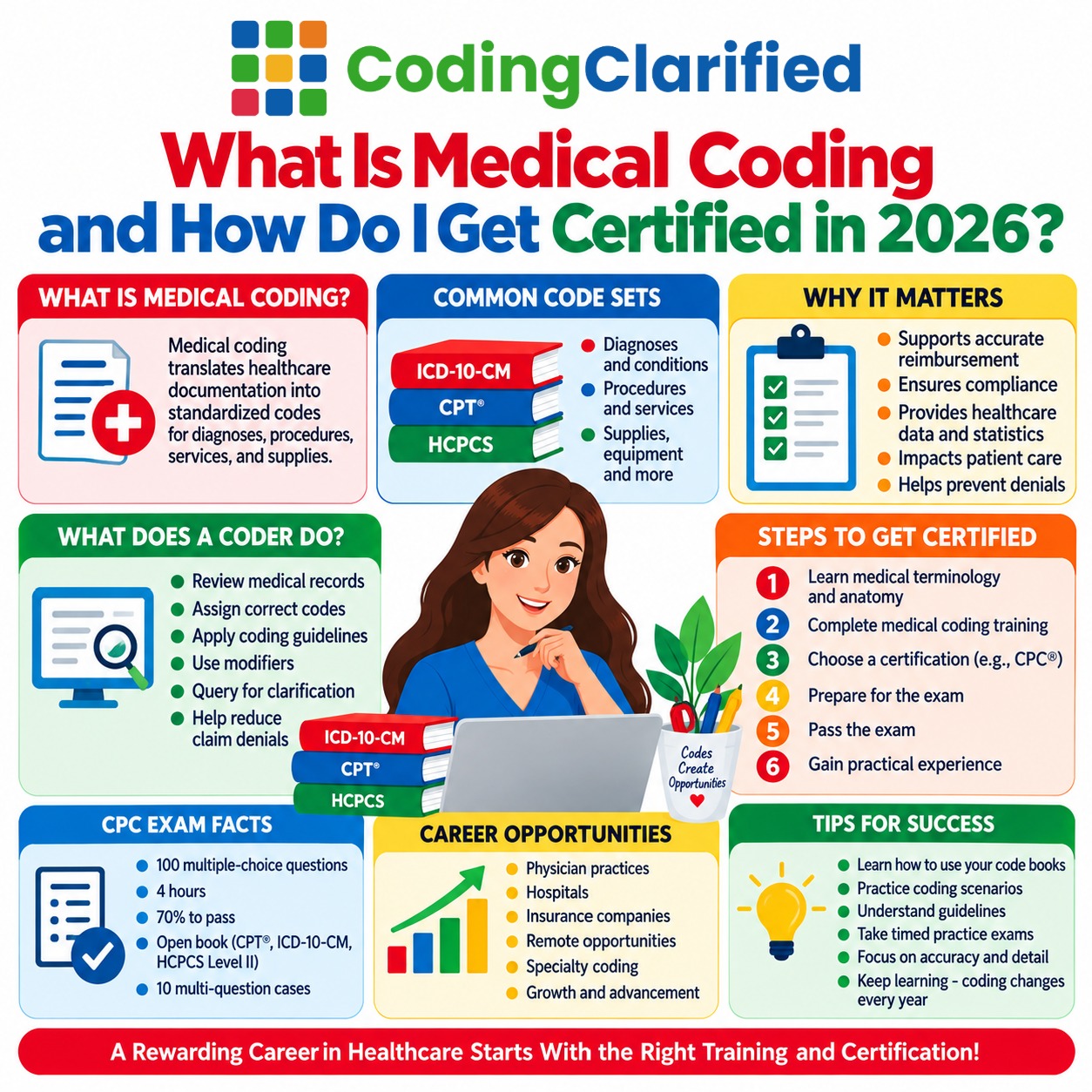
In 2026, medical coders commonly work with ICD-10-CM, CPT®, and HCPCS Level II. Additionally, employers increasingly expect certified coders to understand current guidelines, payer requirements, electronic health records, and computer-assisted or AI-supported coding tools.
This guide explains what medical coding is, what medical coders do, how to become certified, what the CPC exam involves, and how to start a medical coding career in 2026.
Key Takeaways on Medical Coding Certification
- Medical coding converts healthcare documentation into standardized diagnosis, procedure, service, and supply codes.
- Professional coders commonly use ICD-10-CM, CPT®, and HCPCS Level II.
- Medical coding affects reimbursement, compliance, healthcare data, quality reporting, and patient records.
- You do not necessarily need a four-year college degree to become a medical coder.
- The AAPC Certified Professional Coder (CPC®) credential is a widely recognized certification for professional medical coding.
- The current CPC exam contains 100 multiple-choice questions, allows four hours, and requires a score of at least 70% to pass.
- Certification is important; however, practical coding experience can make you more competitive for your first job.
- Remote medical coding jobs exist, but entry-level remote positions may be more competitive.
- Coding changes every year, so professional coders must continue learning throughout their careers.
- AI can assist medical coders, but coders still need to verify documentation, guidelines, compliance, and coding accuracy.
What Is Medical Coding?
Medical coding is the process of translating information from a patient’s medical record into standardized codes.
A medical coder may review physician notes, operative reports, laboratory results, imaging reports, emergency department records, office visits, and other healthcare documentation. Next, the coder determines which codes accurately describe the documented diagnoses and services.
These codes create a common language that healthcare providers, insurance companies, government programs, and other organizations can use.
For example, medical coding can represent:
- Patient diagnoses
- Physician services
- Surgical procedures
- Diagnostic testing
- Laboratory services
- Medical supplies
- Durable medical equipment
- Medications administered in certain settings
- Ambulance services
- Preventive services
Consequently, medical coding connects clinical documentation with reimbursement and healthcare data.
What Are the Three Main Medical Coding Systems?
New medical coding students usually begin by learning three major code sets.
ICD-10-CM
ICD-10-CM is primarily used to report diagnoses and conditions in U.S. healthcare settings.
For example, a coder may use an ICD-10-CM code to describe diabetes, hypertension, an injury, an infection, or another documented condition.
Coders must select codes based on provider documentation and the Official Guidelines for Coding and Reporting. Additionally, they must pay attention to details such as laterality, encounter type, manifestations, complications, and code sequencing.
The Centers for Medicare & Medicaid Services (CMS) publishes official ICD-10 resources and updates. In fact, coding students should become comfortable using official resources instead of relying only on internet searches or AI-generated coding answers.
CPT®
Current Procedural Terminology, or CPT®, is maintained by the American Medical Association.
CPT® codes primarily describe medical procedures and professional services. For instance, the code set includes evaluation and management services, surgery, radiology, pathology and laboratory services, and medicine services.
Coders must understand more than individual CPT® codes. Instead, they also need to understand section guidelines, parenthetical instructions, modifiers, bundled services, and other coding rules.
HCPCS Level II
HCPCS Level II codes identify many products, supplies, equipment, medications, ambulance services, and other services that may not be represented by CPT®.
CMS maintains HCPCS Level II. Furthermore, CMS releases HCPCS updates throughout the year, making current coding resources especially important in 2026.
Why Is Medical Coding Important?
Medical coding happens behind the scenes, but it plays an important role throughout healthcare.
Accurate coding helps healthcare organizations submit claims that reflect documented services. Additionally, coded information contributes to healthcare statistics, research, quality reporting, risk adjustment, public health information, and financial operations.
Incorrect coding, on the other hand, can create serious problems.
Errors may result in:
- Claim denials
- Delayed reimbursement
- Incorrect payment
- Compliance concerns
- Failed audits
- Inaccurate healthcare data
- Additional administrative work
Therefore, medical coders must balance productivity with accuracy.
What Does a Medical Coder Do Every Day?
A medical coder’s responsibilities vary by employer and specialty. However, the basic process usually starts with reviewing medical documentation.
First, the coder determines what happened during the patient encounter. Next, the coder identifies the diagnoses, procedures, and services supported by the documentation. Then, applicable coding guidelines and payer rules must be considered before codes are finalized.
Depending on the position, a medical coder may also:
- Review medical records for missing information.
- Apply ICD-10-CM, CPT®, and HCPCS Level II codes.
- Assign appropriate modifiers.
- Review National Correct Coding Initiative edits.
- Research payer policies.
- Identify documentation problems.
- Submit provider queries when clarification is appropriate.
- Review denied claims.
- Respond to coding audits.
- Work with billing, compliance, and clinical teams.
- Use encoder or computer-assisted coding software.
- Verify suggestions produced by AI-supported coding systems.
As a result, medical coding requires critical thinking rather than simple data entry.
Is Medical Coding the Same as Medical Billing?
No. Although medical coding and medical billing work closely together, they are different functions.
Medical coders analyze clinical documentation and determine the appropriate codes. Medical billers generally use coded information to prepare, submit, track, and follow up on insurance claims.
In some smaller healthcare organizations, one employee may perform both responsibilities. However, larger organizations often separate coding and billing roles.
Understanding this difference is important when searching for training because a short medical billing course may not provide enough education to prepare you for professional coding certification.
How Do I Become a Certified Medical Coder in 2026?
The path becomes easier when you break it into steps.
Step 1: Learn Medical Terminology and Anatomy
Before you can accurately code a procedure, you need to understand what the provider performed.
Therefore, build a foundation in:
- Medical terminology
- Anatomy and physiology
- Pathophysiology
- Common diseases
- Surgical terminology
- Pharmacology basics
- Diagnostic procedures
Strong medical knowledge can make learning coding significantly easier.
Step 2: Complete Medical Coding Training
Next, choose a training program that teaches current coding systems and prepares you for a recognized certification.
Quality training should cover ICD-10-CM, CPT®, HCPCS Level II, coding guidelines, modifiers, compliance, documentation, and reimbursement concepts.
Additionally, look beyond the course itself. Ask whether the program includes instructor support, practice exams, certification preparation, hands-on coding, career resources, internships, Practicode, or apprenticeship opportunities.
For a complete roadmap, read our How to Become a Medical Coder in 2026: 10 Steps to Start Your Career.
Step 3: Choose a Medical Coding Certification
Several coding credentials exist. Therefore, your certification should match the type of coding career you want.
One common entry point is the Certified Professional Coder (CPC®) credential offered by AAPC. The CPC focuses primarily on coding professional services performed by physicians and other qualified healthcare professionals.
Other credentials are available through organizations such as AHIMA for coders interested in different healthcare settings.
Before selecting a certification, research actual job postings for the positions you want. That simple step can show you which credentials employers commonly request.
Step 4: Prepare for the CPC Exam
If you choose the CPC credential, expect to demonstrate much more than code lookup skills.
The CPC exam covers CPT®, ICD-10-CM, HCPCS Level II, anatomy, medical terminology, coding guidelines, compliance, modifiers, and other professional coding topics.
In 2026, the AAPC CPC exam contains 100 multiple-choice questions. Candidates receive four hours, and a score of 70% or higher is required to pass.
Current AAPC membership is also one of AAPC’s basic exam registration requirements.
For a detailed breakdown of all 100 questions, read What Is on the AAPC CPC Exam in 2026? Complete 100-Question Exam Breakdown.
Step 5: Pass Your Certification Exam
Passing the CPC exam demonstrates that you have met AAPC’s testing standard for the credential.
However, certification should not be your only goal.
Employers need coders who can apply guidelines to real medical documentation. Therefore, continue practicing complete charts and coding scenarios after you pass.
Step 6: Build Practical Coding Experience
Experience can be one of the biggest challenges for newly certified coders.
Fortunately, there are several ways to strengthen your skills.
Consider:
- Coding internships
- AAPC Practicode
- Registered apprenticeships
- Real-world case practice
- Healthcare positions with coding exposure
- Specialty coding exercises
Practical experience helps bridge the gap between answering multiple-choice exam questions and coding real medical records.
CPC Student Tips for 2026
Do not try to memorize thousands of medical codes. Instead, learn how the code books and guidelines are organized so you can efficiently find and verify information.
During CPC preparation, practice navigating CPT®, ICD-10-CM, and HCPCS Level II regularly. Furthermore, keep a list of the subjects you miss most often so you can identify patterns.
Time management also matters. With 100 questions in four hours, you have an average of about 2.4 minutes per question.
Most importantly, review the rationale behind every missed practice question. Understanding why an answer is correct builds stronger coding skills than simply memorizing an answer key.
Can You Become a Medical Coder Without a College Degree?
A four-year college degree is not required for many medical coding positions.
Instead, employers frequently focus on relevant education, certification, coding skills, and experience. However, individual job requirements vary.
That distinction makes medical coding attractive to people who want a healthcare career but do not want to spend four years completing a bachelor’s degree.
Nevertheless, avoid programs that make medical coding sound effortless. Professional coding requires detailed training and continued education.
Can Medical Coders Work From Home in 2026?
Yes. Remote medical coding remains a real career option in 2026.
Healthcare systems, physician groups, insurance companies, coding vendors, and other organizations may hire remote coders. However, remote does not automatically mean entry level.
Many employers prefer remote candidates who already have coding experience because those employees may need to work independently.
Therefore, newly certified coders should consider onsite and hybrid positions along with remote opportunities.
For more guidance, read Work From Home Medical Coding Jobs in 2026: How to Find Legitimate Remote Coding Jobs.
How Is AI Changing Medical Coding in 2026?
Artificial intelligence and computer-assisted coding tools continue to change healthcare workflows. However, technology does not eliminate the need to understand coding rules.
AI can help identify possible codes, analyze documentation, automate repetitive tasks, or flag records for review. Nevertheless, a suggested code still needs to be supported by the medical record and applicable coding guidelines.
Experienced coders also recognize documentation conflicts, payer requirements, bundling rules, compliance concerns, and unusual clinical situations.
Therefore, students entering medical coding in 2026 should learn to work with technology while independently verifying coding accuracy.
The valuable skill is no longer simply finding a code. Instead, it is understanding whether that code is correct and defensible.
Staying Current With Medical Coding Changes in 2026
Medical coding is not a career where you learn the rules once and use them forever.
CPT® receives annual updates. Meanwhile, ICD-10-CM updates can affect diagnosis coding, and CMS publishes HCPCS Level II changes during the year.
For example, CMS has already published the October 2026 HCPCS Level II update files. Additionally, FY 2027 ICD-10-CM codes become effective October 1, 2026.
Consequently, professional coders must develop the habit of checking effective dates and current official guidance.
Continuing education is part of the career, not something you finish when you pass the CPC exam.
Can I Get Financial Help for Medical Coding Training?
Possibly.
Depending on your eligibility and location, workforce programs, scholarships, grants, military-spouse benefits, and other funding programs may help cover career training.
The Workforce Innovation and Opportunity Act, commonly called WIOA, can provide eligible individuals with access to approved career training through state and local workforce programs.
Because funding varies by location and individual eligibility, research available assistance before paying the full cost of training yourself.
For additional options, see Medical Coding Scholarships in 2026: How to Get CPC Training Funded.
Common Mistakes to Avoid When Starting Medical Coding
Choosing Training Only Because It Is Cheap
Price matters, but it should not be your only consideration. Compare certification preparation, instructor access, coding materials, hands-on experience, career support, and what is included in tuition.
Assuming Certification Guarantees a Job
The CPC credential can strengthen your resume; however, certification does not guarantee immediate employment. Combine certification with practical coding experience, a targeted resume, networking, and consistent job searching.
Expecting an Immediate Work-From-Home Job
Remote coding is possible, but new coders compete against experienced professionals for many remote positions. Therefore, consider hybrid and onsite opportunities when building your first year of experience.
Memorizing Codes
Professional coders do not need to memorize thousands of codes. Instead, learn how to locate, verify, and correctly apply codes using official guidelines.
Coding Directly From the Index
Finding a possible code in an index is only the beginning. Always verify the code and review applicable instructional notes, guidelines, exclusions, modifiers, and documentation requirements.
Using Outdated Information
Coding changes regularly. Consequently, old books, outdated videos, social media posts, and older online articles may contain information that is no longer correct.
Relying Completely on AI
AI can be useful for learning and research, but it can also produce incorrect coding answers. Therefore, verify coding decisions using authoritative, current sources.
Authoritative Medical Coding Resources
Medical coding students should learn to use primary and authoritative resources. Learn more about Coding Clarified and our medical coding training program.
AAPC provides information about CPC certification, certification exams, continuing education, and professional coding education.
The Centers for Medicare & Medicaid Services provides official Medicare coding and billing resources, including ICD-10 and HCPCS Level II information.
The CMS ICD-10 resource center provides current ICD-10-CM and ICD-10-PCS files, guidelines, and updates.
Additionally, the American Medical Association maintains CPT®. Professional coders should use current, authorized CPT® resources when coding services and procedures.
Is Medical Coding a Good Career Choice in 2026?
Medical coding can be a strong career choice for people who enjoy healthcare, research, detailed work, problem-solving, and continuous learning.
It can also lead to several career paths.
Experienced coders may eventually move into:
- Coding auditing
- Risk adjustment and HCC coding
- Compliance
- Clinical documentation improvement
- Coding education
- Revenue cycle management
- Coding supervision
- Consulting
- Specialty coding
However, your long-term success depends on continuing to improve your skills.
For additional career-development strategies, read How to Excel in Medical Coding in 2026.
Final Thoughts: How to Become a Certified Medical Coder in 2026
Medical coding is much more than converting diagnoses and procedures into numbers and letters.
Professional coders interpret medical documentation, apply official coding guidelines, verify code selection, understand compliance requirements, and help healthcare organizations accurately represent the services patients receive.
If you want to become a certified medical coder in 2026, begin with strong medical terminology and anatomy knowledge. Next, complete quality medical coding training and learn ICD-10-CM, CPT®, and HCPCS Level II.
Then, prepare for a recognized certification such as the CPC and build practical coding experience.
Technology will continue to change medical coding. However, accurate documentation review, critical thinking, compliance knowledge, and the ability to verify coding decisions remain essential skills.
Your goal should not simply be to pass a certification exam.
Your goal should be to become an accurate, confident, ethical, and employable medical coder.
Frequently Asked Questions About Medical Coding and Certification
Quick answers to the questions students ask most about medical coding and certification.
What exactly does a medical coder do?
A medical coder reviews healthcare documentation and assigns standardized codes for documented diagnoses, procedures, services, and supplies. Additionally, coders apply coding guidelines, modifiers, payer requirements, and compliance rules when appropriate.
How do I become a certified medical coder in 2026?
Start with medical terminology, anatomy, and pathophysiology. Next, complete medical coding training in ICD-10-CM, CPT®, and HCPCS Level II. Then, prepare for and pass a recognized certification exam such as the AAPC CPC exam. Finally, build practical coding experience through employment, Practicode, an internship, an apprenticeship, or other hands-on opportunities.
How long does it take to become a medical coder?
The timeline depends on your education, prior healthcare knowledge, training program, study schedule, and certification plan. Some focused programs can be completed within several months; however, becoming fully job-ready may require additional certification preparation and hands-on experience.
Do I need a degree to become a medical coder?
Not necessarily. Many coding jobs focus on professional certification, relevant education, and coding experience rather than requiring a bachelor’s degree. However, employers establish their own requirements, so review job postings for the positions you eventually want.
Is the CPC exam hard?
The CPC exam can be challenging because it tests medical terminology, anatomy, CPT®, ICD-10-CM, HCPCS Level II, coding guidelines, modifiers, compliance, and other coding concepts. In 2026, candidates have four hours to complete 100 multiple-choice questions and need at least 70% to pass. Consistent study and timed practice can make the exam much more manageable.
Can I become a medical coder with no healthcare experience?
Yes. Many people enter medical coding without previous healthcare employment. However, beginners should build a strong foundation in anatomy, medical terminology, pathophysiology, documentation, and coding guidelines before attempting advanced coding.
Can I work from home after becoming CPC certified?
Yes, remote medical coding jobs exist. However, certification alone does not guarantee a remote position. Many employers prefer remote coders with proven coding experience, so new CPCs should remain open to onsite, hybrid, internship, and apprenticeship opportunities while building experience.
Will AI replace medical coders?
AI will continue to change how medical coding work is performed, but coding requires more than generating a possible code. Coders must interpret documentation, apply official guidelines, recognize compliance issues, evaluate payer requirements, and verify that codes are supported. Therefore, coders who develop strong analytical and auditing skills will be better positioned as technology continues to evolve.