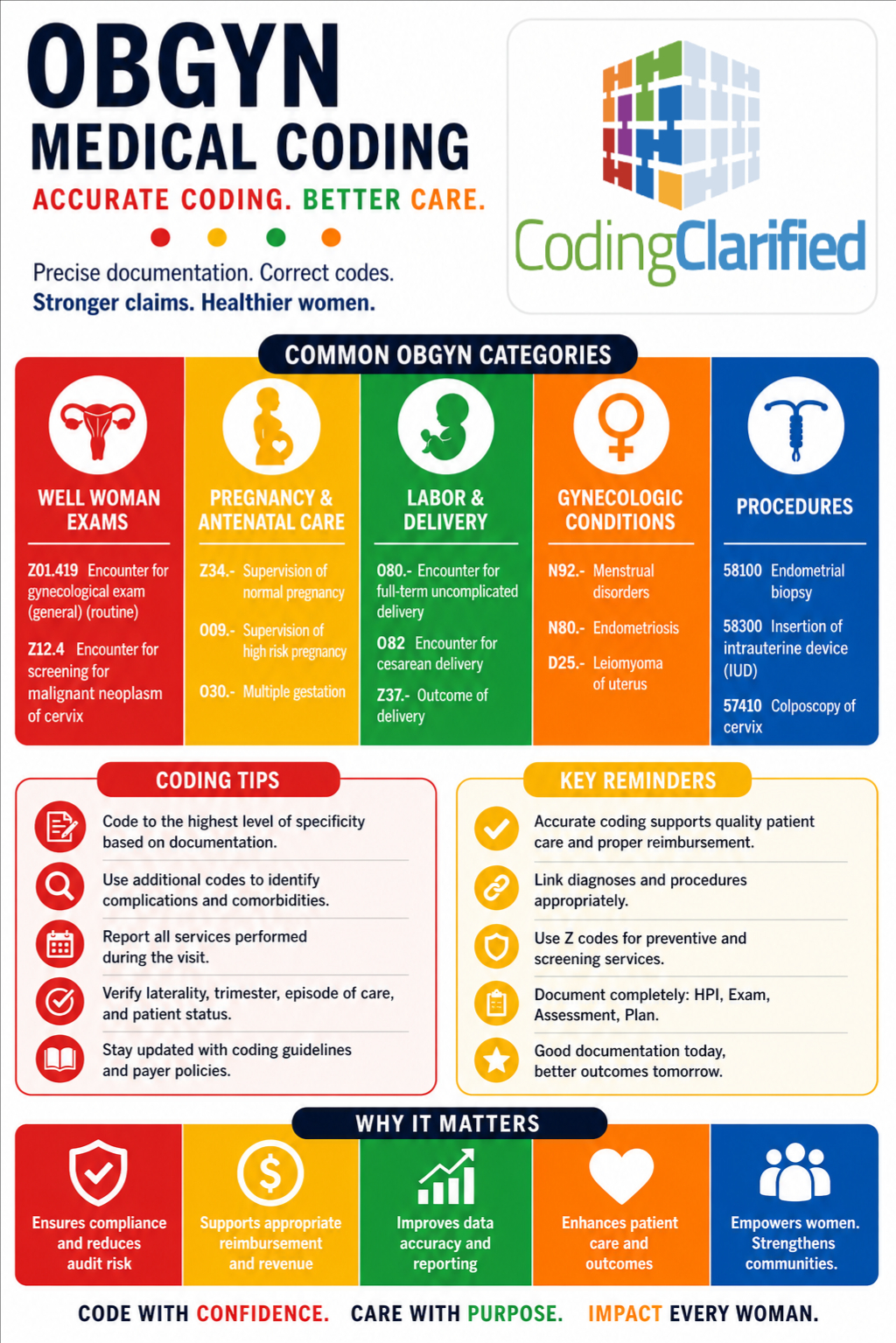
OB/GYN medical coding combines obstetric care, gynecologic services, preventive care, diagnostic testing, surgery, and Evaluation and Management (E/M) coding. Because these services often overlap, coders must understand what can be reported separately and what is included in another service.
In 2026, OB/GYN coders also face an unusual challenge. Current global maternity CPT codes remain available during 2026; however, major maternity coding changes take effect January 1, 2027. Therefore, coders must understand today’s rules while preparing for the new maternity coding structure.
This 2026 guide explains OB/GYN CPT and ICD-10-CM coding, global obstetric packages, antepartum care, delivery, postpartum services, gynecology procedures, ultrasounds, modifiers, preventive care, common coding mistakes, and the upcoming 2027 maternity changes.
Key Takeaways: OB/GYN Coding in 2026
- OB/GYN coding includes obstetrics, gynecology, preventive services, procedures, surgery, imaging, and E/M services.
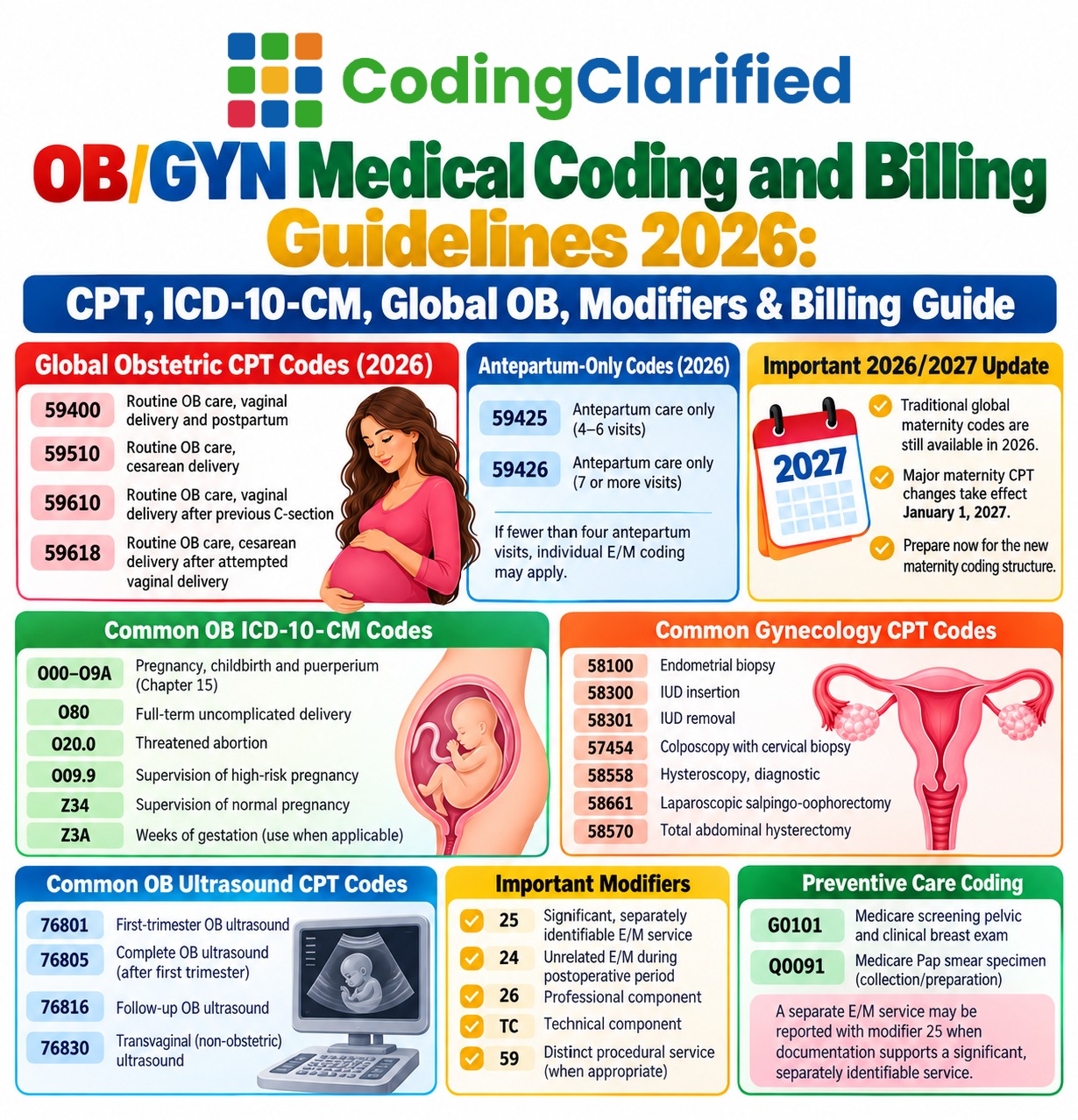
- Current 2026 global maternity codes include 59400, 59510, 59610, and 59618.
- Antepartum-only codes 59425 and 59426 may apply when the same provider or group provides part, but not all, of the antepartum care.
- ICD-10-CM Chapter 15 codes O00–O9A generally take sequencing priority when the condition affects pregnancy.
- Weeks of gestation may require an additional code from category Z3A.
- Routine OB services should not automatically be billed separately when they are included in the global maternity package.
- Gynecology coding requires close attention to procedure approach, anatomy, extent of the procedure, and whether services are bundled.
- Modifier 25 may apply when a significant, separately identifiable E/M service occurs on the same day as another procedure.
- CMS NCCI edits should be reviewed before separately reporting procedures that may be bundled.
- Major maternity CPT changes begin January 1, 2027, so practices should prepare during 2026.
What Is OB/GYN Medical Coding?
OB/GYN medical coding converts the services provided by obstetricians and gynecologists into CPT, HCPCS Level II, and ICD-10-CM codes.
Obstetric coding focuses primarily on pregnancy, prenatal care, labor, delivery, pregnancy complications, and postpartum care. Gynecologic coding, meanwhile, covers preventive care, abnormal bleeding, contraception, infertility, pelvic pain, cervical disease, endometriosis, uterine disorders, and many other conditions.
In addition, OB/GYN practices frequently perform procedures. These may include IUD insertion, endometrial biopsy, colposcopy, hysteroscopy, laparoscopy, hysterectomy, and ultrasound.
Because of this wide scope, successful OB/GYN coders must understand both diagnosis and procedure coding.
For additional anatomy and procedure guidance, review our Female Reproductive System Medical Coding Guide.
Global Obstetric Coding in 2026
One of the most important concepts in OB/GYN billing is the global obstetric package.
For services performed under the traditional 2026 global maternity structure, commonly used CPT codes include:
- 59400 – Routine obstetric care including antepartum care, vaginal delivery, and postpartum care
- 59510 – Routine obstetric care including antepartum care, cesarean delivery, and postpartum care
- 59610 – Routine obstetric care including antepartum care, vaginal delivery after previous cesarean delivery, and postpartum care
- 59618 – Routine obstetric care including antepartum care, cesarean delivery following attempted vaginal delivery after previous cesarean delivery, and postpartum care
However, payer policies vary. Therefore, never assume that every payer processes maternity care using the same billing method.
ACOG provides detailed resources on obstetric coding and payment. Practices should also verify each payer’s maternity billing rules before submitting claims.
What Is Included in the Global OB Package?
A global maternity service generally combines routine antepartum care, delivery, and postpartum care when the reporting requirements are met.
Routine antepartum services commonly involve scheduled pregnancy visits, routine history and examination, pregnancy monitoring, and counseling that forms part of standard maternity care.
Delivery services are then included according to the specific global maternity CPT code selected. Finally, routine postpartum management included within the global package should not be separately reported simply because another visit occurred.
However, not every service provided during pregnancy belongs to the global package.
For a deeper explanation of bundled services, read Medical Coding and Billing and the Global Period.
What Services May Be Reported Outside the Global OB Package?
Certain medically necessary services may qualify for separate reporting when they are not part of routine global maternity care.
Examples may include:
- Medically necessary obstetric ultrasounds
- Laboratory testing
- Certain fetal testing
- Treatment of complications
- Services unrelated to the pregnancy
- Some separately identifiable procedures
- Care outside the defined global maternity service
- Services performed by another provider when care is split
Nevertheless, separate billing depends on the circumstances, CPT guidance, payer rules, documentation, and applicable NCCI edits.
Coders should never unbundle a service simply because the documentation lists it separately.
Antepartum-Only Care: CPT 59425 and 59426
Sometimes one provider performs only part of the patient’s prenatal care.
For 2026, the following codes may apply when CPT and payer requirements are met:
- 59425 – Antepartum care only, 4–6 visits
- 59426 – Antepartum care only, 7 or more visits
If fewer than four antepartum visits occur, individual E/M coding may apply instead.
This distinction becomes especially important when a patient transfers to another OB/GYN practice, changes insurance, moves, or receives prenatal and delivery services from different providers.
Documentation should clearly show the dates and number of visits. In addition, coders should verify whether the payer requires global, antepartum-only, or individual E/M reporting.
Important 2026 Update: Prepare Now for the 2027 Maternity Coding Changes
OB/GYN practices should pay close attention to pregnancies beginning during the second half of 2026.
Effective January 1, 2027, the AMA is restructuring maternity CPT coding and eliminating the traditional global maternity coding model. As a result, codes such as 59400, 59510, 59610, 59618, 59425, 59426, and 59430 are among the codes scheduled for deletion for 2027.
The new structure separates maternity care into more distinct phases, including antepartum care, labor management, delivery, and postpartum care.
Therefore, a pregnancy that begins in 2026 but continues into 2027 may cross two different coding structures.
ACOG has encouraged health plans to transition toward E/M reporting for antepartum services during 2026, particularly for pregnancies that will continue into 2027. However, payer implementation can vary. Coders should confirm the payer’s transition policy before changing the billing method.
For a complete explanation, read our Global Maternity Codes Are Being Eliminated in 2027: What Coders Need to Know.
ICD-10-CM Coding for Pregnancy
ICD-10-CM obstetric coding requires special attention because Chapter 15 contains specific rules for pregnancy, childbirth, and the puerperium.
Chapter 15 includes codes O00–O9A.
When a condition affects the pregnancy, Chapter 15 codes generally take sequencing priority over codes from other chapters. Additional diagnosis codes may then identify the condition more specifically.
For example, coders should carefully identify:
- The pregnancy complication
- Trimester
- Weeks of gestation
- Fetus, when required
- Whether the encounter involves antepartum, delivery, or postpartum care
- Whether another condition affects management of the pregnancy
If the provider documents that the pregnancy is incidental to the encounter, Z33.1 may apply instead of a Chapter 15 code.
For additional guidance, see our Pregnancy and Childbirth Medical Coding Guide.
Weeks of Gestation: Category Z3A
OB coders should look for documented weeks of gestation.
Category Z3A provides codes that identify the patient’s completed weeks of pregnancy. For example, a code from this category may accompany the appropriate obstetric diagnosis when required.
Do not calculate gestational age from dates unless the coding rules and documentation support doing so. Instead, code from the provider’s documented gestational age and follow the current ICD-10-CM Official Guidelines.
Normal Pregnancy vs. Pregnancy Complication
Coders must distinguish normal pregnancy supervision from a pregnancy affected by a complication.
Codes from category Z34 describe encounters for supervision of normal pregnancy. However, these codes should not be assigned when the patient has a current pregnancy complication that requires an obstetric Chapter 15 code for the encounter.
Similarly, O80 represents an encounter for a full-term uncomplicated delivery. It should not be used simply because the patient delivered vaginally.
To report O80, the case must meet the ICD-10-CM definition of a full-term uncomplicated delivery. Consequently, the presence of a qualifying antepartum, delivery, or postpartum complication can change diagnosis selection.
OB/GYN Ultrasound Coding
Ultrasound coding is another high-error area in OB/GYN practices.
Common CPT codes include:
- 76801 – First-trimester obstetric ultrasound meeting the code requirements
- 76805 – Complete obstetric ultrasound after the first trimester
- 76816 – Follow-up obstetric ultrasound
- 76830 – Transvaginal non-obstetric ultrasound
However, do not select an ultrasound code based only on the word “ultrasound.”
Instead, review:
- Pregnancy status
- Gestational age
- Medical necessity
- Structures examined
- Complete versus limited examination
- Transabdominal versus transvaginal approach
- Number of fetuses when applicable
- Whether the study is initial or follow-up
Additionally, confirm whether the provider reports the global service or only the professional component.
Common Gynecology CPT Procedures
Gynecology coding covers a large range of services. Frequently encountered examples include:
- 58100 – Endometrial sampling/biopsy
- 58300 – IUD insertion
- 58301 – IUD removal
- 57454 – Colposcopy with cervical biopsy and endocervical sampling
Surgical procedures require even more detail. For example, hysterectomy code selection may depend on the surgical approach, uterus size, structures removed, and other services performed.
Therefore, never code a gynecologic surgery from the procedure title alone. Read the operative report and identify exactly what the surgeon performed.
Preventive and Problem-Oriented Visits
A patient may present for a preventive gynecologic examination and also have a separate problem addressed.
For example, a patient schedules a routine preventive visit but also reports heavy abnormal uterine bleeding. The physician performs the preventive service and separately evaluates the new problem, orders testing, and creates a treatment plan.
When documentation supports a significant and separately identifiable problem-oriented E/M service, separate reporting may be appropriate. Modifier 25 may be required on the problem-oriented E/M code.
However, the presence of a diagnosis alone does not justify an additional E/M service.
The documentation must demonstrate separate work beyond the usual components of the preventive encounter or procedure.
For more help with E/M selection, review our Evaluation and Management Coding Guidelines for 2026.
Medicare Well-Woman Coding Is Different
Medicare preventive gynecology billing differs from standard CPT preventive medicine coding.
For eligible Medicare patients, HCPCS G0101 may describe a screening pelvic and clinical breast examination. HCPCS Q0091 may apply to obtaining, preparing, and conveying a screening Pap smear specimen to the laboratory when Medicare requirements are met.
These services have specific coverage and frequency rules.
Moreover, CMS NCCI guidance explains that a separate E/M service should not be reported when the encounter only involves performing the screening service. A significant and separately identifiable medically necessary E/M service for another problem, however, may qualify for separate reporting with modifier 25.
Important OB/GYN Modifiers
Modifiers can significantly affect OB/GYN reimbursement.
Modifier 25 identifies a significant, separately identifiable E/M service performed by the same physician or qualified health care professional on the same day as another procedure or service.
Modifier 24 may identify an unrelated E/M service during a postoperative period when all requirements are met.
Modifier 26 identifies the professional component of certain diagnostic services when applicable.
Modifier TC identifies the technical component when appropriate.
Modifier 59, or the applicable X{EPSU} modifier, may identify distinct procedural services in limited situations when documentation and coding rules support separate reporting.
Never append a modifier merely to bypass an NCCI edit. Instead, first determine whether the services are truly distinct.
OB/GYN Coding Scenario
Scenario
A 29-year-old established patient who is 24 weeks pregnant presents for a scheduled prenatal appointment. The physician documents gestational age and routine pregnancy management.
During the visit, the patient also reports new urinary symptoms. The physician evaluates the complaint, orders appropriate testing, documents the assessment, and develops a treatment plan.
How Should the Coder Approach This Case?
First, determine how the patient’s maternity care is being billed. If the provider and payer use a 2026 global obstetric package, routine prenatal work may already be included in that package.
Next, review the urinary complaint. A separate service should not automatically be reported simply because another diagnosis exists.
Instead, ask:
- Was the problem medically necessary to evaluate?
- Did the provider perform work beyond routine prenatal care?
- Does the documentation support a separately identifiable E/M service?
- Is the condition affecting the pregnancy?
- What Chapter 15 ICD-10-CM code applies?
- Is an additional code needed to identify the urinary condition?
- Is a Z3A code appropriate for the documented weeks of gestation?
- Does the payer require a modifier or have specific maternity billing rules?
This step-by-step approach prevents both undercoding and unbundling.
Common Mistakes to Avoid in OB/GYN Coding
1. Assuming Every Pregnancy Uses Global Billing
Payers may have different maternity billing rules. Additionally, split care, transferred care, or a pregnancy spanning the 2026–2027 transition may require a different approach.
2. Reporting Routine Services Separately From a Global Package
Check what the global maternity code includes before billing another service. Otherwise, the claim may represent unbundling.
3. Missing the Trimester
Many Chapter 15 codes require trimester specificity. Therefore, always review the documentation before choosing an unspecified option.
4. Forgetting Weeks of Gestation
When applicable, add the appropriate code from category Z3A to capture documented gestational age.
5. Using Z34 With a Current Pregnancy Complication
Normal pregnancy supervision codes do not replace Chapter 15 complication codes when a pregnancy complication is being managed.
6. Using O80 for Every Vaginal Delivery
Code O80 has specific requirements. A vaginal delivery with a qualifying complication is not automatically coded as O80.
7. Automatically Adding Modifier 25
A separate diagnosis does not automatically justify modifier 25. Documentation must support a significant, separately identifiable E/M service.
8. Coding From the Procedure Heading
Gynecologic operative coding requires review of the entire operative report. The approach, anatomy, extent, and additional procedures can all change CPT selection.
9. Ignoring NCCI Edits
Before separately reporting related procedures, check the current CMS NCCI edits and CPT guidance.
10. Forgetting the 2027 Transition
This is especially important during late 2026. A patient’s prenatal care may begin under 2026 rules and continue after the new maternity CPT structure becomes effective January 1, 2027.
CPC Student Tips for OB/GYN Coding
For CPC students, start by deciding whether the question involves obstetrics or gynecology. That simple first step can narrow the code search quickly.
With obstetric questions, look for trimester, weeks of gestation, pregnancy complication, fetus information, and whether the encounter involves antepartum care, delivery, or postpartum care.
Next, remember that Chapter 15 obstetric codes usually have sequencing priority when the condition affects the pregnancy.
CPT questions, determine whether the service is part of global maternity care before selecting a separate code.
Likewise, pay close attention to words such as complete, limited, follow-up, vaginal, cesarean, laparoscopic, open, diagnostic, operative, insertion, removal, biopsy, and excision. These details often separate one CPT answer choice from another.
Finally, do not select a modifier simply because it appears familiar. CPC questions often test whether you understand why the modifier is needed.
OB/GYN Documentation Checklist
Strong documentation makes accurate coding much easier.
Coding obstetric encounters, look for gestational age, trimester, pregnancy status, complications, fetal information when required, medical necessity, and the plan of care.
For gynecologic procedures, meanwhile, review the anatomical site, surgical approach, extent of the procedure, findings, specimens, devices, and additional procedures performed.
When coding imaging, confirm the type and extent of the study. For E/M services, make sure documentation supports the reported level and any separately identifiable service.
2026 OB/GYN Coding Resources
Because OB/GYN coding is changing quickly, coders should rely on current official resources.
Useful references include:
- American College of Obstetricians and Gynecologists (ACOG) Coding and Billing Resources
- AMA CPT 2027 Maternity Care Services Changes
- CMS National Correct Coding Initiative
- CDC/NCHS ICD-10-CM Official Guidelines
- AAPC
Coders should also check individual payer policies because maternity billing requirements can vary.
Final Thoughts
OB/GYN medical coding in 2026 requires much more than memorizing maternity and gynecology codes. Coders must understand global obstetric billing, ICD-10-CM Chapter 15 rules, E/M services, gynecologic procedures, imaging, modifiers, NCCI edits, and payer-specific requirements.
Moreover, 2026 is an important transition year. The traditional global maternity CPT structure remains relevant during 2026, but major changes take effect January 1, 2027.
As a result, coders should verify the date of service, payer policy, documentation, and applicable year’s code set before submitting claims. This habit helps prevent denials, unbundling, incorrect sequencing, and missed reimbursement.
Frequently Asked Questions About OB/GYN Medical Coding in 2026
What CPT codes are used for global maternity care in 2026?
Common global maternity CPT codes include 59400 for vaginal delivery with routine antepartum and postpartum care, 59510 for cesarean delivery with routine antepartum and postpartum care, 59610 for vaginal delivery after previous cesarean with global care, and 59618 for cesarean delivery following attempted vaginal delivery after previous cesarean with global care. Always verify payer requirements.
Are global maternity CPT codes being eliminated in 2026?
No. The major CPT maternity restructuring takes effect January 1, 2027. However, 2026 is a transition year, and ACOG has published recommendations for preparing for the new reporting structure, especially when a pregnancy continues into 2027.
When should CPT 59425 or 59426 be used?
In 2026, 59425 may report 4–6 antepartum visits, while 59426 may report 7 or more antepartum visits when the requirements for antepartum-only reporting are met. Payer rules should also be checked.
Do pregnancy ICD-10-CM codes take priority over other diagnosis codes?
Generally, yes. Codes from Chapter 15, O00–O9A, have sequencing priority over codes from other chapters when the condition affects pregnancy, childbirth, or the puerperium. Additional codes may identify the condition more fully.
Should a Z3A code be reported for pregnancy?
A code from category Z3A may be assigned to identify the patient’s completed weeks of gestation when applicable. Coders should use the documented gestational age and follow the current ICD-10-CM Official Guidelines.
Can modifier 25 be used in an OB/GYN office?
Yes, when the documentation supports a significant and separately identifiable E/M service on the same date as another procedure or service. However, modifier 25 should not be used merely because the provider documents two diagnoses.
Can an OB ultrasound be billed separately from global maternity care?
Certain medically necessary diagnostic ultrasounds may be separately reportable because they are not automatically included in routine global obstetric care. Nevertheless, the coder must confirm medical necessity, CPT requirements, documentation, payer policy, and applicable bundling rules.
What is the biggest OB/GYN coding change coders should prepare for?
The major upcoming change is the restructuring of maternity care CPT coding effective January 1, 2027. The traditional global maternity codes will be replaced by a more itemized structure that separately captures phases of maternity care. Therefore, OB/GYN coders should begin learning the new system during 2026.