

By Janine Mothershed CPC, CPC-I
Updated October 2026 for 2027. The knee arthroplasty CPT codes in this guide are unchanged for 2027, and the ICD-10-CM codes reflect the FY2027 code set effective October 1, 2026.
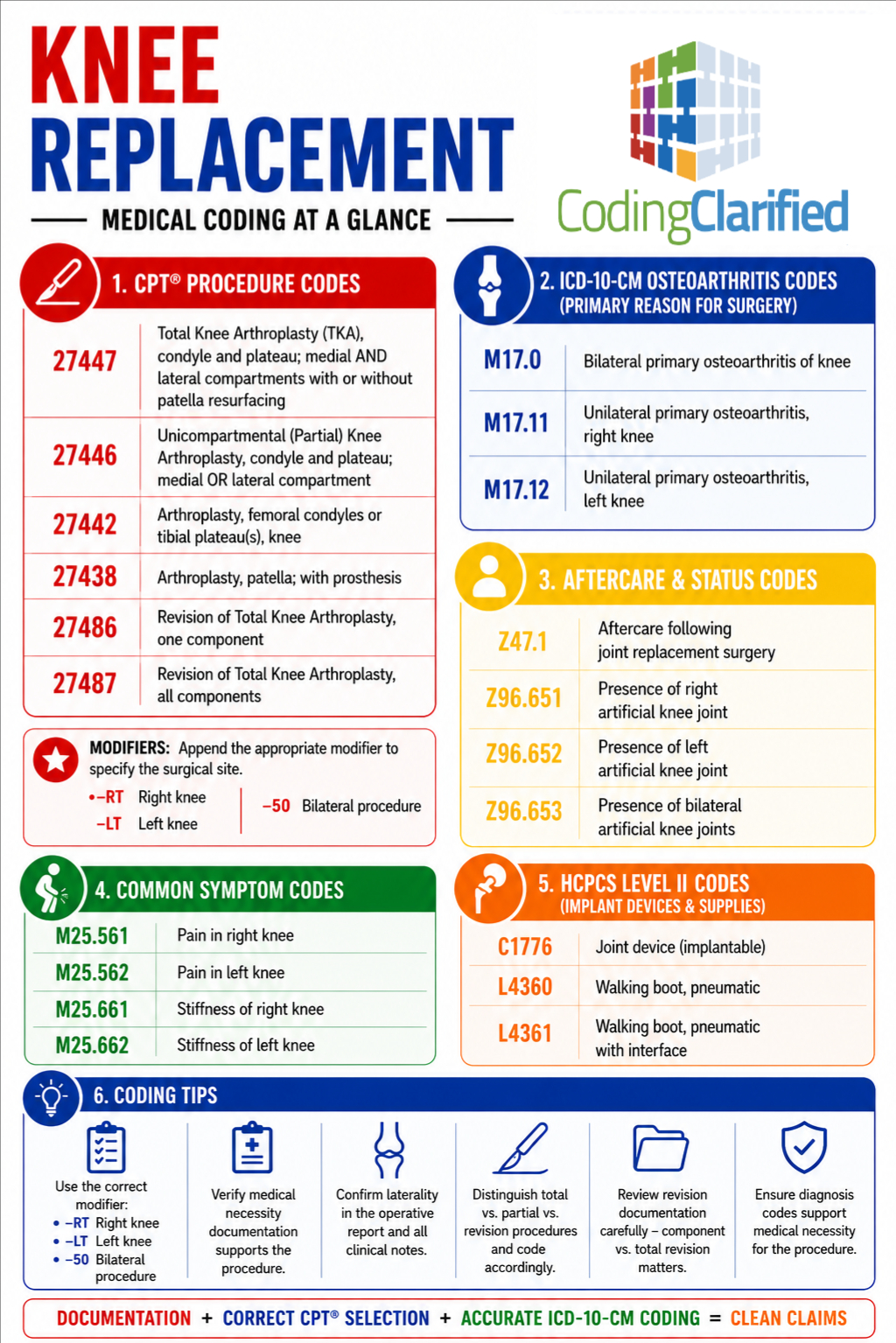
Quick answer: A total knee replacement is CPT 27447 and a partial (unicompartmental) knee replacement is CPT 27446, each with RT or LT. Revisions are 27486 (one component) or 27487 (femoral and entire tibial component), and 27488 reports removal of the prosthesis. The usual diagnosis is osteoarthritis from category M17, such as M17.11 for the right knee, and Z96.651 to Z96.653 report the presence of an artificial knee joint after surgery.
New to medical coding? See how our CPC Training gets you certified.
What are the key takeaways for knee replacement coding?
- CPT 27447 reports total knee arthroplasty (TKA).
- CPT 27446 reports unicompartmental (partial) knee replacement.
- Revision knee arthroplasty is reported with CPT 27486, 27487 or 27488, depending on the components revised or removed.
- Accurate coding requires documentation of the compartments involved and the prosthetic components replaced.
- Laterality modifiers RT and LT are essential for a clean claim.
- Medical necessity is supported by ICD-10-CM diagnoses such as M17.11, M17.12 or a prosthetic complication code.
Which CPT codes are used for knee arthroplasty?
| CPT Code | Procedure | Description |
|---|---|---|
| 27446 | Partial Knee Arthroplasty | Replacement of one compartment (medial OR lateral) |
| 27447 | Total Knee Arthroplasty | Replacement of medial AND lateral compartments, with or without patella resurfacing |
| 27486 | Revision TKA | Revision of one component |
| 27487 | Revision TKA | Revision of the femoral and entire tibial component |
| 27488 | Prosthesis Removal | Removal of knee prosthesis, with or without insertion of a spacer |
| 27599 | Patellofemoral Arthroplasty | Unlisted procedure, femur or knee |
Why does knee replacement coding matter in 2027?
Total knee replacement remains one of the most commonly performed orthopedic procedures in the United States. As a result, payers continue to scrutinize documentation, medical necessity and code selection. Medicare Advantage plans and commercial insurers increasingly use preauthorization programs and claim edits to review orthopedic procedures, and orthopedic surgery claims frequently undergo post payment audits. Strong documentation and accurate code selection help reduce denials and recoupments.
Coders should carefully review operative reports to determine whether the procedure was primary or revision, and partial or total. See the AAPC website for coding education and the Medicare Coverage Database for the Local Coverage Determinations (LCDs) that apply in your region.
What is the difference between a total and a partial knee replacement?
Understanding the distinction between total and partial knee replacement is one of the most important parts of knee arthroplasty coding. Both procedures replace damaged portions of the knee joint, but they differ significantly in scope.
What is the CPT code for a total knee arthroplasty?
A total knee arthroplasty replaces the damaged articular surfaces of both the medial and lateral compartments of the knee. In many cases, the patella is also resurfaced during the same procedure. Because the entire joint is reconstructed, it is typically performed when osteoarthritis affects multiple compartments. Review the operative report to verify that both compartments were replaced before assigning CPT 27447.
CPT 27447: Arthroplasty, knee, condyle and plateau; medial AND lateral compartments with or without patella resurfacing (total knee arthroplasty).
Coding example: A patient presents with severe tricompartmental osteoarthritis of the right knee. The surgeon replaces the femoral, tibial and patellar articular surfaces.
- 27447-RT
- M17.11 Unilateral primary osteoarthritis, right knee
What is the CPT code for a partial knee replacement?
A partial knee replacement replaces only one compartment of the knee and preserves the unaffected portions of the joint. Patients may experience shorter recovery times and better preservation of native anatomy. Operative reports often describe it as unicompartmental knee arthroplasty, medial compartment replacement, lateral compartment replacement or partial knee replacement.
CPT 27446: Arthroplasty, knee, condyle and plateau; medial OR lateral compartment.
Coding example: A patient undergoes replacement of only the medial compartment of the left knee.
- 27446-LT
- M17.12 Unilateral primary osteoarthritis, left knee
What is the CPT code for a patellofemoral arthroplasty?
CPT has no specific code for an isolated patellofemoral arthroplasty. Report 27599 (unlisted procedure, femur or knee) for the entire procedure, per CPT Assistant, February 2021. That guidance replaced older advice to report 27438 or 27442. Because unlisted codes require supporting documentation, check payer policies and submit the operative report with the claim.
How do you code a revision total knee arthroplasty?
Revision surgery addresses failed prosthetic components caused by infection, loosening, instability, wear, fracture or mechanical failure. Revisions involve more physician work and operative time than primary procedures, so documentation of which components were removed and implanted is essential. Revision codes apply only to a knee with a previously implanted prosthesis.
When is CPT 27486 reported?
CPT 27486 is reported when only one component of a previously implanted prosthesis is revised. Common scenarios include:
- Tibial component revision only
- Femoral component revision only
- Patellar component revision only
- Polyethylene liner (tibial insert) exchange only
Coding example: The tibial component of a right knee prosthesis becomes loose. The surgeon removes and replaces the tibial component and retains the rest of the prosthesis.
- 27486-RT
- T84.032A Mechanical loosening of internal prosthetic joint, right knee, initial encounter
When is CPT 27487 reported?
CPT 27487 is reported when the femoral and entire tibial components are revised. These procedures are more complex because the surgeon removes multiple components and reconstructs the joint, and they are often performed for mechanical failure, loosening or infection of the existing prosthesis.
Coding example: The surgeon removes the femoral and tibial components of a left knee prosthesis because of mechanical loosening and replaces them with new components.
- 27487-LT
- T84.033A Mechanical loosening of internal prosthetic joint, left knee, initial encounter
When is CPT 27488 reported?
CPT 27488 reports removal of a knee prosthesis, with or without insertion of a spacer. It is commonly reported during staged treatment of an infected prosthetic joint, with T84.53XA (right knee) or T84.54XA (left knee).
Which ICD-10-CM codes support knee replacement?
The diagnosis must explain why surgery was necessary and match the physician documentation and operative findings. Do not assign diagnoses that are not clearly documented.
| ICD-10-CM Code | Description |
|---|---|
| M17.0 | Bilateral primary osteoarthritis of knee |
| M17.11 | Unilateral primary osteoarthritis, right knee |
| M17.12 | Unilateral primary osteoarthritis, left knee |
| M17.31 | Unilateral post-traumatic osteoarthritis, right knee |
| M17.32 | Unilateral post-traumatic osteoarthritis, left knee |
| M05.761 | Rheumatoid arthritis with rheumatoid factor of right knee without organ or systems involvement |
| M05.762 | Rheumatoid arthritis with rheumatoid factor of left knee without organ or systems involvement |
| T84.032A | Mechanical loosening of internal prosthetic joint, right knee, initial encounter |
| T84.033A | Mechanical loosening of internal prosthetic joint, left knee, initial encounter |
| T84.53XA | Infection and inflammatory reaction due to internal right knee prosthesis, initial encounter |
| T84.54XA | Infection and inflammatory reaction due to internal left knee prosthesis, initial encounter |
How do you code follow up visits after a knee replacement (Z96.65 and Z47.1)?
After surgery, the presence of an artificial knee joint is reported with a Z96.65 status code:
- Z96.651 Presence of right artificial knee joint
- Z96.652 Presence of left artificial knee joint
- Z96.653 Presence of artificial knee joint, bilateral
For routine postoperative follow up during recovery from the joint replacement, report Z47.1 (aftercare following joint replacement surgery) with the matching Z96.65 code to identify the joint. When the visit is for a complication of the prosthesis, report the T84 complication code instead of aftercare.
What does Medicare require for knee replacement coverage in 2027?
Medicare requires documentation that supports medical necessity, generally including chronic pain, functional limitations, failed conservative treatment and radiographic evidence of joint disease. Medicare Administrative Contractors (MACs) may publish LCDs with specific requirements, so review the applicable payer policy before submitting the claim.
Which modifiers are used for knee replacement?
| Modifier | Description |
|---|---|
| LT | Left side |
| RT | Right side |
| 50 | Bilateral procedure |
| 22 | Increased procedural services |
| 59 | Distinct procedural service |
Bilateral knee replacement: For Medicare, report a bilateral total knee arthroplasty on one line as 27447-50 with 1 unit, not as two lines with RT and LT. Some commercial payers prefer RT and LT on separate lines, so check the payer’s bilateral billing policy.
What documentation is required for knee arthroplasty coding?
Accurate coding begins with complete physician documentation. The operative report should clearly identify:
- Total versus partial replacement
- Primary versus revision procedure
- Laterality
- Components removed and components implanted
- Prosthetic complications
- Medical necessity and surgical findings
Without these details, coders may struggle to support the reported CPT and ICD-10-CM codes, and denial and audit risk increase.
What are the most common knee replacement coding mistakes?
Mistake 1: Confusing CPT 27446 and CPT 27447
Determine whether one compartment or both compartments were replaced.
Mistake 2: Missing laterality modifiers
Always verify whether RT or LT should be appended, or 50 for a bilateral Medicare claim.
Mistake 3: Using revision codes for primary procedures
Revision codes apply only to previously implanted prosthetic joints.
Mistake 4: Selecting the wrong revision code
Determine whether one component or the femoral and entire tibial components were revised.
Mistake 5: Failing to review operative reports
Procedure titles alone do not always provide enough information for accurate code assignment.
Mistake 6: Assigning unsupported diagnosis codes
Ensure that every diagnosis code supports medical necessity and is documented by the provider.
How should CPC students study knee arthroplasty coding?
Knee arthroplasty is a high yield area on the CPC exam, and orthopedic questions often contain distractor terminology.
- Highlight 27446 and 27447 in your CPT manual.
- Create comparison notes for 27486, 27487 and 27488.
- Focus on compartment terminology.
- Learn the difference between primary and revision procedures.
- Practice reviewing operative reports rather than memorizing descriptions.
- Pay attention to laterality requirements.
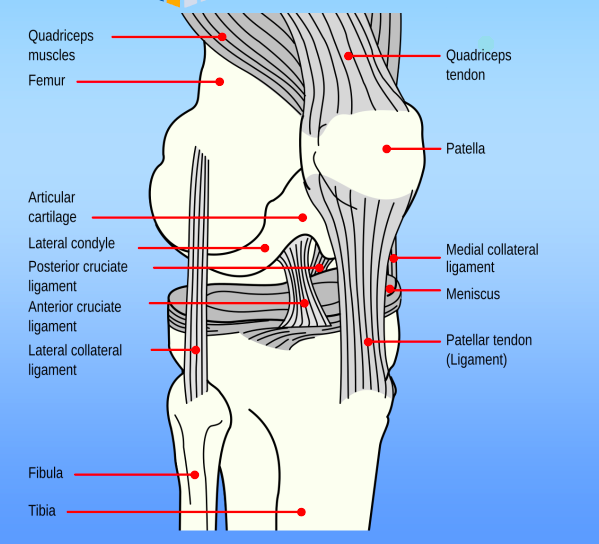
- Review musculoskeletal anatomy before tackling orthopedic questions.
Related Coding Clarified resources
Continue building your orthopedic coding knowledge with these related articles:
- Medical Coding Orthopedics
- Medical Coding Fractures
- External Causes
- Medical Coding Global Surgery
- ICD-10 Codes for Pain: Chronic, Acute, and Cancer-Related (FY2027)
- Medical Coding Reference Library
Browse our complete resource library.
Frequently asked questions
What is the CPT code for a total knee replacement?
The CPT code for total knee arthroplasty is 27447.
What is the CPT code for a partial knee replacement?
A partial or unicompartmental knee replacement is reported with 27446.
What is the difference between CPT 27447 and CPT 27446?
27447 describes replacement of both the medial and lateral compartments. 27446 describes replacement of only one compartment.
What is CPT 27486 used for?
27486 is reported when one component of a previously implanted knee prosthesis is revised, including a polyethylene liner exchange alone.
When should CPT 27487 be reported?
Report 27487 when the femoral and entire tibial components are revised during the same procedure.
What diagnosis codes are commonly used with total knee arthroplasty?
Common diagnoses include M17.11, M17.12, M17.31 and M17.32, depending on the documented condition.
Are laterality modifiers required for knee replacement procedures?
Most payers require RT or LT to identify the knee. Medicare wants a bilateral procedure reported as 27447-50.
Is patella resurfacing separately reportable with CPT 27447?
No. Patella resurfacing is included in 27447 when performed as part of a total knee arthroplasty.
What is the difference between Z96.65 and Z47.1?
Z96.651 to Z96.653 report that the patient has an artificial knee joint. Z47.1 reports aftercare following joint replacement surgery and is paired with the Z96.65 code to identify the joint.
What is the CPT code for a patellofemoral arthroplasty?
Report 27599, the unlisted procedure code for the femur or knee, per CPT Assistant, February 2021.
How do you code a polyethylene liner exchange?
An isolated exchange of the tibial polyethylene insert is a one component revision, reported with 27486 and the appropriate laterality modifier.
Coding Clarified final thoughts
Knee arthroplasty coding requires careful analysis of physician documentation, operative reports, diagnosis selection and payer requirements. CPT 27447 is the most frequently reported knee replacement code, but coders must also understand when 27446, 27486, 27487, 27488 and 27599 apply. Accurate ICD-10-CM coding establishes medical necessity, and proper modifier use helps prevent claim delays and denials throughout 2027.
Ready to code like this for a living?
Coding Clarified’s AAPC licensed CPC program takes you from beginner to certified, with an internship and a job board for graduates.
You may qualify for WIOA funding in 30+ states. Check your eligibility.