Medical Coding for Wound Care in 2027: CPT, ICD-10-CM, Debridement, and Documentation Guide
Medical Coding for Wound Care in 2027
Wound care coding remains one of the most challenging areas of medical coding because accurate code selection depends on the wound type, depth, size, documentation, and treatment performed. Because of this complexity, selecting the wrong code can lead to claim denials, underpayments, audits, or compliance concerns.
Healthcare providers treat millions of wounds every year, ranging from simple traumatic injuries to complex diabetic ulcers and pressure injuries. Consequently, medical coders must carefully review provider documentation before assigning CPT®, HCPCS Level II, and ICD-10-CM codes.
You may also find our article on laceration repair coding helpful.
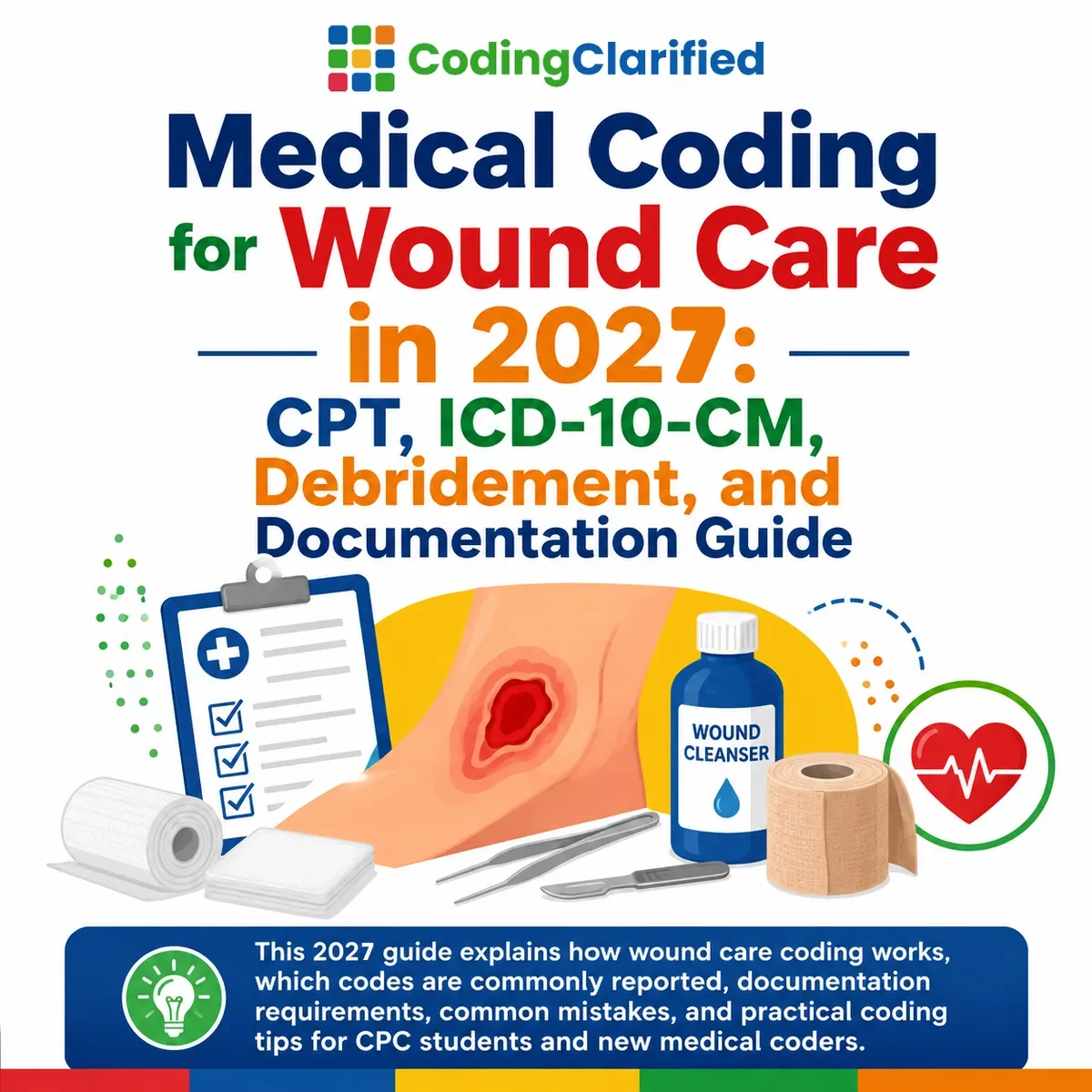
This updated 2027 guide explains how wound care coding works, which codes are commonly reported, documentation requirements, common mistakes, and practical coding tips for CPC students and new medical coders.
Key Takeaways
- Correct wound care coding depends on the wound’s depth, location, size, and treatment.
- Documentation must clearly describe the tissue removed during debridement.
- Surface area calculations determine many wound care code selections.
- Not every wound cleaning procedure qualifies as surgical debridement.
- Active wound management differs from routine dressing changes.
- Medical necessity remains essential for reimbursement in 2027.
- Coders should review operative notes, progress notes, and nursing documentation together whenever appropriate.
What Is Wound Care Coding?
Wound care coding involves reporting the medical services provided to evaluate, treat, cleanse, debride, dress, and monitor wounds. Depending on the patient’s condition, treatment may occur in settings such as:
- Physician offices
- Hospital outpatient departments
- Ambulatory surgery centers
- Skilled nursing facilities
- Home health settings
- Hospital inpatient units
Because treatment methods vary widely, coders must understand the differences between simple wound management, active wound care, selective debridement, surgical debridement, and skin substitute applications.
Furthermore, documentation often changes throughout the healing process, making each encounter unique.
Why Accurate Wound Care Coding Matters in 2027
Payers continue increasing scrutiny of wound care claims. As a result, providers should expect additional reviews when documentation does not support the reported services.
For this reason, accurate coding helps:
- Reduce claim denials
- Improve reimbursement accuracy
- Demonstrate medical necessity
- Support quality reporting
- Reduce audit risk
- Improve compliance with CMS requirements
Meanwhile, incorrect coding may delay payment or require costly appeals.
Common Types of Wounds
Before assigning diagnosis or procedure codes, coders should identify exactly what type of wound the provider is treating.
Common wound categories include:
Surgical wounds
These wounds result from operative procedures and typically heal through primary intention.
Traumatic wounds
For example:
- Lacerations
- Abrasions
- Puncture wounds
- Crush injuries
- Animal bites
Pressure injuries
Pressure injuries develop from prolonged pressure over bony areas. Coders classify them using specific ICD-10-CM codes based on anatomical site and stage.
Diabetic foot ulcers
Patients with diabetes frequently develop chronic foot ulcers requiring ongoing wound care, debridement, and infection management.
Venous ulcers
Venous insufficiency often causes chronic lower-extremity ulcers requiring long-term treatment.
Arterial ulcers
Similarly, peripheral arterial disease can lead to ischemic wounds with delayed healing.
Common ICD-10-CM Diagnosis Codes
Diagnosis coding always begins with the provider’s documented condition rather than the treatment performed.
For example:
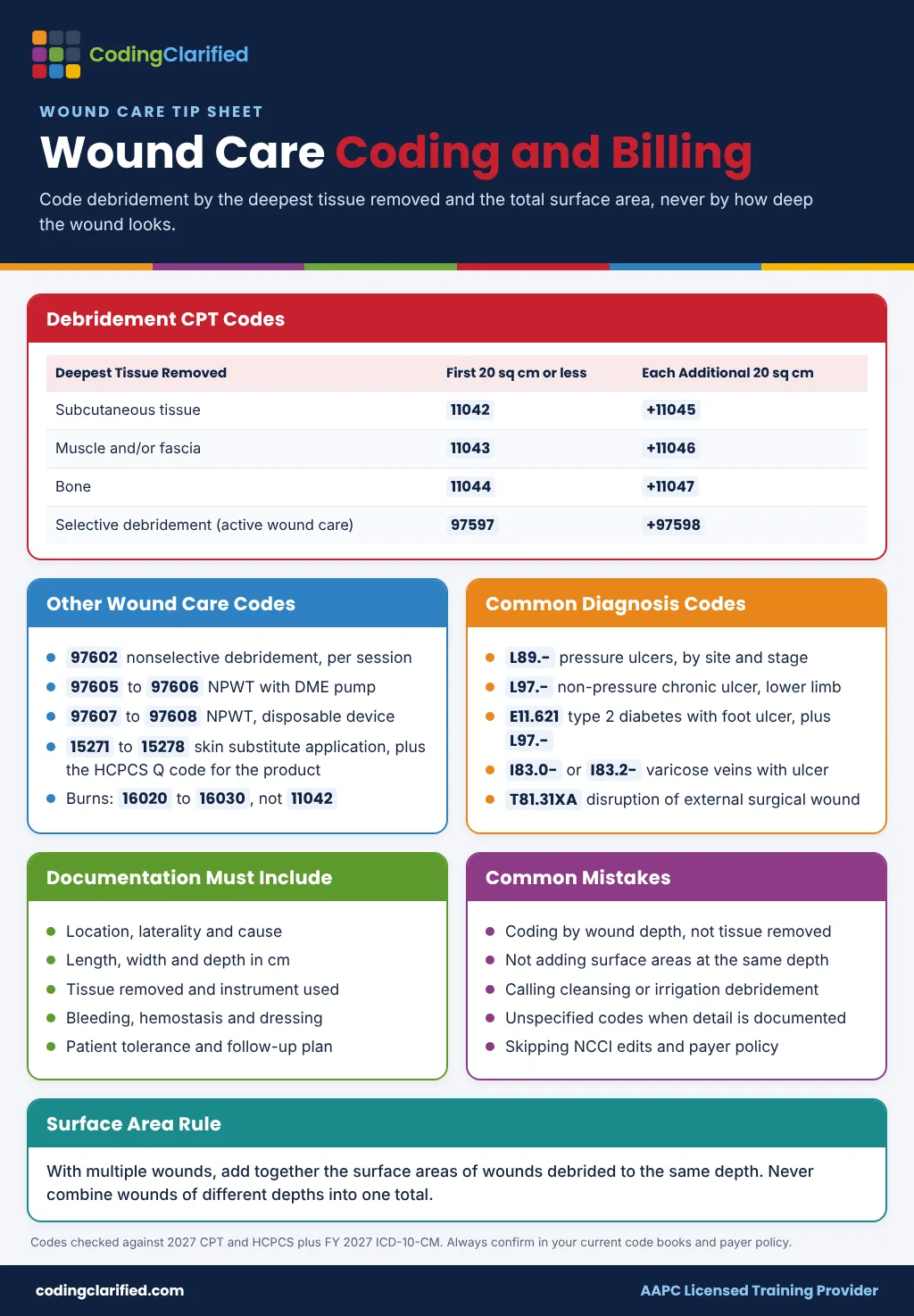
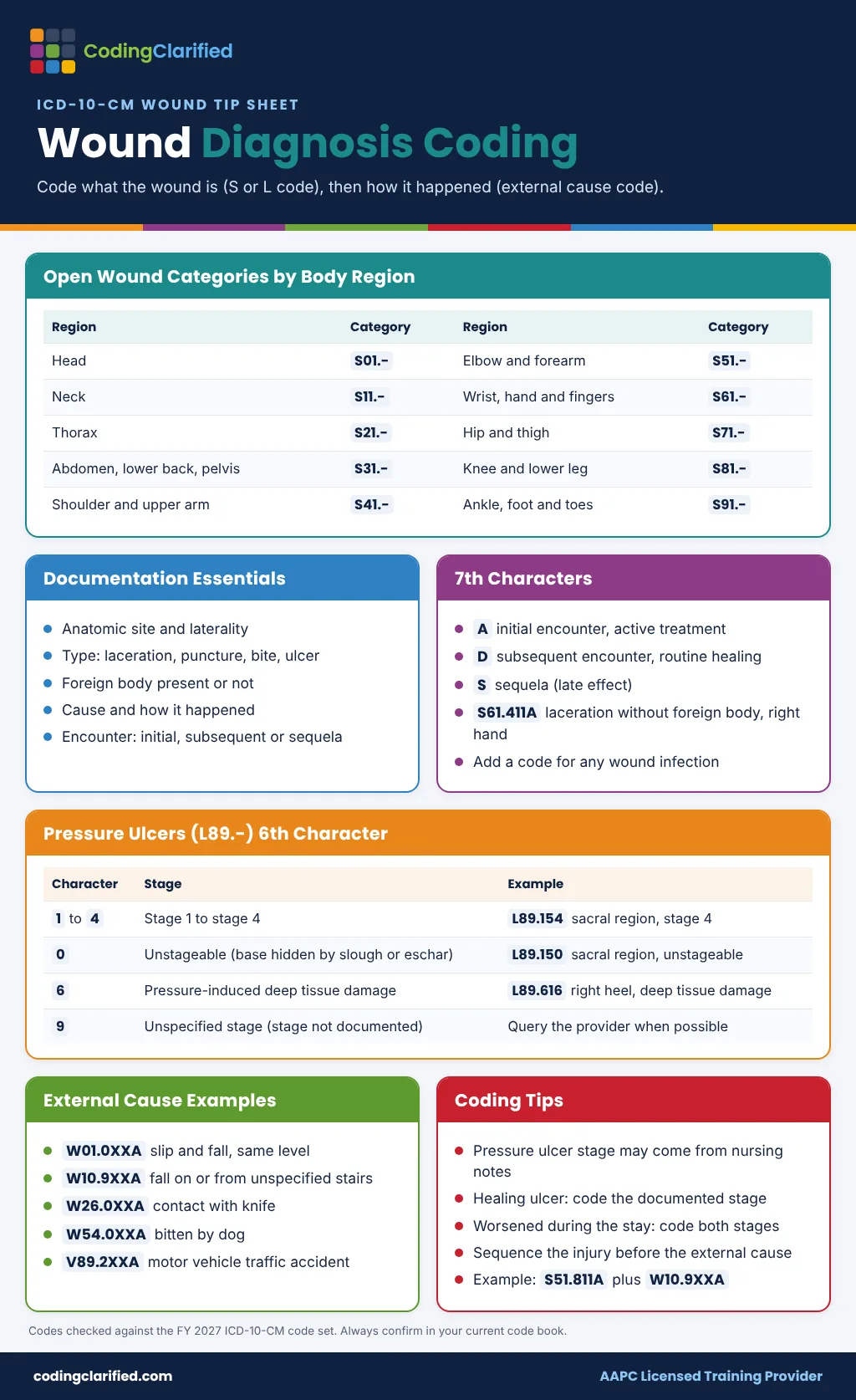
- L89.* — Pressure ulcers
- L97.* — Non-pressure chronic ulcers of the lower limb
- E11.621 — Type 2 diabetes mellitus with foot ulcer
- S81.* — Open wound of lower leg
- S91.* — Open wound of foot
- T81.31XA — Disruption of external operation wound
- T81.32XA — Disruption of internal operative wound
- I83.0- and I83.2- — Varicose veins of lower extremities with ulcer (I83.2- adds inflammation)
- I87.31- and I87.33- — Chronic venous hypertension with ulcer (I87.33- adds inflammation)
Therefore, always assign the diagnosis code that best describes the patient’s documented condition and highest level of specificity.
Understanding Wound Debridement
Debridement removes devitalized tissue that delays wound healing.
However, not every wound cleaning qualifies as reportable debridement.
During debridement, providers may remove:
- Necrotic tissue
- Slough
- Eschar
- Fibrin
- Biofilm
- Contaminated tissue
The documentation should clearly identify the deepest level of tissue removed because that determines code selection.
Selective vs. Surgical Debridement
One of the most common coding errors occurs when coders confuse selective debridement with surgical debridement.
Selective Debridement
Selective debridement removes nonviable tissue while preserving healthy tissue whenever possible.
For example:
- High-pressure waterjet
- Scissors
- Scalpel
- Forceps
- Curette
In addition, documentation should identify the technique used and the tissue removed.
Surgical Debridement
In contrast, surgical debridement extends deeper into the wound and may involve removing:
- Epidermis
- Dermis
- Subcutaneous tissue
- Muscle
- Fascia
- Bone
Because reimbursement differs significantly, documentation must support the deepest tissue actually removed rather than the wound’s overall depth.
Common CPT Codes for Debridement
Several CPT® code families report surgical wound debridement.
For example:
Debridement of Subcutaneous Tissue
- 11042
- 11045 (each additional 20 sq cm)
Muscle and Fascia Debridement
- 11043
- 11046
Debridement of Bone
- 11044
- 11047
In general, these codes depend on:
- Total surface area
- Deepest tissue removed
- Anatomical documentation
- Medical necessity
Coders should never report separate debridement codes for multiple wounds at the same depth until they have completed total surface area calculations according to CPT guidelines.
Active Wound Care Management Codes
Coders report some wound treatments using active wound care management codes instead of surgical debridement.
For example, common codes include:
- 97597
- 97598
These services generally involve selective debridement without excision of deeper tissues.
In addition, documentation should support:
- The wound assessment
- Tissue removed
- Instrument used
- Surface area treated
- Patient response
Failure to document these elements may also result in claim denials.
Measuring Wound Surface Area
Surface area calculations directly affect code selection.
Providers generally document:
- Length
- Width
- Depth
Medical coders should verify whether measurements represent:
- Individual wounds
- Combined wounds
- Pre-debridement measurements
- Post-debridement measurements
Additionally, CPT instructions specify how to combine multiple wounds reported under the same code family.
In short, accurate math remains just as important as accurate code selection.
Documentation Requirements for 2027
Strong documentation remains the foundation of accurate wound care coding.
Specifically, providers should document:
- Wound location
- Laterality
- Cause of wound
- Stage (if applicable)
- Measurements
- Depth
- Tissue removed
- Instrument used
- Amount of tissue removed
- Bleeding
- Hemostasis
- Dressing applied
- Patient tolerance
- Follow-up plan
However, incomplete documentation often prevents coders from assigning the most accurate procedure codes.
Likewise, missing details may delay reimbursement during payer review.
Skin Substitute Applications
Advanced wound care often includes skin substitute products to encourage healing when standard treatment has not been successful.
Providers may use these products for:
- Diabetic foot ulcers
- Venous leg ulcers
- Certain chronic wounds
- Selected surgical wounds
In addition, coders should carefully review:
- The operative report
- Product documentation
- Product size
- Amount applied
- Amount discarded (when applicable)
- Medical necessity
Many skin substitute claims also require reporting the appropriate HCPCS Level II product code in addition to the applicable CPT® application code.
Because payer policies change frequently, always verify current CMS and commercial payer coverage requirements before submitting claims.
Negative Pressure Wound Therapy (Wound VAC)
Negative Pressure Wound Therapy (NPWT), commonly called wound VAC therapy, removes excess fluid while promoting wound healing.
In particular, documentation should clearly identify:
- Wound measurements
- Dressing type
- Therapy performed
- Device management
- Medical necessity
Depending on the encounter, coders may report wound management, dressing changes, or other applicable services when documentation supports them.
Always review current CPT® instructions and payer policies before assigning NPWT-related procedure codes.
Modifier Considerations
Some wound care services require modifiers to accurately describe the circumstances of treatment.
For example, commonly used modifiers may include:
- Modifier 25 – Significant, separately identifiable E/M service
- Modifier 59 – Distinct procedural service when appropriate
- Modifier 76 – Repeat procedure by the same physician
- Modifier 77 – Repeat procedure by another physician
Modifier selection should always reflect the medical record and payer requirements. Also, never append modifiers simply to bypass claim edits.
Medical Necessity in Wound Care Coding
Medical necessity remains one of the primary reasons payers deny wound care claims.
Therefore, providers should clearly document:
- Why treatment was necessary
- The patient’s response to previous treatment
- Signs of infection or delayed healing
- Comorbid conditions affecting healing
- Clinical progression
- Ongoing treatment goals
For example, documentation must support repeated debridement by demonstrating continued medical necessity rather than routine wound maintenance.
Wound Care Billing Tips
Following a consistent review process can improve coding accuracy.
Consider these best practices:
- Review the diagnosis before selecting procedure codes.
- Then verify the wound location and laterality.
- Confirm the deepest tissue removed.
- Then calculate the correct wound surface area.
- Read the entire procedure note.
- Also check National Correct Coding Initiative (NCCI) edits.
- Verify payer-specific billing policies.
- Finally, confirm documentation supports medical necessity.
Although these steps require extra time, they often reduce denials and appeals.
Common Documentation Challenges
Even experienced providers occasionally omit important details.
In particular, watch for documentation that fails to include:
- Exact wound measurements
- Tissue depth
- Debridement method
- Surface area
- Anatomical location
- Laterality
- Stage of pressure injury
- Healing progress
- Medical necessity
- Follow-up care
Whenever documentation lacks sufficient detail, coders should follow their organization’s query policies.
Common Mistakes to Avoid
Many wound care coding errors occur because documentation and coding guidelines do not align.
Therefore, avoid these common mistakes:
- Reporting debridement based on wound depth instead of the deepest tissue removed.
- Forgetting to total wound surface areas when CPT® instructions require it.
- Reporting surgical debridement when only wound cleansing occurred.
- Assigning unspecified ICD-10-CM codes when documentation supports greater specificity.
- Ignoring payer-specific coverage requirements.
- Omitting appropriate modifiers when documentation supports them.
- Failing to review NCCI edits before billing.
- Coding from the diagnosis list instead of the provider’s complete documentation.
Overall, careful review helps prevent denials and improves coding accuracy.
CPC Student Tips
Wound care coding frequently appears on the CPC® exam because it tests multiple coding concepts at the same time.
When preparing for the exam:
- Learn the wound debridement code families.
- Also practice calculating wound surface area.
- Understand tissue depth definitions.
- Study common pressure ulcer coding rules.
- In addition, review diabetic ulcer coding guidelines.
- Become familiar with modifier usage.
- Read complete operative reports instead of relying on summaries.
Many new coders focus only on memorizing codes. However, successful coders learn how to interpret provider documentation first.
2027 Wound Care Coding Updates
Although the core wound care coding principles remain consistent, 2027 brings a few dates to know. First, the FY 2027 ICD-10-CM update took effect October 1, 2026, and it did not change the pressure ulcer (L89), lower limb ulcer (L97) or diabetic foot ulcer codes in this guide. Second, CPT 2027 takes effect January 1, 2027. The debridement (11042 to 11047), active wound care (97597, 97598) and NPWT (97605 to 97608) codes do not appear in the CPT 2027 changes published so far, but always confirm them in your 2027 CPT book. Overall, 2027 continues to emphasize documentation quality, accurate diagnosis coding, and medical necessity.
Healthcare organizations are increasingly using electronic documentation tools that capture wound measurements, photographs, and treatment progression more consistently. As a result, coders may have access to more detailed clinical information than in previous years.
Additionally, Medicare Administrative Contractors (MACs) and commercial insurers continue to monitor claims involving chronic wound care, repeated debridement procedures, and advanced wound care products. Thorough documentation remains the best defense during audits.
Medical coders should also stay current with annual updates to:
- CPT®
- ICD-10-CM
- National Correct Coding Initiative (NCCI) edits
- CMS Local Coverage Determinations (LCDs)
- Individual payer policies
In fact, keeping coding knowledge current is one of the easiest ways to reduce denials and improve claim accuracy.
Frequently Asked Questions
What diagnosis codes are commonly used for wound care?
Common ICD-10-CM code categories include L89.* for pressure ulcers, L97.* for chronic lower-extremity ulcers, E11.621 for diabetic foot ulcers, S81.* for open wounds of the lower leg, and S91.* for open wounds of the foot. Always assign the code that most accurately reflects the provider’s documentation.
How do I choose the correct wound debridement CPT® code?
The correct CPT® code depends on the deepest tissue removed during the procedure, not simply the overall wound depth. Surface area calculations also affect code selection.
Can multiple wounds be combined when reporting debridement?
Yes. CPT® guidelines often require combining wounds of the same tissue depth before selecting the appropriate procedure code. However, always review the current CPT® instructions.
Is routine wound cleaning considered debridement?
No. Routine cleansing, irrigation, or dressing changes do not automatically qualify as reportable surgical debridement. Instead, documentation must support the procedure performed.
Why is documentation so important for wound care coding?
Documentation supports medical necessity, code selection, reimbursement, and compliance. Conversely, missing information can result in denials, audits, or inaccurate coding.
Do skin substitute procedures require additional coding?
Often, yes. Many skin substitute procedures require reporting both the appropriate CPT® application code and the applicable HCPCS Level II product code, depending on payer requirements.
What is the most common wound care coding mistake?
One of the most frequent errors is selecting a debridement code based on the wound’s overall depth instead of the deepest tissue actually removed during the procedure.
Related Coding Clarified Articles
To continue building your wound care coding knowledge, you may also find these Coding Clarified resources helpful:
- Medical Coding Skin Substitutes
- Medical Coding for Skin Grafts
- Skin Tag Removal CPT Codes: 11200 & 11201 Guide (2026)
- Medical Coding “Clarified” Biopsy – Skin Nevus
- Coding Clarified Blog
References
- American Academy of Professional Coders (AAPC)
- Centers for Medicare & Medicaid Services (CMS)
- National Correct Coding Initiative (NCCI)
- ICD-10-CM Official Guidelines for Coding and Reporting
- CMS Local Coverage Determinations (LCDs) for Wound Care Services.
Coding Clarified Final Thoughts
Wound care coding requires much more than matching diagnosis and procedure codes. Instead, coders must understand anatomy, tissue depth, wound measurements, documentation requirements, payer policies, and current coding guidelines to report services accurately.
Because wound care treatments continue to evolve in 2027, staying current with annual coding updates is essential. In addition, careful documentation review, accurate code selection, and a strong understanding of CPT®, HCPCS Level II, and ICD-10-CM guidelines will help reduce denials, support compliance, and improve reimbursement.
Whether you are preparing for the CPC® exam or working as a professional medical coder, mastering wound care coding is a valuable skill that will strengthen your coding accuracy and confidence.