Medical Coding for Skin Tag Removal: CPT 11200 and ICD-10-CM
Key Takeaways
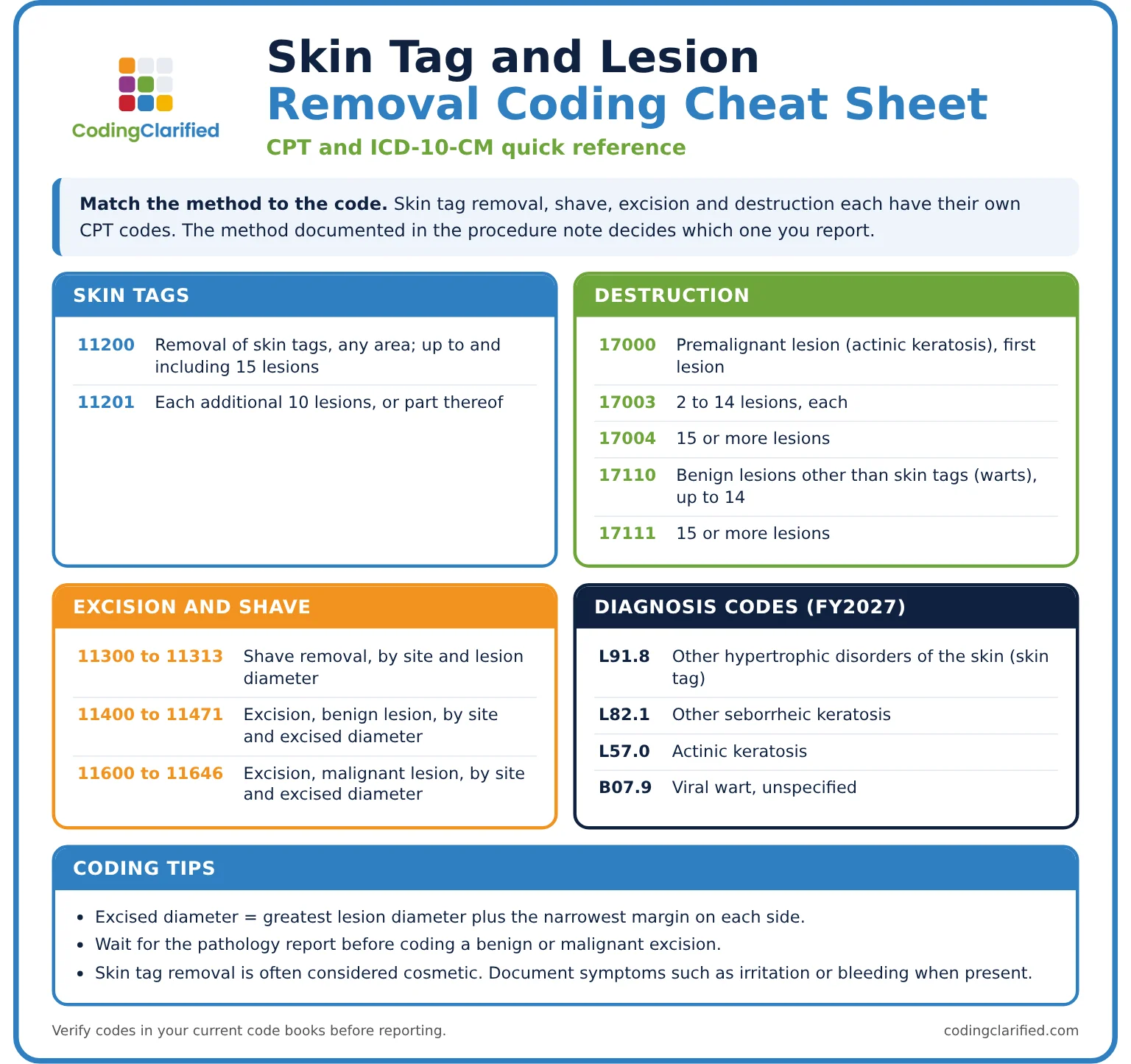
- Use CPT 11200 for the removal of 1–15 skin tags.
- Report +11201 for each additional 10 lesions or part thereof beyond the first 15.
- The method of removal does not affect code selection when reporting skin tag removal.
- The most commonly reported diagnosis code is L91.8 (Other hypertrophic disorders of the skin).
- Documentation should clearly state the total number of skin tags removed.
- Cosmetic skin tag removal is generally not covered by Medicare or most commercial payers.
- Medical necessity must be documented when symptoms such as bleeding, irritation, pain, or recurrent inflammation are present.
- CPC students should understand the lesion count system because it appears frequently on certification exams.
Overview: What Is the CPT Code for Skin Tag Removal?
Skin tag removal is coded based on the total number of lesions removed. Use CPT 11200 for the removal of the first 1–15 skin tags. For each additional 10 skin tags (or part thereof), report add-on code +11201. These codes apply regardless of the removal method, including excision, ligation, or cryotherapy. The most commonly reported diagnosis code is L91.8.
Why Accurate Skin Tag Coding Matters in 2026
Skin tag removal remains one of the most frequently performed dermatologic procedures in physician offices, urgent care centers, and specialty practices. However, many coding errors still occur because coders focus on the removal method rather than the lesion count.
In 2026, payer scrutiny continues to increase. Therefore, accurate CPT reporting and proper documentation are essential for reimbursement and audit protection.
Furthermore, understanding the distinction between skin tag removal codes and lesion destruction codes can prevent costly claim denials.
Understanding Skin Tags
Skin tags, also known as acrochordons, are benign fibrocutaneous growths that commonly appear in areas where skin rubs together.
Common locations include:
- Neck
- Axillae (underarms)
- Groin
- Eyelids
- Under the breasts
Although skin tags are usually harmless, providers may remove them when they become irritated, bleed, snag on clothing, or interfere with daily activities.
The Skin Tag Count System (CPT 11200–11201)
Unlike many dermatology procedures, skin tag removal coding depends primarily on the number of lesions removed.
Consequently, coders must carefully review provider documentation to determine the total count.
CPT 11200 Description
CPT 11200
Removal of skin tags, multiple fibrocutaneous tags, any area; up to and including 15 lesions
Report 11200 when the provider removes between 1 and 15 skin tags.
Examples
- 3 skin tags removed = 11200
- 10 skin tags removed = 11200
- 15 skin tags removed = 11200
CPT 11201 Description
+CPT 11201
Each additional 10 lesions, or part thereof (List separately in addition to code for primary procedure)
Report 11201 only in addition to 11200.
Furthermore, the code may be reported when any portion of the next 10 lesions is removed.
Examples
| Number of Skin Tags Removed | CPT Coding |
|---|---|
| 16–25 | 11200 + 11201 |
| 26–35 | 11200 + 11201 x2 |
| 36–45 | 11200 + 11201 x3 |
| 46–55 | 11200 + 11201 x4 |
Coding Example
A dermatologist removes 25 skin tags from the patient’s neck and axilla.
Correct Coding:
- 11200
- +11201
Because the first 15 lesions are included in 11200, the remaining 10 lesions require one unit of 11201.
Skin Tag Removal Coding Scenarios
Scenario 1
Provider removes 8 skin tags from the neck.
Code: 11200
Scenario 2
Provider removes 18 skin tags from both axillae.
Codes:
- 11200
- +11201
Scenario 3
Provider removes 33 skin tags from multiple body areas.
Codes:
- 11200
- +11201 x2
Does the Removal Method Matter?
One of the most common coding misconceptions involves the removal technique.
Fortunately, CPT guidelines simplify reporting.
The following methods all use 11200–11201 when removing skin tags:
- Excision
- Cryotherapy
- Ligation
- Electrosurgery
- Scissor removal
Therefore, coders should focus on lesion count rather than technique.
ICD-10-CM Codes for Skin Tag Removal
Diagnosis coding should reflect the reason for treatment.
The most frequently reported code is:
Common ICD-10-CM Code
L91.8 – Other hypertrophic disorders of the skin
This diagnosis commonly supports skin tag removal when medically necessary.
Additional ICD-10-CM Codes That May Apply
Depending on documentation, providers may also report:
| ICD-10-CM Code | Description |
|---|---|
| L91.8 | Other hypertrophic disorders of the skin |
| R20.8 | Other disturbances of skin sensation |
| L29.9 | Pruritus, unspecified |
| R23.8 | Other skin changes |
| L30.9 | Dermatitis, unspecified (when documented) |
Always code to the highest level of specificity supported by the medical record.
Medical Necessity and Coverage Considerations
Many payers classify skin tag removal as cosmetic when lesions are asymptomatic.
As a result, reimbursement often depends on documentation of medical necessity.
Documentation should support conditions such as:
- Recurrent bleeding
- Chronic irritation
- Pain
- Inflammation
- Obstruction of vision
- Repeated trauma from clothing or jewelry
Moreover, providers should document failed conservative treatment when applicable.
For Medicare guidance, review CMS policies:
For coding guidance:
Documentation Requirements for Skin Tag Removal
Strong documentation supports clean claims and audit compliance.
Providers should document:
- Number of skin tags removed
- Anatomical location
- Medical necessity
- Symptoms
- Removal method
- Patient consent
- Post-procedure instructions
Additionally, photographs may support medical necessity when payer policies require visual evidence.
CPT 11200 vs Lesion Destruction Codes
Another common coding mistake involves confusing skin tags with benign lesions.
Skin Tags
Use:
- 11200
- +11201
Benign Lesion Destruction
Use:
- 17110
- 17111
These codes apply to benign lesions such as:
- Seborrheic keratoses
- Warts
- Molluscum contagiosum
Consequently, coders must verify lesion type before assigning CPT codes.
Reimbursement Tips for 2026
As payer audits continue to increase throughout 2026, coders should focus on documentation accuracy.
For better claim outcomes:
- Verify payer medical necessity policies.
- Count lesions carefully.
- Confirm diagnosis support.
- Review LCDs when applicable.
- Avoid reporting cosmetic procedures as medically necessary.
- Ensure documentation supports every lesion billed.
Furthermore, maintaining detailed procedure notes can significantly reduce denial risk.
Common Mistakes to Avoid
Many denials occur because of preventable coding errors.
Avoid these common mistakes:
Counting Incorrectly
Always count the total number of skin tags removed.
Reporting 11201 Alone
11201 is an add-on code and cannot be billed by itself.
Using Lesion Destruction Codes
Do not report 17110 or 17111 for documented skin tags.
Ignoring Medical Necessity
Payers often deny claims when documentation only states cosmetic removal.
Missing Location Documentation
Providers should document all treatment sites clearly.
CPC Student Tips
Skin tag coding appears frequently on CPC exams because it tests CPT coding fundamentals.
CPC Exam Tip #1
Remember the threshold:
- 11200 = 1–15 lesions
- 11201 = each additional 10 lesions or part thereof
CPC Exam Tip #2
Focus on lesion count rather than removal method.
CPC Exam Tip #3
Watch for distractor answers using destruction codes such as 17110 and 17111.
CPC Exam Tip #4
Always identify whether the question describes skin tags, warts, or another lesion type.
CPC Exam Tip #5
Memorize that 11201 is an add-on code and requires 11200.
Related Coding Clarified Articles
For additional coding guidance, review these related resources:
- Medical Coding Blog Hub
- Anatomical Modifiers Guide: Finger, Toe, & Eyelid HCPCS Codes (2026 Update)
- Evaluation and Management (E/M) Guidelines for 2026: The Complete Guide
- Medical Coding “Clarified” Biopsy – Skin Nevus
- Medical Coding for Pressure Ulcers
These articles provide additional CPT, ICD-10-CM, documentation, and CPC exam insights.
Additional Resources
Frequently Asked Questions (FAQ)
What is CPT code 11200 used for?
CPT 11200 is used for the removal of up to 15 skin tags, regardless of the removal method.
When should CPT 11201 be reported?
Report +11201 for each additional 10 skin tags, or part thereof, beyond the first 15 lesions.
Can 11201 be billed without 11200?
No. 11201 is an add-on code and must always be reported with 11200.
Does cryotherapy change the CPT code selection?
No. Skin tag removal coding depends on lesion count, not removal method.
What is the most common ICD-10 code for skin tags?
The most common diagnosis code is L91.8 (Other hypertrophic disorders of the skin).
Are skin tag removals covered by Medicare?
Coverage depends on medical necessity. Cosmetic removal is generally not covered.
What documentation is required for skin tag removal?
Documentation should include lesion count, anatomical location, symptoms, medical necessity, removal method, and provider assessment.
How would you code removal of 28 skin tags?
Report:
- 11200
- +11201 x2
The first 15 lesions are included in 11200, while the remaining 13 lesions require two units of 11201.
Coding Clarified Final Thoughts
Skin tag removal coding may appear simple, yet counting lesions correctly is critical for accurate reimbursement. In 2026, payers continue to emphasize documentation, medical necessity, and procedure specificity. Therefore, coders should verify lesion counts, understand add-on code rules, and distinguish skin tags from other benign lesions. By mastering CPT 11200, +11201, and the appropriate ICD-10-CM diagnoses, coders can improve claim accuracy, reduce denials, and strengthen CPC exam performance.