
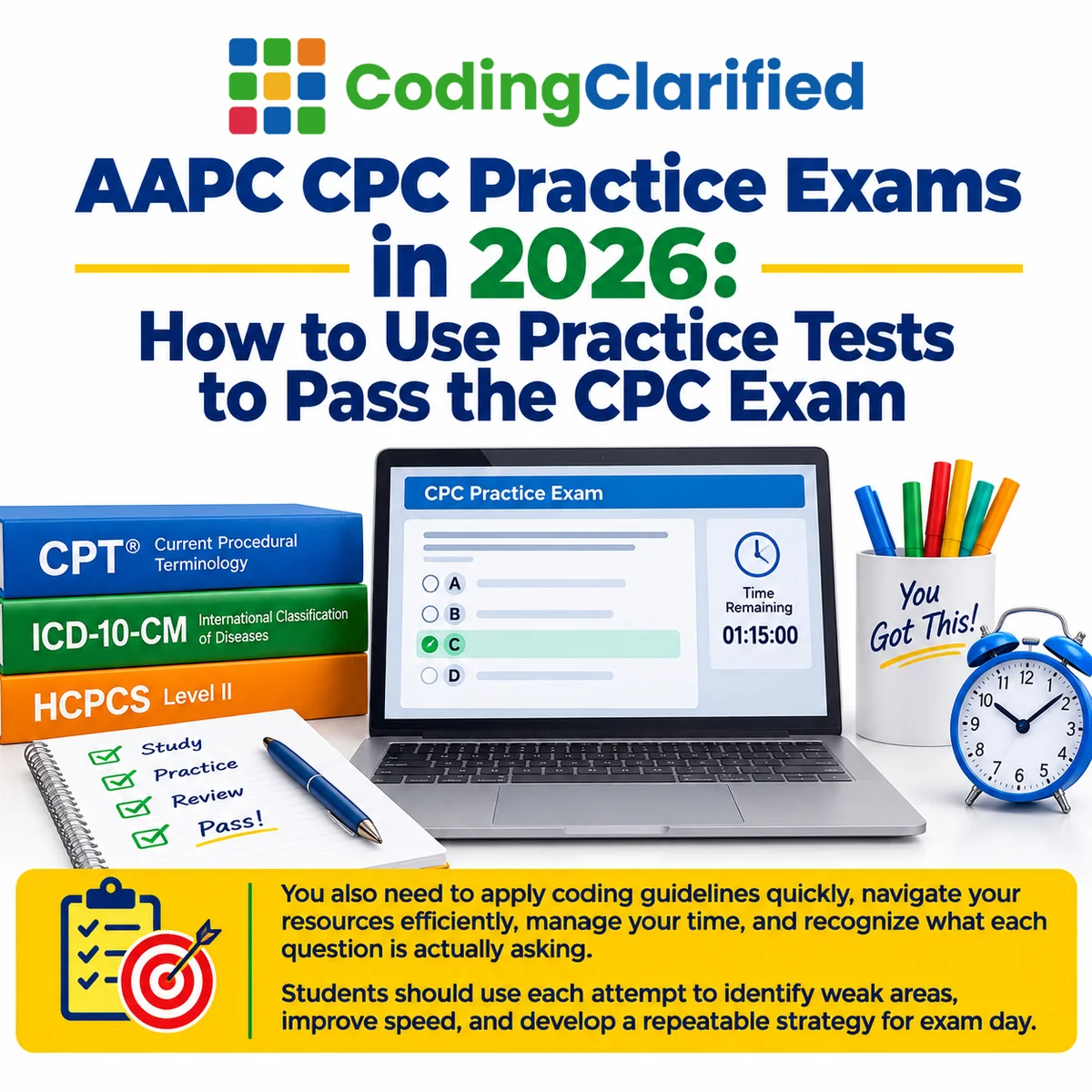
Preparing for the Certified Professional Coder (CPC) exam takes more than memorizing medical terminology and learning where codes are located. You also need to apply coding guidelines quickly, navigate your resources efficiently, manage your time, and recognize what each question is actually asking.
That is where AAPC CPC practice exams can make a major difference.
In 2026, practice exams remain one of the most useful tools for CPC students because they help turn coding knowledge into test-taking skill. However, simply taking practice test after practice test is not enough. Instead, students should use each attempt to identify weak areas, improve speed, and develop a repeatable strategy for exam day.
This guide explains how AAPC practice exams work, why they matter, how often you should take them, what scores to aim for, and how to use your results to prepare for the CPC certification exam.
Key Takeaways on AAPC CPC Practice Exams
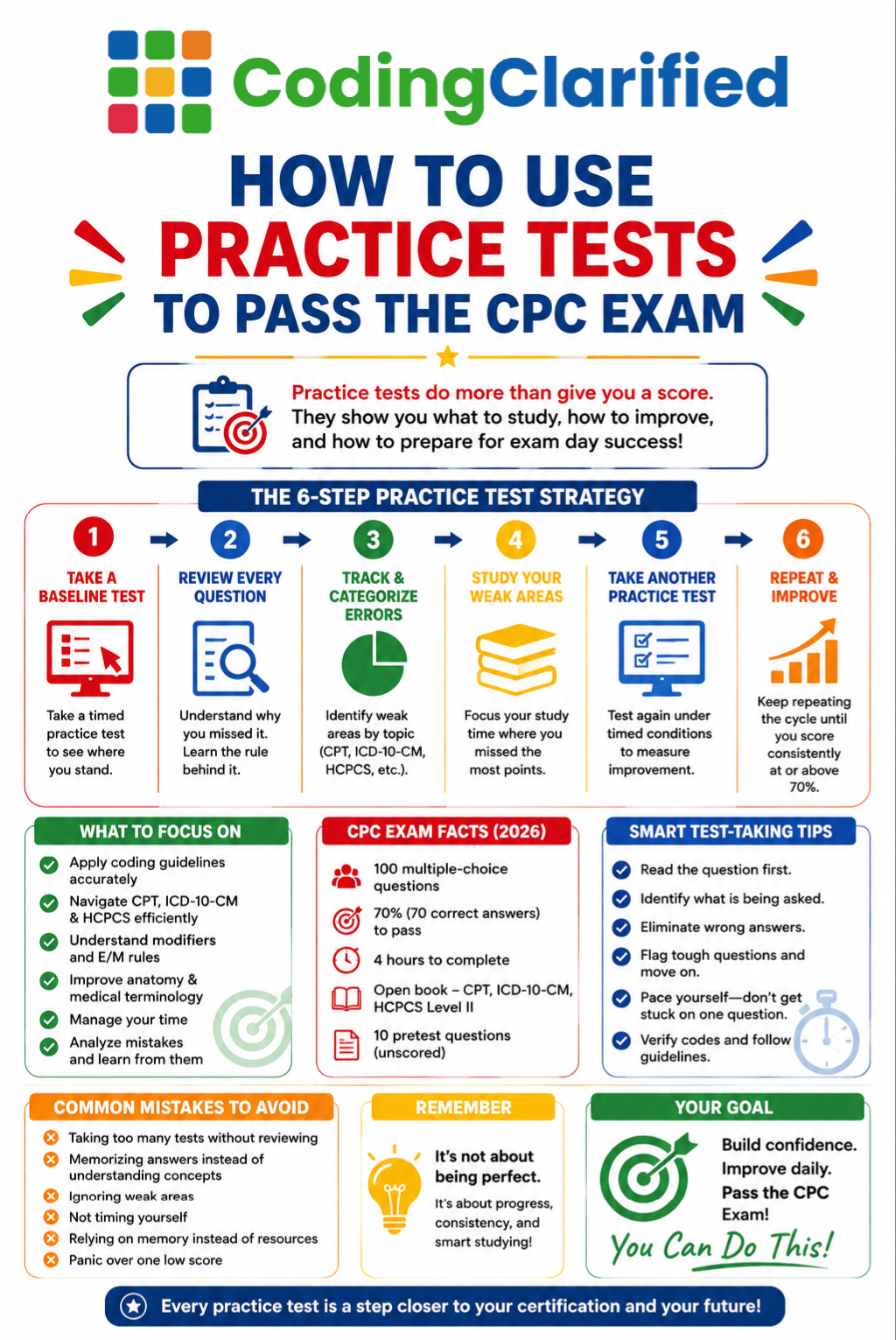
- The AAPC CPC exam contains 100 questions, and candidates need at least 70 correct answers to pass.
- AAPC practice exams help students become comfortable with the online testing format, question style, coding resources, and time pressure.
- Practice tests work best as diagnostic tools, not just score generators.
- Reviewing every missed question usually provides more value than immediately taking another practice exam.
- Students should practice navigating CPT, ICD-10-CM, and HCPCS Level II resources instead of trying to memorize every code.
- Timed practice helps students learn when to answer, skip, flag, and return to difficult questions.
- A consistent practice score above the minimum passing level can provide a better readiness signal than one unusually high score.
- Current-year coding resources matter because CPT, HCPCS Level II, ICD-10-CM, payer rules, and coding guidance can change.
What Is an AAPC CPC Practice Exam?
An AAPC CPC practice exam is a simulated test designed to help students prepare for the Certified Professional Coder certification examination.
Importantly, AAPC states that its practice exams are now delivered on the same online platform as its electronic certification exams. Therefore, students can become familiar with the format, tools, and resources they may encounter during the actual electronic exam.
AAPC also recommends practice exams as a way to identify strengths and weaknesses while becoming familiar with the format and time limits of the certification test.
Visit the AAPC Practice Exams FAQ for current information directly from AAPC.
Practice exams should not replace your coding course, manuals, study guide, or guideline review. Instead, they help you determine whether you can apply what you have learned under exam-style conditions.
Why Are CPC Practice Exams So Important in 2026?
The CPC exam does not simply ask whether you recognize a medical term or remember a code.
You must interpret documentation, locate information, apply coding rules, eliminate incorrect answers, and make a decision efficiently.
For example, a student may understand surgical coding well during homework but struggle when several similar answers appear in a timed question. Likewise, another student may know ICD-10-CM conventions but spend too much time researching one diagnosis.
Practice exams expose these problems before certification day.
Additionally, they give students a measurable way to answer an important question:
Am I actually ready for the CPC exam?
Understanding the CPC Exam Format in 2026
According to AAPC, the CPC certification examination contains 100 multiple-choice questions. Candidates must answer at least 70 questions correctly to earn a passing score of 70%.
The examination covers areas such as:
- CPT coding
- ICD-10-CM
- HCPCS Level II
- E/M services
- Anatomy
- Medical terminology
- Modifiers
- Coding guidelines
- Compliance and regulatory topics
- Medical coding cases
Students should review the current exam information directly through AAPC’s CPC Exam Information before testing because exam policies and testing procedures can change.
For a more complete overview, read our Ultimate Medical Coding AAPC CPC Certification Guide.
How AAPC Practice Exams Help You Pass the CPC Exam
1. They Identify Your Weak Coding Areas
A practice exam gives you something ordinary studying cannot always provide: objective feedback.
You may feel confident about ICD-10-CM but discover that you regularly miss questions involving guidelines or sequencing. Meanwhile, another student may struggle with modifiers, E/M services, anatomy, or a particular CPT section.
Once you identify those patterns, you can spend more time where it matters.
Instead of studying everything equally, focus on the topics that cost you the most points.
That approach makes studying much more efficient.
2. They Improve Your Coding Speed
Time management can become one of the biggest challenges on the CPC exam.
Students sometimes spend several minutes researching one difficult question because they feel they must solve it before moving forward. Unfortunately, doing that repeatedly can create serious time problems later in the exam.
Practice tests teach you to recognize when a question deserves more research and when you should flag it and continue.
Furthermore, timed practice helps you develop a natural rhythm.
You begin learning how quickly you can navigate CPT, ICD-10-CM, and HCPCS Level II resources without rushing so much that you make careless mistakes.
3. They Teach You How CPC Questions Are Structured
Medical coding questions often contain more information than you need.
Consequently, students must learn how to identify the key details.
For example, a surgical question may require you to recognize:
- Procedure performed
- Anatomical location
- Surgical approach
- Number of lesions or sites
- Size or measurement
- Whether services are bundled
- Applicable modifiers
- Add-on code requirements
Rather than reading every question as a large block of information, practice exams teach you to break scenarios into smaller coding decisions.
That skill becomes increasingly valuable as questions become more complicated.
4. They Improve Code Book and Resource Navigation
The CPC exam measures coding ability, not your ability to memorize thousands of codes.
Therefore, efficient navigation matters.
Students should know where major sections begin, how guidelines are organized, and how to move between the index and tabular information efficiently.
For example, if a practice question involves a total knee arthroplasty such as 27447, knowing where to begin your CPT search saves valuable time. Likewise, when working with a diagnosis such as I10, students should still verify the code and applicable instructions rather than relying only on memory.
For additional preparation tips, read Medical Coding Study Tips: Why Too Many Notes in Your Manuals Can Hurt Your CPC Exam Performance.
Students taking an electronic exam may also benefit from our guide on Using eBooks for the AAPC CPC Exam.
The Best Way to Use CPC Practice Exams
A practice test becomes much more valuable when you use a structured process.
Step 1: Take a Baseline Practice Exam
After completing most of your CPC coursework, take a practice exam to establish your baseline.
Do not worry if the first score is disappointing.
Instead, treat it as data.
Record your overall score and identify which topics caused the most difficulty.
Step 2: Review Every Incorrect Answer
This may be the most important step.
Do not simply look at the correct answer and move on. Instead, determine why you selected the wrong answer.
Ask yourself:
- Did I misunderstand the question?
- Did I choose the wrong main term?
- Did I overlook a guideline?
- Did I miss a modifier?
- Did I select a bundled service?
- Did I confuse similar codes?
- Did I rush?
- Did I spend too much time researching?
Understanding the reason behind the error helps prevent the same mistake later.
Step 3: Track Your Missed Questions by Category
Create a simple CPC practice exam error log.
For example:
| Area | Missed Questions | Action |
|---|---|---|
| ICD-10-CM | 4 | Review guidelines and sequencing |
| E/M | 5 | Review current E/M rules |
| Modifiers | 3 | Study modifier definitions |
| Surgery | 6 | Practice CPT section navigation |
| HCPCS | 2 | Review Level II structure |
| Anatomy | 4 | Review body systems |
Afterward, study the categories with the highest number of errors first.
This method prevents random studying.
Step 4: Study the Weak Areas
Spend focused study time reviewing the concepts that caused problems.
Use your coding manuals, course materials, instructor notes, study guide, and authoritative coding resources.
Additionally, remember that coding information changes.
CMS publishes official ICD-10-CM information and annual code updates. Therefore, students should become comfortable checking reliable sources instead of depending on random coding websites or outdated social media posts.
Review the current CMS ICD-10 resources and the FY 2026 ICD-10-CM Official Guidelines for Coding and Reporting when studying diagnosis coding.
Step 5: Take Another Timed Practice Exam
Once you have reviewed your weak areas, take another practice test.
Compare the new results with your baseline.
Did your score improve?
More importantly, did your weakest categories improve?
If your overall score increased only because you performed better in areas you already knew, you still need additional work.
Step 6: Repeat the Review Process
Continue the cycle:
Practice → Review → Study → Practice Again
This approach is much more effective than repeatedly answering questions without studying the mistakes between attempts.
Sample CPC-Style Questions With Worked Answers
1. A patient with type 2 diabetes has diabetic chronic kidney disease, stage 3a. Which codes apply?
Answer: E11.22 and N18.31. ICD-10-CM presumes a link between diabetes and CKD, so code E11.22 for type 2 diabetes with diabetic CKD, and add N18.31 to report the stage, as the instructional note directs.
2. A provider excises a benign lesion from the back. The excised diameter, including margins, is 1.5 cm. Which CPT code applies?
Answer: 11402. Benign excisions of the trunk, arms, or legs are coded by excised diameter, and 1.5 cm falls in the 1.1 to 2.0 cm range.
3. A new patient office visit has moderate medical decision making. Which E/M code applies?
Answer: 99204. For office visits, the level is based on medical decision making or total time, and moderate MDM for a new patient supports 99204.
Notice the pattern: each answer comes from a guideline or instructional note, not memory. That is how to review every practice question.
Practice Exams in Our 16 Week Study Plan
In our 16 week CPC study schedule, students take a first timed practice exam once all code sets are covered, review every wrong answer by category, then take a second timed exam before test day. Our instructor-guided program includes practice exams and the midterm through the course tracker.
What Practice Exam Score Should You Aim for Before the CPC Exam?
AAPC requires a score of at least 70% on the CPC certification exam.
However, students should avoid treating 70% on one practice test as automatic proof that they are ready.
A practice score can change depending on question difficulty, subject mix, test anxiety, distractions, and familiarity with specific questions.
Therefore, consistency matters.
Ideally, you want to demonstrate that you can repeatedly perform at or above the passing level under realistic testing conditions. Building some cushion above 70% may also help account for exam-day stress or unfamiliar questions.
Most importantly, pay attention to why you are missing questions rather than chasing one particular practice score.
CPC Student Tips for Practice Exams
Practice Under Realistic Conditions
Set aside uninterrupted time and remove unnecessary distractions.
Additionally, avoid looking up answers through outside websites while completing a timed simulation.
Your goal is to learn how you perform under exam-like conditions.
Learn to Flag Difficult Questions
One hard question should not consume the time needed to answer several easier ones.
If you cannot make reasonable progress, flag the question and continue.
Return to it later when possible.
Use the Process of Elimination
You do not always need to identify the correct answer immediately.
Sometimes you can quickly identify two incorrect choices.
As a result, you improve your odds and reduce the amount of research required.
Read the Question Before Over-Researching
Determine exactly what the question wants.
A long scenario may ultimately ask about only one diagnosis, procedure, modifier, or coding rule.
Therefore, focus your research on the actual question.
Verify Codes Instead of Trusting Memory
Recognizing a familiar code can save time, but memory can also create errors.
Always pay attention to code descriptions, parenthetical instructions, guidelines, exclusions, and other applicable notes.
Don’t Ignore Official Coding Resources
Practice exams prepare you for certification, but CPC students should also understand where authoritative coding guidance comes from.
For ICD-10-CM, CMS and the National Center for Health Statistics publish official coding guidance. Additionally, CMS maintains the National Correct Coding Initiative (NCCI), which promotes correct coding and helps prevent improper coding of Medicare Part B and Medicaid claims.
The 2026 CMS NCCI Policy Manual became effective January 1, 2026, while CMS continues to publish quarterly updates to applicable edit files.
Students can explore the CMS National Correct Coding Initiative resources and 2026 Medicare NCCI Policy Manual.
These resources may look overwhelming at first. However, learning that they exist, and understanding their purpose, helps students develop the research habits they will need after certification.
Common Mistakes to Avoid With AAPC CPC Practice Exams
Taking Too Many Tests Without Reviewing Them
Completing five practice exams does not automatically make you more prepared than completing three.
If you never analyze your mistakes, you may continue repeating them.
Therefore, spend significant time reviewing each test.
Memorizing Practice Questions
Repeated attempts can cause students to remember an answer rather than understand the coding concept.
That creates false confidence.
Instead, explain why the answer is correct and why the other options are wrong.
Studying Only Your Favorite Sections
Many students naturally spend more time on topics they enjoy.
Unfortunately, that does not solve weak areas.
Use your practice results to guide your study schedule, even when the weakest section is not your favorite.
Ignoring Time Management
An untimed score may tell you what you know, but it does not fully show how you will perform under exam conditions.
Gradually incorporate timed practice into your preparation.
Panicking Over One Low Score
One poor practice exam does not determine your final CPC result.
Look for patterns across multiple attempts.
Then, correct the weaknesses causing the lower score.
Depending on Practice Exams Alone
Practice exams are only one part of CPC preparation.
Students still need coding education, guideline review, anatomy, medical terminology, manual or eBook navigation skills, and plenty of hands-on coding practice.
For additional resources, see Tools to Study for the AAPC CPC Exam.
A Simple 7-Day CPC Practice Exam Strategy
If you are approaching your exam date, try this basic plan.
Day 1: Complete a timed practice exam and record your results.
Day 2: Review every incorrect answer and categorize your mistakes.
Day 3: Study your weakest CPT areas.
Day 4: Review ICD-10-CM, HCPCS Level II, modifiers, and guidelines.
Day 5: Complete another timed practice exam.
Day 6: Review missed questions and complete targeted practice.
Day 7: Perform a lighter review, organize your exam resources, and avoid exhausting yourself with last-minute cramming.
Adjust this schedule based on your scores and available study time.
Students who need more preparation should stretch the same strategy across several weeks instead of trying to compress everything into seven days.
How Coding Clarified Uses Practice Exams in CPC Preparation
At Coding Clarified, we view practice exams as part of a larger CPC preparation pathway rather than a stand-alone solution.
Students need to learn coding concepts first. Next, they need opportunities to apply those concepts. Finally, practice exams help measure whether they can apply their knowledge efficiently under testing conditions.
Coding Clarified’s training resources include CPC preparation tools designed to support students as they move from education toward certification.
Practice exams are especially useful near the end of training because students can identify remaining weaknesses before scheduling or taking their certification exam.
After certification, students should continue developing real-world coding skills through additional practice and experience.
Students interested in the next step can also read our AAPC Practicode in 2026: How to Pass Cases, Improve Your Coding Skills, and Complete Practicode Faster.
Final Thoughts: Are AAPC CPC Practice Exams Worth It in 2026?
Yes. When used correctly, AAPC CPC practice exams can be one of the most useful tools in your certification preparation.
Their greatest value does not come from simply receiving a score.
Instead, practice exams show you where your preparation stands.
They can reveal weak coding areas, improve time management, strengthen resource navigation, familiarize you with the electronic testing environment, and help you develop a better strategy for difficult questions.
AAPC itself recommends practice testing as a way to diagnose strengths and weaknesses while becoming familiar with the format and time constraints of the certification exam.
Most importantly, treat every missed question as information.
Determine why you missed it, review the applicable rule, practice the concept again, and measure your improvement.
That process turns a practice exam into a true learning tool.
By combining strong medical coding education, current coding resources, targeted review, and realistic practice testing, you can walk into your 2026 CPC exam much better prepared to succeed.
Frequently Asked Questions About AAPC CPC Practice Exams
Quick answers to the questions CPC students ask most about AAPC practice exams.
How many questions are on the CPC exam in 2026?
The AAPC CPC certification exam contains 100 multiple-choice questions. Candidates must correctly answer at least 70 questions to earn the required 70% passing score. Always check AAPC before your exam because certification policies can change.
Are AAPC CPC practice exams worth buying?
For many CPC students, yes. Practice exams can help identify weak areas, improve pacing, and provide experience with exam-style questions. In addition, AAPC’s current practice exams use the same online platform as its electronic certification exams, which can help students become familiar with the testing environment.
Are AAPC practice exams the same as the real CPC exam?
No. You should not expect the exact same questions. Instead, practice exams help simulate the type of testing experience and knowledge application needed for certification. Their purpose is preparation, assessment, and skill development.
What score should I get on CPC practice exams before taking the real exam?
The official CPC passing requirement is 70%. However, students should focus on consistently performing at or above the passing level rather than relying on one practice score. Ideally, you should also understand why you missed each question and show improvement in your weaker subjects.
How many CPC practice exams should I take?
There is no perfect number for every student. Several well-reviewed practice exams usually provide more value than repeatedly taking tests without analyzing the results. Focus on the cycle of testing, reviewing mistakes, studying weak areas, and testing again.
Should I time myself when taking a CPC practice exam?
Yes, especially as your exam date approaches. Early in your studies, untimed practice can help you learn concepts. Later, timed practice becomes important because it teaches you to manage difficult questions, navigate resources efficiently, and maintain a reasonable pace.
What should I do if I keep failing CPC practice exams?
First, stop taking new tests temporarily and analyze your previous results. Identify the subjects responsible for most of your missed questions. Then, review those coding sections, guidelines, anatomy concepts, modifiers, or terminology before attempting another practice exam. A low practice score is most useful when it tells you exactly what to study next.
What is the best way to study for the CPC exam in 2026?
Combine structured CPC education with current coding resources, guideline review, hands-on coding exercises, timed practice exams, and targeted review of missed questions. Additionally, practice navigating the resources you will use during your exam. The goal is not to memorize every code; instead, develop the ability to find, verify, and apply coding information accurately and efficiently.
This article is part of our CPC exam prep study hub, with everything you need to prepare for and pass the CPC exam.