Anterior Cervical Discectomy and Fusion (ACDF) Coding in 2026: PEEK Cage, Anterior Plate, CPT, ICD-10-CM, and Documentation Guide
Key Takeaways
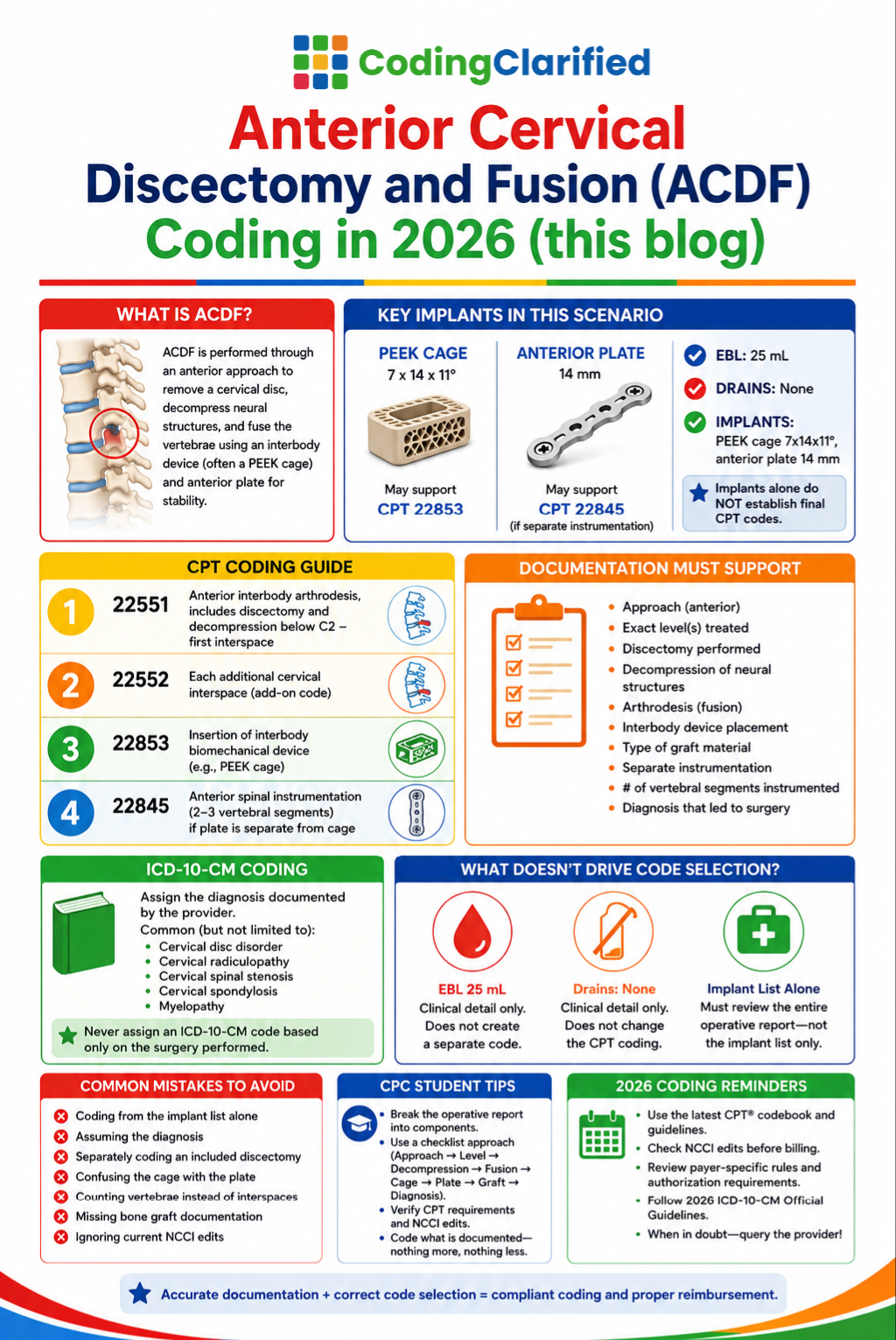
- A PEEK interbody cage and anterior cervical plate strongly suggest an anterior cervical fusion procedure; however, implants alone do not establish the final CPT codes.
- For an anterior cervical discectomy and fusion (ACDF) with decompression below C2, CPT 22551 commonly represents the first treated interspace when the complete documentation supports the code.
- CPT 22552 may apply to each additional cervical interspace when the surgeon performs and documents the required work.
- CPT 22853 may apply to insertion of an interbody biomechanical device, such as a PEEK cage, when all code requirements are met.
- A separate anterior plate may support anterior instrumentation coding, such as 22845, depending on the number of vertebral segments instrumented and whether the plate functions as separate instrumentation.
- An estimated blood loss (EBL) of 25 mL and “drains: none” are clinically useful details, but they do not independently generate additional CPT codes.
- The diagnosis must come from the provider’s documentation. Coders should never select an ICD-10-CM diagnosis simply because a cervical fusion was performed.
- In 2026, coders should verify current CPT guidance, NCCI edits, payer rules, and ICD-10-CM guidelines before submitting the claim.
ACDF Medical Coding in 2026
Anterior cervical discectomy and fusion, commonly called ACDF, is a spine surgery that can challenge even experienced medical coders. Although the procedure may sound straightforward, several separate components can appear in the operative report.
For example, the surgeon may perform a discectomy, nerve root decompression, interbody fusion, placement of a biomechanical cage, bone grafting, and anterior instrumentation. Therefore, coders must determine which services are included in the primary procedure and which services may be separately reportable.
Additionally, implant terminology can create confusion. A PEEK cage may represent an interbody biomechanical device, while an anterior plate may represent separate spinal instrumentation. However, the coder must review the complete operative report before assigning either code.
This 2026 coding scenario provides a perfect example.
Coding Scenario
The available operative documentation includes:
Estimated Blood Loss (EBL): 25 mL
Drains: None
Implants:
- PEEK cage, 7 × 14 × 11°
- Anterior plate, 14 mm
At first glance, an experienced spine coder may suspect an ACDF because the surgeon used an interbody PEEK cage and anterior plate. Nevertheless, the implant section does not tell us everything needed for final coding.
Most importantly, we still need to know:
- What procedure did the surgeon perform?
- What cervical level or levels were treated?
- Was a complete discectomy performed?
- Was decompression of the spinal cord and/or nerve roots performed?
- Was arthrodesis performed?
- What material was placed inside or around the cage?
- Was the anterior plate separate from the cage?
- How many vertebral segments did the plate span?
- What diagnosis led to the surgery?
Consequently, the implant list provides valuable clues, but it cannot replace the operative report.
What Is an ACDF?
Anterior cervical discectomy and fusion is performed through an anterior, or front-of-neck, approach. Generally, the surgeon accesses the affected cervical disc, removes disc material, decompresses neural structures when necessary, prepares the disc space, and performs a fusion.
Next, the surgeon may place an interbody device into the disc space. A PEEK cage is one common example.
PEEK stands for polyetheretherketone. It is a synthetic material commonly used for spinal interbody devices because it provides structural support while the fusion heals.
Additionally, surgeons may place an anterior plate across the vertebral bodies for stabilization. Because the cage and plate can represent different coding components, coders must understand exactly what each device does.
CPT 22551: The Primary ACDF Code
For a cervical anterior interbody fusion below C2 that includes the required discectomy and decompression work, CPT 22551 is often the starting point.
Importantly, 22551 is more than a simple fusion code. The service includes several components associated with the ACDF procedure, including disc-space preparation and discectomy when performed as described by the code.
Therefore, coders should not automatically assign a separate anterior cervical discectomy code for work already included in 22551.
AAPC’s CPT information for 22551 describes the code within the anterior or anterolateral approach arthrodesis family and explains that a cervical disc is removed and fusion is performed to stabilize the vertebrae.
Authoritative resource: AAPC CPT 22551 reference
Example
Suppose the full operative report states that the surgeon performed:
- C5-C6 anterior cervical discectomy
- Decompression of the spinal cord and nerve roots
- Preparation of the endplates
- C5-C6 anterior interbody fusion
If all CPT requirements are documented, 22551 may represent the primary ACDF service.
However, coders should always compare the actual operative documentation with the current CPT descriptor and instructions.
What Happens When More Than One Cervical Level Is Fused?
Multiple-level ACDF procedures require careful level counting.
For example, C5-C6 represents one interspace. If the surgeon also performs the qualifying ACDF procedure at C6-C7, the second interspace may support CPT 22552.
Therefore, a properly documented two-level ACDF may involve:
- 22551 — first cervical interspace
- 22552 — each additional cervical interspace
The important word is interspace.
Coders should not simply count the number of vertebrae mentioned in the report. Instead, identify the actual disc spaces treated.
For instance:
C4-C5 = first interspace
C5-C6 = second interspace
C6-C7 = third interspace
Consequently, accurate anatomy becomes essential in spine surgery coding.
Coding the PEEK Cage: CPT 22853
The PEEK cage listed in this scenario deserves special attention.
CPT 22853 describes insertion of an interbody biomechanical device into an intervertebral disc space in conjunction with interbody arthrodesis when the code requirements are met.
Therefore, a PEEK cage placed into the disc space during an ACDF may support 22853.
The AMA has specifically discussed 22853 in connection with biomechanical devices placed into a discectomy defect during spinal fusion procedures, including ACDF procedures.
However, coders should not assign 22853 simply because the word “cage” appears in the implant list. Instead, the operative report should establish where the device was placed and its role in the fusion.
Documentation should identify:
- Device type
- Interspace where the device was placed
- Purpose of the device
- Fusion being performed
- Number of interspaces receiving devices
This documentation becomes especially important when multiple cages are used.
PEEK Cage vs. Anterior Plate: Why the Difference Matters
One of the most important lessons in this scenario involves distinguishing integral device anchoring from separate anterior instrumentation.
CPT 22853 includes integral anterior instrumentation used to anchor certain interbody devices. For example, some cages include screws or flanges that directly secure the cage.
However, a separate anterior cervical plate may represent a different service.
The AMA has explained that integral device anchoring is not the same as separate anterior spinal instrumentation. A standalone anterior cervical plate capable of stabilizing the spinal segment independently of the cage may qualify as separately reportable anterior instrumentation when the documentation and CPT requirements support it.
Therefore, the phrase:
“Anterior plate 14 mm”
is important.
Nevertheless, coders still need the operative report to determine where the plate was placed and how many vertebral segments it spans.
When Could CPT 22845 Apply?
CPT 22845 describes anterior spinal instrumentation involving two to three vertebral segments.
Consequently, a separate anterior cervical plate spanning two vertebral bodies during a single-level ACDF may potentially support 22845, provided the documentation and current coding rules are satisfied.
For example, a complete operative report might document:
- C5-C6 ACDF
- PEEK interbody cage at C5-C6
- Separate anterior cervical plate spanning C5-C6
Depending on the full documentation and current edits, the coding structure may include:
22551 — qualifying single-level ACDF
22853 — interbody biomechanical device
22845 — separate anterior instrumentation spanning two to three vertebral segments
However, coders must verify the current CPT instructions and NCCI edits rather than automatically billing every implant mentioned.
CMS includes 22551, 22552, 22845, and 22853 among spinal procedure codes addressed in its current outpatient prior authorization guidance. Therefore, these services remain highly relevant to cervical fusion coding in 2026.
Authoritative resource: CMS Hospital Outpatient Prior Authorization Program
What About Bone Graft Coding?
This scenario does not tell us what graft material the surgeon used.
That omission matters.
A PEEK cage provides structural support, but the surgeon may fill the cage or surrounding disc space with autograft, allograft, or another material. Therefore, the coder must review the body of the operative report rather than assume a graft type from the implant list.
Depending on documentation, spinal graft coding may involve codes from the 20930–20938 family.
For example, the surgeon might document morselized allograft, structural allograft, local autograft, or autograft harvested through a separate incision.
Each situation has different coding considerations.
Consequently, never code a graft that is not documented.
Does EBL of 25 mL Affect CPT Coding?
The operative report states:
EBL: 25 mL
Estimated blood loss is an important clinical detail because it documents the amount of blood lost during surgery. Nevertheless, an EBL of 25 mL does not normally create an additional CPT procedure code by itself.
Instead, coders should view EBL as part of the overall surgical record.
Additionally, low blood loss may help demonstrate that the procedure occurred without major hemorrhagic complications. However, coders should never assign a postoperative hemorrhage or anemia diagnosis solely from an EBL value.
The provider must document the diagnosis.
Does “Drains: None” Change the Coding?
No separate CPT code results simply because the operative report states:
Drains: None.
This statement documents that the surgeon did not leave a surgical drain.
However, the absence of a drain does not change the basic ACDF code selection.
This detail remains useful because it provides a more complete picture of the procedure and postoperative management. Still, CPT coding should focus on the actual reportable surgical services.
ICD-10-CM Diagnosis Coding for ACDF
The scenario does not provide a diagnosis. Therefore, a final ICD-10-CM code cannot be assigned from this excerpt alone.
This is an important coding lesson.
A coder should never see a cervical fusion and automatically select a diagnosis such as cervical radiculopathy, spinal stenosis, or disc disorder.
Instead, the provider’s documented diagnosis determines the ICD-10-CM assignment.
Depending on the complete record, an ACDF might treat conditions such as:
- Cervical disc disorder
- Cervical radiculopathy
- Cervical spinal stenosis
- Cervical spondylosis
- Myelopathy
- Other documented cervical spine disorders
However, these conditions are not interchangeable.
Additionally, combination codes may apply in certain circumstances. Therefore, coders should review the Alphabetic Index, Tabular List, instructional notes, and 2026 ICD-10-CM Official Guidelines before assigning the final diagnosis.
For additional guidance, review Coding Clarified’s ICD-10-CM 2026 Updates.
Why the Full Operative Report Matters
This case demonstrates why coders should never code spine surgery from the implant log alone.
The implant section tells us that a PEEK cage and anterior plate were used. However, it does not establish the complete surgical work.
Instead, review the entire operative report and identify:
- Preoperative diagnosis
- Postoperative diagnosis
- Procedure title
- Surgical approach
- Exact cervical level or levels
- Discectomy work
- Decompression performed
- Arthrodesis technique
- Interbody device placement
- Graft material
- Separate instrumentation
- Number of vertebral segments instrumented
- Complications
- Additional separately reportable procedures
Coding Clarified’s guide on How to Code Operative Reports Efficiently provides additional strategies for breaking down complex operative notes.
Example of a Complete ACDF Coding Analysis
Assume the full operative report documents a single-level C5-C6 ACDF with decompression.
The surgeon removes the C5-C6 disc, decompresses the spinal cord and nerve roots, prepares the endplates, performs the interbody fusion, inserts a PEEK cage, and places a separate anterior cervical plate spanning C5-C6.
In that situation, the coder would investigate:
- 22551 for the qualifying ACDF
- 22853 for the PEEK interbody biomechanical device
- 22845 for qualifying separate anterior instrumentation across two vertebral segments
- Appropriate graft code, if separately reportable and documented
- Appropriate ICD-10-CM diagnosis based on the physician’s documented condition
Importantly, this is an illustrative coding pathway, not the final coding answer for the limited scenario provided.
The missing operative details must be reviewed first.
2026 ACDF Coding and Compliance Considerations
Spinal fusion remains an important area of coding and reimbursement oversight in 2026. Therefore, coders should use current-year CPT resources and review payer-specific requirements before claim submission.
Additionally, CMS policies may affect authorization and reimbursement for certain spine procedures performed in hospital outpatient settings. NCCI edits can also affect which procedure combinations may be reported together.
For Medicare claims, review the current CMS National Correct Coding Initiative.
Meanwhile, ICD-10-CM coding must follow the current fiscal-year guidelines. Coding Clarified also provides a detailed overview of the 2026 ICD-10-CM Updates.
Because annual rules can change, coders should avoid relying on an old coding sheet or memorized code combination.
Common Mistakes to Avoid
Coding From the Implant List Alone
Seeing “PEEK cage” and “anterior plate” does not provide enough information to finalize an ACDF claim.
Instead, read the complete operative report.
Assuming the Diagnosis
A cervical fusion does not automatically mean cervical radiculopathy or spinal stenosis.
Therefore, assign only the diagnosis documented by the provider.
Separately Coding an Included Discectomy
When the discectomy and decompression work are included in 22551, do not unbundle an additional procedure merely because the operative report describes the discectomy in detail.
Confusing the Cage With the Plate
The PEEK cage and separate anterior plate may represent different components of the surgery.
Consequently, determine whether instrumentation is integral to the cage or represents standalone spinal instrumentation.
Counting Vertebrae Instead of Interspaces
For 22551 and 22552, coders must understand the difference between vertebral segments and interspaces.
For example, C5-C6 represents one interspace but involves two vertebral bodies.
Missing Bone Graft Documentation
Do not assume the cage contains allograft or autograft.
Instead, locate the graft description in the operative report.
Ignoring Current NCCI Edits
Even when documentation appears to support two CPT codes, current bundling edits may affect reporting.
Therefore, verify current NCCI guidance before submitting the claim.
CPC Student Tips for Coding ACDF Procedures
For CPC students, spine surgery becomes much easier when you break the operative report into separate pieces.
First, identify the approach. In this scenario, you would look for confirmation of an anterior cervical approach.
Next, identify the main procedure. Was there a discectomy with decompression and fusion?
Then, count the interspaces.
Afterward, identify every implant. Ask yourself whether each device represents an interbody cage, integral fixation, or separate instrumentation.
Finally, look for graft material and confirm the diagnosis.
A useful CPC exam strategy is to write a short checklist beside the scenario:
Approach → Level → Decompression → Fusion → Cage → Plate → Graft → Diagnosis
This method helps prevent missed services while also reducing unbundling errors.
For additional CPC preparation, review the Coding Clarified Complete Guide to Preparing for the CPC Exam.
Practical Coding Differentiation: What Each Detail Tells You
| Documentation | Coding Significance |
|---|---|
| Anterior cervical approach | Helps identify the correct spinal procedure family |
| Discectomy | May be included in 22551 when requirements are met |
| Neural decompression | Important component supporting 22551 |
| Fusion/arthrodesis | Essential for selecting the arthrodesis code |
| PEEK cage | May support 22853 |
| Separate anterior plate | May support 22845 or another instrumentation code depending on segments |
| Bone graft | May support a code from 20930–20938, depending on type and harvest |
| EBL 25 mL | Clinical documentation; generally no separate CPT code |
| Drains: none | Clinical documentation; no separate CPT code |
| Diagnosis | Determines ICD-10-CM coding and supports medical necessity |
The key difference is that an implant does not equal a procedure code automatically.
Instead, the surgeon’s documented work must support every code reported.
Related Coding Clarified Resources
Continue building your surgical and diagnosis coding skills with these Coding Clarified articles:
- How to Code Operative Reports Efficiently
- ICD-10-CM 2026 Updates
- 2026 ICD-10-CM Updates
- ICD-10 Updates April 2026
- Coding Clarified Complete Guide to Preparing for the CPC Exam
Final Coding Clarified Takeaway
The documentation “EBL 25 mL, drains none, PEEK cage 7 × 14 × 11°, anterior plate 14 mm” provides useful clues about the surgery. However, it does not provide enough information to assign a final CPT or ICD-10-CM code set.
If the complete operative report confirms a qualifying single-level anterior cervical discectomy, decompression, and fusion below C2, 22551 may represent the primary procedure. Additionally, placement of the PEEK cage may support 22853, while a separate anterior plate may support 22845 when its documentation and segment count meet the code requirements.
Nevertheless, the coder must verify the spinal level, number of interspaces, decompression, arthrodesis, cage placement, instrumentation, graft material, and diagnosis.
That documentation-first approach remains one of the most important principles of accurate spine surgery coding in 2026.
Frequently Asked Questions About ACDF Coding in 2026
What CPT code is used for a single-level ACDF?
CPT 22551 commonly applies to the first cervical interspace below C2 when the surgeon performs the qualifying anterior interbody arthrodesis with the required discectomy and decompression work. However, coders must verify the complete operative documentation and current CPT guidance.
What CPT code is used for a PEEK cage during ACDF?
CPT 22853 may apply when the surgeon inserts a qualifying interbody biomechanical device, such as a PEEK cage, into the intervertebral disc space in conjunction with interbody arthrodesis. Nevertheless, the operative report must support the service.
Can you bill an anterior cervical plate separately from the PEEK cage?
Potentially, yes. A separate anterior plate may support an anterior instrumentation code such as 22845 when the device functions as separate instrumentation and the documented number of vertebral segments meets the code requirements. In contrast, integral fixation that is part of the interbody device may be included in 22853.
What is the difference between CPT 22551 and 22552?
CPT 22551 represents the initial qualifying cervical interspace below C2. Meanwhile, 22552 is an add-on code that may be reported for each additional qualifying cervical interspace.
Does an EBL of 25 mL require an additional diagnosis or procedure code?
Usually, no. An estimated blood loss of 25 mL is a clinical documentation element and does not independently create a CPT or ICD-10-CM code. Furthermore, coders should not diagnose anemia or hemorrhage based only on the EBL.
Does “drains: none” affect ACDF coding?
Generally, no. The absence of a drain does not change the primary ACDF code selection. However, it remains useful clinical information within the operative report.
What ICD-10-CM code should be used for an ACDF?
There is no single ICD-10-CM diagnosis code for every ACDF. Instead, the diagnosis depends on the condition documented by the provider, such as a disc disorder, radiculopathy, spinal stenosis, spondylosis, or myelopathy. Therefore, coders must review the documented diagnosis and current ICD-10-CM instructions rather than infer a condition from the surgery.
What documentation should coders review before coding an ACDF?
Coders should confirm the diagnosis, surgical approach, exact cervical level or levels, number of interspaces, discectomy, decompression, arthrodesis, interbody device, graft material, and spinal instrumentation. Additionally, review current CPT instructions, NCCI edits, ICD-10-CM guidelines, and payer-specific requirements before submitting the claim.