
Medical Coding for Sinusitis in 2027: ICD-10-CM Codes (FY2027), Odontogenic Sinusitis, CPT Coding, and Documentation Guide
Quick Answer: Acute sinusitis is coded from category J01 and chronic sinusitis from J32, based on the sinus involved and whether the provider documents recurrence. New for FY2027 (effective October 1, 2026), odontogenic sinusitis has its own codes, J34.830 through J34.839.
New to medical coding? See how our CPC Training gets you certified.
Medical coding for sinusitis can look simple until the documentation says “acute recurrent maxillary sinusitis,” “chronic pansinusitis,” or simply “sinus infection.” Although these diagnoses sound similar, they can lead to very different ICD-10-CM code selections.
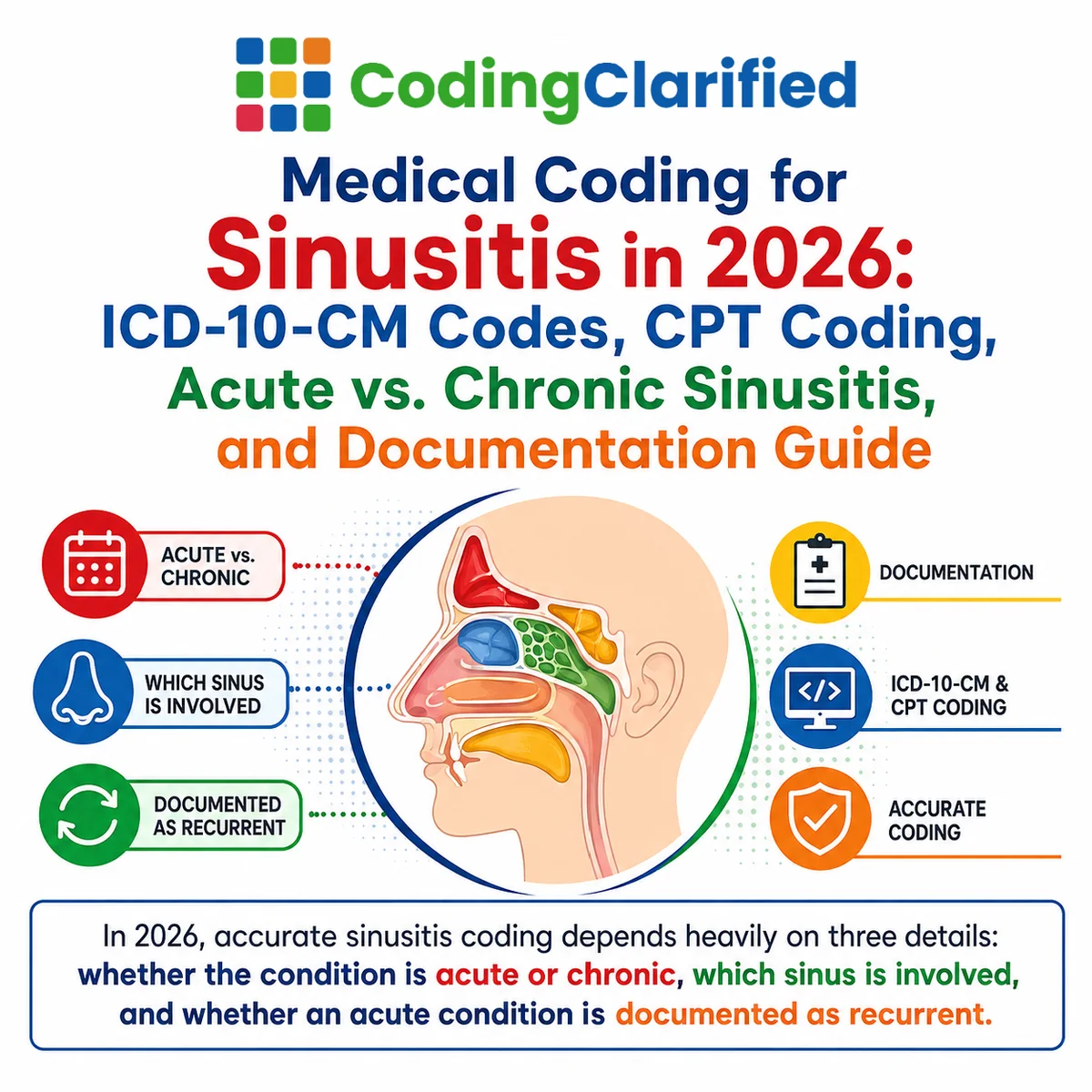
For FY2027, accurate sinusitis coding depends heavily on three details: whether the condition is acute or chronic, which sinus is involved, and whether an acute condition is documented as recurrent. Therefore, coders should never select a sinusitis code based only on the word “sinusitis.”
Additionally, services performed during the encounter may require CPT coding. An office visit, nasal endoscopy, CT scan, or other service must meet its own documentation and medical necessity requirements.
This FY2027 guide explains how to code sinusitis correctly, including acute, recurrent, chronic, unspecified, and the new odontogenic sinusitis codes. Moreover, we will review common ICD-10-CM codes, CPT considerations, documentation requirements, common mistakes, and CPC exam tips.
Key Takeaways
- New for FY2027: odontogenic sinusitis (sinusitis from a dental source) has its own codes, J34.830 through J34.839.
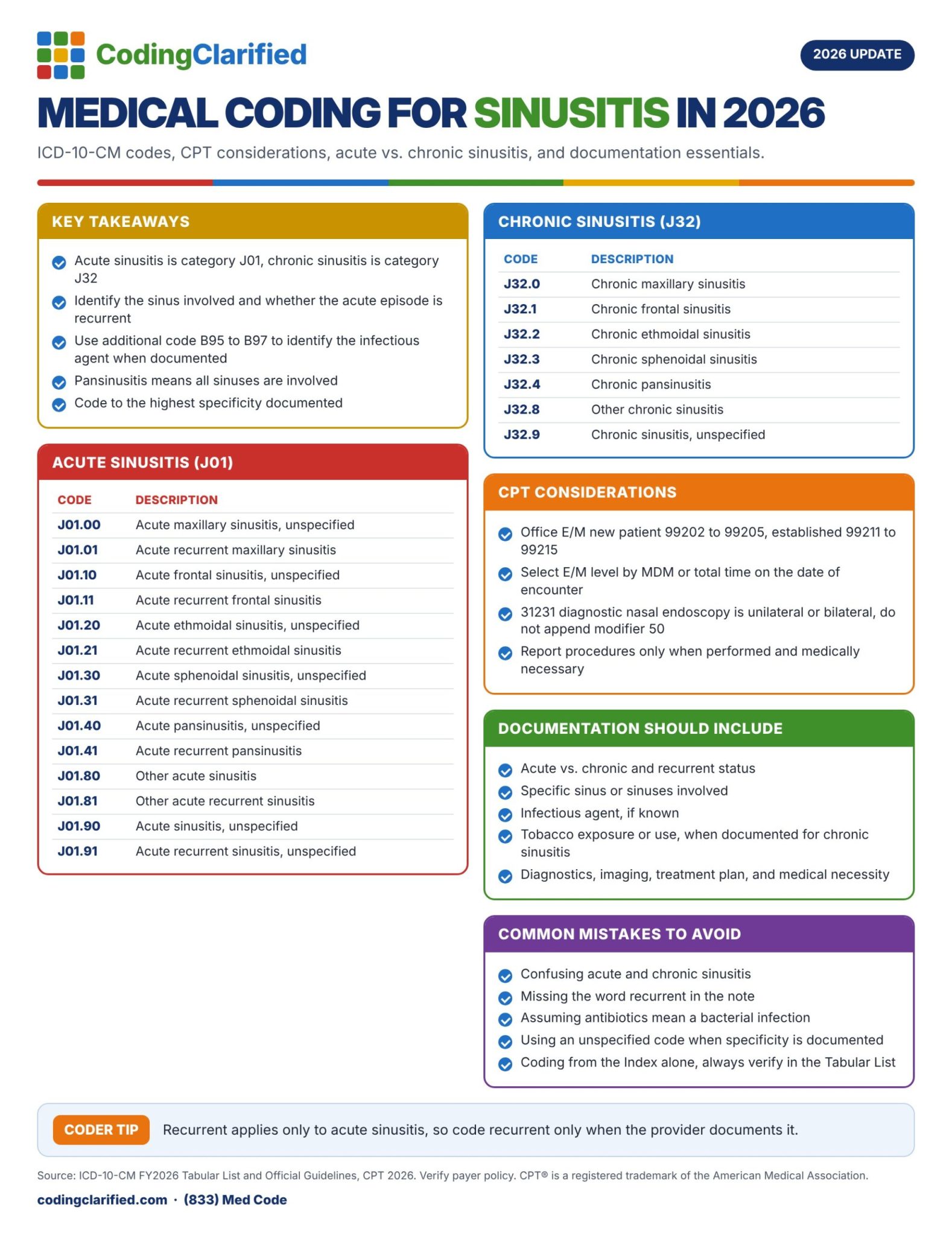
- Acute sinusitis generally falls under ICD-10-CM category J01.-.
- Chronic sinusitis generally falls under category J32.-.
- Acute sinusitis codes can distinguish between an unspecified episode and recurrent disease.
- Coders should identify the specific sinus involved whenever the provider documents it.
- Maxillary, frontal, ethmoidal, sphenoidal, and pansinusitis have separate codes.
- Do not assume that repeated sinus infections automatically mean chronic sinusitis.
- Likewise, do not assume that sinusitis is bacterial simply because antibiotics were prescribed.
- ICD-10-CM instructs coders to use an additional code from B95-B97 when an infectious agent is identified and the instruction applies.
- CPT coding depends on the actual service performed, not simply the sinusitis diagnosis.
- For encounters on or after October 1, 2026, always verify codes and instructional notes against the FY2027 code set.
What Is Sinusitis?
Sinusitis means inflammation of the paranasal sinuses. Patients may experience nasal congestion, facial pressure, headache, drainage, cough, postnasal drip, or other upper respiratory symptoms. However, symptoms alone do not allow a coder to diagnose sinusitis.
Clinically, sinusitis may develop after a viral respiratory infection, while allergies, structural problems, and other conditions can also contribute. Furthermore, not every sinus infection requires antibiotics. The provider determines the diagnosis and treatment based on the patient’s clinical presentation.
For coding purposes, the provider’s final documented diagnosis matters most. Therefore, coders need to determine whether the record supports acute, recurrent acute, chronic, or another documented type of sinusitis.
Sinusitis ICD-10-CM Codes for FY2027
Three ICD-10-CM groups cover most sinusitis diagnoses:
- J01.- — Acute sinusitis
- J32.- — Chronic sinusitis
- J34.83: Odontogenic sinusitis (new for FY2027)
However, these categories contain more specific codes. Consequently, coders should continue through the Alphabetic Index and verify the final code in the Tabular List rather than stopping at the category level.
Acute Sinusitis ICD-10-CM Codes
Acute sinusitis falls under category J01.-.
Common acute sinusitis codes include:
| ICD-10-CM Code | Description |
|---|---|
| J01.00 | Acute maxillary sinusitis, unspecified |
| J01.01 | Acute recurrent maxillary sinusitis |
| J01.10 | Acute frontal sinusitis, unspecified |
| J01.11 | Acute recurrent frontal sinusitis |
| J01.20 | Acute ethmoidal sinusitis, unspecified |
| J01.21 | Acute recurrent ethmoidal sinusitis |
| J01.30 | Acute sphenoidal sinusitis, unspecified |
| J01.31 | Acute recurrent sphenoidal sinusitis |
| J01.40 | Acute pansinusitis, unspecified |
| J01.41 | Acute recurrent pansinusitis |
| J01.80 | Other acute sinusitis |
| J01.81 | Other acute recurrent sinusitis |
| J01.90 | Acute sinusitis, unspecified |
| J01.91 | Acute recurrent sinusitis, unspecified |
Notice how the documentation can significantly change the final code. For example, “acute maxillary sinusitis” and “acute recurrent maxillary sinusitis” do not map to the same code.
Therefore, coders should look for both anatomical location and recurrence before assigning the final ICD-10-CM code.
Acute vs. Acute Recurrent Sinusitis Coding
One of the most important coding distinctions involves acute versus acute recurrent sinusitis.
Suppose the provider documents:
Acute maxillary sinusitis
The appropriate code may be J01.00.
However, if the provider specifically documents:
Acute recurrent maxillary sinusitis
The code changes to J01.01.
The word recurrent matters. Therefore, coders should not add it because the patient had sinusitis previously. Instead, the provider needs to establish the current diagnosis as recurrent when that distinction affects code assignment.
Likewise, a history showing several past sinus infections does not give the coder authority to convert the current diagnosis into recurrent sinusitis. Documentation drives the code.
Chronic Sinusitis ICD-10-CM Codes
Chronic sinusitis falls under ICD-10-CM category J32.-.
Common chronic sinusitis codes include:
| ICD-10-CM Code | Description |
| J32.0 | Chronic maxillary sinusitis |
| J32.1 | Chronic frontal sinusitis |
| J32.2 | Chronic ethmoidal sinusitis |
| J32.3 | Chronic sphenoidal sinusitis |
| J32.4 | Chronic pansinusitis |
| J32.8 | Other chronic sinusitis |
| J32.9 | Chronic sinusitis, unspecified |
Again, anatomical specificity matters. For example, a provider who documents “chronic maxillary sinusitis” supports J32.0, while documentation of “chronic pansinusitis” points toward J32.4.
Additionally, coders should not assign chronic sinusitis simply because symptoms have occurred more than once. The provider’s diagnosis must support the chronic condition.
New for FY2027: Odontogenic Sinusitis Codes (J34.83)
Effective October 1, 2026, ICD-10-CM added subcategory J34.83, Odontogenic sinusitis. Odontogenic sinusitis is sinusitis that comes from a dental source, such as an infected upper tooth or a complication of a dental procedure. It most often involves the maxillary sinus, because the roots of the upper back teeth sit just below it.
| ICD-10-CM Code | Description |
|---|---|
| J34.830 | Odontogenic sinusitis, maxillary sinus |
| J34.831 | Odontogenic sinusitis, ethmoid sinus |
| J34.832 | Odontogenic sinusitis, frontal sinus |
| J34.833 | Odontogenic sinusitis, sphenoid sinus |
| J34.839 | Odontogenic sinusitis, unspecified |
These codes sit in category J34, Other disorders of nose and nasal sinuses, not in J01 or J32. Therefore, a coder who searches only the acute and chronic sinusitis categories will miss them.
When to Use J34.83 Codes
Assign a J34.83 code only when the provider documents odontogenic sinusitis or clearly links the sinusitis to a dental source. Do not assign it simply because the patient has a dental problem and sinusitis at the same time. The provider must make the connection.
Additionally, check the Tabular List entry for J34.83 for its instructional notes, including any instruction to code the dental condition, and review the Excludes notes at J01 and J32 before finalizing the code.
Documentation Example: Odontogenic Sinusitis
Diagnosis: Right maxillary sinusitis due to an infected upper molar.
Potential ICD-10-CM code: J34.830, plus any code the Tabular List instructs for the dental condition.
Many of these patients need both dental treatment and sinus surgery. For a related procedure scenario, see Medical Coding Scenario Clarified for Functional Endoscopic Sinus Surgery (FESS).
What Is the ICD-10-CM Code for Sinusitis, Unspecified?
This question causes frequent coding errors.
If the documentation simply states “sinusitis” without identifying it as acute or chronic, coders must carefully follow the Alphabetic Index and Tabular List rather than assuming an acute infection.
J32.9 represents chronic sinusitis, unspecified, and the J01 category contains acute sinusitis codes. However, ICD-10-CM conventions and index entries determine how the documented wording maps to the final code.
Therefore, never assume that an unspecified “sinus infection” equals J01.90 just because the patient appears acutely ill. Instead, follow the documented diagnosis and verify the index pathway.
For more guidance on this process, see Coding Clarified’s Medical Coding Correctly Using CPT, ICD-10 & HCPCS.
Coding the Specific Sinus Involved
Sinusitis coding becomes easier when coders understand the basic anatomy.
The primary sinus locations represented in the ICD-10-CM sinusitis codes include:
- Maxillary
- Frontal
- Ethmoidal
- Sphenoidal
- Multiple sinuses or pansinusitis
For example, “acute recurrent frontal sinusitis” supports J01.11, while “chronic frontal sinusitis” supports J32.1.
Meanwhile, pansinusitis generally describes inflammation involving all or multiple paranasal sinus regions as clinically documented. Coders should still use the provider’s diagnosis rather than interpreting imaging findings independently.
Can You Code the Infectious Organism With Sinusitis?
Sometimes.
The ICD-10-CM categories for acute and chronic sinusitis contain instructions concerning additional coding when an infectious agent has been identified. For example, codes from B95-B97 may identify bacterial, viral, or other infectious agents as the cause of diseases classified elsewhere.
However, do not infer the organism from treatment.
For example, a prescription for an antibiotic does not automatically establish bacterial sinusitis. Instead, the documentation must support the organism or infectious cause before the coder reports an additional organism code.
This distinction helps prevent overcoding while keeping the claim consistent with the medical record.
Should Sinusitis Symptoms Be Coded Separately?
Usually, symptoms routinely associated with a confirmed diagnosis are not separately reported unless a guideline or specific circumstance supports separate coding.
For example, a patient with confirmed acute sinusitis may have:
- Nasal congestion
- Facial pressure
- Headache
- Drainage
- Cough
- Postnasal drip
If these symptoms are integral to the diagnosed condition, coders generally do not report every symptom separately. However, a symptom may warrant separate coding when it is not routinely associated with the condition, receives separate evaluation, or meets other applicable coding requirements.
For a deeper review, see Medical Coding Signs & Symptoms in Diseases.
CPT Coding for Sinusitis Encounters
There is no single CPT code for “treating sinusitis.”
Instead, CPT coding describes the professional service or procedure performed. Therefore, a routine sinusitis encounter may involve an office or outpatient E/M service when the documentation supports it.
Common established-patient office/outpatient E/M codes include:
- 99211
- 99212
- 99213
- 99214
- 99215
Common new-patient office/outpatient codes include:
- 99202
- 99203
- 99204
- 99205
However, the diagnosis does not determine the E/M level. Instead, select the E/M code according to the current CPT guidelines using medical decision making or total time when applicable.
Additionally, an ENT specialist may perform diagnostic nasal endoscopy when medically necessary. For example, 31231 describes diagnostic nasal endoscopy, unilateral or bilateral, using a rigid or flexible endoscope.
Still, coders should never report 31231 simply because an ENT physician evaluated sinusitis. The medical record must show that the endoscopy was actually performed and support the service.
CT Imaging and Sinusitis
Some patients with recurrent or chronic sinus disease may undergo CT imaging. Nevertheless, the coder should report only the imaging study actually ordered and performed.
CT coding depends on factors such as the anatomical area, whether contrast was used, and the specific service documented. Additionally, medical necessity must support the imaging.
For more information about radiology coding, see Medical Coding and Billing for X-Rays in 2026.
Sinusitis Documentation Requirements
Good documentation makes sinusitis coding much easier.
Ideally, the provider should document:
- Acute versus chronic
- Recurrent status when applicable
- Specific sinus involved
- Pansinusitis when clinically diagnosed
- Confirmed infectious organism, when known
- Relevant associated conditions
- Diagnostic testing or imaging
- Procedures performed
- Treatment plan
- Medical necessity for additional services
Furthermore, coders should review the complete encounter instead of pulling a diagnosis from a problem list without context.
Documentation Example 1: Acute Sinusitis
Diagnosis: Acute maxillary sinusitis.
Potential ICD-10-CM code: J01.00
Here, the provider identifies both the acute nature and maxillary location. However, the documentation does not identify the condition as recurrent.
Documentation Example 2: Acute Recurrent Sinusitis
Diagnosis: Acute recurrent maxillary sinusitis.
Potential ICD-10-CM code: J01.01
In this case, “recurrent” changes the final code. Therefore, coders must read the entire diagnosis rather than stopping after “acute maxillary sinusitis.”
Documentation Example 3: Chronic Sinusitis
Chronic Sinusitis
Diagnosis: Chronic pansinusitis.
Potential ICD-10-CM code: J32.4
Here, both chronicity and sinus involvement are documented. As a result, the coder can select a much more specific code than an unspecified sinusitis code.
Common Mistakes to Avoid When Coding Sinusitis
1. Confusing Acute and Chronic Sinusitis
Never choose J01.- or J32.- based on how long you think the patient has been sick. Instead, code from the provider’s documented diagnosis and the ICD-10-CM rules.
2. Missing the Word “Recurrent”
Acute recurrent sinusitis has specific codes. Therefore, missing one word in the diagnosis can result in incorrect code selection.
3. Assuming Antibiotics Mean Bacterial Sinusitis
Treatment does not replace diagnosis documentation. Consequently, coders should not infer bacterial sinusitis merely because the provider prescribed an antibiotic.
4. Using an Unspecified Code When Specificity Is Available
If the physician documents maxillary, frontal, ethmoidal, sphenoidal, or pansinusitis, use the corresponding code when supported. Otherwise, an unspecified code may unnecessarily reduce coding specificity.
5. Coding Every Symptom Separately
Congestion, facial pressure, and drainage may be integral to sinusitis. Therefore, review the guidelines before adding symptom codes to a confirmed diagnosis.
6. Assuming Multiple Past Infections Equal Chronic Sinusitis
Recurrent acute disease and chronic disease are not interchangeable coding terms. Instead, follow the provider’s documented diagnosis.
7. Coding From the Alphabetic Index Alone
The Index helps locate the code, but the Tabular List provides essential instructions. Accordingly, always verify Includes notes, Excludes notes, additional-code instructions, and code specificity.
For additional guidance, review Medical Coding Steps for ICD-10-CM.
CPC Student Tips for Sinusitis Coding
Sinusitis questions make excellent CPC exam scenarios because a single word can change the answer.
First, underline words such as acute, chronic, recurrent, maxillary, frontal, ethmoidal, sphenoidal, and pansinusitis.
Next, locate the diagnosis in the Alphabetic Index. Then, verify your code in the Tabular List before selecting your answer.
Also, do not let medications influence your diagnosis selection. If the scenario says the physician prescribed an antibiotic, that information alone does not authorize you to code bacterial sinusitis.
Finally, watch for distractor answers. For example, a question may give you J01.00 and J01.01 as choices. If the documentation includes the word “recurrent,” that one word may determine the correct answer.
Understanding the structure of ICD-10-CM Chapter 10 can also make respiratory coding questions easier. Review Medical Coding ICD-10-CM Chapters for additional practice.
FY2027 Sinusitis Coding Update
The FY2027 ICD-10-CM code set took effect October 1, 2026, and applies to dates of service through September 30, 2027. For sinusitis, the key change is the new odontogenic sinusitis subcategory, J34.83. The acute sinusitis (J01) and chronic sinusitis (J32) codes did not change.
Always code from the code set in effect on the date of service. Services before October 1, 2026 use the FY2026 code set, and J34.83 codes are not valid for those dates.
For the full list of FY2027 changes, see Coding Clarified’s ICD-10-CM 2027 Updates.
Authoritative Sinusitis and Coding Resources
Coders should verify coding information through authoritative resources, especially when documentation or code selection is unclear.
- CMS ICD-10-CM Coding Resources
- CMS FY 2027 ICD-10-CM Official Guidelines for Coding and Reporting
- AAPC Codify – Acute Sinusitis J01
- AAPC Codify – Chronic Sinusitis J32
- CDC Sinus Infection Basics
Frequently Asked Questions About Medical Coding for Sinusitis
What is the ICD-10-CM code for odontogenic sinusitis?
Effective October 1, 2026, odontogenic sinusitis is reported with subcategory J34.83. The code depends on the sinus involved: J34.830 maxillary, J34.831 ethmoid, J34.832 frontal, J34.833 sphenoid, and J34.839 unspecified. Assign these codes only when the provider documents that the sinusitis comes from a dental source.
What is the ICD-10-CM code for acute sinusitis?
Acute sinusitis falls under category J01.-. However, the final code depends on the sinus involved and whether the condition is recurrent. For example, acute maxillary sinusitis, unspecified is J01.00, while acute recurrent maxillary sinusitis is J01.01.
What is the ICD-10-CM code for chronic sinusitis?
Chronic sinusitis falls under category J32.-. For example, chronic maxillary sinusitis is J32.0, chronic frontal sinusitis is J32.1, and chronic pansinusitis is J32.4. Therefore, use the most specific code supported by documentation.
What is the difference between J01 and J32?
Category J01.- represents acute sinusitis, while J32.- represents chronic sinusitis. Additionally, acute codes provide options for recurrent acute disease. Coders should rely on provider documentation rather than determining chronicity themselves.
What is the ICD-10-CM code for acute recurrent sinusitis?
The code depends on the sinus involved. For example, acute recurrent maxillary sinusitis is J01.01, while acute recurrent pansinusitis is J01.41. If the provider documents acute recurrent sinusitis without specifying the sinus, J01.91 may apply.
Can I code bacterial sinusitis because the provider prescribed antibiotics?
No. Antibiotic treatment alone does not establish a bacterial cause for coding purposes. Instead, code the diagnosis documented by the provider and report an infectious agent only when the documentation and applicable ICD-10-CM instructions support it.
Should congestion and headache be coded with sinusitis?
Usually, symptoms routinely associated with a confirmed condition are not separately reported. However, separate symptom coding may apply when a symptom is not integral to the condition or when specific coding guidelines support separate reporting.
What CPT code is used for a sinusitis office visit?
There is no single CPT code specifically for a sinusitis visit. Office/outpatient E/M codes such as 99202-99205 for new patients and 99211-99215 for established patients may apply. However, the level depends on the current E/M coding rules and documentation, not the sinusitis diagnosis itself.
What documentation is most important for sinusitis coding?
Look for acute versus chronic status, recurrence, the specific sinus involved, confirmed infectious agents when applicable, and any procedures or diagnostic testing performed. Above all, never infer greater specificity than the provider documented.
Coding Clarified Final Thoughts
Medical coding for sinusitis in FY2027 requires more than finding a generic “sinus infection” code. Instead, coders need to determine whether the provider documented acute, acute recurrent, chronic, or unspecified sinusitis and then identify the specific sinus involved whenever possible.
Small documentation details can make a significant difference. For instance, J01.00 and J01.01 differ because one represents acute maxillary sinusitis without documented recurrence while the other represents acute recurrent maxillary sinusitis. Likewise, chronic maxillary sinusitis J32.0 differs from chronic pansinusitis J32.4.
Therefore, always start with the provider’s documentation, locate the diagnosis in the Alphabetic Index, and verify the code in the Tabular List. In addition, review all Includes, Excludes, and additional-code instructions before finalizing the claim.
For FY2027, accurate sinusitis coding still comes down to a simple rule: documentation drives code selection, and specificity matters
Ready to code like this for a living?
Coding Clarified’s AAPC licensed CPC program takes you from beginner to certified, with an internship and a job board for graduates.
You may qualify for WIOA funding in 30+ states. Check your eligibility.