Present on Admission (POA) Coding Guidelines 2026: Indicators, ICD-10-CM Rules, Examples & Common Mistakes
Key Takeaways
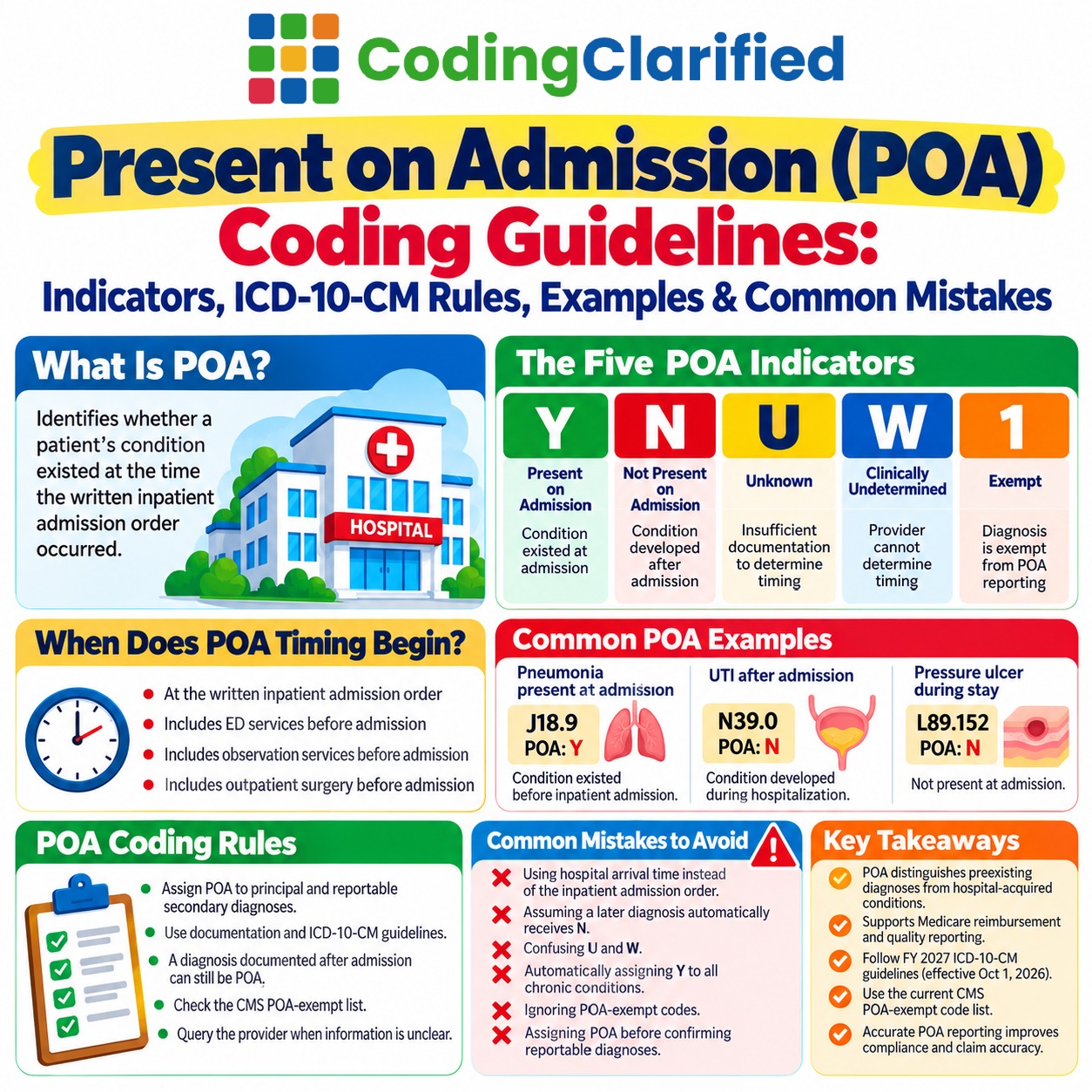
Present on Admission (POA) identifies whether a patient’s condition existed at the time the written inpatient admission order occurred.
The five POA indicators are Y, N, U, W, and 1, and each has a specific reporting purpose.
POA reporting generally applies to principal and reportable secondary diagnoses on applicable inpatient hospital claims.
Conditions that develop during emergency department care, observation, or outpatient surgery before inpatient admission generally qualify as present on admission.
A diagnosis documented after admission does not automatically mean the condition developed after admission.
Accurate POA reporting supports hospital quality measurement, Medicare reimbursement, and coding compliance.
As of October 1, 2026, coders should follow the FY 2027 ICD-10-CM guidelines and current CMS POA-exempt code list.
What Is Present on Admission (POA) in Medical Coding?
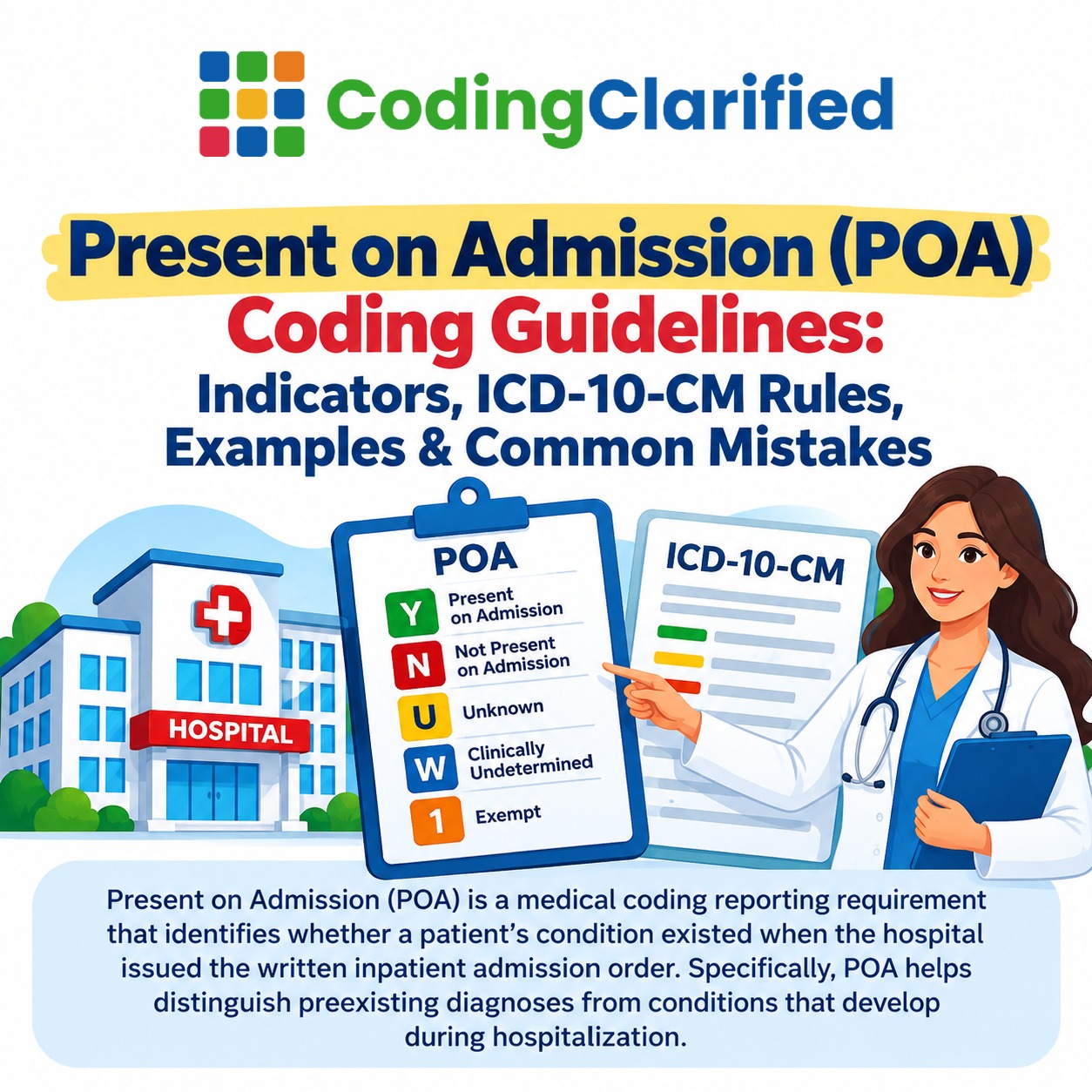
Present on Admission (POA) is a medical coding reporting requirement that identifies whether a patient’s condition existed when the hospital issued the written inpatient admission order. Specifically, POA helps distinguish preexisting diagnoses from conditions that develop during hospitalization.
The Centers for Medicare & Medicaid Services (CMS) requires applicable inpatient hospitals to report POA indicators for principal and secondary diagnoses. As a result, coders must carefully review the medical record to determine when each reportable condition began.
For example, a patient arrives at the emergency department with pneumonia. The physician evaluates the patient, confirms the diagnosis, and orders inpatient admission. Because the pneumonia existed before the inpatient admission order, the coder generally assigns POA indicator Y.
Learn more in our guide to what an MCC is in medical coding.
However, if a patient develops a new infection several days after inpatient admission, the appropriate indicator may be N. Therefore, the timing of the condition is essential to accurate reporting.
Understanding POA is particularly important for hospital inpatient coders. Additionally, it supports accurate reimbursement, quality reporting, and compliance with Medicare regulations.
Why Is POA Important in Medical Coding and Billing?
POA reporting plays an important role in inpatient coding because it helps identify hospital-acquired conditions and supports accurate claims processing. Furthermore, Medicare uses POA information when applying certain hospital payment policies.
1. Hospital-Acquired Conditions (HACs)
Hospital-acquired conditions are certain complications or illnesses that develop during hospitalization. For example, these may include specific pressure ulcers, catheter-associated infections, and surgical site infections.
CMS uses POA indicators to determine whether certain diagnoses meet the criteria for the Hospital-Acquired Condition Present on Admission Payment Provision. Consequently, accurate reporting helps distinguish conditions that existed before admission from those that developed afterward.
2. Medicare Reimbursement
Certain hospital-acquired conditions may affect Medicare Severity Diagnosis Related Group (MS-DRG) payments. Specifically, qualifying HAC diagnoses may not count as complications or comorbidities (CCs) or major complications or comorbidities (MCCs) when they were not present on admission.
However, not every condition that develops during hospitalization results in a payment reduction. Instead, CMS applies specific payment rules to designated conditions.
3. Hospital Quality Reporting
Hospitals use POA data to evaluate patient safety and treatment outcomes. For instance, an infection present when a patient arrives differs from an infection that develops during inpatient treatment.
Therefore, accurate POA reporting helps hospitals evaluate complications and improve patient care.
4. Coding Compliance
POA reporting also supports accurate medical records and claims. Additionally, it helps hospitals demonstrate compliance with official ICD-10-CM coding guidelines.
For more information about hospital diagnosis reporting, read our Inpatient Medical Coding Guidelines.
What Are the Five POA Indicators?
CMS recognizes five POA indicators. Although each indicator consists of only one character, it communicates important information about a patient’s diagnosis.
| POA Indicator | Meaning | Description |
|---|---|---|
| Y | Yes | The condition existed at the time of inpatient admission. |
| N | No | The condition developed after inpatient admission. |
| U | Unknown | Documentation is insufficient to determine whether the condition was present. |
| W | Clinically undetermined | The provider cannot clinically determine whether the condition was present. |
| 1 | Exempt | The diagnosis is exempt from POA reporting. |
POA Indicator Y: Present on Admission
Assign Y when the documentation supports that the condition existed when the written inpatient admission order occurred.
For example, a patient arrives with chest pain and receives a diagnosis of acute myocardial infarction. If the condition existed before the inpatient admission order, the coder assigns Y.
Importantly, the provider does not have to establish the final diagnosis before admission. Instead, the condition itself must have existed at that time.
POA Indicator N: Not Present on Admission
Assign N when documentation establishes that the condition developed after inpatient admission.
For instance, a patient develops a pressure ulcer during a prolonged hospitalization. If the ulcer was not present at admission, the coder reports N.
However, coders should never assign N simply because the provider documented the diagnosis later in the hospital stay.
POA Indicator U: Insufficient Documentation
Assign U when the medical record lacks enough information to determine whether a condition existed at admission.
For example, the provider documents a urinary tract infection but does not clarify when it developed. If the record cannot establish the timing, the coder should seek clarification when appropriate.
Ultimately, U reflects insufficient documentation rather than the provider’s clinical inability to determine onset.
POA Indicator W: Clinically Undetermined
Assign W when the provider states that the timing of a condition cannot be clinically determined.
For example, a physician may document that it is impossible to determine whether an infection began before or after inpatient admission.
Unlike U, W reflects the provider’s clinical judgment rather than missing documentation.
POA Indicator 1: Exempt
Assign 1 when a diagnosis appears on the official CMS POA-exempt list.
These diagnoses generally involve conditions or circumstances for which POA reporting is not applicable or meaningful. However, coders must verify exemptions against the current fiscal year’s official list.
When Does POA Timing Begin?
One of the most important POA coding rules involves the written inpatient admission order.
According to the official ICD-10-CM guidelines, the key point for determining POA status is when the inpatient admission order occurs. Therefore, the patient’s physical arrival at the hospital does not automatically establish the POA reference point.
Emergency Department Services
A patient arrives at the emergency department with abdominal pain. During the evaluation, the patient develops an additional condition before the physician issues the inpatient admission order.
Because the condition existed before inpatient admission, it generally qualifies as POA.
Observation Services
A patient receives observation services for chest pain. Several hours later, the patient develops another reportable condition before the inpatient admission order.
Although the condition developed at the hospital, it generally receives POA indicator Y.
Outpatient Surgery
A patient undergoes outpatient surgery and develops a complication before a subsequent inpatient admission order.
In this situation, the complication generally qualifies as present on admission. However, coders must still review the documentation and applicable ICD-10-CM guidelines.
POA Coding Examples: Real-World Inpatient Scenarios
Practical examples help medical coders understand how POA indicators apply to common hospital situations. Additionally, they demonstrate why accurate documentation and timing matter.
Example 1: Pneumonia Present on Admission
A patient arrives at the emergency department with fever, cough, and shortness of breath. After evaluation, the physician diagnoses pneumonia and orders inpatient admission.
ICD-10-CM Code: J18.9 – Pneumonia, unspecified organism
POA Indicator: Y
Explanation: The pneumonia existed before the inpatient admission order. Therefore, the condition qualifies as present on admission.
Example 2: Urinary Tract Infection After Admission
A patient receives inpatient treatment for congestive heart failure. On hospital day four, the patient develops a urinary tract infection that was not present earlier.
ICD-10-CM Code: N39.0 – Urinary tract infection, site not specified
POA Indicator: N
Explanation: The documentation establishes that the infection developed after admission. Consequently, N is appropriate.
Example 3: Sepsis Diagnosed After Admission
A patient arrives with fever, low blood pressure, and other signs of infection. The physician later confirms sepsis based on findings that existed before inpatient admission.
ICD-10-CM Code: A41.9 – Sepsis, unspecified organism
POA Indicator: Y, when documentation supports the timing
Explanation: Although the provider confirmed sepsis after admission, the condition existed beforehand. Therefore, the diagnosis may qualify as POA.
Example 4: Pressure Ulcer Developing During Hospitalization
A patient enters the hospital without a pressure ulcer. Several days later, the physician documents a new stage 2 pressure ulcer of the sacral region.
ICD-10-CM Code: L89.152 – Pressure ulcer of sacral region, stage 2
POA Indicator: N
Explanation: The pressure ulcer developed after inpatient admission. Accordingly, N is appropriate when documentation confirms that timing.
Example 5: Insufficient Documentation
A patient receives treatment for several medical conditions. Later, the physician documents acute kidney injury without establishing when it began.
ICD-10-CM Code: N17.9 – Acute kidney failure, unspecified
POA Indicator: U, if documentation remains insufficient
Explanation: The record does not establish whether the condition existed at admission. Therefore, the coder should seek clarification when appropriate before assigning U.
Example 6: Clinically Undetermined Onset
A patient receives treatment for a bacterial infection. After reviewing the clinical findings, the physician states that the infection’s onset cannot be clinically determined.
POA Indicator: W
Explanation: The provider has specifically documented clinical uncertainty about the condition’s timing. Consequently, W is appropriate.
These examples assume that the diagnoses meet inpatient reporting requirements. Actual coding decisions require review of the complete medical record and applicable coding guidelines.
How to Assign POA Indicators Correctly
Accurate POA reporting requires a consistent review process. First, coders must identify the reportable ICD-10-CM diagnoses before assigning POA indicators.
Follow these six steps:
Review the admission timeline. Identify when the written inpatient admission order occurred.
Examine the medical record. Review the history and physical, progress notes, consultation reports, and discharge summary.
Confirm reportable diagnoses. Apply the official ICD-10-CM guidelines before assigning POA indicators.
Check POA exemptions. Verify whether each diagnosis appears on the current fiscal year’s POA-exempt list.
Assign the correct indicator. Use Y, N, U, or W when applicable, based on documentation and official guidelines.
Query the provider when necessary. Seek clarification when missing, conflicting, or unclear information prevents accurate reporting.
Additionally, coders should remember that the date a provider confirms a diagnosis does not always establish when the condition began. Therefore, accurate POA reporting requires careful review of the entire clinical timeline.
Special POA Coding Guidelines for 2026
Certain diagnoses require additional attention because their POA status may involve more than one condition or a complex clinical timeline. Consequently, coders should review Appendix I of the official ICD-10-CM guidelines.
Combination Codes
Combination codes describe multiple conditions or a condition with an associated complication. For example, a single ICD-10-CM code may identify diabetes with a specific complication.
When all components of a combination code existed at admission, the coder generally assigns Y. However, if one component developed after admission, N generally applies under the combination-code guidelines.
For example, a patient enters the hospital with diabetes but develops a diabetic complication after admission. If one combination code represents both conditions, the coder must consider the timing of every component.
Chronic Conditions
Chronic illnesses such as hypertension, diabetes, and chronic obstructive pulmonary disease often exist before hospitalization. Therefore, these diagnoses commonly receive Y when documentation confirms they were present at admission.
However, an acute complication related to a chronic illness may develop later. Accordingly, coders must evaluate the specific diagnosis and applicable combination-code rules.
Obstetric Conditions
Pregnancy-related diagnoses also require careful POA review. For instance, a patient may enter the hospital with preterm labor or develop a complication after admission.
The POA indicator depends on when the obstetric condition occurred, not simply whether the patient delivered during the hospitalization. Additionally, coders must follow the relevant ICD-10-CM chapter guidelines.
Learn more in our OB/GYN Medical Coding and Billing Guidelines.
Conditions Diagnosed After Admission
A provider may not recognize or confirm a condition until several days after admission. Nevertheless, the condition may still qualify as present on admission.
For example, laboratory results may confirm an infection after admission even though the patient showed signs of the infection beforehand. Therefore, coders should review provider documentation and the clinical timeline rather than relying only on the diagnosis date.
Common POA Coding Mistakes to Avoid
Even experienced inpatient coders can make POA reporting mistakes. However, understanding the most common errors can help improve accuracy.
Mistake 1: Using the hospital arrival time instead of the inpatient admission order.
The inpatient admission order establishes the POA reference point. Therefore, a condition that develops during outpatient observation before inpatient admission generally qualifies as POA.
Mistake 2: Assuming every diagnosis documented after admission receives N.
A diagnosis may be confirmed later even though the condition existed at admission. Instead, coders must evaluate the actual onset.
Mistake 3: Confusing U and W.
U identifies insufficient documentation, while W reflects the provider’s clinical inability to determine timing. Consequently, these indicators are not interchangeable.
Mistake 4: Automatically assigning Y to every chronic condition and related complication.
Although the chronic illness may have existed before admission, a new complication may not have. Therefore, coders should review each reportable diagnosis carefully.
Mistake 5: Ignoring POA-exempt diagnoses.
CMS maintains a specific list of exempt ICD-10-CM codes. Accordingly, coders must check the current list rather than assume a diagnosis is exempt.
Mistake 6: Assigning POA indicators before completing diagnosis coding.
POA reporting does not determine whether a condition qualifies as a reportable diagnosis. First, coders must apply the official diagnosis coding rules and then determine the appropriate POA status.
CPC Student Tips: Understanding POA for Medical Coding Certification
Although the Certified Professional Coder (CPC) exam focuses primarily on physician and outpatient coding, understanding POA helps students build a stronger foundation in inpatient coding, documentation, and reimbursement.
Students preparing for certification should focus on these essential concepts:
Memorize the five indicators. Understand the difference between Y, N, U, W, and exempt status.
Remember the inpatient admission order. This is the key reference point for determining POA.
Understand U versus W. Insufficient documentation differs from a provider’s clinical uncertainty.
Practice inpatient scenarios. Review when conditions developed and compare those findings with the admission timeline.
Study combination codes. Learn how the timing of multiple conditions affects one diagnosis code.
Review official guidelines. Appendix I provides the rules for POA reporting.
Additionally, students should practice reviewing medical records and identifying reportable diagnoses. These skills help prepare future coders for inpatient coding positions.
Explore our Medical Record Abstraction and EHR Documentation Guide to strengthen medical record review skills.
2026 POA Coding Updates: What Medical Coders Need to Know
The ICD-10-CM code set follows the federal fiscal year, which begins October 1. As a result, medical coders must update their coding references annually.
Effective October 1, 2026, the FY 2027 ICD-10-CM guidelines apply to the coding period ending September 30, 2027.
Although the five familiar POA indicator values remain part of the reporting system, hospitals must use the current diagnosis codes and POA-exempt list. Additionally, coding departments should update their encoders, billing software, and internal training materials.
An important distinction involves POA-exempt codes. While some claims-processing systems represent exempt status with indicator 1, the official ICD-10-CM guidelines instruct coders to leave the POA field blank for diagnoses on the exempt list.
Therefore, coders should follow the official reporting instructions and their facility’s approved claims-processing procedures.
Authoritative POA Coding Resources
For accurate and current reporting, medical coders should consult these resources:
CMS: FY 2027 ICD-10-CM Official Guidelines for Coding and Reporting — Review Appendix I for POA reporting guidelines.
CMS: Hospital-Acquired Conditions and POA Coding — Includes POA reporting resources and exempt-code files.
CMS: POA Reporting Requirements — Explains inpatient reporting requirements.
CMS: ICD-10-CM Codes and Updates — Provides current code-set information.
AAPC — Offers medical coding education and certification resources.
How Can Medical Coders Improve POA Accuracy?
Improving POA accuracy begins with consistent documentation review. First, coders should establish a clear timeline of the patient’s medical conditions and inpatient admission.
Next, they should compare that timeline with the provider’s documentation and final diagnosis codes. When information is missing or conflicting, an appropriate provider query can help resolve uncertainty.
Furthermore, coding departments can improve reporting through regular audits, continuing education, and annual guideline updates. These practices support accurate claims and reduce avoidable errors.
Understanding the differences between inpatient and outpatient reporting is also valuable. For additional guidance, read our Outpatient Medical Coding Guidelines.
Frequently Asked Questions About Present on Admission (POA) Coding
1. What does POA mean in medical coding?
POA stands for Present on Admission. It identifies whether a patient’s condition existed when the written inpatient admission order occurred. Additionally, POA reporting helps hospitals distinguish preexisting diagnoses from conditions that developed during inpatient treatment.
2. What are the five POA indicators?
The five POA indicators are Y, N, U, W, and 1. Y means present on admission, while N means not present. U indicates insufficient documentation, and W means the provider cannot clinically determine the timing. Finally, 1 represents exempt status in applicable claims-processing systems, although official ICD-10-CM guidelines direct coders to leave the POA field blank for exempt codes.
3. What is the difference between POA indicators U and W?
U means the medical record lacks enough information to determine whether the condition existed at admission. In contrast, W means the provider cannot clinically determine when the condition developed. Therefore, coders must distinguish incomplete documentation from clinical uncertainty.
4. Is a condition diagnosed after admission automatically hospital-acquired?
No. A condition may exist before admission even when the provider confirms the diagnosis later. For example, laboratory results may confirm an infection after admission, although the infection was already present. Consequently, coders must evaluate the documented clinical timeline.
5. Does POA apply to outpatient medical coding?
POA reporting generally applies to applicable inpatient hospital claims rather than routine outpatient claims. However, conditions that develop during emergency department care, observation, or outpatient surgery before a subsequent inpatient admission order generally qualify as present on admission.
6. Can POA indicators affect Medicare reimbursement?
Yes. Certain hospital-acquired conditions can affect Medicare MS-DRG payments when they were not present on admission. However, the payment impact depends on the specific diagnosis and applicable CMS payment rules. Therefore, accurate POA reporting helps support proper reimbursement.
7. What happens when the provider does not document whether a condition was present on admission?
Coders should review the complete medical record and seek clarification when appropriate. If the documentation remains insufficient, U may apply. However, if the provider specifically states that the timing cannot be clinically determined, W is the appropriate indicator.
8. Where can medical coders find the official POA guidelines for 2026?
Medical coders can find POA reporting instructions in Appendix I of the ICD-10-CM Official Guidelines for Coding and Reporting. Additionally, CMS provides annual POA-exempt code lists and hospital-acquired condition reporting resources. For discharges beginning October 1, 2026, coders should use the FY 2027 guidelines.