Thoracentesis Medical Coding Case Study 2026: CPT Codes, ICD-10-CM, Malignant Pleural Effusion & Billing Guidelines
Thoracentesis is a common procedure in pulmonary medicine, but assigning the correct CPT and ICD-10-CM codes requires careful review of the operative report. Medical coders must identify why the provider performed the procedure, whether imaging guidance was used, and which diagnoses the documentation supports.
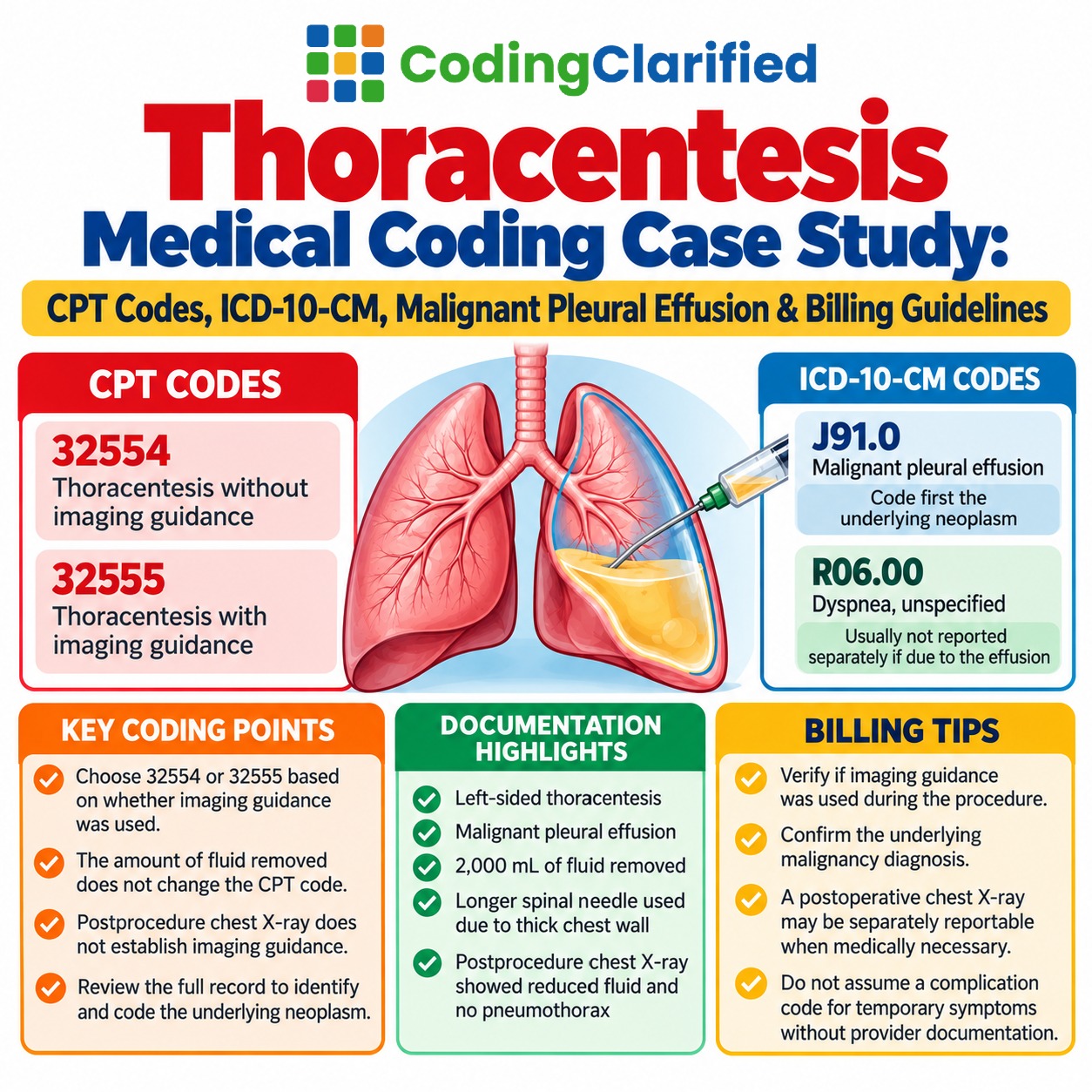
In this 2026 medical coding case study, we examine a patient who underwent a left-sided thoracentesis to relieve dyspnea caused by a documented malignant pleural effusion. During the procedure, the physician encountered a thick chest wall, changed needles, and manually removed 2,000 mL of pleural fluid.
Although the procedure appears straightforward, several coding details can affect claim accuracy. For example, the physician performed a chest X-ray after the thoracentesis, but the report does not document ultrasound guidance during needle placement.
This case study explains how to identify the correct procedure code, apply ICD-10-CM diagnosis guidelines, recognize documentation gaps, and avoid common billing mistakes.
Key Takeaways
CPT 32554 describes thoracentesis involving needle or catheter aspiration of the pleural space without imaging guidance.
CPT 32555 describes thoracentesis with imaging guidance. The operative report must support the guidance.
ICD-10-CM J91.0 identifies malignant pleural effusion. Because this code has a code-first instruction, coders must also identify and sequence the underlying neoplasm when documented.
ICD-10-CM R06.00 identifies dyspnea, unspecified. However, coders should not automatically report dyspnea separately when it represents an integral symptom of the established condition.
The amount of fluid removed does not change the thoracentesis CPT code.
A postoperative chest X-ray does not establish imaging guidance for thoracentesis.
The physician’s use of a longer spinal needle does not justify an additional procedure code.
For 2026 coding, always review the applicable CPT code set, ICD-10-CM conventions, payer requirements, and complete medical record before submitting a claim.
What Is Thoracentesis?
Thoracentesis is a procedure in which a healthcare provider inserts a needle or catheter through the chest wall into the pleural space to remove fluid.
The pleural space lies between the two layers of tissue surrounding the lungs. Normally, this space contains a small amount of fluid that helps the lungs move smoothly during breathing.
However, certain medical conditions can cause excess fluid to accumulate. Providers call this condition a pleural effusion.
Common causes include heart failure, pneumonia, malignancy, liver disease, kidney disease, and other inflammatory conditions.
When pleural fluid builds up, the patient may experience shortness of breath, chest discomfort, coughing, or difficulty taking a deep breath.
Thoracentesis can serve two purposes:
Diagnostic thoracentesis: The provider removes fluid for laboratory testing to help determine the cause of the effusion.
Therapeutic thoracentesis: The provider removes fluid to reduce pressure on the lungs and relieve symptoms.
In this case, the physician removed a large amount of fluid from the patient’s left pleural space. Therefore, the documented procedure supports therapeutic thoracentesis.
Medical Coding Case Study: Left Thoracentesis for Malignant Pleural Effusion
Medical Specialty: Cardiovascular / Pulmonary
Procedure: Thoracentesis, left
Preoperative Diagnosis: Malignant pleural effusion, left, with dyspnea
Postoperative Diagnosis: Malignant pleural effusion, left, with dyspnea
Clinical Scenario
A patient presented with a documented malignant pleural effusion involving the left pleural space. The fluid accumulation caused dyspnea, and the physician scheduled a thoracentesis to remove the excess fluid.
After obtaining informed consent, the physician brought the patient to the recovery area of the operating room.
The provider prepared and draped the posterior left chest wall using sterile technique. Next, the physician infiltrated 1% Xylocaine above the seventh intercostal space along the midscapular line.
Initially, the physician attempted to use a standard thoracentesis set. However, the needle could not reach the pleural cavity because the patient had a very thick chest wall.
Consequently, the physician switched to an 18-gauge spinal needle, which was long enough to access the fluid.
After reaching the pleural space, the physician manually withdrew approximately 2,000 mL of light, milky fluid.
Near the end of the procedure, the patient reported feeling faint. Therefore, the physician carefully withdrew the needle and allowed the patient to lie down.
The patient improved after several minutes. Additionally, the care team administered a 250 mL normal saline bolus and continued observation.
Following the procedure, a chest X-ray showed a substantial reduction in pleural fluid. The imaging also confirmed that the patient had no pneumothorax or other obvious procedural complication.
The physician planned to discharge the patient if she remained stable after observation.
Important Documentation Findings
| Clinical detail | Coding significance |
|---|---|
| Left-sided pleural effusion | Confirms the treatment location |
| Malignant pleural effusion | Supports J91.0, subject to the code-first instruction |
| Manual removal of 2,000 mL | Confirms pleural fluid aspiration |
| Longer spinal needle used | Does not create a separate procedure |
| No imaging guidance documented during aspiration | Supports 32554 rather than 32555 |
| Chest X-ray after the procedure | Does not count as procedural imaging guidance |
| Dyspnea documented | Requires evaluation before separate symptom coding |
| Temporary faintness | Does not automatically establish a separately reportable complication |
CPT Coding for Thoracentesis in 2026
Selecting the correct thoracentesis CPT code depends primarily on whether the provider used imaging guidance.
CPT 32554: Thoracentesis Without Imaging Guidance
CPT 32554 describes thoracentesis involving aspiration of the pleural space with a needle or catheter, without imaging guidance.
This code applies when the provider performs the aspiration without documented imaging guidance during the procedure.
In our case, the physician inserted a needle through the posterior left chest wall and manually withdrew pleural fluid.
Although the physician changed from a standard thoracentesis needle to a longer spinal needle, the procedure remained thoracentesis.
Correct procedure code for the supplied operative report: CPT 32554.
CPT 32555: Thoracentesis With Imaging Guidance
CPT 32555 describes thoracentesis performed with imaging guidance.
For example, a physician may use ultrasound to locate the fluid collection and guide needle placement.
However, coders should never assume imaging guidance occurred simply because the patient underwent an imaging study before or after the procedure.
In this scenario, the physician documented a chest X-ray after completing the thoracentesis. Therefore, the postoperative X-ray does not support 32555.
CPT 32554 vs. CPT 32555
| Coding requirement | 32554 | 32555 |
|---|---|---|
| Pleural fluid aspiration | Yes | Yes |
| Imaging guidance | No | Yes |
| Needle or catheter technique | Yes | Yes |
| Fluid volume determines code | No | No |
| Supported by this report | Yes | No |
2026 coding tip: Always distinguish imaging performed to guide the needle from imaging performed afterward to evaluate the patient’s condition.
Does Removing 2,000 mL of Fluid Change the CPT Code?
No. The volume of pleural fluid removed does not determine whether the physician reports 32554 or 32555.
For example, a provider might remove 500 mL during one procedure and 2,000 mL during another. Both procedures may qualify for the same CPT code when the technique and imaging circumstances match.
Similarly, using a longer needle because of the patient’s body habitus does not create a different thoracentesis code.
Instead, coders should focus on the service performed and the documented use or absence of imaging guidance.
ICD-10-CM Coding for Malignant Pleural Effusion
The diagnosis coding requires more attention because the provider documented a malignant pleural effusion without identifying the underlying cancer.
ICD-10-CM J91.0: Malignant Pleural Effusion
ICD-10-CM J91.0 identifies malignant pleural effusion.
This code describes pleural fluid accumulation associated with an underlying malignant neoplasm.
However, J91.0 contains a critical instruction:
Code first the underlying neoplasm.
Consequently, the coder must review the complete medical record to identify the malignancy responsible for the pleural effusion.
The supplied operative report does not identify a primary cancer, metastatic cancer, or other specific malignant neoplasm.
Therefore, the report alone does not support assigning a specific cancer code.
For example, if the complete record documents secondary malignant neoplasm of the pleura, C78.2 may be appropriate. However, coders must not assume pleural metastasis simply because the provider documents malignant pleural effusion.
Similarly, C80.1, malignant (primary) neoplasm, unspecified, should not be assigned automatically to fill a documentation gap.
Best practice: Review the oncology history, pathology findings, referring provider’s documentation, and relevant clinical notes. If the underlying malignancy remains unclear, request clarification before finalizing diagnosis sequencing.
The ICD-10-CM code-first instruction takes precedence over a general assumption that the condition receiving treatment should always appear first.
Why ICD-10-CM J90 Is Not Appropriate
ICD-10-CM J90 describes pleural effusion, not elsewhere classified.
Although this code may apply to an unspecified pleural effusion, it does not represent the documented malignant condition in this case.
The physician specifically diagnosed malignant pleural effusion. Therefore, J91.0 provides the appropriate specificity, together with the required underlying neoplasm code.
Additionally, coders should avoid assigning both J90 and J91.0 to describe the same effusion.
Should Dyspnea Be Coded Separately?
ICD-10-CM R06.00 describes dyspnea, unspecified.
The physician documented dyspnea as a symptom associated with the malignant pleural effusion.
However, ICD-10-CM guidelines generally advise against separately coding symptoms routinely associated with a confirmed diagnosis unless an instruction or the circumstances support additional reporting.
In this scenario, the dyspnea appears directly related to the pleural fluid accumulation. Therefore, separate reporting of R06.00 is generally unnecessary.
If the medical record identifies an independent cause of dyspnea or supports a separately reportable condition, the coder should reassess the diagnosis selection.
Final CPT and ICD-10-CM Coding Answer
CASE STUDY ANSWER
| CPT | 32554 — Thoracentesis without imaging guidance |
| ICD-10-CM | J91.0 — Malignant pleural effusion |
| Required additional diagnosis | Underlying neoplasm code, to be identified from the complete record and sequenced before J91.0 |
| Dyspnea | R06.00 — Generally not separately reported in this scenario |
The CPT code is supported by the supplied procedure note. The diagnosis code set is incomplete until the underlying malignancy is established.
Is the Postoperative Chest X-Ray Separately Billable?
The physician ordered or performed a chest X-ray after the thoracentesis to evaluate the reduction in pleural fluid and check for pneumothorax.
Because the X-ray occurred after needle removal, it does not establish imaging guidance for the procedure.
However, a postoperative chest X-ray may qualify for separate reporting when the documentation supports a medically necessary diagnostic service and the provider or facility meets applicable billing requirements.
For example, CPT 71045 describes a single-view chest radiograph, while CPT 71046 describes a two-view chest radiograph.
The supplied operative report does not identify the number of radiographic views. Therefore, the coder cannot select either code from this report alone.
Instead, review the radiology order, image report, view count, payer policy, and professional or technical billing responsibility.
AAPC’s thoracentesis guidance distinguishes postoperative chest radiography from the imaging guidance included in 32555.
How to Code the Patient’s Brief Faintness
Near the end of the procedure, the patient reported feeling faint. The physician stopped the aspiration, removed the needle, and provided supportive care.
Although the patient experienced temporary symptoms, the operative report does not establish a specific complication diagnosis.
For example, the provider did not document a vasovagal reaction, syncope, hypotension, or another confirmed adverse event.
Therefore, coders should not assign a procedural complication code based only on the temporary symptom and the administration of saline.
If additional documentation establishes a clinically significant condition that meets reporting requirements, the coder can evaluate whether a separate diagnosis code applies.
The postoperative chest X-ray also showed no pneumothorax. Consequently, no pneumothorax diagnosis is supported by this case.
Common Mistakes to Avoid When Coding Thoracentesis
1. Reporting CPT 32555 without documented imaging guidance. A chest X-ray after the procedure does not support imaging-guided thoracentesis.
2. Using ICD-10-CM J90 instead of J91.0. The provider documented malignant pleural effusion, not an unspecified effusion.
3. Ignoring the code-first instruction. J91.0 requires coding the underlying neoplasm first.
4. Assuming the location of the primary cancer. A malignant pleural effusion does not automatically establish lung cancer or pleural metastasis.
5. Reporting additional CPT codes for a longer needle. Changing needle length does not establish another separately reportable procedure.
6. Coding dyspnea automatically. Review whether the symptom is integral to the established condition.
7. Assigning a complication without provider documentation. Feeling faint does not automatically establish a procedural complication.
8. Selecting a chest X-ray code without the radiology report. The number of views and billing circumstances must be supported.
9. Confusing thoracentesis with indwelling pleural drainage. Thoracentesis involves aspiration, whereas a separately classified drainage procedure may leave a catheter in place.
10. Coding from the operative report without reviewing the full record. The underlying cancer diagnosis may appear elsewhere in the patient’s documentation.
CPC Exam Tips: How to Approach a Thoracentesis Coding Question
Thoracentesis questions test a student’s ability to distinguish similar procedures and apply diagnosis coding conventions.
First, identify the procedure performed. In this case, the physician aspirated fluid from the pleural cavity.
Next, determine whether imaging guidance occurred. The documentation does not describe imaging during needle placement or aspiration.
Then, review whether the physician left an indwelling drainage catheter. The report describes removal of the aspiration needle, so the procedure does not support an indwelling pleural catheter code.
After identifying 32554, examine the diagnosis. The physician documented malignant pleural effusion, which supports J91.0.
Finally, check the Tabular List for instructional notes. The code-first instruction requires identification of the underlying neoplasm.
CPC exam strategy: When a scenario includes a procedure followed by imaging, pay close attention to when the imaging occurred. Timing may change the correct CPT selection.
For more exam preparation, read our Guide to Approaching Long Medical Coding Exam Scenarios.
2026–2027 Coding Updates: What Thoracentesis Coders Should Know
Medical coders must distinguish calendar-year CPT updates from fiscal-year ICD-10-CM updates.
The 2026 CPT code set applies to services performed during calendar year 2026. Meanwhile, the FY 2027 ICD-10-CM code set took effect October 1, 2026, and applies to encounters through September 30, 2027.
Therefore, a thoracentesis performed in October 2026 requires the applicable 2026 CPT code set and FY 2027 ICD-10-CM code set.
CMS provides the updated code files and official diagnosis coding guidelines on its ICD-10 resource page.
Coders should also review current National Correct Coding Initiative edits, Medicare Administrative Contractor guidance, and payer-specific medical necessity policies.
For example, a payer may require documentation explaining why the physician performed a therapeutic thoracentesis, including the patient’s symptoms and clinical findings.
Additionally, billing teams should confirm whether a procedure occurred in a physician office, outpatient hospital, or inpatient setting because payment and claim requirements differ.
Related Medical Coding Resources
Continue building your coding knowledge with these resources from Coding Clarified:
Medical Coding Blog and Case Study Library — Explore additional CPT and ICD-10-CM coding scenarios.
Outpatient Medical Coding Guidelines — Review diagnosis selection, outpatient procedures, and billing practices.
Medical Record Abstraction: How to Review EHR Documentation — Learn how to identify essential coding details in clinical records.
Inpatient Medical Coding Guidelines — Understand inpatient diagnosis sequencing and hospital coding requirements.
Medical Coding and Billing Errors: Legal and Financial Responsibility — Explore documentation, compliance, and claim accuracy.
Authoritative Coding References
For additional guidance, consult the following professional resources:
AAPC: CPT 32554 — Thoracentesis without imaging guidance.
AAPC: CPT 32555 — Thoracentesis with imaging guidance.
CMS: Official ICD-10-CM Coding Guidelines for FY 2027 — Diagnosis coding conventions, sequencing, and neoplasm guidelines.
CMS: National Correct Coding Initiative — Procedure-to-procedure edits and related Medicare coding policies.
Coding Clarified Final Thoughts
Accurate thoracentesis coding requires more than identifying the procedure name.
In this case, the physician performed a left-sided thoracentesis without documented imaging guidance, supporting CPT 32554.
The documented malignant pleural effusion supports ICD-10-CM J91.0, but the underlying malignancy must be identified and coded first.
Additionally, the postoperative chest X-ray, temporary faintness, and use of a longer spinal needle do not automatically justify additional codes.
By reviewing the operative report carefully, following ICD-10-CM sequencing instructions, and confirming the documentation for every reported service, medical coders can reduce errors and improve claim accuracy.
Frequently Asked Questions About Thoracentesis Medical Coding
1. What CPT code should be used for thoracentesis without imaging guidance?
CPT 32554 applies when a physician performs thoracentesis using needle or catheter aspiration without imaging guidance. The amount of fluid removed does not change the code. However, coders should verify that the provider did not leave an indwelling drainage catheter.
2. What is the difference between CPT 32554 and CPT 32555?
The primary difference is imaging guidance. CPT 32554 describes thoracentesis without imaging guidance, while CPT 32555 describes thoracentesis with imaging guidance. Additionally, a postoperative chest X-ray does not qualify as guidance during the procedure.
3. What ICD-10-CM code describes malignant pleural effusion?
ICD-10-CM J91.0 identifies malignant pleural effusion. However, the code contains an instruction to code the underlying neoplasm first. Therefore, coders must review the patient’s documentation to determine the appropriate cancer diagnosis and sequencing.
4. Can dyspnea be coded separately with malignant pleural effusion?
Dyspnea may be separately reportable when the documentation and coding guidelines support it. However, when dyspnea represents a routine symptom of an established malignant pleural effusion, coders generally should not report R06.00 separately. Instead, evaluate whether the symptom has independent clinical significance.
5. Does the amount of fluid removed affect thoracentesis coding?
No. Whether the physician removes 500 mL, 1,000 mL, or 2,000 mL, the volume alone does not determine the CPT code. Instead, the coder selects the procedure based on the documented technique and imaging guidance.
6. Can a chest X-ray after thoracentesis be billed separately?
A postoperative chest X-ray may qualify for separate reporting when it meets medical necessity, documentation, and payer requirements. For example, 71045 may apply to a single-view chest radiograph. However, the coder must review the radiology documentation before selecting a code.
7. Is a complication code required when a patient feels faint during thoracentesis?
Not automatically. A patient may experience temporary dizziness or faintness without developing a separately reportable procedural complication. Therefore, coders should review the provider’s diagnosis and clinical documentation rather than assume a complication occurred.
8. What is the correct coding answer for this thoracentesis case study?
The documented procedure supports CPT 32554 because the physician performed needle aspiration without documented imaging guidance.
The malignant pleural effusion supports ICD-10-CM J91.0. However, the complete diagnosis coding requires identification of the underlying neoplasm, which must be sequenced first.
Final coding conclusion: 32554 is the supported CPT code, and J91.0 is the documented pleural effusion diagnosis. The underlying malignancy requires further record review before the claim can be fully coded.