
By Janine Mothershed CPC, CPC-I
Updated October 2026 for 2027. No changes to these diagnostic CT codes have been announced for CPT 2027. Confirm against the 2027 CPT code book in January.
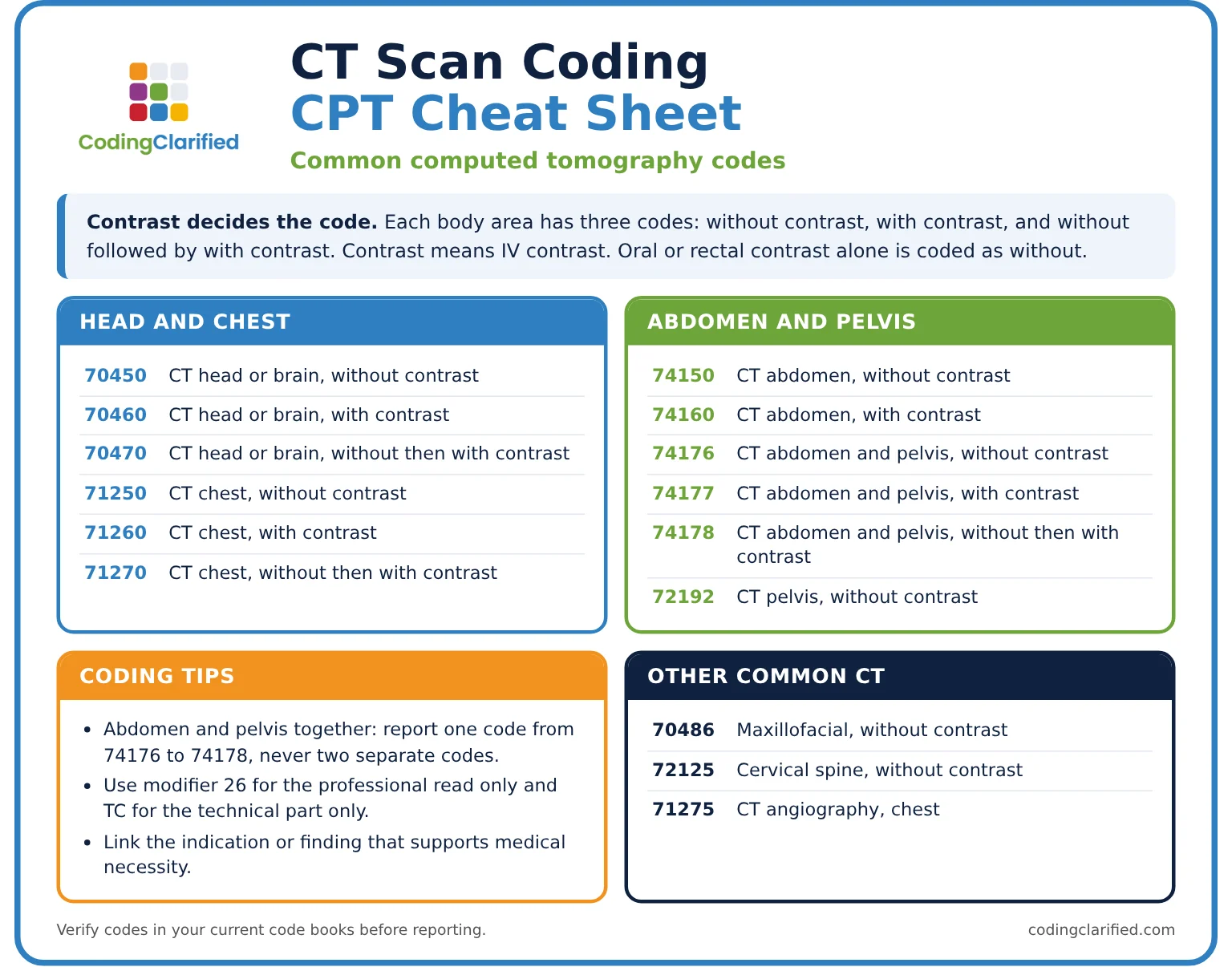
Quick answer: The most common CT scan CPT codes are 70450 (head without contrast), 71250 (chest without contrast), 71260 (chest with contrast) and 74176 to 74178 (abdomen and pelvis). Choose the code by body area first, then by contrast: without, with, or without followed by with. Oral or rectal contrast alone counts as without contrast, and a CT angiography (CTA) of the chest for a suspected pulmonary embolism is 71275.
Computed Tomography (CT) scans remain among the most commonly reported diagnostic imaging procedures in healthcare. Consequently, understanding how to accurately assign CT scan CPT codes is essential for medical coders, billers, CPC students, radiology coders, and compliance professionals.
Because reimbursement often depends on proper code selection, coders must understand the relationship between the anatomical site imaged and whether contrast material was used during the study. Even a small documentation oversight can result in denials, delayed payments, or compliance concerns.
In this 2027 guide, we’ll review the most frequently used CT scan CPT codes, explain contrast administration rules, discuss common coding mistakes, and provide practical coding tips that can help both new and experienced coders improve accuracy.
New to medical coding? See how our CPC Training gets you certified.
Key Takeaways
- CT scan CPT codes are selected based on the body area scanned and contrast usage.
- Most CT studies fall into one of three categories: without contrast, with contrast, or with and without contrast.
- Documentation must clearly support the anatomical region and contrast administration.
- Combined “with and without contrast” codes should be reported instead of separate CT codes.
- CT coding frequently appears on CPC certification exams and in daily radiology coding workflows.
- Medical necessity and payer-specific requirements should always be reviewed.
- CMS and commercial payer reimbursement policies continue to evolve in 2027.
What Is a CT Scan?
A CT (Computed Tomography) scan is a diagnostic imaging procedure that uses X-rays and computer processing technology to create detailed cross-sectional images of internal organs, tissues, blood vessels, and bones.
CT imaging is commonly ordered for:
- Trauma evaluations
- Stroke assessments
- Cancer diagnosis and staging
- Infection detection
- Abdominal pain workups
- Pulmonary evaluations
- Orthopedic injuries
- Emergency department visits
Because CT scans are performed across nearly every medical specialty, coders frequently encounter these services in both hospital and physician practice settings.
How are CT scan CPT codes organized?
The CPT Imaging Section organizes CT codes according to:
- Anatomical location
- Contrast administration
- Complexity of the study
Generally, each anatomical region contains three code choices:
- Without contrast
- With contrast
- With and without contrast
Understanding this structure makes locating the correct code significantly easier.
What are the most common CT scan CPT codes? (2027 Quick Reference)
| Body Area | Without Contrast | With Contrast | With & Without Contrast |
|---|---|---|---|
| Head/Brain | 70450 | 70460 | 70470 |
| Maxillofacial Area (including sinuses) | 70486 | 70487 | 70488 |
| Neck (Soft Tissue) | 70490 | 70491 | 70492 |
| Chest | 71250 | 71260 | 71270 |
| Abdomen | 74150 | 74160 | 74170 |
| Abdomen & Pelvis | 74176 | 74177 | 74178 |
| Pelvis | 72192 | 72193 | 72194 |
| Upper Extremity | 73200 | 73201 | 73202 |
| Lower Extremity | 73700 | 73701 | 73702 |
| Cervical Spine | 72125 | 72126 | 72127 |
| Thoracic Spine | 72128 | 72129 | 72130 |
| Lumbar Spine | 72131 | 72132 | 72133 |
| Chest CT Angiography (CTA) | None | 71275 (includes noncontrast images, if performed) | None |
| Low Dose CT for Lung Cancer Screening | 71271 | None | None |
Always verify the most current CPT code set and payer guidance before final code assignment.
What counts as “with contrast” in CT coding?
One of the most important concepts in CT coding involves contrast administration.
The CPT contrast rule: “With contrast” means contrast given intravascularly (IV), intra-articularly (into a joint) or intrathecally (into the spinal canal). Oral contrast alone or rectal contrast alone does not qualify, so a study using only oral or rectal contrast is coded without contrast. This is one of the most tested CT concepts on the CPC exam.
When is a CT coded without contrast?
A study performed without any contrast material.
Common examples include:
- Initial head injury evaluations
- Stroke screenings
- Sinus studies
- Trauma assessments
Example:
70450: CT head or brain without contrast material.
When is a CT coded with contrast?
Contrast material is administered during the examination to enhance visualization of organs, tissues, or vascular structures.
Example:
71260: CT chest with contrast.
When is a CT coded with and without contrast?
The patient undergoes two imaging phases:
- Initial non-contrast study
- Subsequent contrast-enhanced study
Because two imaging phases are performed, reimbursement is typically higher.
Example:
74178: CT abdomen and pelvis without contrast followed by contrast-enhanced imaging.
What documentation is needed for CT coding?
Successful CT coding begins with thorough documentation review.
Coders should verify:
Anatomical Site
Documentation should clearly identify the body region scanned.
Examples:
- Head
- Neck
- Chest
- Abdomen
- Pelvis
- Abdomen and Pelvis
Contrast Usage
The radiology report should specify:
- No contrast administered
- Contrast administered
- Both phases performed
Clinical Indication
Documentation should establish medical necessity.
Examples:
- Headache
- Trauma
- Cancer staging
- Abdominal pain
- Suspected pulmonary embolism
Number of Studies Performed
Multiple CT scans may occur during a single encounter.
For example:
- CT head
- CT cervical spine
- CT chest
Each service must be supported and coded appropriately.
What are the most common CT coding mistakes?
Mistake #1: Incorrect Contrast Selection
One of the most frequent errors occurs when coders choose a contrast code despite documentation indicating no contrast was administered.
Always verify the radiology report.
Mistake #2: Confusing Abdomen with Abdomen and Pelvis
This distinction is commonly tested on CPC exams.
A CT abdomen alone differs from a CT abdomen and pelvis examination.
Never assume both regions were imaged.
The combined code rule: When CT of the abdomen and CT of the pelvis are performed in the same session, report one combined code from 74176 to 74178. Do not report a separate abdomen code (74150 to 74170) together with a separate pelvis code (72192 to 72194). If one region is scanned without contrast and the other with contrast, report 74178.
Mistake #3: Reporting Separate Codes for With and Without Contrast Studies
If the CPT code includes both phases, report the single combined code.
Do not separately report:
- Without contrast code
- With contrast code
for the same study.
Mistake #4: Missing Additional Imaging Studies
Trauma patients frequently receive multiple CT examinations during the same visit.
Review the complete radiology documentation before assigning codes.
Mistake #5: Ignoring Medical Necessity Requirements
Even when the CPT code is correct, claims may deny if diagnosis coding does not support medical necessity.
Review payer-specific policies whenever applicable.
How do you answer CT coding questions on the CPC exam?
CT imaging questions appear regularly on CPC certification exams.
To answer these questions quickly:
Step 1: Identify the Body Region
Determine exactly what was scanned.
Step 2: Identify Contrast Usage
Look for:
- Without contrast
- With contrast
- With and without contrast
Step 3: Locate the Appropriate CPT Range
Use the CPT Imaging Section index.
Step 4: Verify the Full Code Description
Always read the complete code descriptor before selecting an answer.
Following this process can dramatically reduce coding errors and improve exam speed.
How are CT scans coded in real-world scenarios?
Scenario 1
A patient presents to the emergency department following a fall.
Procedure:
CT head without contrast.
Code:
70450
Scenario 2
A patient undergoes CT chest with intravenous contrast to evaluate a suspected pulmonary embolism.
Code:
71260
Note: Many pulmonary embolism studies are performed as a CT angiography (CTA) of the chest, often called a PE protocol. If the report documents a CTA with angiographic image postprocessing, report 71275 instead of 71260.
Scenario 3
A patient receives CT abdomen and pelvis without contrast followed by contrast-enhanced imaging for cancer surveillance.
Code:
74178
These examples illustrate how body region and contrast administration drive CPT selection.
What compliance rules apply to CT coding in 2027?
As healthcare auditing continues to increase, compliance remains a major focus area.
Coders should regularly review:
- AMA CPT guidance
- CMS reimbursement policies
- National Correct Coding Initiative (NCCI) edits
- Local Coverage Determinations (LCDs)
Authoritative Resources:
- AMA CPT Guidance: AMA CPT Guidance
- CMS Physician Fee Schedule: CMS Physician Fee Schedule
Staying current with annual updates helps prevent denials and supports accurate reimbursement.
Additional Coding Clarified Resources
You may also find these Coding Clarified articles helpful:
- Medical Coding for Radiology
- Evaluation and Management (E/M) Guidelines for 2026
- ICD-10-CM Coding Guidelines
- Modifier Usage in Medical Coding
- Medical Necessity in Medical Coding
- About Coding Clarified
- MRI CPT Coding Guide
- Medical Coding Reference Library
Final Thoughts
CT scan coding follows a predictable structure once coders understand how CPT organizes imaging services.
Remember this formula:
Body Area + Contrast Usage = Correct CT CPT Code
By consistently reviewing documentation, verifying contrast administration, and understanding common coding pitfalls, medical coders can improve both accuracy and compliance.
Whether you’re preparing for the CPC exam or coding radiology services professionally, mastering CT scan CPT codes remains an essential skill in 2027.
Frequently Asked Questions (FAQ)
What is the difference between CT with contrast and CT without contrast?
A CT without contrast does not use contrast material. A CT with contrast uses contrast during the imaging study to improve visualization of tissues, organs, and blood vessels.
How do I code a CT scan performed with and without contrast?
Report the single CPT code that specifically describes a study performed both without contrast and with contrast. Do not report separate codes.
What is the CPT code for a CT head without contrast?
The CPT code is 70450.
What is the CPT code for a CT chest with contrast?
The CPT code is 71260.
What is the CPT code for a CT abdomen and pelvis without contrast?
The CPT code is 74176.
Why are CT coding questions common on the CPC exam?
CT coding questions test a candidate’s ability to identify anatomical sites, understand contrast administration, and navigate the CPT Imaging section efficiently.
Can multiple CT scans be coded during the same encounter?
Yes. If separate medically necessary CT examinations are performed and documented, multiple CT codes may be reported when supported by payer guidelines.
Where can coders verify CT coding guidance?
Coders should review AMA CPT guidance, CMS reimbursement policies, NCCI edits, payer policies, and official coding resources annually.
Does oral contrast count as “with contrast”?
No. Oral contrast alone or rectal contrast alone is coded as without contrast. Only intravascular, intra-articular or intrathecal contrast makes a CT study “with contrast.”
What is the CPT code for a CT angiography (CTA) of the chest for a pulmonary embolism?
CPT 71275 reports a CTA of the chest. Use 71260 only when the report documents a routine CT chest with contrast rather than a CT angiography.
What is the CPT code for a low dose CT lung cancer screening?
CPT 71271 reports a low dose CT of the thorax for lung cancer screening, without contrast.
Ready to code like this for a living?
Coding Clarified’s AAPC licensed CPC program takes you from beginner to certified, with an internship and a job board for graduates.
You may qualify for WIOA funding in 30+ states. Check your eligibility.