
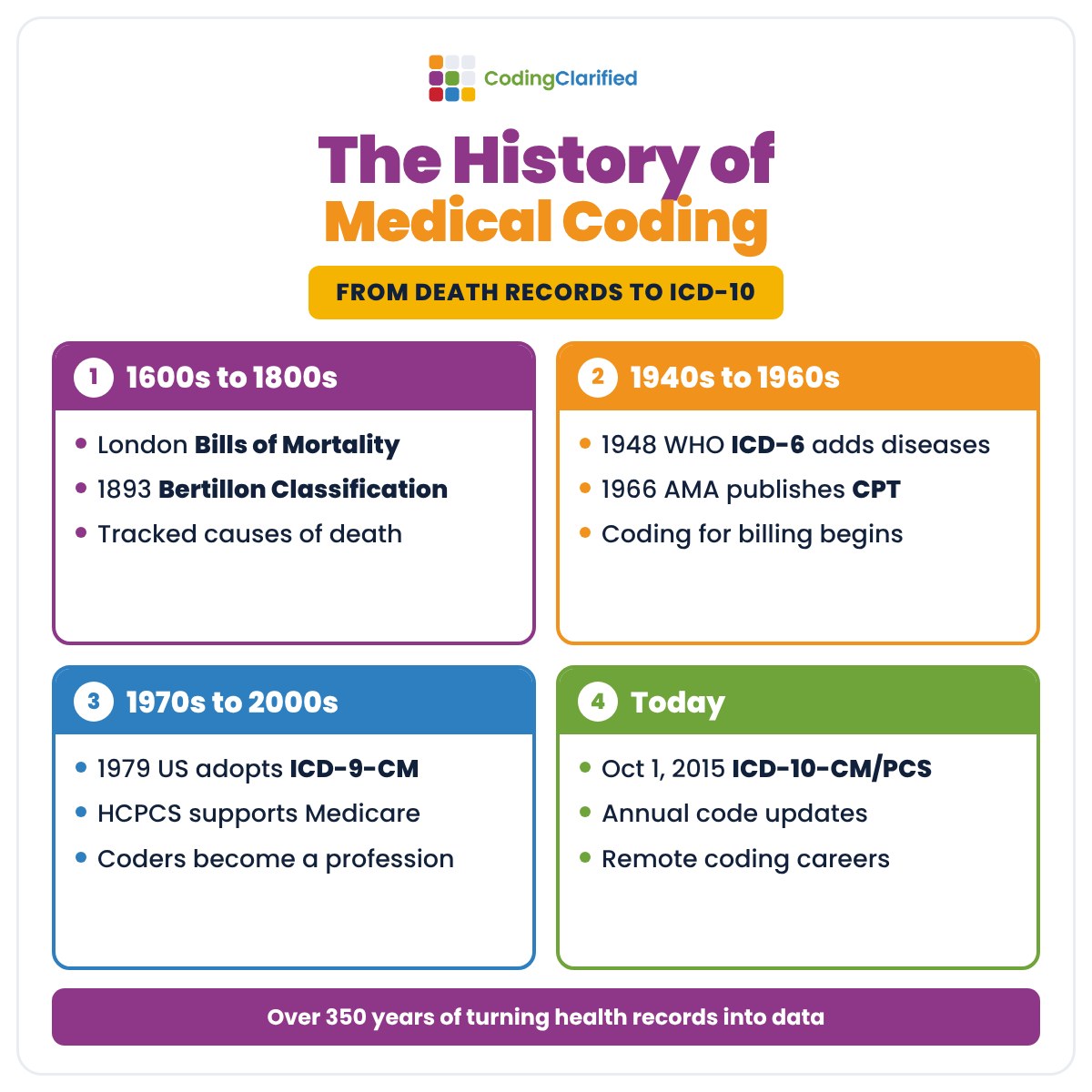
Medical coding began with efforts to classify causes of death. The International List of Causes of Death was adopted in 1893 and later became the International Classification of Diseases (ICD), maintained by the World Health Organization. The United States adopted clinical versions for billing, moved from ICD-9-CM to ICD-10-CM and ICD-10-PCS on October 1, 2015, and the AMA introduced CPT in 1966.
The history of medical coding stretches back more than 350 years. Long before computers and claim forms, people looked for ways to track disease and causes of death. Today, those early efforts have grown into the detailed code sets that medical coders use every day.
The Early History of Medical Coding
One of the earliest examples comes from London’s Bills of Mortality. These weekly reports listed deaths and their causes in the city. In 1662, John Graunt studied the Bills and used them to find patterns in disease and death. As a result, many historians call his work the beginning of modern health statistics.
During the Great Plague of 1665 and 1666, the Bills became even more important. They showed how fast the plague spread through London. However, clerks did not record causes of death in a consistent way, so the data had limits.
Building a Classification System
In the 1830s and 1840s, Dr. William Farr, a British epidemiologist, pushed for a uniform system to classify causes of death. Later, in 1893, Jacques Bertillon presented the International List of Causes of Death. Countries around the world adopted it and revised it about every ten years.
In 1948, the newly formed World Health Organization (WHO) took over the list. At that point, it became the International Classification of Diseases (ICD), and it began to include illnesses as well as causes of death. For the first time, doctors and researchers could compare health data across countries.
Medical Coding in the United States
In the United States, providers began using codes for billing and payment. For example, the American Medical Association first published CPT in 1966 to describe procedures and services. Later, Medicare adopted HCPCS to cover supplies, drugs, and other items.
For many years, coders worked from paper records and printed code books. In the 1980s, coders still wrote much of their work by hand or on a typewriter. Over time, however, electronic health records and coding software changed the job.
The United States moved from ICD-9-CM to ICD-10-CM on October 1, 2015. The new code set is far more specific than the old one. In particular, it captures laterality, severity, and anatomy in much greater detail. As a result, payers receive more accurate data for reimbursement and quality reporting.
Medical Coding Today
Today, ICD-10-CM contains more than 70,000 diagnosis codes, and it updates every October. Medical codes support claims, coverage decisions, and public health research. In addition, health plans such as Medicare and Medicaid rely on them to track disease and plan care.
Technology has also changed where coders work. Most records now move electronically, so many coders work remotely. In short, the history of medical coding shows a field that keeps growing and changing.
If you want to become part of this important field, Coding Clarified homepage about our program and contact us today. The future of medical coding looks bright.
Medical Coding History Timeline
- 1893: The International List of Causes of Death, developed by Jacques Bertillon, is adopted. It becomes the basis for the ICD.
- 1948: The World Health Organization takes responsibility for the ICD with the sixth revision, which adds diseases as well as causes of death.
- 1966: The American Medical Association publishes the first edition of CPT.
- 1979: The United States begins using ICD-9-CM.
- 1996: HIPAA leads to national standard code sets for electronic claims.
- October 1, 2015: ICD-10-CM and ICD-10-PCS replace ICD-9-CM in the United States.
- 2022: ICD-11 takes effect internationally. The United States has not yet adopted it.
Frequently Asked Questions About the History of Medical Coding
When did the United States switch to ICD-10?
On October 1, 2015, when ICD-10-CM and ICD-10-PCS replaced ICD-9-CM for diagnoses and inpatient procedures.
Who created CPT?
The American Medical Association introduced CPT in 1966 and still maintains it today.
Will the United States move to ICD-11?
Not yet. ICD-11 is in use internationally, but the United States has not set an adoption date. Read ICD-9 vs ICD-10 vs ICD-11 for the differences.