Medical Coding for Skin Neoplasm Excision in 2026: CPT, ICD-10-CM, Shave Removal, and Layered Closure Guide
Key Takeaways
- Correctly distinguish between excision and shave removal before selecting a CPT® code.
- Always code each lesion separately when documentation supports it.
- Measure the lesion plus the narrowest surgical margins for excision coding.
- Layered (intermediate) closure is not included in excision codes, so report it separately with an intermediate repair code.
- However, shave removal uses a completely different CPT® code family than excision.
- In addition, final pathology determines whether the lesion is coded as benign or malignant.
- As a result, accurate operative note documentation prevents coding errors and enables proper reimbursement.
Medical Coding for Skin Neoplasm Excision in 2026
Overall, skin lesion procedures remain one of the most commonly coded services in dermatology, plastic surgery, otolaryngology, and family practice. Although these procedures may appear straightforward, coders frequently make mistakes when choosing between excision and shave removal codes.
Moreover, coders must understand lesion measurement rules, closure guidelines, pathology documentation, and anatomical locations before assigning the correct CPT® codes.
This operative report provides an excellent learning opportunity because it includes:
- Two benign facial lesion excisions
- One shave removal
- Layered closures
- Multiple specimens
- Separate anatomical sites
Understanding why each procedure is coded differently will help new medical coders avoid common exam and workplace errors.
Operative Summary
Preoperative Diagnosis
- Enlarging nevus of the left upper cheek
- Enlarging nevus of the left lower cheek
- Enlarging superficial nevus of the right nasal ala
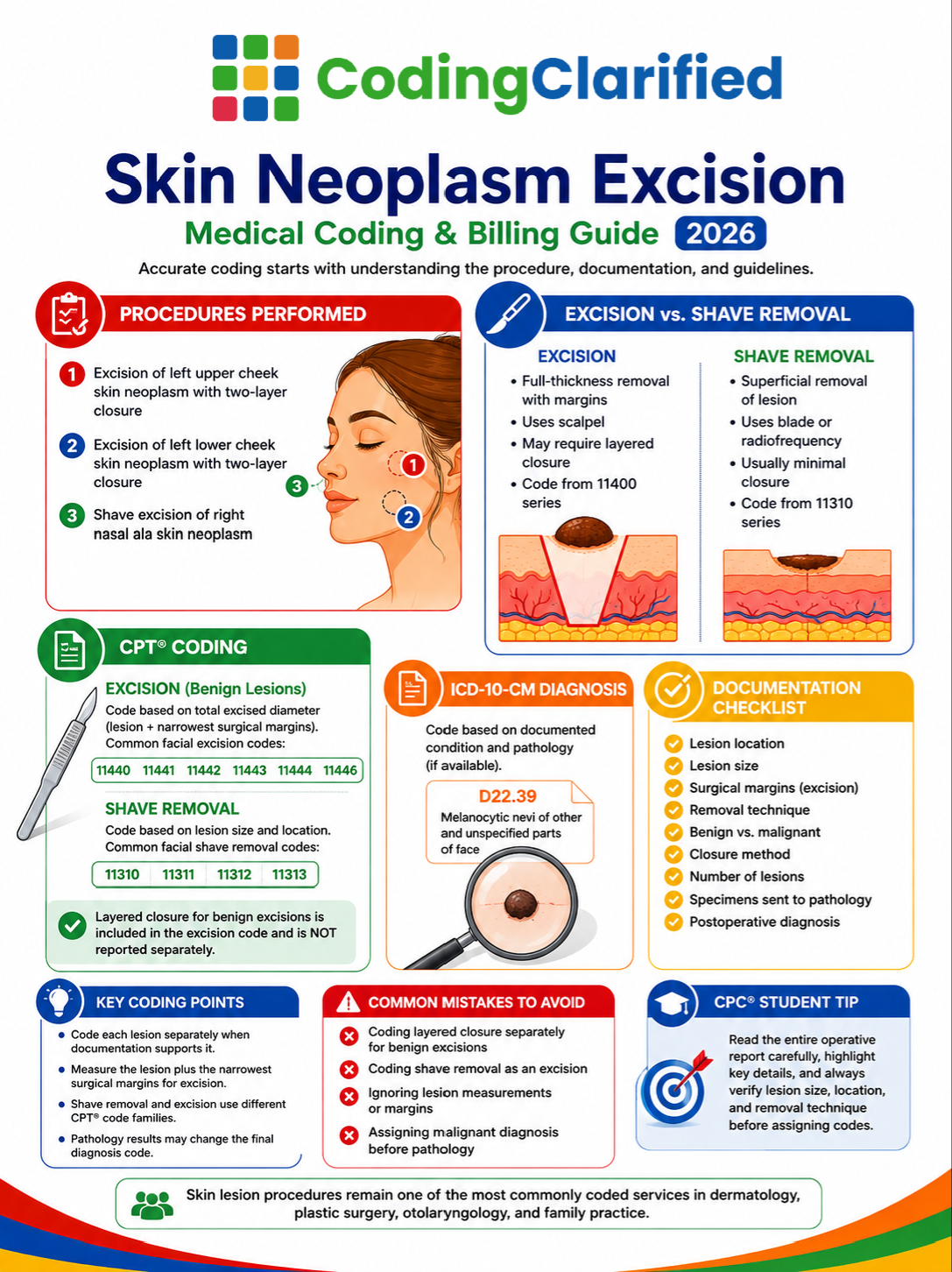
Procedures Performed
- Excision of left upper cheek skin neoplasm with layered closure
- Excision of left lower cheek skin neoplasm with layered closure
- Shave excision of right nasal ala skin neoplasm
The operative report documents that all lesions appeared clinically benign but were enlarging. Therefore, the physician removed them for diagnosis and treatment.
Why Documentation Matters
Before assigning any code, coders should verify several important elements.
The operative report should clearly document:
- Lesion location
- Lesion size
- Surgical margins (for excisions)
- Benign versus malignant status
- Closure method
- Number of lesions removed
- Specimens sent to pathology
Without complete documentation, selecting the correct CPT® code becomes much more difficult.
Furthermore, pathology results should always be reviewed whenever available because they may change the final diagnosis coding.
Understanding Excision vs. Shave Removal
For example, one of the biggest coding mistakes involves confusing shave removal with surgical excision.
Excision
An excision removes the lesion through the full thickness of the skin.
Characteristics include:
- Scalpel incision
- Full-thickness removal
- Margins included
- May require layered closure
In this operative report, the physician excised:
- Left upper cheek lesion
- Left lower cheek lesion
Both lesions required layered closure because they extended deeper into the tissue.
Shave Removal
Shave removal differs significantly.
Instead of removing the entire skin thickness, the physician removes only the elevated portion of the lesion.
Characteristics include:
- Superficial removal
- No full-thickness excision
- Usually minimal closure
- Frequently performed with a blade or radiofrequency device
The right nasal ala lesion was removed by superficial shave excision.
Therefore, it is reported from the shave removal code family rather than the excision code family.
CPT Coding for This Procedure
Step 1: Determine Whether the Lesions Are Benign
The operative report repeatedly describes the lesions as benign-appearing nevi.
Unless pathology later identifies malignancy, benign lesion excision codes are appropriate.
Step 2: Measure the Lesion
For excisions, coders measure:
Greatest lesion diameter + narrowest surgical margins
This total measurement determines the appropriate CPT® code.
The documentation reports each lesion measured approximately:
0.5 × 1 cm
However, the surgeon did not document surgical margins.
Therefore, the final code selection depends on the documented excised diameter.
This illustrates an important coding principle:
Never guess margins.
Possible CPT Coding
Depending on the final excised diameter documented, the facial excisions may fall within codes such as:
- 11440
- 11441
- 11442
- 11443
- 11444
- 11446
The correct code depends entirely on the total excised diameter.
Shave Removal CPT Codes
Shave removals are coded separately.
Facial shave removals may be reported using:
- 11310
- 11311
- 11312
- 11313
Again, lesion size determines the final code.
Is Layered Closure Reported Separately?
No.
This is one of the most frequently tested CPC exam concepts.
For benign lesion excisions, the excision code includes only simple closure. Report intermediate (layered) closure separately.
Consequently, code the physician’s two-layer closure of the cheek separately with an intermediate repair code for the face (12051 to 12057), based on the total repair length.
Many beginning coders miss this additional repair code.
Doing so would result in incorrect coding.
ICD-10-CM Diagnosis Coding
The physician documented enlarging nevi.
Because pathology was not yet available, the final diagnosis should reflect the documented condition.
Possible diagnosis codes may include:
- D22.39 — Melanocytic nevi of other and unspecified parts of face
If pathology later identifies another diagnosis, coding should follow the final pathology report.
Never assign a malignant diagnosis before pathology confirms malignancy.
Specimen Submission
Each lesion was submitted separately.
Although pathology processing is important clinically, it does not change the procedure coding.
Instead, separate specimens support documentation that three distinct lesions were removed.
Why the Facial Location Matters
Facial lesions often require greater precision.
The surgeon documented:
- Left upper cheek
- Left lower cheek
- Right nasal ala
Each represents a separate anatomical location.
Additionally, facial procedures frequently require layered closure because cosmetic outcomes are important.
Step-by-Step Coding Process
Experienced medical coders typically follow the same workflow.
Step 1
Review the preoperative diagnosis.
Step 2
Read the entire operative note.
Step 3
Determine benign versus malignant status.
Step 4
Identify every lesion removed.
Step 5
Determine whether each lesion was excised or shaved.
Step 6
Verify lesion measurements.
Step 7
Confirm whether closure is separately reportable.
Step 8
Assign the appropriate diagnosis codes.
Following this process helps improve coding accuracy while reducing claim denials.
Coding Tips for CPC Students
Skin procedures appear regularly on CPC exams.
Therefore, students should practice distinguishing between different removal techniques.
Remember these study tips:
- Read every operative report completely.
- Highlight lesion size.
- Highlight lesion location.
- Circle documentation describing margins.
- Identify shave versus excision.
- Review pathology when available.
- Learn which closures are bundled.
Practicing these habits will improve both testing and real-world coding performance.
Common Mistakes to Avoid
Even experienced coders occasionally make errors.
Avoid these common mistakes:
- Leaving off the intermediate repair code for a layered closure.
- Coding shave removals as excisions.
- Ignoring lesion measurements.
- Guessing surgical margins.
- Assigning malignant diagnosis codes before pathology.
- Combining multiple lesions into one procedure code.
- Forgetting that each lesion is coded individually when appropriate.
- Using pathology findings that were not available on the date of service.
Fortunately, careful documentation review prevents nearly all of these mistakes.
Documentation Checklist
Before coding skin lesion procedures, verify that the operative note includes:
- Lesion location
- Lesion size
- Surgical margins
- Removal technique
- Benign or malignant diagnosis
- Closure method
- Number of lesions
- Pathology submission
- Postoperative diagnosis
A complete operative report supports accurate coding and appropriate reimbursement.
Why This Procedure Is an Excellent CPC Exam Example
This operative report includes several concepts frequently tested on certification exams.
Students must recognize:
- Excision versus shave removal
- Multiple lesions
- Facial anatomy
- Layered closure rules
- Lesion measurement
- Benign diagnosis coding
- Separate procedure reporting
Learning these concepts together builds stronger coding skills.
2026 Coding Updates and Best Practices
Medical coding continues to evolve each year. For 2026, dermatology coding still requires careful review of the most current CPT® code descriptors, payer policies, and documentation guidelines. Coders should avoid relying on older coding references or memory alone.
Additionally, many payers continue to emphasize documentation accuracy during audits. Complete lesion measurements, clear anatomical descriptions, and pathology-supported diagnoses remain essential for clean claim submission.
Always verify code changes in the current coding manuals before submitting claims.
Frequently Asked Questions
What is the difference between a shave removal and an excision?
A shave removal removes only the superficial portion of a lesion. An excision removes the lesion through the full thickness of the skin with surgical margins.
Is layered closure coded separately with benign lesion excisions?
Yes. Benign lesion excision codes include only simple closure. Report layered (intermediate) closure separately with codes 12031 to 12057, based on the anatomic site and total repair length. Add together the lengths of repairs in the same anatomic group and of the same complexity.
How is lesion size measured for excision coding?
Measure the greatest clinical diameter of the lesion and add the narrowest surgical margins taken on each side. That total determines the correct CPT® code.
Should pathology determine the diagnosis code?
Yes. If pathology later identifies a different diagnosis, the diagnosis coding should reflect the final pathology findings when appropriate.
Can multiple lesions be reported separately?
Yes. Each lesion is coded separately when documentation supports separate procedures at different anatomical sites.
Are shave removals coded from the same code family as excisions?
No. Shave removals and excisions have different CPT® code families.
What documentation is most important for skin lesion coding?
Coders should verify lesion size, location, margins, removal technique, closure, pathology, and the number of lesions removed.
Coding Clarified Final Thoughts
Although skin lesion procedures may appear simple, accurate coding requires careful attention to documentation, lesion measurements, surgical technique, and closure rules. This operative report demonstrates several coding concepts that every CPC student and medical coder should master.
When coders consistently distinguish between shave removals and excisions, verify lesion measurements, and follow current 2026 coding guidelines, they improve coding accuracy, reduce denials, and support proper reimbursement.
Related Coding Clarified Articles
Continue building your dermatology and surgical coding knowledge with these additional resources from Coding Clarified:
- Medical Coding Skin Substitutes
- Medical Coding for Skin Grafts
- Medical Coding Lesions
- Medical Coding “Clarified” Biopsy – Skin Nevus
- Medical Coding Debridement
Browse more articles here:
Coding Clarified Blog
Authoritative References
- American Academy of Professional Coders (AAPC)
- Centers for Medicare & Medicaid Services (CMS)
- National Correct Coding Initiative (NCCI)
- ICD-10-CM Official Guidelines for Coding and Reporting
- American Medical Association CPT Resources