Medical Coding for ADHD in 2026: CPT, ICD-10-CM Coding Guide for Accurate Reporting
Attention-Deficit/Hyperactivity Disorder (ADHD) is one of the most commonly diagnosed neurodevelopmental disorders in the United States. Because ADHD often requires ongoing office visits, medication management, behavioral health services, and psychological testing, medical coders frequently encounter these records.
However, coding ADHD correctly requires more than simply assigning an ICD-10-CM diagnosis code. Coders must understand documentation requirements, Evaluation and Management (E/M) coding, psychological testing services, and payer-specific rules to ensure accurate reimbursement.
-
This 2026 ADHD medical coding guide explains the diagnosis codes, CPT coding considerations, documentation requirements, and common coding mistakes every medical coder should know.
Key Takeaways
- ADHD is reported using ICD-10-CM category F90.
- Documentation must identify the ADHD type whenever possible.
- E/M services are selected using current medical decision making or total time guidelines.
- Psychological testing services may be reported separately when supported by documentation.
- Medication management alone does not automatically support higher-level E/M coding.
- Behavioral health services often accompany ADHD treatment.
- Accurate documentation reduces denials and audit risk.
- Coders should always review payer policies for behavioral health coverag
What Is ADHD?
Attention-Deficit/Hyperactivity Disorder (ADHD) is a chronic neurodevelopmental disorder that affects attention, impulsivity, and hyperactivity. Symptoms usually begin during childhood, although many adults continue to experience ADHD throughout life.
Healthcare providers diagnose ADHD after completing a comprehensive clinical evaluation. Therefore, documentation often includes patient interviews, standardized assessment tools, family history, behavioral observations, and school or workplace information.
As a result, ADHD encounters frequently involve primary care physicians, pediatricians, psychiatrists, psychologists, neurologists, nurse practitioners, and physician assistants.
ICD-10-CM Codes for ADHD
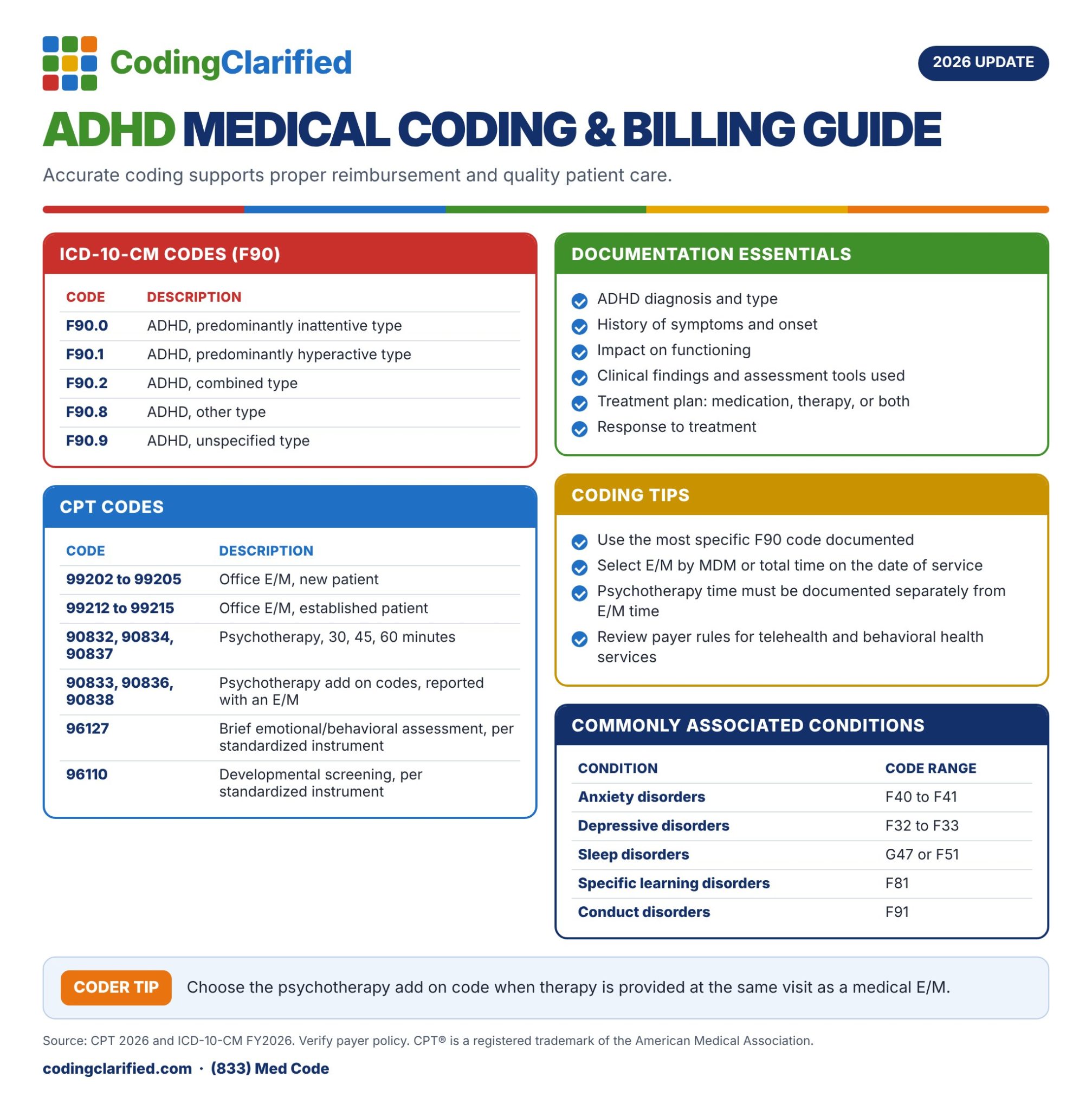
The primary diagnosis codes come from ICD-10-CM category F90.
Common ADHD diagnosis codes include:
- F90.0 – Attention-deficit hyperactivity disorder, predominantly inattentive type
- F90.1 – Attention-deficit hyperactivity disorder, predominantly hyperactive type
- F90.2 – Attention-deficit hyperactivity disorder, combined type
- F90.8 – Other attention-deficit hyperactivity disorders
- F90.9 – Attention-deficit hyperactivity disorder, unspecified type
Whenever documentation identifies the ADHD presentation, coders should assign the most specific diagnosis available. Otherwise, use F90.9 only when the provider does not document the type.
How ADHD Is Diagnosed
Although coders do not diagnose patients, understanding the clinical workflow helps interpret documentation correctly.
Typically, providers evaluate:
- Attention deficits
- Hyperactivity
- Impulsivity
- Symptom duration
- Functional impairment
- School performance
- Work performance
- Family history
- Behavioral questionnaires
Additionally, providers often rule out anxiety, depression, autism spectrum disorder, sleep disorders, thyroid disease, substance use, and learning disabilities before confirming ADHD.
CPT Coding for ADHD Office Visits
Many ADHD encounters involve office visits for evaluation or medication management.
Office visits are commonly reported using the current E/M code family.
Examples include:
New Patient Office Visits
- 99202
- 99203
- 99204
- 99205
Established Patient Office Visits
- 99211
- 99212
- 99213
- 99214
- 99215
Since 2021, office visit selection depends on either:
- Medical decision making (MDM), or
- Total physician or qualified healthcare professional time.
Consequently, coders should never select an E/M level based solely on history or examination documentation.
Medication Management Coding
Many ADHD patients return every few months for medication monitoring.
These visits commonly include:
- Medication effectiveness review
- Side effect assessment
- Prescription refill
- Blood pressure monitoring
- Weight monitoring
- Growth assessment
- Review of controlled substance monitoring
However, medication refills alone do not automatically justify higher-level E/M services.
Instead, coders should evaluate the complete documentation to determine the appropriate MDM level or total time.
Psychological Testing CPT Codes
Some patients undergo formal psychological testing before receiving an ADHD diagnosis.
Depending on documentation, providers may report services such as:
- 96130
- 96131
- 96136
- 96137
- 96138
- 96139
These codes represent psychological testing evaluation and administration services.
Importantly, documentation must support medical necessity, testing time, scoring, interpretation, and written reports when required.
Neurobehavioral Status Examination
Certain complex evaluations may include a neurobehavioral status examination.
The primary CPT code includes:
- 96116
This service evaluates cognitive functioning, reasoning, memory, attention, and executive function.
Because this examination has strict documentation requirements, coders should carefully review the provider’s report before assigning the code.
Behavioral Health Services
Many ADHD patients receive counseling in addition to medication management.
Depending on documentation, behavioral health coding may include psychotherapy services such as:
- 90832
- 90834
- 90837
Additionally, family psychotherapy services may be appropriate when documentation supports medical necessity.
Always verify payer-specific behavioral health policies before reporting these services together with E/M visits.
Telehealth ADHD Coding in 2026
Telehealth continues to play an important role in ADHD treatment.
Providers often perform:
- Medication follow-up
- Counseling
- Behavioral assessments
- Care coordination
Therefore, coders should verify:
- Current telehealth coverage
- Place of Service requirements
- Modifier requirements
- State-specific regulations
- Individual payer policies
Because telehealth policies continue to evolve, checking current payer guidance remains essential.
Documentation Requirements for ADHD Coding
Complete documentation helps support both diagnosis coding and procedure coding.
A quality ADHD note typically includes:
- Confirmed diagnosis
- ADHD type
- Presenting symptoms
- Medication review
- Side effects
- Clinical assessment
- Treatment plan
- Follow-up schedule
- Time documentation when applicable
- Medical decision making
Furthermore, providers should clearly document any coexisting mental health conditions that affect treatment decisions.
Common ADHD Comorbidities
Patients with ADHD frequently have additional diagnoses.
Examples include:
- Anxiety disorders
- Depression
- Learning disabilities
- Autism spectrum disorder
- Oppositional defiant disorder
- Sleep disorders
- Substance use disorders
Each diagnosis should be coded only when documented and clinically evaluated during the encounter.
Common Mistakes to Avoid
Even experienced coders make ADHD coding errors. Fortunately, many are easy to prevent.
Common mistakes include:
- Assigning F90.9 when documentation supports a more specific ADHD type.
- Selecting E/M levels based only on medication refills.
- Coding psychological testing without required documentation.
- Reporting testing codes without documented interpretation.
- Missing separately documented behavioral health services.
- Ignoring payer-specific telehealth requirements.
- Failing to review medical necessity.
- Coding suspected ADHD before the provider confirms the diagnosis.
Careful record review significantly improves coding accuracy and reduces denials.
CPC Student Tips
Students preparing for the CPC exam frequently encounter behavioral health coding questions.
Keep these tips in mind:
- Memorize the ADHD diagnosis codes within category F90.
- Practice selecting E/M levels using current MDM guidelines.
- Learn the differences between psychological testing and psychotherapy.
- Review modifier usage for behavioral health services.
- Read every operative or clinic note carefully before assigning codes.
- Never assume documentation that is not present.
- Watch for medical necessity requirements.
- Become familiar with payer-specific behavioral health rules.
Consistent practice with real-world scenarios builds confidence for both the CPC exam and daily coding work.
ADHD Coding Example
A 13-year-old established patient returns for a follow-up ADHD visit.
The physician reviews medication effectiveness, evaluates mild appetite suppression, adjusts the dosage, updates the treatment plan, and schedules a three-month follow-up.
Possible coding may include:
Diagnosis:
- F90.2 – Attention-deficit hyperactivity disorder, combined type
Procedure:
- Appropriate established patient E/M code based on documented MDM or total time (such as 99213 or 99214, if supported by the documentation).
Remember that the documentation—not the diagnosis alone—determines the correct E/M level.
Why Accurate ADHD Coding Matters
Accurate coding improves reimbursement, supports compliance, and reflects the complexity of patient care.
Additionally, complete documentation helps providers demonstrate medical necessity while reducing the risk of audits and claim denials.
As behavioral health services continue expanding in 2026, ADHD coding remains an important skill for every medical coder.
Frequently Asked Questions (FAQ)
What ICD-10-CM code is used for ADHD?
Most ADHD diagnoses fall under category F90. Coders should report the most specific code supported by provider documentation, such as F90.0, F90.1, F90.2, F90.8, or F90.9.
Can ADHD medication refill visits always be billed with a high-level E/M code?
No. Medication refills alone do not determine the E/M level. Instead, coders must review the documented medical decision making or total time.
Can ADHD be coded with anxiety or depression?
Yes. If the provider documents and evaluates multiple conditions during the encounter, each diagnosis may be reported according to ICD-10-CM guidelines.
Are psychological testing services separately billable?
Yes. Codes such as 96130, 96131, 96136, 96137, 96138, and 96139 may be reported when documentation supports medical necessity, administration, interpretation, and reporting requirements.
What documentation is required for ADHD coding?
Documentation should identify the ADHD type, assessment findings, treatment plan, medication management, medical decision making, and follow-up recommendations.
Is telehealth allowed for ADHD follow-up visits?
Many payers allow telehealth ADHD follow-up services. However, coders should verify current payer policies, modifiers, and Place of Service requirements because coverage continues to evolve.
Should coders assign unspecified ADHD whenever ADHD is documented?
No. Coders should report F90.9 only when the provider does not specify the ADHD presentation. Always use the highest level of specificity supported by documentation.
Coding Clarified Final Thoughts
ADHD coding requires careful review of provider documentation, accurate ICD-10-CM diagnosis selection, and proper E/M code assignment. Although many encounters appear straightforward, documentation details often determine whether a claim is paid correctly.
By staying current with 2026 coding guidance, understanding behavioral health services, and following payer-specific requirements, medical coders can improve accuracy, reduce denials, and support high-quality patient care.
Related Coding Clarified Articles
Continue building your medical coding knowledge with these related resources from Coding Clarified:
- Evaluation and Management (E/M) Guidelines for 2026: The Complete Guide )
- Medical Coding Autism Spectrum Disorder
- Medical Coding ICD-10 Combo Codes
- Medical Coding ICD-10-CM Excludes 1
- Medical Coding ICD-10-CM Excludes 2
Authoritative References
- American Academy of Professional Coders (AAPC)
- Centers for Medicare & Medicaid Services (CMS)
- National Correct Coding Initiative (NCCI)
- ICD-10-CM Official Guidelines for Coding and Reporting
- American Academy of Pediatrics (AAP) – ADHD Clinical Practice Guidelines