Medical Coding for Tympanostomy Tube Placement and Adenoidectomy (2026)
How to Code Bilateral Tympanostomy Tube Placement and Adenoidectomy Using CPT®, ICD-10-CM & HCPCS
Tympanostomy tube placement is one of the most frequently performed pediatric surgical procedures in the United States. Many children who experience recurrent ear infections also develop enlarged adenoids that contribute to chronic middle ear disease, nasal obstruction, and hearing problems. As a result, physicians commonly perform an adenoidectomy during the same operative session.
For medical coders, these cases require careful review of the operative report to determine whether the tympanostomy was unilateral or bilateral, whether the adenoidectomy was complete, and whether any additional procedures were performed. Selecting the correct CPT®, ICD-10-CM, and, when appropriate, HCPCS Level II codes helps reduce claim denials while ensuring accurate reimbursement.
This coding guide reviews a real operative report and explains the coding process step by step using 2026 coding guidance.
Key Takeaways
Bilateral tympanostomy tube placement is typically reported with CPT® 69436 when performed under general anesthesia.
Adenoidectomy performed in a patient younger than age 12 is generally reported with CPT® 42830.
Documentation should clearly identify the surgical approach, laterality, anesthesia, and diagnoses.
Chronic otitis media and adenoid hypertrophy must be supported by physician documentation before assigning ICD-10-CM diagnosis codes.
HCPCS Level II codes generally are not separately reportable for physician professional coding in this operative scenario.
Careful review of the operative report helps prevent unbundling errors and incorrect modifier use.
Why This Procedure Matters in Medical Coding
Children with chronic ear infections often develop persistent middle ear fluid that affects hearing and speech development. Likewise, enlarged adenoids can block the eustachian tubes, making ear infections even more frequent.
Consequently, ENT surgeons frequently perform tympanostomy tube insertion together with an adenoidectomy during the same surgical encounter. Because two separate procedures are performed, coders must determine which services are separately reportable and whether National Correct Coding Initiative (NCCI) edits affect billing.
Understanding these procedures is valuable for:
- CPC® exam preparation
- Pediatric surgery coding
- Otolaryngology (ENT) coding
- Hospital outpatient coding
- Ambulatory surgery center (ASC) coding
- Physician office coding
Operative Report Summary
Preoperative Diagnosis
- Adenotonsillar hypertrophy
- Chronic otitis media
Postoperative Diagnosis
- Adenotonsillar hypertrophy
- Chronic otitis media
Procedures Performed
- Bilateral tympanostomy with pressure-equalization tube placement
- Adenoidectomy
Anesthesia
General endotracheal anesthesia
Step 1: Review the Operative Note
Before assigning any procedure codes, identify exactly what the surgeon performed.
The operative report documents:
- Removal of enlarged adenoid tissue using suction cautery
- Bilateral myringotomy incisions
- Suctioning of middle ear fluid
- Placement of ventilation tubes into both ears
- No tonsillectomy performed
- No additional ENT procedures documented
Because the documentation clearly identifies two separate procedures, each procedure should be coded independently when supported by CPT® guidelines.
CPT Coding
Procedure 1: Bilateral Tympanostomy Tube Placement
The operative report documents:
- Incision into both tympanic membranes
- Aspiration of middle ear fluid
- Placement of ventilation tubes
- General anesthesia
The appropriate CPT® code is:
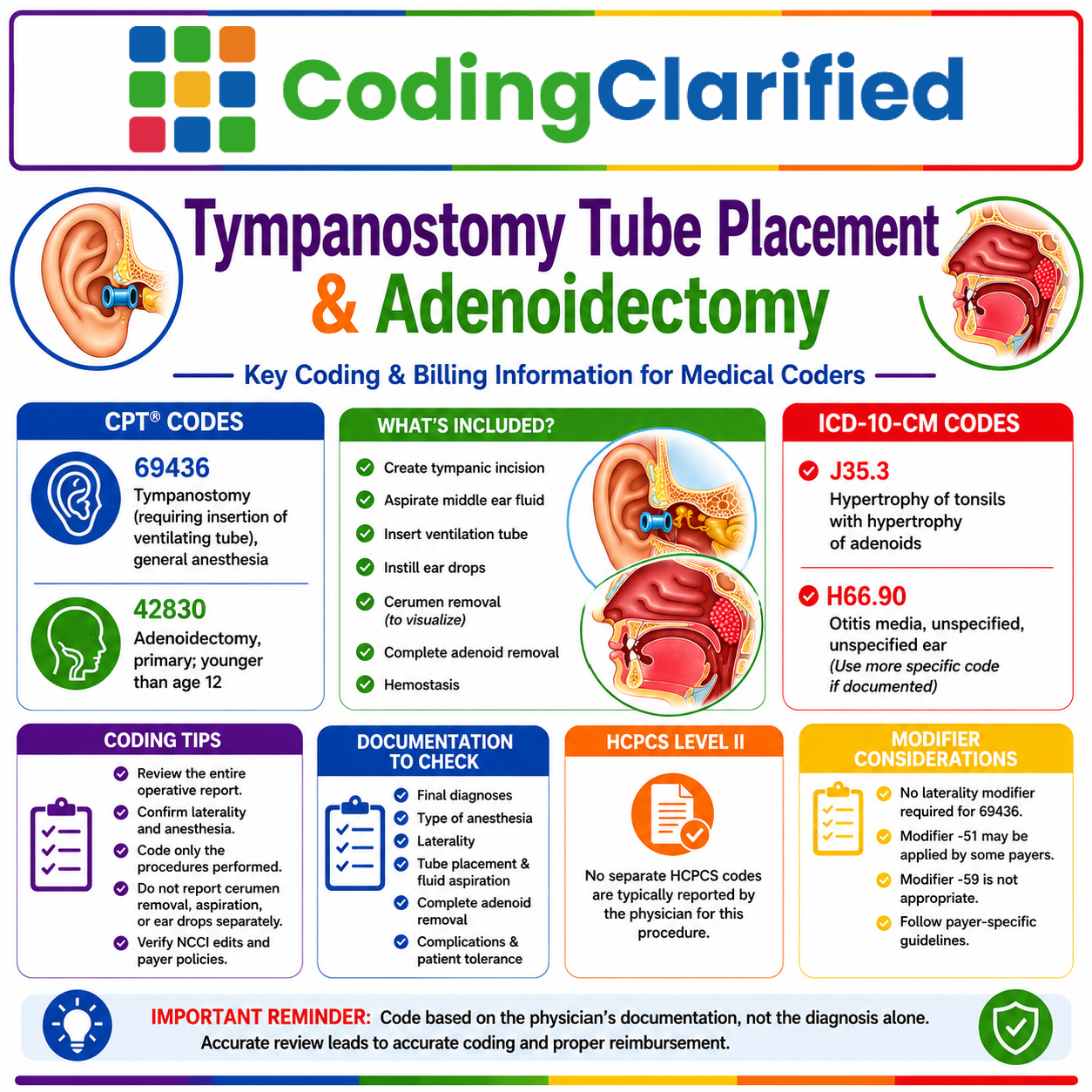
69436 Tympanostomy (requiring insertion of ventilating tube), general anesthesia
Several important details support this code selection.
First, the surgeon inserted pressure-equalization tubes into both ears.
Next, the patient underwent general anesthesia, which distinguishes this service from procedures performed under local or topical anesthesia.
Finally, CPT® describes tympanostomy tube insertion regardless of whether middle ear fluid is aspirated before tube placement.
Therefore, CPT® 69436 accurately represents the bilateral tympanostomy procedure performed during this operative session.
Why CPT® 69436 Is Correct
The operative report specifically states:
- Tympanostomy incision
- Fluid suctioned
- Tube inserted
- Procedure repeated on the opposite ear
- General anesthesia used
These documented elements match the CPT® descriptor for 69436.
Procedure 2: Adenoidectomy
The surgeon next removed the patient’s adenoid tissue using suction electrocautery.
Documentation includes:
- Soft palate retraction
- Visualization of the nasopharynx
- Complete fulguration of the adenoid bed
- Removal extending throughout the nasopharynx
The appropriate CPT® code is:
42830 Adenoidectomy, primary; younger than age 12
This code describes a primary adenoidectomy performed in patients younger than twelve years old.
Because tympanostomy tube placement and adenoidectomy involve different anatomic sites and represent separate procedures, both CPT® codes may be reported when documentation supports each service.
CPT Codes Reported
| CPT® Code | Description |
|---|---|
| 69436 | Tympanostomy requiring insertion of ventilating tube under general anesthesia |
| 42830 | Primary adenoidectomy, younger than age 12 |
ICD-10-CM Coding
Selecting diagnosis codes begins with the physician’s documented conditions rather than the procedures performed.
The operative report identifies:
- Chronic otitis media
- Adenotonsillar hypertrophy
Because the tonsils were not removed, coders should carefully review provider documentation before automatically assigning a diagnosis for tonsillar hypertrophy.
In many operative reports, physicians document adenotonsillar hypertrophy even when only an adenoidectomy is performed. However, ICD-10-CM coding must reflect the documented diagnoses and the procedures actually performed.
Potential diagnosis codes include:
| ICD-10-CM Code | Description |
|---|---|
| H66.90 | Otitis media, unspecified, unspecified ear |
| J35.3 | Hypertrophy of tonsils with hypertrophy of adenoids |
If the physician documents a more specific form of chronic otitis media elsewhere in the medical record, a more specific ICD-10-CM code should be assigned instead of H66.90.
Likewise, coders should always code to the highest level of specificity supported by provider documentation.
HCPCS Level II Coding
In most physician and facility claims, no separate HCPCS Level II supply codes are reported for the tympanostomy tubes used during surgery.
Instead, the ventilation tubes are generally considered part of the surgical procedure and are included in payment under the applicable reimbursement methodology.
Likewise, the Cortisporin® ear drops administered during the procedure are typically not separately billable by the physician because they are considered routine surgical supplies.
However, facility billing requirements may vary depending on the payer and the outpatient payment system. Therefore, coders should always verify payer-specific reporting instructions before assigning any HCPCS Level II codes.
Operative Report Coding Breakdown
Understanding why each CPT® code was selected is just as important as knowing the code itself. Successful medical coders develop the habit of reviewing every operative report from beginning to end before assigning any codes.
Instead of looking only at the procedure title, read the body of the report carefully. Frequently, surgeons document additional details that affect code selection, laterality, or diagnosis coding.
Let’s break down this operative report step by step.
Operative Note Breakdown
“The patient was taken to the operating room…”
This portion describes the surgical preparation.
It documents:
- Patient positioning
- Sterile preparation
- General endotracheal anesthesia
Although the surgeon documented anesthesia, anesthesia services are generally reported separately by the anesthesia provider and are not coded by the surgeon.
However, the fact that general anesthesia was used is extremely important because it supports reporting CPT® 69436 rather than the code describing tympanostomy performed without general anesthesia.
Soft Palate Retraction
The surgeon documented placement of:
- McIvor mouth gag
- Robinson catheters
- Soft palate retraction
These steps provide surgical exposure.
Therefore, they are considered routine components of the adenoidectomy and are not separately reportable.
Coders should avoid assigning additional procedure codes for routine exposure techniques unless CPT® specifically instructs otherwise.
Coding the Adenoidectomy
Next, the surgeon directed attention to the nasopharynx.
The operative report states that:
- Suction cautery was used.
- The adenoid bed was fulgurated.
- The adenoid tissue was removed throughout the nasopharynx.
- Hemostasis was achieved.
These documented steps describe a complete adenoidectomy.
Because no prior adenoidectomy was documented and the patient is presumed to be a child based on the operative scenario, the appropriate CPT® code remains:
42830 – Primary adenoidectomy, younger than age 12
Importantly, the operative report does not describe removal of the tonsils.
Although the diagnosis includes adenotonsillar hypertrophy, only the adenoids were removed during this procedure.
Consequently, coders should not report a tonsillectomy code.
Coding the Tympanostomy Tube Placement
After completing the adenoidectomy, the surgeon turned attention to the ears.
The documentation states:
- Cerumen removed
- Tympanic membrane incision created
- Middle ear fluid suctioned
- Ventilation tube inserted
- Cortisporin® instilled
- Cotton ball placed
- Procedure repeated on opposite ear
These findings fully support reporting:
69436 – Tympanostomy (requiring insertion of ventilating tube), general anesthesia
Notice that CPT® does not require separate coding for:
- Cerumen removal performed to visualize the tympanic membrane
- Suctioning middle ear fluid
- Placement of topical drops
- Cotton ball placement
These services are all considered integral components of the tympanostomy procedure.
Why Cerumen Removal Is Not Separately Reported
One of the most common CPC exam mistakes involves cerumen removal.
Many students see this statement:
“The canal was cleaned of ceruminous debris.”
Then they immediately think about cerumen removal codes.
However, CPT® instructs coders to report cerumen removal separately only when it represents a distinct procedure meeting the code requirements.
In this case, the surgeon removed only enough wax to visualize the tympanic membrane before surgery.
Because this cleaning was necessary to perform the tympanostomy, it is included in CPT® 69436.
No additional CPT® code should be assigned.
Why Middle Ear Fluid Aspiration Is Included
The operative report states:
Fluid was suctioned from the middle ear space.
Some beginning coders wonder whether aspiration should be reported separately.
Fortunately, CPT® already includes aspiration of middle ear fluid as part of tympanostomy tube placement.
Therefore, no additional procedure code is assigned.
Why Cortisporin Drops Are Not Separately Coded
The surgeon instilled Cortisporin ear drops after inserting each ventilation tube.
These drops help reduce inflammation and infection immediately following surgery.
Nevertheless, routine medications administered during a surgical procedure are generally included in the global surgical package.
Accordingly, physician coding does not separately report HCPCS medication codes for this routine intraoperative administration.
Facility billing requirements may differ depending on payer policy.
Can These Procedures Be Reported Together?
Yes.
The operative report supports reporting both:
- 69436
- 42830
These procedures involve different anatomical sites and represent distinct surgical services.
Furthermore, neither procedure is considered incidental to the other.
Always verify current National Correct Coding Initiative (NCCI) edits before billing multiple procedures together, because payer edits can change over time. As of 2026, these procedures are generally reportable together when documentation supports each service.
Modifier Considerations
Many students ask whether a modifier is needed.
For this operative report:
- No laterality modifier is required for 69436, because the CPT® descriptor inherently describes tympanostomy tube insertion and does not require separate reporting for each ear.
- Modifier -51 (Multiple Procedures) may be appended by some payers, although many claims processing systems automatically apply multiple procedure logic.
- Modifier -59 is not appropriate because these procedures are not bundled services that require bypassing an edit.
Always follow payer-specific modifier guidelines.
Documentation Tips for Medical Coders
Strong physician documentation makes coding significantly easier.
When reviewing tympanostomy and adenoidectomy reports, verify that the operative note includes:
- Final postoperative diagnoses
- Type of anesthesia
- Laterality
- Tube placement
- Fluid aspiration
- Complete adenoid removal
- Surgical technique
- Hemostasis
- Any complications
- Patient tolerance
If documentation is incomplete, a provider query may be necessary before assigning codes.
Common Mistakes to Avoid
Even experienced coders occasionally make mistakes with ENT procedures. Fortunately, many of these errors are preventable.
1. Coding a Tonsillectomy That Was Never Performed
The diagnosis states adenotonsillar hypertrophy.
However, only the adenoids were removed.
Always code the documented procedure—not simply the diagnosis.
2. Reporting Cerumen Removal Separately
Routine cleaning performed to visualize the tympanic membrane is included in the tympanostomy procedure.
Do not assign a separate cerumen removal code unless the documentation supports a distinct, reportable service.
3. Coding Ear Tubes Twice
Some beginning coders mistakenly report one tympanostomy code for each ear.
Instead, CPT® 69436 represents the bilateral procedure performed during the same operative session.
4. Selecting an Unspecified Diagnosis Without Looking Further
Although this sample scenario supports a general diagnosis discussion, real medical records often contain additional specificity.
Review the entire chart before assigning an unspecified ICD-10-CM code.
5. Forgetting the Global Surgical Package
Supplies, routine medications, and standard surgical steps are generally included in the primary CPT® procedure.
Avoid separately coding services that are integral to the surgery.
CPC Student Tips
Students preparing for the CPC® exam frequently encounter ENT operative reports. Building a consistent review process can improve both coding accuracy and exam performance.
Here are several strategies to remember:
- Read the entire operative report before looking up CPT® codes.
- Identify each distinct procedure performed.
- Highlight laterality and anesthesia type.
- Look for words such as incision, removal, insertion, repair, or excision to identify the primary service.
- Verify whether any services are bundled under NCCI edits.
- Confirm that every diagnosis supports medical necessity for the procedures performed.
- Use the CPT® Index first, then verify the full code description in the Tabular section.
- Never assume a procedure was performed based solely on the preoperative diagnosis.
Developing these habits will help you on the CPC® exam and in real-world coding positions.
What CPT® code is used for tympanostomy tube placement under general anesthesia?
When a surgeon performs a myringotomy with insertion of ventilating tubes under general anesthesia, the correct CPT® code is typically 69436. This code includes creating the tympanic membrane incision, aspirating middle ear fluid when necessary, and inserting the ventilation tube.
Always verify the anesthesia type documented in the operative report before selecting the code.
Can tympanostomy tube placement and an adenoidectomy be billed together?
Yes. In most cases, CPT® 69436 and CPT® 42830 may be reported together because they represent separate procedures performed on different anatomical structures. Nevertheless, coders should review current National Correct Coding Initiative (NCCI) edits and payer policies before submitting the claim.
Is cerumen removal separately reportable during tympanostomy tube placement?
Usually, no.
If the surgeon removes a small amount of cerumen simply to visualize the tympanic membrane before inserting the tube, that service is considered part of the tympanostomy procedure.
However, if the documentation supports a separate, medically necessary cerumen removal that meets the CPT® requirements, it may be reportable. Always review the operative report carefully.
Which ICD-10-CM codes are commonly reported for this procedure?
Diagnosis coding depends entirely on the physician’s documentation.
In this operative scenario, common diagnoses include:
- J35.3 – Hypertrophy of tonsils with hypertrophy of adenoids
- H66.90 – Otitis media, unspecified, unspecified ear (or a more specific chronic otitis media code if documented)
Whenever possible, assign the most specific ICD-10-CM code supported by the medical record.
Are HCPCS Level II codes required for tympanostomy tubes?
Generally, no.
For physician professional claims, the tympanostomy tubes and routine surgical supplies are included in the surgical procedure. Likewise, medications such as Cortisporin® administered during surgery are typically not separately reportable by the physician.
Facility billing requirements may differ depending on payer policies and the outpatient payment system.
Does the diagnosis of adenotonsillar hypertrophy mean a tonsillectomy should also be coded?
No.
Coders should report only the procedures that were actually performed.
In this operative report, the surgeon removed the adenoids but did not remove the tonsils. Therefore, assigning a tonsillectomy CPT® code would be incorrect, even though the diagnosis included adenotonsillar hypertrophy.
Is laterality required when reporting CPT 69436?
No.
Although the operative report documents that tubes were inserted into both ears, CPT® 69436 does not require separate reporting for each ear in this scenario. Follow CPT® instructions and payer guidelines if a payer has unique reporting requirements.
What should coders review before assigning the final codes?
Before finalizing coding, verify:
- Physician’s final diagnoses
- Procedures actually performed
- Type of anesthesia
- Laterality
- Operative findings
- Surgical technique
- Any complications
- NCCI edits
- Current payer policies
Taking a systematic approach improves coding accuracy and helps reduce denials.
2026 Medical Coding Updates
Although the overall coding principles for tympanostomy tube placement and adenoidectomy remain consistent, medical coders should stay current with annual coding changes. Every year, CPT®, ICD-10-CM, HCPCS Level II, and NCCI edits may be revised.
For 2026, remember these best practices:
- Review the latest CPT® code descriptors before assigning procedure codes.
- Verify annual ICD-10-CM updates that may affect chronic otitis media diagnosis coding.
- Check NCCI Procedure-to-Procedure edits for any payer-specific changes.
- Confirm Medicare and commercial payer policies regarding multiple procedures and modifier usage.
- Use the current CPT®, ICD-10-CM, and HCPCS Level II manuals rather than relying on older coding references.
Keeping your coding resources current is one of the easiest ways to improve accuracy and maintain compliance.
Coding Clarified Final Coding Summary
For the operative report presented in this article, the appropriate code selection is:
CPT
- 69436 – Tympanostomy (requiring insertion of ventilating tube), general anesthesia
- 42830 – Adenoidectomy, primary; younger than age 12
ICD-10-CM
Review the physician’s documentation first, then assign the most specific diagnosis codes supported by the medical record.
- J35.3 – Hypertrophy of tonsils with hypertrophy of adenoids
- H66.90 – Otitis media, unspecified, unspecified ear (or a more specific chronic otitis media code if documented elsewhere in the medical record)
HCPCS Level II
- Physicians typically do not report separate HCPCS Level II codes for this procedure.
Conclusion
Coding tympanostomy tube placement with an adenoidectomy requires more than simply identifying the procedure names. Successful coders carefully analyze the operative report, confirm the documented diagnoses, verify the anesthesia type, and apply the correct CPT®, ICD-10-CM, and HCPCS coding guidelines.
Moreover, understanding which services are included in the global surgical package helps prevent common billing errors such as separately reporting routine cerumen removal, middle ear fluid aspiration, or intraoperative medications. Reviewing NCCI edits and payer-specific policies before submitting claims further supports accurate reimbursement.
For CPC® students, cases like this are excellent practice because they reinforce operative report analysis, procedure coding, diagnosis selection, and documentation review—all essential skills for both the certification exam and real-world medical coding careers.
As coding guidance continues to evolve, staying current with the latest CPT®, ICD-10-CM, HCPCS Level II, and CMS updates will help you code confidently in 2026 and beyond.
Internal Coding Clarified Resources
To strengthen your understanding of surgical and specialty coding, explore these related Coding Clarified articles:
- Medical Coding Same Day Surgery
- Medical Coding E/M Prolonged
- Abstracting from the EHR
- Medical Coding OP Reports
- Medical Coding How to Query
- How to Approach a Long Medical Coding Exam Scenario
These articles expand on operative report interpretation, CPT® coding principles, and documentation best practices while reinforcing concepts frequently tested on the CPC® exam.
Authoritative Resources
For the most current coding guidance, always refer to official coding resources before submitting claims.
- American Academy of Professional Coders (AAPC)
- Centers for Medicare & Medicaid Services (CMS)
- National Correct Coding Initiative (NCCI)
- ICD-10-CM Official Guidelines for Coding and Reporting
- American Medical Association CPT Resources
- American Academy of Otolaryngology–Head and Neck Surgery (AAO-HNS). Clinical Practice Resource