Hierarchical Condition Category (HCC) coding continues to play a major role in value-based healthcare during 2026. While many new medical coders focus primarily on CPT and ICD-10-CM coding, HCC coding requires a different mindset. Instead of simply reporting today’s services, coders must accurately capture chronic conditions that affect future patient care and healthcare reimbursement.
Because Medicare Advantage enrollment continues to grow each year, healthcare organizations rely on accurate HCC coding to properly reflect patient complexity. Incorrect coding can lead to compliance risks, inaccurate risk scores, lost reimbursement, and incomplete patient records.
This guide explains how HCC coding works in 2026, why it matters, and how medical coders can improve their documentation review skills.
Key Takeaways on HCC Coding in 2026
- HCC coding uses ICD-10-CM diagnosis codes to calculate patient risk scores.
- Every reported condition must be supported by provider documentation.
- Chronic conditions generally must be documented and coded every calendar year.
- HCC coding affects Medicare Advantage, ACOs, and many value-based care programs.
- Documentation must demonstrate that each condition was evaluated during the encounter.
- Accurate coding improves both reimbursement and patient care planning.
What Is Hierarchical Condition Category (HCC) Coding?
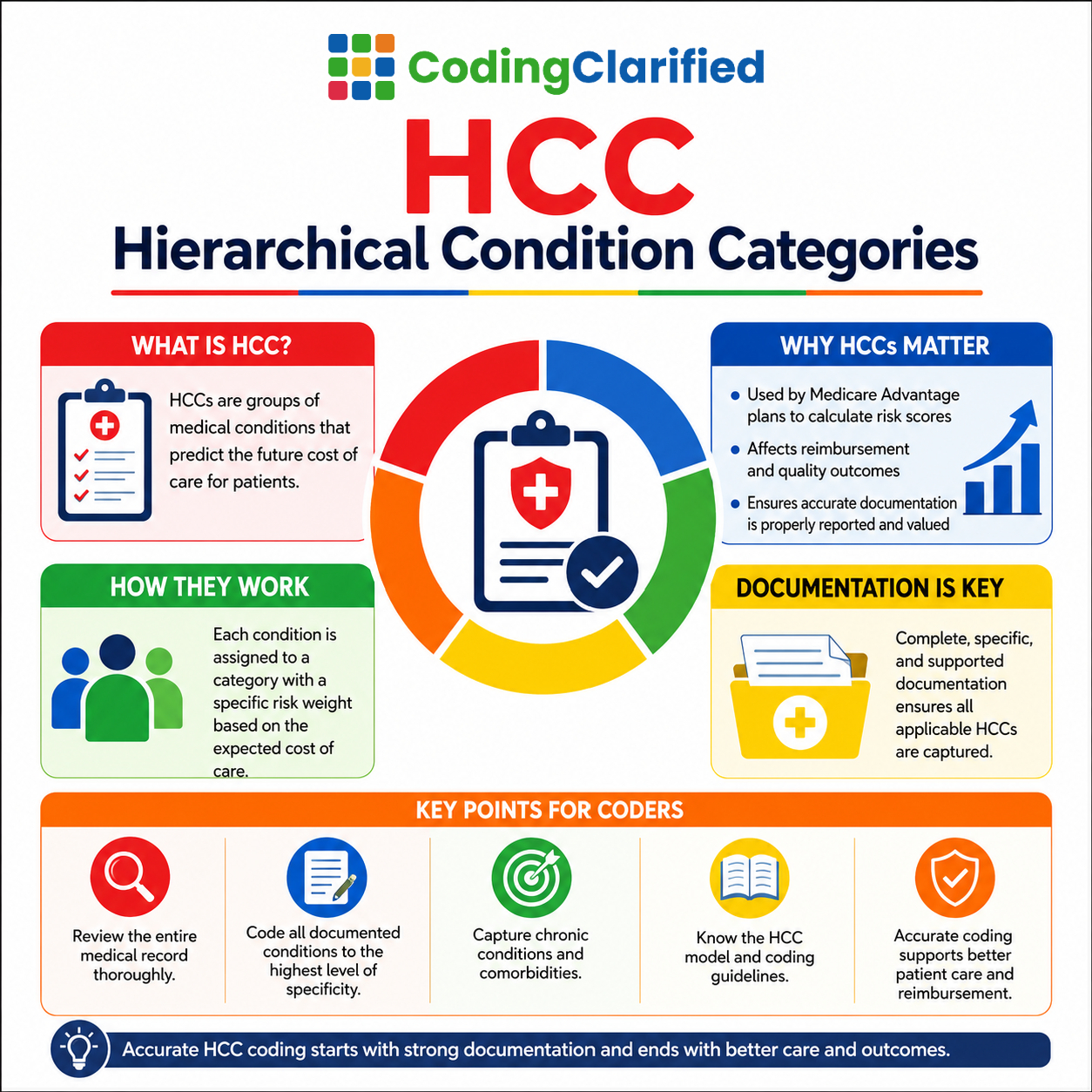
Hierarchical Condition Category (HCC) coding is a risk-adjustment model developed by the Centers for Medicare & Medicaid Services (CMS). Rather than paying health plans based only on the number of patients enrolled, CMS adjusts payments according to each patient’s expected healthcare costs.
Patients with multiple chronic illnesses generally require more healthcare resources than healthier individuals. Consequently, CMS uses HCC coding to estimate future medical costs fairly.
Instead of creating new diagnosis codes, HCC coding relies on existing ICD-10-CM diagnosis codes. Selected diagnosis codes map to specific HCC categories, each carrying a relative risk value.
Why HCC Coding Matters in 2026
Value-based care continues to expand across the healthcare industry. Therefore, HCC coding has become one of the most important specialties within medical coding.
Accurate HCC coding helps:
- Reflect the patient’s overall health status
- Support proper Medicare Advantage reimbursement
- Improve quality reporting
- Assist care management programs
- Identify high-risk patients earlier
- Reduce compliance concerns
Healthcare organizations increasingly perform HCC audits throughout the year. As a result, coders who understand risk adjustment remain highly valuable in today’s job market.
How HCC Coding Works
The HCC process begins with provider documentation.
First, the provider documents every condition that affects patient care during the encounter.
Next, the medical coder assigns the appropriate ICD-10-CM diagnosis codes.
Then, CMS maps eligible diagnosis codes into HCC categories.
Finally, the patient’s Risk Adjustment Factor (RAF) score is calculated using numerous factors, including:
- Age
- Gender
- Medicaid eligibility
- Disability status
- HCC diagnoses
- Disease interactions
Higher RAF scores generally indicate patients with greater expected healthcare needs.
HCC Coding Is Based on Documentation
Documentation remains the foundation of HCC coding.
Even if a patient has a long history of diabetes or heart failure, coders cannot report those diagnoses unless the provider documents and addresses them during the current calendar year.
Providers should demonstrate that each chronic condition received attention during the encounter.
Many organizations teach the MEAT documentation concept:
- Monitor
- Evaluate
- Assess/Address
- Treat
When documentation supports one or more of these activities, the diagnosis is generally appropriate for HCC reporting.
Common Chronic Conditions That Frequently Map to HCC Categories
Numerous chronic diseases qualify for HCC reporting when documented appropriately.
Common examples include:
- Diabetes with complications
- Congestive heart failure
- Chronic kidney disease
- Chronic obstructive pulmonary disease (COPD)
- Major depressive disorder
- Vascular disease
- Morbid obesity
- Pressure ulcers
- Protein-calorie malnutrition
- Amputation status
- Organ transplant status
Remember that not every ICD-10-CM diagnosis code maps to an HCC. Consequently, coders should verify mapping using current CMS resources.
Annual Recapture Is Essential
One of the biggest differences between HCC coding and traditional diagnosis coding involves annual recapture.
Many chronic conditions must be documented again each calendar year.
For example, if a patient has documented diabetes in 2025 but no provider documents or evaluates it during 2026, that diagnosis generally will not contribute to the patient’s 2026 risk score.
Therefore, providers should review chronic conditions during annual wellness visits and routine follow-up appointments.
Disease Hierarchies Prevent Duplicate Risk
The word “hierarchical” has an important meaning.
When multiple related conditions exist, CMS generally counts only the highest severity diagnosis within that disease family.
For example, severe diabetic complications may replace less severe diabetic manifestations rather than adding both values together.
Likewise, advanced heart failure categories may override less severe categories.
This hierarchy prevents duplicate payment for similar conditions while still recognizing disease severity.
HCC Coding vs Traditional Medical Coding
Although both specialties use ICD-10-CM diagnosis codes, their purposes differ significantly.
| Traditional Coding | HCC Coding |
|---|---|
| Supports today’s claim | Predicts future healthcare costs |
| Focuses on current encounter | Focuses on chronic disease burden |
| Payment tied to services | Payment adjusted for patient complexity |
| May not require yearly recapture | Requires annual documentation of chronic diseases |
Understanding both approaches makes coders more versatile in today’s healthcare environment.
Common Documentation Requirements
Coders should look for documentation that includes:
- Specific diagnosis
- Laterality when applicable
- Disease severity
- Associated complications
- Current treatment
- Medication management
- Provider assessment
- Follow-up plans
Specific documentation produces more accurate coding than vague statements.
Common Mistakes to Avoid
Even experienced coders make HCC coding mistakes. Fortunately, most are preventable.
Common errors include:
- Coding conditions that were not addressed during the encounter.
- Reporting diagnoses based only on medication lists.
- Assuming every chronic disease maps to an HCC category.
- Missing documentation that supports disease severity.
- Forgetting annual recapture requirements.
- Using unspecified diagnosis codes when documentation supports greater specificity.
- Assigning diagnoses without provider documentation.
Reviewing the entire medical record carefully helps reduce these errors.
CPC Student Tips
Students often find HCC coding intimidating at first. However, consistent practice builds confidence quickly.
Keep these tips in mind:
- Master ICD-10-CM coding before learning HCC mapping.
- Read provider documentation before looking at diagnosis codes.
- Learn the MEAT documentation concept thoroughly.
- Practice reviewing complete charts instead of isolated diagnoses.
- Stay current with annual CMS risk adjustment updates.
- Review official coding guidelines regularly.
- Perform practice chart audits whenever possible.
Risk adjustment is becoming one of the fastest-growing specialties for certified medical coders.
Career Opportunities in HCC Coding
Healthcare organizations increasingly seek coders with HCC experience.
Potential positions include:
- Risk Adjustment Coder
- Medicare Advantage Coder
- HCC Auditor
- Clinical Documentation Improvement (CDI) Specialist
- Quality Improvement Analyst
- Risk Adjustment Educator
These positions often combine coding knowledge with documentation review and compliance expertise.
Helpful Resources for Learning HCC Coding
If you want to strengthen your coding skills, these Coding Clarified articles may also help:
- Coding Clarified HCC Internship
- Medical Coding Apprenticeship FAQ
- What Is HCC in Medical Coding
- Future of HCC Medical Coding: How AI is Shaping the Industry
- Medical Coding: Outlook for 2026 and Beyond
- Medical Coding M.E.A.T.
- About Coding Clarified
These resources build foundational knowledge that supports successful HCC coding careers.
Authoritative Resources
For the most current guidance, review these trusted organizations:
- CMS Risk Adjustment
- National Correct Coding Initiative (NCCI)
- ICD-10-CM Official Guidelines for Coding and Reporting
- Medicare Learning Network
Always use the latest CMS publications and annual coding updates when assigning HCC-related diagnoses.
Frequently Asked Questions About HCC Coding
Here are quick answers to the questions medical coders ask most often about HCC coding.
What is HCC coding?
HCC coding is a CMS risk-adjustment system that uses selected ICD-10-CM diagnosis codes to estimate future healthcare costs for Medicare Advantage and other value-based programs.
Does every ICD-10-CM diagnosis code map to an HCC?
No. Only specific diagnosis codes map to HCC categories. Many diagnosis codes do not affect a patient’s risk score.
Do chronic conditions need to be coded every year?
Yes. In most cases, providers must document and address chronic conditions during each calendar year for them to contribute to the current year’s risk adjustment.
Can coders assign HCC diagnoses from the medication list?
No. Medication lists alone do not support diagnosis coding. The provider must document and assess the condition during the encounter.
What does MEAT stand for?
MEAT stands for Monitor, Evaluate, Assess/Address, and Treat. It helps demonstrate that a chronic condition received appropriate attention during the encounter.
Is HCC coding only used for Medicare?
Although CMS developed HCC coding for Medicare Advantage, many commercial value-based contracts now use similar risk-adjustment models.
Is HCC coding a good career choice?
Yes. As value-based healthcare expands, experienced HCC coders remain in high demand across physician groups, hospitals, accountable care organizations, and insurance companies.
Coding Clarified Final Thoughts
HCC coding has become one of the most valuable specialties in medical coding. As value-based reimbursement continues to expand throughout 2026, healthcare organizations need coders who understand documentation, risk adjustment, compliance, and chronic disease reporting.
Learning HCC coding requires more than memorizing diagnosis codes. Successful coders analyze provider documentation, understand CMS guidelines, and recognize how chronic conditions influence patient risk scores. Developing these skills can open the door to rewarding career opportunities while improving the accuracy of healthcare data and patient care.