If you are wondering how to become a medical coder in 2026, you may be overwhelmed by conflicting advice about training, certification, experience, and finding your first job. Fortunately, the process becomes much easier when you understand the steps before you begin.
Medical coding requires much more than looking up numbers in a code book. Instead, professional coders review medical documentation and apply coding guidelines to translate diagnoses, procedures, services, and supplies into standardized codes. Therefore, successful coders need strong training, attention to detail, medical knowledge, and the ability to research coding rules.
In 2026, employers also expect new coders to understand current ICD-10-CM, CPT®, and HCPCS Level II coding. Additionally, certification alone may not immediately lead to a remote coding job. Building practical experience and becoming job-ready should be part of your career plan from the beginning.
This guide explains how to become a certified medical coder, prepare for the CPC exam, gain coding experience, and find your first medical coding job in 2026.
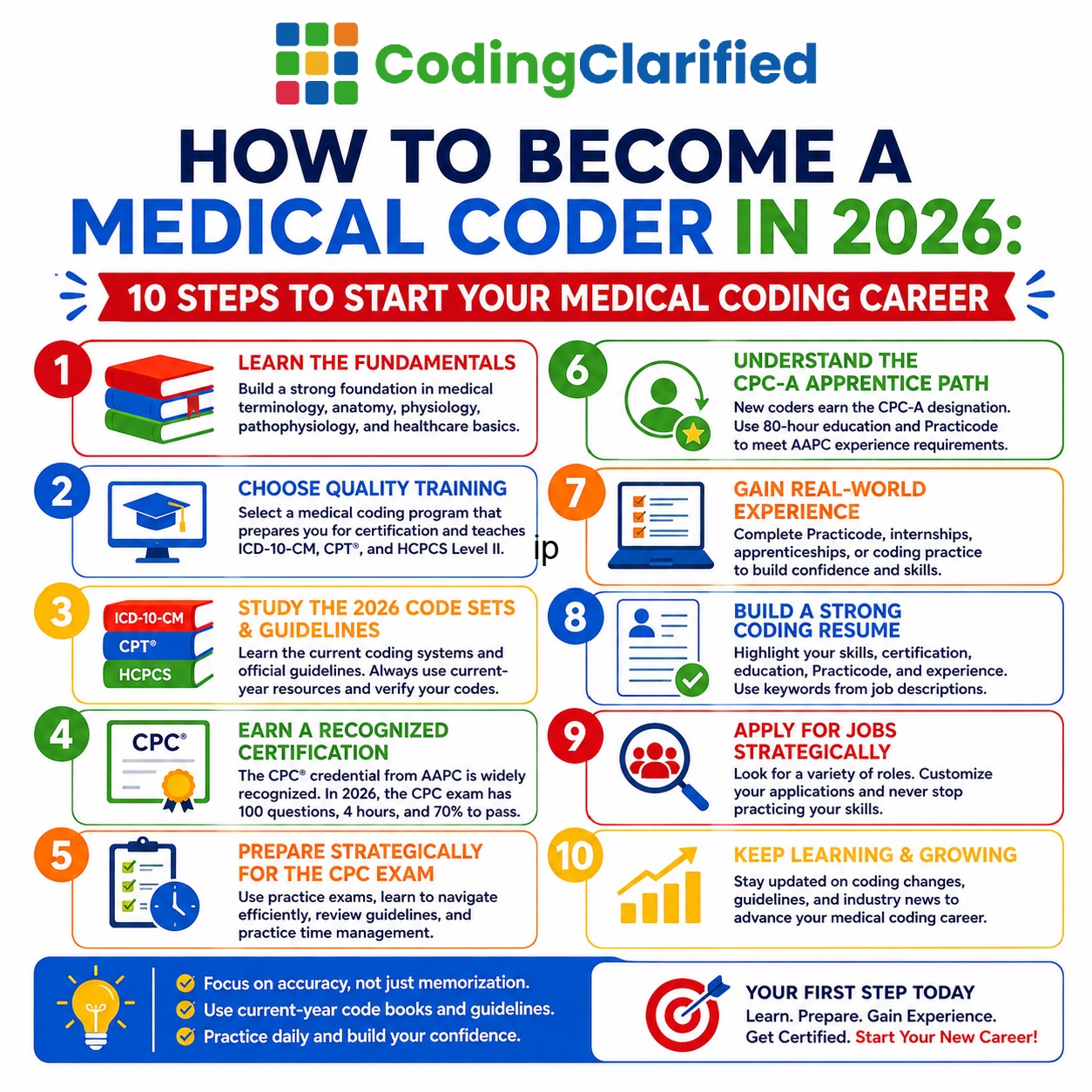
Key Takeaways: How to Become a Medical Coder
- Medical coders need a strong foundation in anatomy, medical terminology, pathophysiology, and coding guidelines.
- A recognized certification, such as the CPC®, can help demonstrate your professional coding knowledge.
- The 2026 AAPC CPC exam contains 100 multiple-choice questions, allows four hours, and requires a score of at least 70% to pass.
- New CPC graduates generally receive the CPC-A apprentice designation until AAPC’s experience requirements have been satisfied.
- An 80-hour qualifying coding course and AAPC Practicode can help satisfy CPC-A experience requirements under current AAPC rules.
- Hands-on coding practice, internships, apprenticeships, and Practicode can help bridge the experience gap.
- A targeted, ATS-friendly resume can improve your chances of getting interviews.
- Remote medical coding is possible; however, new coders should consider onsite, hybrid, and related healthcare positions as well.
- Current-year code books and official coding guidelines matter because coding rules change regularly.
- Your goal should not simply be to pass the CPC exam. Instead, focus on becoming an accurate, confident, employable medical coder.
1. Understand What a Medical Coder Actually Does
Before paying for medical coding training, first make sure you understand the job.
Medical coders review documentation from physicians and other qualified healthcare professionals. Then, they determine which diagnosis and procedure codes accurately represent the documented services.
Depending on the setting, coders may work with:
- ICD-10-CM diagnosis codes
- CPT® procedure and service codes
- HCPCS Level II codes
- Modifiers
- Evaluation and management services
- Surgical procedures
- Payer policies
- National Correct Coding Initiative edits
- Medical necessity requirements
- Compliance rules
Accuracy matters because coding affects reimbursement, claims, healthcare data, compliance, quality reporting, and medical records.
Furthermore, medical coding requires research. Professional coders do not simply memorize thousands of codes. Instead, they learn how to locate information, verify codes, interpret documentation, and apply official guidelines correctly.
2. Build Your Medical Knowledge First
One of the biggest mistakes new students make is jumping directly into CPT® or ICD-10-CM without understanding medical language.
Instead, build a strong foundation in:
- Medical terminology
- Anatomy and physiology
- Pathophysiology
- Pharmacology basics
- Surgical terminology
- Diagnostic tests
- Common diseases and conditions
For example, a coder reviewing an operative report needs to understand the anatomy and procedure before choosing a code. Likewise, diagnosis coding becomes easier when you understand the condition documented by the provider.
AAPC identifies anatomy, medical terminology, and pathophysiology as important foundational knowledge for CPC preparation.
Therefore, do not treat these subjects as unnecessary prerequisites. They form the language you will use throughout your medical coding career.
3. Choose the Right Medical Coding Training Program
Next, choose your training carefully.
In 2026, there are many online medical coding programs. However, price and convenience should not be the only factors in your decision.
Look for training that prepares you for a recognized certification and teaches current coding rules. Additionally, determine how much instructor support, exam preparation, hands-on practice, and career assistance you will receive.
Ask these questions before enrolling:
- Does the program prepare me for the CPC or another recognized credential?
- Does it use current-year coding resources?
- Are anatomy, medical terminology, and pathophysiology included or required?
- Will I learn ICD-10-CM, CPT®, and HCPCS Level II?
- Does the program include CPC exam preparation?
- Are practice exams included?
- Can I receive help when I do not understand a coding concept?
- Does the program provide hands-on coding practice?
- Is career or resume support available?
- Are internship, Practicode, or apprenticeship opportunities available after certification?
Most importantly, find out what happens after you finish the coursework. Passing a course is only one step toward becoming employable.
For a deeper comparison, read Online Medical Coding Training in 2026: Advantages, Disadvantages, CPC Certification, and How to Choose the Right Program.
4. Learn the Current 2026 Code Sets and Guidelines
Medical coding changes constantly. Consequently, students should learn to work with current coding resources rather than outdated books and rules.
In 2026, coders should become comfortable navigating:
- ICD-10-CM
- CPT®
- HCPCS Level II
- ICD-10-CM Official Guidelines for Coding and Reporting
- CMS National Correct Coding Initiative resources
- Payer policies
- Medicare guidance when applicable
CMS and the National Center for Health Statistics publish the official ICD-10-CM coding guidelines. Therefore, students should become comfortable using authoritative resources rather than depending entirely on search engines, social media posts, or AI-generated answers.
Additionally, remember an important rule: never code from memory alone when verification is required.
Recognizing a familiar code may speed up your research. However, you still need to review applicable instructions, guidelines, notes, exclusions, modifiers, and documentation requirements.
5. Earn a Recognized Medical Coding Certification
Certification can make an important difference when applying for coding positions.
One common credential for physician and outpatient professional coding is the Certified Professional Coder (CPC®) credential from AAPC.
The CPC exam tests knowledge of CPT®, ICD-10-CM, HCPCS Level II, modifiers, coding guidelines, anatomy, medical terminology, compliance, and other professional coding concepts.
As of 2026, AAPC states that the CPC examination contains 100 multiple-choice questions. Candidates have four hours to complete the exam and need at least 70% to pass.
Current AAPC membership is also required before scheduling an AAPC certification examination.
Certification options can vary depending on the career path you want to pursue. For example, AHIMA also offers coding credentials, including the CCA® and CCS®.
Therefore, research the jobs you eventually want before choosing a credential.
6. Prepare Strategically for the CPC Exam
Do not wait until the week before your exam to figure out how you will manage your time.
Instead, begin practicing code-book or approved-resource navigation while completing your training.
AAPC’s CPC exam covers many subjects. Therefore, students need both coding knowledge and an effective testing strategy.
Practice:
- Reading questions carefully
- Identifying the main procedure or diagnosis
- Eliminating clearly incorrect answers
- Locating codes efficiently
- Applying guidelines
- Recognizing modifier rules
- Flagging difficult questions
- Returning to challenging questions later
- Working under a time limit
Additionally, use practice exams to identify weaknesses rather than simply chasing a passing score.
If you repeatedly miss surgery questions, study surgery. If modifiers cause problems, review modifiers. Likewise, if you understand the rules but cannot finish on time, focus on navigation and pacing.
Read AAPC CPC Practice Exams in 2026: How to Use Practice Tests to Pass the CPC Exam for a more detailed exam-preparation strategy.
CPC Student Tip
Do not try to memorize the entire CPT®, ICD-10-CM, or HCPCS Level II code set.
Instead, learn how the coding systems are organized and how to find the correct answer efficiently. Strong navigation skills will help you on the CPC exam and throughout your coding career.
7. Understand the CPC-A Apprentice Designation
Many new coders become discouraged when they pass the CPC exam and discover the CPC-A designation.
However, understanding the process before testing can help you plan ahead.
Under current AAPC requirements, a newly certified coder generally receives the CPC-A designation until the applicable experience requirement has been satisfied.
AAPC currently provides several ways to meet those requirements. For example, qualifying coding education of at least 80 contact hours can count toward one year of the experience requirement. Additionally, completion of AAPC Practicode can count toward another year.
As a result, students who complete qualifying education and Practicode may have a pathway toward removing the apprentice designation without waiting for two full years of employment.
Always verify current CPC-A removal requirements directly with AAPC because policies can change.
For more practical guidance, read AAPC Practicode in 2026: How to Pass Cases, Improve Your Coding Skills, and Complete Practicode Faster.
8. Gain Real-World Medical Coding Experience
Here is where many new coders get stuck.
Employers frequently want experience, while new coders need an employer to gain experience.
Therefore, start building practical experience before you send hundreds of job applications.
Possible options include:
- AAPC Practicode
- Medical coding internships
- Registered apprenticeships
- Coding exercises
- Case-based practice
- Healthcare positions that provide exposure to coding and documentation
Hands-on practice teaches skills that multiple-choice questions cannot fully measure. For instance, you learn to work through incomplete documentation, distinguish relevant from irrelevant information, research unfamiliar situations, and defend your coding decisions.
Coding Clarified students can also explore our Medical Coding Internship in 2026: How to Gain Real-World Coding Experience Through Coding Clarified guide.
Experience does not replace certification. However, certification plus practical coding experience can create a much stronger entry-level candidate.
9. Build a Medical Coding Resume for 2026
A generic resume may not perform well in today’s hiring environment.
Instead, create a resume specifically for medical coding positions.
Include relevant information such as:
- CPC®, CPC-A®, or other active credentials
- Medical coding education
- ICD-10-CM experience
- CPT® experience
- HCPCS Level II experience
- Practicode
- Internships or apprenticeships
- EHR or healthcare software knowledge
- Medical terminology
- Anatomy and physiology
- Risk adjustment or HCC experience, when applicable
- Coding specialties you have practiced
- Relevant healthcare experience
Additionally, use keywords from the job description naturally in your resume when they accurately describe your qualifications.
Many employers use applicant tracking systems, or ATS, to help organize applications. Therefore, complicated graphics, unrelated information, and vague descriptions can work against you.
Do not hide your CPC-A designation, either. Instead, show employers what you are doing to build experience and improve your skills.
For more help, read What Medical Coding Recruiters Are Looking for on a Resume in 2026.
10. Apply for Medical Coding Jobs Strategically
Your first medical coding job may not have the exact title or work arrangement you imagined.
For example, many new coders want a fully remote position immediately after certification. Remote coding opportunities certainly exist; however, those jobs can attract experienced candidates from across the country.
Therefore, broaden your first job search.
Consider:
- Medical coder
- Coding specialist
- Physician coding
- Outpatient coding
- Risk adjustment coding
- HCC coding
- Medical records
- Health information positions
- Coding-related insurance positions
- Revenue-cycle roles with coding exposure
- Onsite or hybrid coding positions
- Apprenticeship opportunities
Furthermore, customize your application for each position instead of sending the same resume everywhere.
Track the jobs you apply for, follow instructions carefully, and prepare for coding assessments. Most importantly, continue practicing while searching for work.
Your certification proves that you met a professional testing standard. Your interview, resume, assessment, and experience must then show the employer that you can apply that knowledge.
What Is a Certified Medical Coder?
A certified medical coder reviews clinical documentation and translates healthcare information into standardized medical codes. Those codes help healthcare organizations report services, submit claims, track diagnoses, support reimbursement, and maintain accurate patient records.
You may also find our article on what AAPC stands for in medical coding helpful.
For example, physician and outpatient coders commonly work with three major code sets:
- CPT for physician services and procedures
- ICD-10-CM for diagnoses and conditions
- HCPCS Level II for certain supplies, medications, equipment, and services
A coder may review an office visit, operative report, emergency department encounter, pathology report, or other medical record. Then, the coder identifies the services and diagnoses supported by the provider’s documentation.
Accuracy matters because medical coding directly affects reimbursement, compliance, quality reporting, and healthcare data.
How Long Does It Take to Become a Medical Coder?
The short answer: most students are ready for the CPC exam in about four to six months, and can remove the apprentice designation within a few months after that with Practicode. Here is a realistic timeline with an instructor-guided program like ours.
| Stage | Typical time |
|---|---|
| Training (Coding Clarified course outline) | 16 weeks at 12 to 15 study hours per week |
| Exam scheduling and final prep | A few weeks after you finish the course |
| Practicode to remove the A (with your 80 hour course) | About 2 to 3 months part time |
| Real work experience through the HCC internship or apprenticeship | Varies by program |
| Total to certified and job ready | About 6 to 12 months for most students |
Without Practicode, removing the A takes up to two years of verified work experience. See how to remove the CPC-A and our 16 week CPC study schedule.
What Speeds It Up
- A steady weekly study schedule
- Prior healthcare experience or medical terminology
- Instructor feedback instead of self study alone
- Starting Practicode right after the exam
What Slows It Down
- Long breaks between study sessions
- Skipping timed practice exams
- Waiting to look for experience until after removing the A
- Memorizing codes instead of learning the guidelines
Be cautious of programs promising a highly paid remote coding job after a few weeks of training. Medical coding is a skilled profession, and building strong skills takes time.
Can You Get Help Paying for Medical Coding Training?
Yes, some students may qualify for career-training assistance.
Depending on eligibility and location, options may include workforce development programs, grants, scholarships, military-spouse education benefits, and other career-training assistance.
Workforce Innovation and Opportunity Act programs, for example, may provide training assistance to eligible individuals through state and local workforce agencies.
Funding availability varies. Therefore, investigate assistance before paying the entire tuition cost yourself.
Read Medical Coding Grants and Scholarships in 2026: How to Pay for Medical Coding Training for more information.
Common Mistakes to Avoid When Becoming a Medical Coder
Choosing a Program Based Only on Price
The least expensive program is not automatically the best value. Instead, compare certification preparation, instructor support, coding resources, exam preparation, hands-on experience, and career support.
Thinking Certification Guarantees a Job
Certification can strengthen your qualifications, but it does not guarantee employment. Therefore, combine your credential with practical experience, a strong resume, networking, and a focused job-search strategy.
Expecting Your First Job to Be Remote
Remote medical coding jobs exist, but competition can be strong. Consequently, refusing onsite or hybrid opportunities may unnecessarily limit your first-job options.
Memorizing Codes Instead of Learning Guidelines
Codes change, and thousands exist. Instead, understand coding conventions, guidelines, documentation requirements, and how to research the correct code.
Using Outdated Coding Resources
Annual updates matter. Therefore, verify information using current-year coding resources and authoritative guidance.
Applying for Hundreds of Jobs With the Same Resume
More applications do not automatically produce more interviews. Instead, target appropriate positions and adjust your resume to highlight the qualifications each employer requests.
Stopping Your Education After Passing the CPC Exam
Passing the exam begins your professional development; it does not end it. Coding rules, payer policies, technology, and regulations continue to change.
CPC Student Tips for Success in 2026
Treat every coding question as a small investigation. First, determine what the documentation actually says. Next, identify the main term or procedure. Then, locate the possible code and verify it against all applicable instructions.
Additionally, keep track of topics you repeatedly miss. A simple error log can reveal patterns involving modifiers, E/M coding, surgery, anatomy, ICD-10-CM guidelines, or HCPCS Level II.
Practice under timed conditions as your exam approaches. However, do not sacrifice accuracy simply to become faster.
Finally, learn to use authoritative sources. A professional coder should know where to verify a rule instead of depending on someone else’s answer.
Authoritative Medical Coding Resources for 2026
Students and professional coders should bookmark reliable industry resources. Learn more about Coding Clarified and our medical coding training program.
Use AAPC website for current CPC certification requirements, exam information, credential maintenance, and professional coding education.
Refer to the Centers for Medicare & Medicaid Services (CMS) for Medicare coding resources, National Correct Coding Initiative information, ICD-10 resources, and other federal coding guidance.
Additionally, AHIMA website provides information about health information management and credentials such as CCA®, CCS®, RHIT®, and RHIA®.
For ICD-10-CM diagnosis coding, always review the applicable ICD-10-CM Official Guidelines for Coding and Reporting along with the current code set.
Final Thoughts: How to Become a Medical Coder in 2026
Becoming a medical coder requires more than completing a course and passing an exam.
First, develop a strong foundation in medical terminology, anatomy, pathophysiology, and coding guidelines. Next, choose quality training and prepare for a recognized certification such as the CPC.
After certification, continue building hands-on experience through Practicode, internships, apprenticeships, or other coding opportunities. Meanwhile, develop a targeted resume and apply strategically for positions that match your current experience.
Most importantly, think beyond your first job.
Medical coding can lead to opportunities in physician coding, outpatient coding, inpatient coding, risk adjustment, auditing, compliance, education, consulting, management, and other healthcare areas. Your first coding credential can become the beginning of a much larger career.
Frequently Asked Questions About Becoming a Medical Coder in 2026
Quick answers to the questions students ask most about becoming a medical coder.
How do I become a medical coder in 2026?
Start by learning medical terminology, anatomy, pathophysiology, and basic healthcare concepts. Next, complete quality medical coding training in ICD-10-CM, CPT®, and HCPCS Level II. Then, prepare for a recognized certification such as the CPC. After certification, gain practical coding experience and begin applying for entry-level coding positions.
Do I need a college degree to become a medical coder?
Not necessarily. Many medical coding career paths focus on coding education and professional certification rather than requiring a four-year degree. However, individual employers may set their own education requirements. Therefore, review actual job postings in the area of coding you want to pursue.
What certification is best for a new medical coder?
The best credential depends on the setting in which you want to work. The AAPC CPC is widely used for professional coding, while AHIMA offers credentials including the CCA and CCS. Research your target jobs first, and then choose the certification that best matches that career path.
How hard is the CPC exam in 2026?
The CPC exam can be challenging because it tests coding knowledge, medical terminology, anatomy, guidelines, compliance, and your ability to apply information under a time limit. AAPC currently gives candidates four hours to answer 100 multiple-choice questions, and at least 70% is required to pass. Strong preparation and timed practice can make the exam much more manageable.
Can I become a medical coder with no healthcare experience?
Yes. Previous healthcare experience can help, but it is not required for everyone entering medical coding. However, students without a healthcare background should spend extra time learning medical terminology, anatomy, pathophysiology, and documentation before moving into advanced coding.
Can I work from home as a medical coder?
Yes, many medical coding positions are remote. However, entry-level remote jobs can be competitive because employers may prefer coders with proven production experience. Therefore, new coders should consider remote, hybrid, and onsite opportunities when trying to gain their first professional experience.
How can a CPC-A get medical coding experience?
CPC-A coders can build experience through options such as Practicode, internships, apprenticeships, entry-level healthcare roles, and hands-on coding practice. Additionally, AAPC currently allows certain education and Practicode experience to count toward its CPC-A removal requirements. Always verify the latest requirements directly with AAPC.
Is medical coding still a good career in 2026?
Medical coding remains an important part of healthcare reimbursement, compliance, documentation, data, and quality reporting. However, the profession continues to change as technology and AI-assisted coding tools develop. Consequently, coders who understand guidelines, documentation, compliance, payer policies, and complex coding decisions can provide more value than someone who only knows how to look up codes.