CPT 92507 Deleted in 2027: 10 New Timed Speech-Language Pathology CPT Codes Explained
By Janine Mothershed CPC, CPC-I
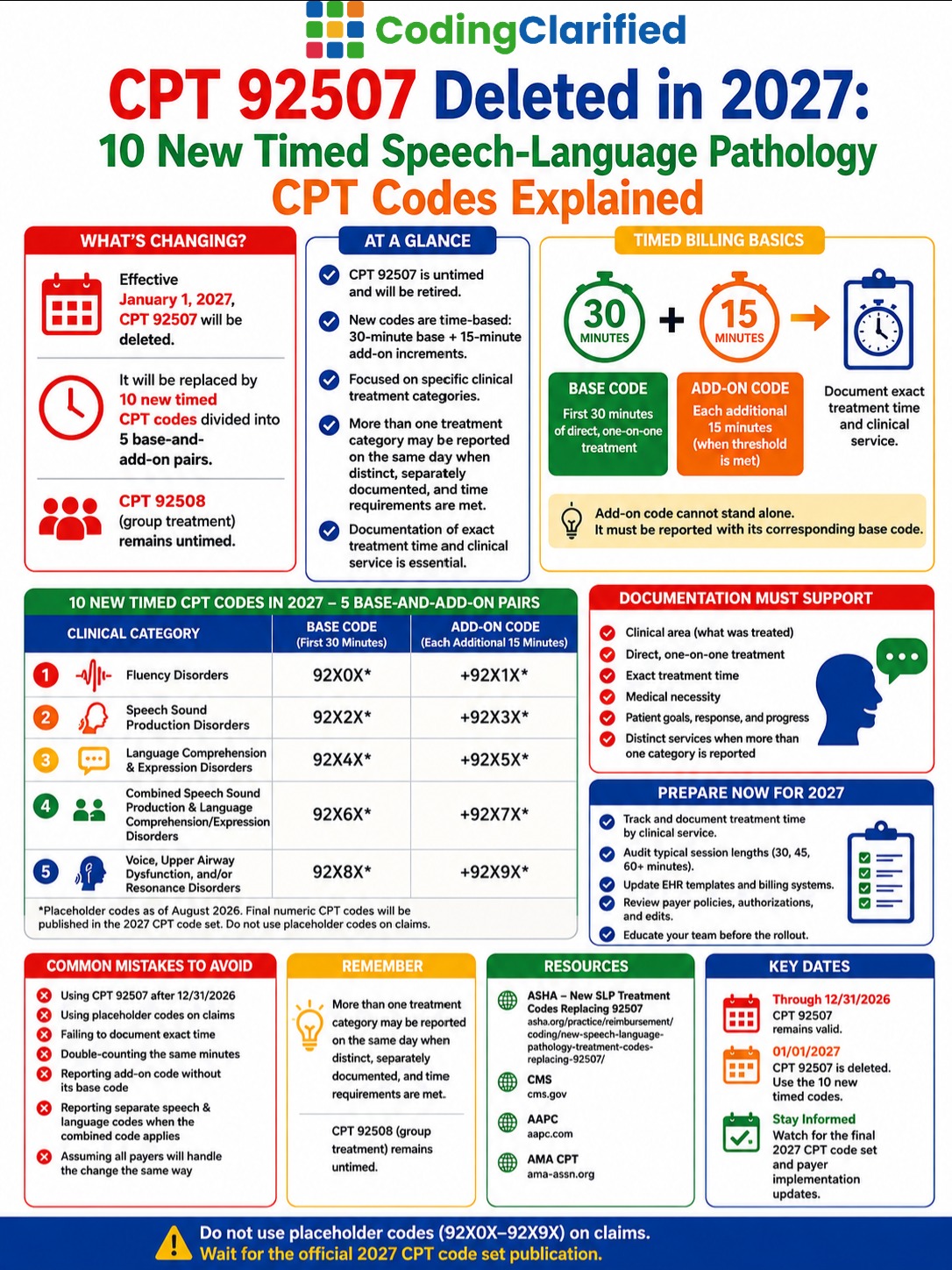
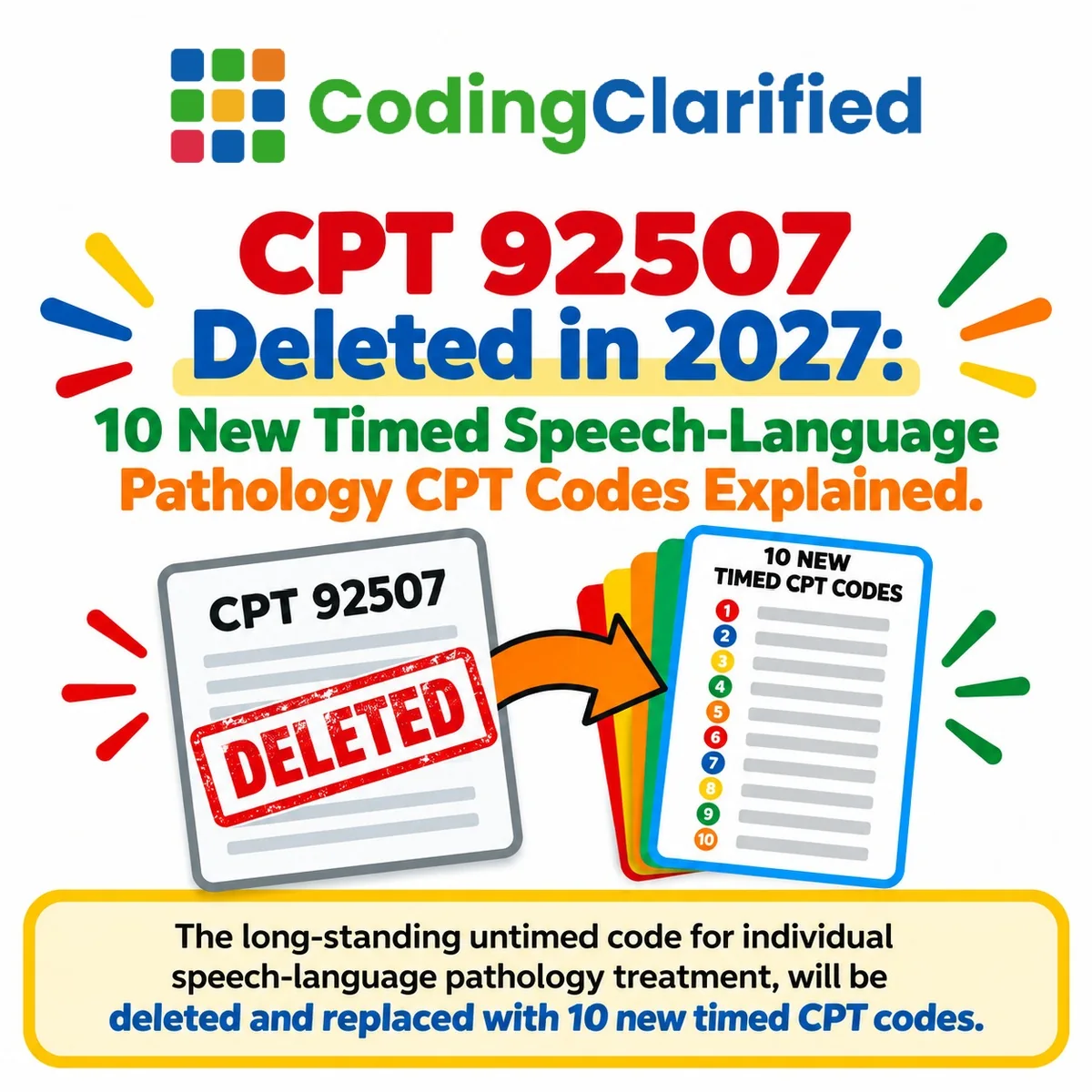
Effective January 1, 2027, one of the most familiar speech-language pathology CPT codes will undergo a major change. CPT 92507, the long-standing untimed code for individual speech-language pathology treatment, will be deleted and replaced with 10 new timed CPT codes.
Instead of reporting one broad code for many types of individual speech-language treatment, speech-language pathologists (SLPs), medical coders, and billers will need to identify the type of treatment performed and the amount of direct treatment time provided.
The 10 new codes are divided into five clinical categories, with each category containing a base code for the initial 30 minutes and an add-on code for each additional 15 minutes.
This is a major change for SLP coding, billing, documentation, EHR workflows, and payer authorization. Therefore, practices should start preparing during 2026, rather than waiting until January 2027.
2026 Update: As of August 2026, the final numeric CPT codes have not yet been published in the official 2027 CPT code set. The American Speech-Language-Hearing Association (ASHA) currently identifies the codes with placeholders 92X0X–92X9X. The final numeric codes are expected with publication of the 2027 CPT code set. Do not use the placeholder codes on claims.
Key Takeaways: CPT 92507 Changes for 2027
- CPT 92507 remains valid through December 31, 2026.
- Effective January 1, 2027, 92507 will be deleted.
- Ten new timed CPT codes will replace the single untimed individual-treatment code.
- The new codes contain five base-and-add-on code pairs.
- Each base code describes the initial 30 minutes of direct, one-on-one treatment.
- Each related add-on code describes each additional 15 minutes.
- The five categories are fluency; speech sound production; language comprehension and expression; combined speech sound and language; and voice, upper airway dysfunction, and/or resonance.
- CPT 92508 will remain available for group treatment and will remain untimed.
- Documentation will need to clearly identify the clinical service and direct treatment time.
- Payer policies, edits, authorizations, and payment rates may differ, so practices should verify requirements before implementation.
Why Is CPT 92507 Being Deleted?
For more than 20 years, CPT 92507 has served as a broad individual treatment code for speech, language, voice, communication, and related disorders. However, speech-language pathology has changed significantly during that time.
In addition, the single untimed code does not clearly show whether an SLP treated a fluency disorder, speech sound disorder, language disorder, or voice condition. It also does not distinguish a relatively short encounter from a much longer treatment session.
In 2024, CMS and the AMA identified a significant increase in Medicare utilization of 92507, which triggered review through the AMA CPT and RUC processes. Consequently, the new structure was developed to better represent modern SLP services and the differences in treatment time and clinical focus.
The result is not simply a replacement code. Instead, 92507 is being divided into an entirely new family of more specific, time-based services.
For additional background, review the official ASHA guidance on the new speech-language pathology treatment codes.
What Is Replacing CPT 92507 in 2027?
The new family contains 10 CPT codes divided into five clinical categories. Each category has one base code and one add-on code.
As of August 2026, ASHA is using placeholder numbers until the AMA publishes the final 2027 CPT code set.
| Treatment Category | Base Code | Add-On Code |
|---|---|---|
| Fluency disorders | 92X0X placeholder | +92X1X placeholder |
| Speech sound production disorders | 92X2X placeholder | +92X3X placeholder |
| Language comprehension and expression disorders | 92X4X placeholder | +92X5X placeholder |
| Combined speech sound production and language disorders | 92X6X placeholder | +92X7X placeholder |
| Voice, upper airway dysfunction, and/or resonance disorders | 92X8X placeholder | +92X9X placeholder |
Important: These are placeholder numbers, not the final reportable CPT codes. Coders should replace them with the official numeric codes once the AMA publishes the 2027 CPT code set.
1. Fluency Disorder Treatment
The first code pair applies to treatment of fluency disorders, including conditions such as stuttering and cluttering.
The placeholder base code 92X0X represents the initial 30 minutes of direct, one-on-one treatment. Meanwhile, placeholder add-on code +92X1X represents each additional 15 minutes.
Documentation should clearly show that the treatment focused on a fluency disorder. Additionally, the record should support the direct treatment time used to determine the appropriate units.
2. Speech Sound Production Disorder Treatment
The second pair covers speech sound production disorders. These services may include treatment of articulation disorders, phonological processes, apraxia, and dysarthria.
The current placeholders are 92X2X for the initial 30 minutes and +92X3X for each additional 15 minutes.
However, coders must pay close attention when language treatment also occurs. If both speech sound production and language comprehension/expression disorders are treated during the session, the combined code family may apply instead.
Therefore, the treatment note must clearly describe what clinical areas the SLP addressed.
3. Language Comprehension and Expression Disorder Treatment
Another base-and-add-on pair covers language comprehension and expression disorders, including receptive and expressive language treatment.
These services may involve patients with aphasia, neurologic disease, traumatic brain injury, cerebrovascular accident, developmental language disorders, or other conditions affecting language.
The placeholders are 92X4X for the initial 30 minutes and +92X5X for each additional 15 minutes.
Again, the clinical focus matters. If treatment addresses both a speech sound production disorder and a language comprehension/expression disorder, the combined code family should be reviewed rather than separately reporting the speech and language code pairs.
4. Combined Speech Sound Production and Language Treatment
One of the most important additions for 2027 is a specific category for patients receiving both speech sound production and language comprehension/expression treatment.
The current placeholders are 92X6X for the initial 30 minutes and +92X7X for each additional 15 minutes.
For example, this category may apply when an SLP treats a child with both articulation and language disorders. Likewise, it may apply when treating an adult with dysarthria and aphasia when the requirements of the code descriptors are met.
This distinction should reduce the need to force combined treatment into a broad catch-all code. However, it also means coders must carefully review the treatment note before selecting a code.
5. Voice, Upper Airway Dysfunction, and/or Resonance Treatment
The fifth category covers voice, upper airway dysfunction, and/or resonance disorders.
Examples may include dysphonia, vocal fold paralysis, spasmodic dysphonia, vocal tremor, inducible laryngeal obstruction, and certain resonance disorders.
The current placeholders are 92X8X for the initial 30 minutes and +92X9X for each additional 15 minutes.
Because this category covers several related clinical areas, documentation should identify the condition being treated and what occurred during the direct treatment period.
How Will Timed Billing Work?
This is where the 2027 change becomes especially important for coders.
CPT 92507 is untimed. In contrast, its replacements will be time-based.
Each new base code represents the initial 30 minutes of direct, one-on-one patient contact. After the requirements for the base service are met, the corresponding add-on code may be used for additional 15-minute increments when the applicable CPT time threshold is met.
ASHA’s current guidance indicates the general CPT midpoint timing rules apply. For the 30-minute base codes, that means one base unit generally requires 16–37 minutes. Then, additional 15-minute units follow the applicable midpoint thresholds.
This makes accurate documentation much more important.
Coders who want additional background on time-based services can review our Time-Based Medical Coding Guidelines and Tips and Medicare 8-Minute Rule.
Example: A 30-Minute Session
Suppose an SLP provides 30 minutes of direct language comprehension and expression treatment.
The documentation supports the appropriate language base code. Therefore, one unit of the applicable initial 30-minute code may be reported when all other requirements are met.
Example: A Longer Treatment Session
Now suppose the same type of treatment continues long enough to satisfy an additional 15-minute increment.
The coder would report the applicable base code plus its corresponding add-on code, provided the documentation and time thresholds support both.
Importantly, an add-on code cannot stand alone. It must accompany its corresponding primary base code.
Can More Than One New Treatment Category Be Reported on the Same Day?
Potentially, yes.
ASHA states that more than one treatment code from the new family may be reported on the same date when the services are distinct, medically necessary, separately supported, and independently meet their time requirements.
However, the same minutes cannot be counted twice.
For example, an SLP might provide a distinct speech sound production service and a separate voice treatment service. In that situation, documentation would need to clearly identify each service, the goals addressed, and the time associated with each treatment.
There are also restrictions within the new family. In particular, separate speech sound and language codes should not be reported together when the combined speech-and-language code describes the service.
Always review the final 2027 CPT instructions, NCCI edits, payer rules, and medically unlikely edits before reporting multiple services.
What Happens to CPT 92508?
CPT 92508 is not being deleted as part of this change.
Instead, 92508 will continue as a stand-alone, untimed code for group treatment involving two or more individuals. Its descriptor and related instructions will be revised for 2027.
Therefore, coders should not assume that every speech-language pathology treatment code is moving to timed billing.
Individual treatment changes dramatically, while group treatment remains untimed.
Documentation Requirements Will Become More Important
Under the current 92507 structure, the exact treatment duration does not determine how many units of the code are reported. Beginning in 2027, however, time will directly affect code assignment for the replacement services.
Consequently, vague documentation such as “speech therapy performed today” will create problems.
A strong treatment note should support:
- The disorder or clinical area treated
- The specific goals addressed
- Direct one-on-one treatment
- Exact treatment time or other required time documentation
- Medical necessity
- Patient response and progress
- Separation of distinct services when multiple treatment categories are reported
Moreover, practices should review their templates before January 2027. Waiting until claims begin denying is a costly way to discover that documentation does not support the new code structure.
For a related example of how timed services affect coding, see our Medical Coding Physical Therapy Guide.
How SLP Practices Should Prepare During 2026
The months remaining in 2026 provide an important implementation window. First, practices should review typical session lengths and determine how often treatment currently lasts 30, 45, 60 minutes, or another duration.
Next, update documentation templates so clinicians can easily record direct treatment minutes by clinical service. Likewise, EHR and practice-management systems should be tested to ensure the new base and add-on codes are available for dates of service beginning January 1, 2027.
Billing teams should also review prior authorization workflows. An authorization written around 92507 may need to be updated or converted when the payer implements the new codes.
Finally, practices should contact Medicare Advantage plans, Medicaid programs, and commercial payers. The effective date of the CPT change is January 1, 2027, but payer coverage, payment, authorization, and claims-processing policies may differ.
For a broader look at annual code-set implementation, read our 2026 CPT Updates and AMA Mid-Year CPT Updates.
Medicare Payment Is Still Being Finalized
Another important 2026 freshness signal involves reimbursement.
CMS included the 10 new SLP treatment codes in the CY 2027 Medicare Physician Fee Schedule proposed rule. According to ASHA, CMS accepted the recommended clinician work RVUs and direct practice expense inputs for all 10 codes.
However, proposed payment information is not the same as final Medicare payment policy.
CMS is expected to finalize Medicare values through the 2027 MPFS final rule later in 2026. Additionally, commercial insurers and Medicaid programs may establish different payment and coverage policies.
Therefore, practices should avoid building their final 2027 financial forecasts solely around proposed Medicare figures.
Coders and billing professionals can monitor the Centers for Medicare & Medicaid Services, American Medical Association, AAPC, and American Speech-Language-Hearing Association for final implementation guidance.
Common Mistakes to Avoid
Continuing to Use CPT 92507 After December 31, 2026
Do not automatically carry 92507 into 2027 charge templates. Instead, remove or deactivate it for dates of service beginning January 1, 2027, once payer implementation has been confirmed.
Using the Placeholder Codes on Claims
The 92X0X–92X9X numbers currently published by ASHA are placeholders. Therefore, coders should wait for the official 2027 CPT code set before using final numeric codes.
Failing to Document Treatment Time
Time becomes essential under the new structure. Accordingly, SLPs should develop consistent methods for recording direct one-on-one treatment time.
Double-Counting Minutes
The same treatment minutes should not support multiple timed services. Instead, documentation must show the distinct time associated with each separately reported service.
Reporting an Add-On Code Alone
An add-on code must accompany its designated base code. Therefore, never treat the additional 15-minute code as an independent service.
Separately Reporting Speech and Language When the Combined Code Applies
The 2027 family specifically includes combined speech sound production and language treatment codes. Consequently, coders must check the new instructions rather than automatically reporting separate categories.
Assuming Every Payer Will Handle the Change the Same Way
CPT establishes the coding structure, but coverage and reimbursement policies can vary. Thus, verify each payer’s requirements before submitting claims.
CPC Student Tips: What Medical Coding Students Should Learn From This Change
For CPC students, the 92507 change offers a useful lesson about how CPT evolves.
First, remember that deleted does not always mean the service disappeared. Sometimes CPT deletes a broad code and replaces it with several more specific codes.
Second, pay attention to base codes and add-on codes. Add-on codes cannot normally be reported independently, so always locate the related primary service.
Third, read the complete CPT instructions and parenthetical notes. A coder who simply searches for “speech therapy” and selects the first matching code could miss the distinction between speech, language, combined treatment, fluency, and voice services.
Finally, watch effective dates carefully. 92507 remains correct through December 31, 2026, while the new family takes effect January 1, 2027. In real-world coding, using the right code for the wrong date of service is still incorrect coding.
What Medical Coders Should Do Before January 1, 2027
Create a crosswalk from 92507 to the five new treatment categories once the AMA releases the final numbers. Then, review EHR favorites, charge masters, claim edits, authorization systems, fee schedules, and documentation templates.
Additionally, educate SLPs before implementation. Coders cannot accurately select a timed code when the clinical note does not identify the treatment category or direct treatment minutes.
Finally, consider auditing several weeks of current 92507 encounters during late 2026. Identify what clinical categories were treated and how long typical sessions lasted. This practice audit can reveal documentation problems before the new codes become mandatory.
Final Thoughts
The deletion of CPT 92507 represents much more than a routine annual CPT update.
Beginning January 1, 2027, individual speech-language pathology treatment will move from one broad, untimed code to 10 timed codes covering five specific clinical treatment categories. As a result, code selection will depend more heavily on both what was treated and how long direct treatment was provided.
During 2026, SLP practices should focus on documentation, time tracking, payer communication, staff training, and software readiness. Meanwhile, medical coders should watch for publication of the official 2027 numeric CPT codes and final CMS payment policies.
Most importantly, do not use 92507 after its deletion date simply because it remains in an old EHR favorite list or billing template. Preparing early will help reduce denials, documentation problems, and revenue-cycle disruption when the new structure becomes effective.
Frequently Asked Questions About CPT 92507 Changes for 2027
Is CPT 92507 being deleted in 2027?
Yes. CPT 92507 remains active through December 31, 2026. However, effective January 1, 2027, it will be deleted and replaced by 10 new timed CPT codes for individual speech-language pathology treatment.
What codes will replace CPT 92507?
Ten codes divided into five base-and-add-on pairs will replace 92507. The five categories cover fluency; speech sound production; language comprehension and expression; combined speech sound and language; and voice, upper airway dysfunction, and/or resonance treatment. As of August 2026, the final numeric CPT codes have not yet been published.
Are the new speech therapy CPT codes timed?
Yes. Each clinical category will have a base code for the initial 30 minutes of direct one-on-one treatment and an add-on code for each additional 15 minutes. Therefore, accurate time documentation will become essential.
Can SLPs use the new codes before January 1, 2027?
No. Continue reporting 92507 when appropriate for dates of service through December 31, 2026. The replacement codes become effective January 1, 2027, subject to payer implementation requirements.
Is CPT 92508 also being deleted?
No. CPT 92508 will remain available for group treatment involving two or more individuals. Additionally, it will remain an untimed service, although its descriptor and instructions are being revised for 2027.
Can an SLP report more than one treatment category on the same day?
Yes, in certain circumstances. Each service must be distinct, medically necessary, properly documented, and independently meet its applicable time requirements. However, the same minutes cannot be counted toward more than one service, and specific code-family restrictions must also be followed.
Will Medicare reimburse the new codes?
CMS has proposed Medicare values for the new 2027 SLP treatment codes. However, the 2027 Medicare Physician Fee Schedule is still in the rulemaking process as of August 2026, so practices should review the final rule when published. Commercial insurance and Medicaid policies may also differ.
How should medical coders prepare for the 2027 CPT 92507 change?
Start during 2026. Review current 92507 encounters, train SLPs on time documentation, update EHR templates, create a crosswalk once final code numbers are available, verify payer policies, and audit early 2027 claims. Most importantly, make sure the documentation clearly identifies both the clinical treatment category and direct treatment time.