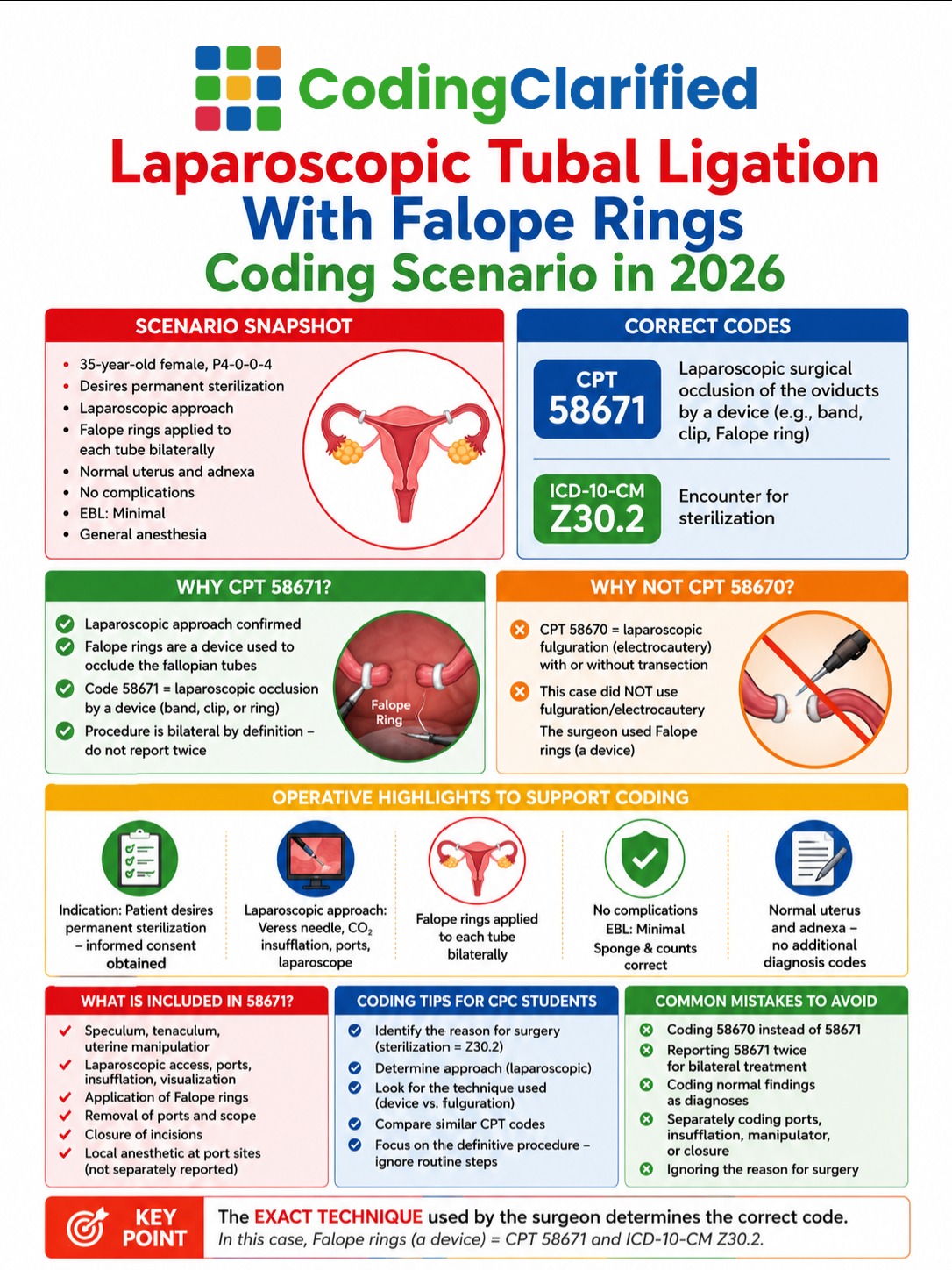
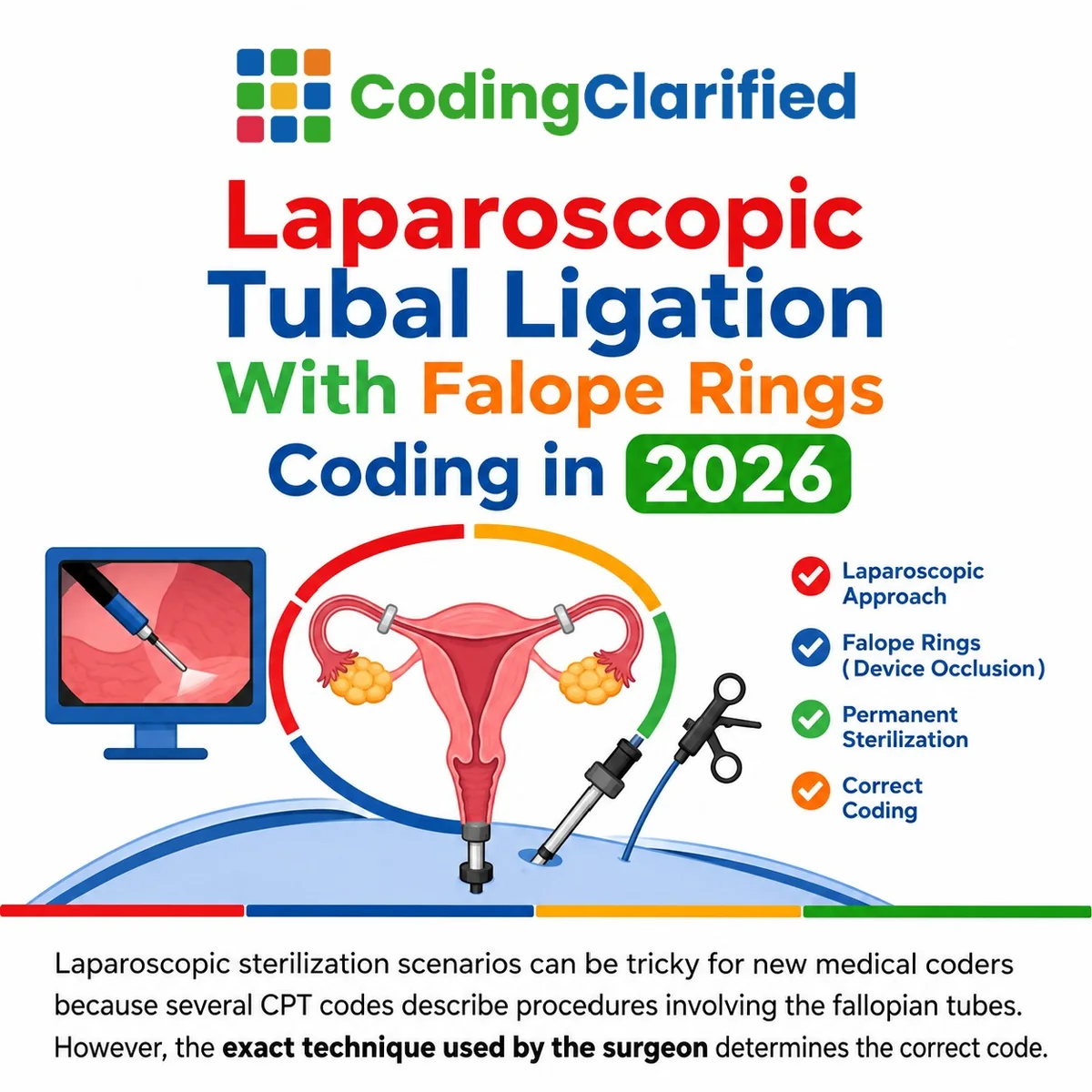
Laparoscopic Tubal Ligation With Falope Rings Coding Scenario in 2026
Laparoscopic sterilization scenarios can be tricky for new medical coders because several CPT codes describe procedures involving the fallopian tubes. However, the exact technique used by the surgeon determines the correct code.
In this 2026 coding scenario, a 35-year-old patient undergoes laparoscopic permanent sterilization with Falope rings. We will review the full operative report first and then walk through how a medical coder should identify the procedure, diagnosis, and correct CPT and ICD-10-CM codes.
Key Takeaways
- The surgeon performs laparoscopic bilateral tubal occlusion using Falope rings.
- The correct CPT code is 58671.
- The primary ICD-10-CM diagnosis is Z30.2, Encounter for sterilization.
- Falope rings are occlusion devices, which helps distinguish 58671 from 58670.
- CPT 58670 describes laparoscopic fulguration rather than device occlusion.
- Routine laparoscopic access, port placement, insufflation, uterine manipulation, and closure are not separately reported by the surgeon.
- For CPC exam questions, always identify the approach and technique before choosing the CPT code.
- For 2026 claims, verify the current CPT code set and payer-specific sterilization requirements.
Medical Coding Scenario
Patient: 35-year-old female, P4-0-0-4
Procedure: Laparoscopic permanent sterilization
Anesthesia: General
Complications: None
Indications for Surgery
The patient is a 35-year-old female, P4-0-0-4, who desires permanent sterilization. The surgeon explained the risks of bleeding, infection, damage to other organs, and subsequent ectopic pregnancy. The patient gave informed consent.
Operative Findings
Normal-appearing uterus and adnexa bilaterally.
Description of Procedure
After administration of general anesthesia, the team placed the patient in the dorsal lithotomy position and prepped and draped her in the usual sterile fashion. Next, the surgeon placed the speculum in the vagina, grasped the cervix with the tenaculum, and inserted a uterine manipulator. This area was then draped off from the remainder of the operative field.
Then the surgeon made a 5-mm umbilical incision after injecting 0.25% Marcaine, 2 mL. After that, the surgeon inserted a Veress needle to confirm an opening pressure of 2 mmHg. The surgeon then insufflated approximately 4 liters of CO2 gas into the abdominal cavity. Next, the surgeon removed the Veress needle and placed a 5-mm port. A laparoscope confirmed the position.
After injecting 2 mL of 0.25% Marcaine, the surgeon placed a second 7-mm port under direct visualization, three fingerbreadths suprapubically. Then the surgeon examined the pelvic cavity and noted the findings above.
The Falope rings were then applied to each tube bilaterally. The surgeon noted good ligated segments.
Finally, the surgeon removed the accessory port and deflated the abdomen. Next, the surgeon removed the laparoscope and sheath. Then the surgeon approximated the skin edges with 5-0 Monocryl suture in subcuticular fashion.
After closure, the surgeon removed the instruments from the vagina. The team returned the patient to the supine position, awakened her from anesthesia, and transferred her to the recovery room in satisfactory condition. Sponge and needle counts were correct at the conclusion of the case. Estimated blood loss was minimal.
What CPT and ICD-10-CM Codes Should Be Reported?
After reviewing the entire operative report, the key coding information is:
CPT: 58671 — Laparoscopic surgical occlusion of the oviducts by device.
ICD-10-CM: Z30.2 — Encounter for sterilization.
The most important sentence in the operative report is:
“The Falope rings were then applied to each tube bilaterally.”
That sentence tells the coder exactly how the surgeon performed the sterilization.
Step 1: Identify the Reason for the Procedure
Before searching for a CPT code, determine why the patient underwent surgery.
The indication states that the patient “desires permanent sterilization.” Therefore, this was an elective sterilization procedure rather than treatment of a disease involving the uterus, ovaries, or fallopian tubes.
The operative findings also document a normal-appearing uterus and adnexa bilaterally. Consequently, there is no abnormal operative finding that changes the primary reason for the encounter.
For ICD-10-CM, this leads us to:
Z30.2 — Encounter for sterilization
CMS also recognizes Z30.2 as the ICD-10-CM diagnosis for an encounter for sterilization.
Step 2: Identify the Surgical Approach
Next, determine how the surgeon accessed the surgical site.
Several phrases confirm a laparoscopic approach:
- A Veress needle was inserted.
- the surgeon used CO2 to insufflate the abdominal cavity.
- A 5-mm port was placed.
- A laparoscope was inserted.
- The surgeon placed a second suprapubic port under direct visualization.
Therefore, the coder should focus on CPT codes describing laparoscopic sterilization rather than an open procedure.
This is an important strategy for CPC students. First identify the approach, and then identify the exact technique.
Step 3: Determine How the Fallopian Tubes Were Occluded
Now we reach the most important coding clue.
The surgeon states:
“The Falope rings were then applied to each tube bilaterally.”
Falope rings are devices placed around portions of the fallopian tubes to create tubal occlusion. Therefore, this procedure involves occlusion by a device.
That documentation supports CPT 58671.
Why CPT 58671 Is Correct
CPT 58671 describes laparoscopic surgical occlusion of the oviducts using a device such as a band or clip.
In this case, the surgeon used Falope rings. Therefore, the operative technique matches 58671.
The procedure also treated both fallopian tubes. However, coders should not report 58671 twice simply because the surgeon applied a ring to each tube.
AAPC’s coding information for 58671 specifically describes laparoscopic closure of the fallopian tubes using a device.
Why CPT 58670 Is Not Correct
CPT 58670 and 58671 are easy to confuse, especially on the CPC exam.
CPT 58670 describes laparoscopic fulguration of the oviducts, with or without transection. In practical terms, the physician uses electrocautery to destroy or seal the tubes.
CPT 58671, however, describes laparoscopic occlusion by a device.
For this scenario:
Fulguration/electrocautery → 58670
Band, clip, or Falope ring → 58671
Because the surgeon placed Falope rings rather than using fulguration, 58671 is the correct answer.
ICD-10-CM Z30.2 Explained
The diagnosis coding is more straightforward.
The patient does not have a disease that requires surgical treatment. Instead, she elects to undergo permanent sterilization.
Therefore, assign:
Z30.2 — Encounter for sterilization
The patient’s obstetric history of P4-0-0-4 does not change the primary diagnosis. Likewise, the normal uterus and adnexa do not create additional diagnosis codes.
CMS provides current Medicare coding and billing resources that coders can use to verify diagnosis and coverage requirements.
Should You Code the Patient’s Normal Operative Findings?
No.
The surgeon documents:
“Normal appearing uterus and adnexa bilaterally.”
A normal finding is not a diagnosis. Therefore, coders should not search for additional ICD-10-CM codes for the uterus, ovaries, or fallopian tubes.
Instead, stay focused on the reason for the encounter: permanent sterilization.
Are the Laparoscopic Ports Separately Coded?
No. The surgeon documents multiple steps necessary to gain laparoscopic access, including the umbilical incision, Veress needle insertion, CO2 insufflation, port placement, and laparoscope insertion.
Although each step appears separately in the operative report, these services are integral to performing the laparoscopic procedure. Therefore, they are not separately reported in addition to 58671.
This illustrates an important coding principle: not every action documented in an operative report receives its own CPT code.
Is the Uterine Manipulator Separately Coded?
No. The physician inserts a speculum, grasps the cervix with a tenaculum, and places a uterine manipulator.
These steps help position the uterus and improve visualization during the laparoscopic procedure. Consequently, they are part of the operative service rather than separate procedures.
Students should learn to distinguish the definitive procedure from the steps required to perform it.
For more help reading operative reports, see Medical Coding From Operative Reports.
What About the Marcaine Injection?
The physician injects 0.25% Marcaine at the laparoscopic incision sites. However, this local anesthetic is part of the surgical service and is not separately reported by the surgeon.
Similarly, the operative report states that general anesthesia was administered. Anesthesia services, when separately reportable, belong to the anesthesia provider’s claim rather than added to the surgeon’s 58671 claim simply because general anesthesia appears in the operative report.
2026 Documentation Points to Check
For laparoscopic sterilization procedures in 2026, coders should carefully review the operative report for the approach, exact sterilization method, laterality or bilateral treatment, indication for the procedure, and any complications.
Additionally, look for documentation identifying whether the surgeon used a Falope ring, clip, band, fulguration, transection, or another technique. These details can completely change the CPT selection.
Sterilization services may also have payer-specific consent requirements. Therefore, billing staff should verify the patient’s payer rules, required consent documentation, and any applicable waiting-period requirements before submitting the claim.
Review CMS Medicare Coverage and Coding Information
Common Mistakes to Avoid
A frequent mistake is choosing 58670 simply because the operative report says “laparoscopic tubal ligation.” Instead, read the procedure description and determine exactly how the tubes were treated.
Another error is overlooking the words “Falope rings.” Those words show the surgeon used a device and strongly point toward 58671.
Additionally, do not report separate CPT codes for routine port placement, CO2 insufflation, uterine manipulation, laparoscopic visualization, local anesthetic injection, or closure. These steps are part of the primary surgical procedure.
Coders may also incorrectly assign diagnoses for the normal uterus or adnexa. However, normal findings do not require diagnosis codes.
Finally, avoid reporting 58671 twice solely because both tubes received Falope rings. Always review the complete CPT instructions and payer-specific rules before assigning modifiers or multiple units.
CPC Student Tips: How to Solve This Scenario on the Exam
When you encounter a long operative report on the CPC exam, do not let the amount of clinical information distract you.
Start by asking:
Why is the patient having surgery?
Here, the answer is permanent sterilization, which leads toward Z30.2.
Next ask:
What surgical approach did the physician use?
The ports, CO2 insufflation, and laparoscope establish a laparoscopic approach.
Finally ask:
What did the surgeon actually do to the fallopian tubes?
The answer is the key phrase: Falope rings were applied bilaterally.
Now compare the CPT choices. Fulguration would support 58670, while device occlusion supports 58671.
This approach helps eliminate distracting details such as incision size, amount of Marcaine, CO2 volume, suture type, blood loss, and positioning.
For additional exam strategies, read How to Approach a Long Medical Coding Exam Scenario.
You can also explore additional medical coding scenarios and CPC education from Coding Clarified.
Final Coding Answer
For this laparoscopic permanent sterilization procedure using Falope rings:
CPT: 58671
ICD-10-CM: Z30.2 — Encounter for sterilization
The key documentation is the surgeon’s statement that Falope rings were applied to each tube bilaterally. Because a device was used to occlude the fallopian tubes, 58671 is appropriate rather than 58670.
For 2026 dates of service, coders should always verify the current CPT and ICD-10-CM code sets and review payer-specific requirements before submitting a claim.
Frequently Asked Questions
1. What is the CPT code for laparoscopic tubal ligation with Falope rings?
The appropriate CPT code is 58671. The surgeon laparoscopically occludes the fallopian tubes using a device, and Falope rings meet that description.
2. What ICD-10-CM code is used for elective permanent sterilization?
Report Z30.2, Encounter for sterilization, when the reason for the encounter is permanent sterilization.
3. What is the difference between CPT 58670 and 58671?
CPT 58670 represents laparoscopic fulguration of the fallopian tubes, with or without transection. Conversely, 58671 represents laparoscopic occlusion using a device such as a band, clip, or Falope ring.
4. Are Falope rings considered a device for CPT coding?
Yes. Falope rings mechanically occlude the fallopian tubes. Therefore, their laparoscopic placement supports 58671 rather than the fulguration code 58670.
5. Should CPT 58671 be reported twice for bilateral Falope-ring placement?
Generally, no. Do not automatically report 58671 twice simply because both fallopian tubes were treated. Always verify current CPT instructions and payer-specific billing requirements.
6. Can the laparoscopic port placement be separately coded?
No. Port insertion, CO2 insufflation, laparoscopic access, visualization, and routine closure are integral components of the primary laparoscopic procedure. Therefore, the surgeon does not separately report them with 58671.
7. Should the normal uterus and adnexa receive ICD-10-CM codes?
No. Normal operative findings are not separately coded as diagnoses. The primary reason for this encounter is sterilization, which supports Z30.2.
8. What is the most important clue for CPC students in this operative report?
Look for the phrase “Falope rings were then applied to each tube bilaterally.” That statement identifies the exact sterilization technique and leads to 58671.
Related Coding Resources
Continue studying with these Coding Clarified resources:
Medical Coding From Operative Reports
How to Approach a Long Medical Coding Exam Scenario
For authoritative coding information, also review AAPC website and CMS.