Cardiac Allograft Transplant Coding in 2026: CPT, ICD-10-CM, ICD-10-PCS, Cardiopulmonary Bypass & Documentation Guide
Cardiac allograft transplantation is one of the most complex procedures a medical coder may encounter. The operative report can include recipient cardiectomy, donor-heart implantation, cardiopulmonary bypass, vascular access, extensive adhesiolysis, temporary chest management, dialysis or hemofiltration access, and treatment of major postoperative complications.
However, coders should not assign a separate CPT code simply because the surgeon describes each step in detail. Instead, they must determine what is included in the primary transplant service, what may qualify as a separately reportable procedure, and which diagnoses the documentation supports.
In this 2026 cardiac transplant coding scenario, the patient undergoes an orthotopic cardiac allograft transplant after severe ischemic cardiomyopathy and previous coronary artery bypass surgery. Additionally, significant postoperative coagulopathy requires extensive blood product administration and hemofiltration.
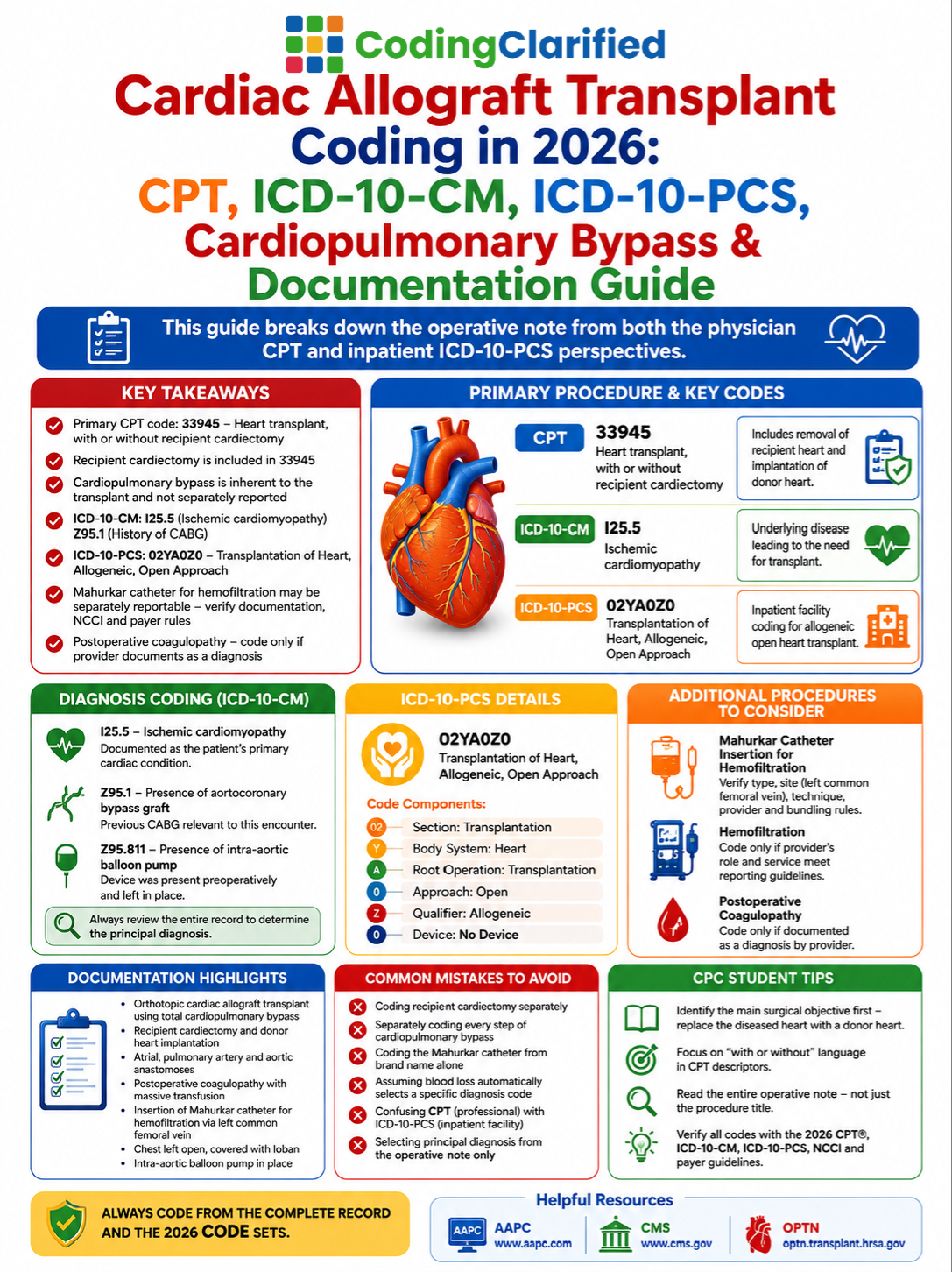
This guide breaks down the operative note from both the physician CPT and inpatient ICD-10-PCS perspectives.
Key Takeaways
- The primary physician procedure in this case points to CPT 33945 for heart transplantation, with or without recipient cardiectomy. AAPC places 33945 in the heart/lung transplantation procedure family.
- Recipient cardiectomy is part of 33945 and should not automatically generate another CPT code.
- Cardiopulmonary bypass is an expected component of the transplant operation and should not automatically be separately reported on the surgeon’s professional claim.
- The underlying ischemic cardiomyopathy supports ICD-10-CM I25.5 when documented as the patient’s diagnosis.
- Prior CABG status may support ICD-10-CM Z95.1 when relevant to the encounter.
- The Mahurkar catheter requires separate analysis. Documentation shows insertion through the left common femoral vein for hemofiltration, but coders must verify CPT guidelines, NCCI edits, payer rules, and who performed the service before separately reporting catheter placement.
- For an inpatient facility claim, the heart transplant is represented through ICD-10-PCS rather than CPT. An allogeneic open heart transplant maps to 02YA0Z0.
- Postoperative coagulopathy should not be assigned a highly specific complication code unless the provider’s documentation supports that relationship and diagnosis.
- The open chest covered with Ioban is part of the operative management described in this case and should not automatically be treated as a separately billable definitive closure.
- Always code from the complete operative record and current 2026 code sets rather than from the procedure heading alone.
Cardiac Allograft Transplant Scenario
The patient has severe ischemic cardiomyopathy and a history of redo coronary artery bypass grafting. Additionally, an intra-aortic balloon pump was in place before surgery.
The surgeon performs an orthotopic cardiac allograft transplantation using total cardiopulmonary bypass. Because the patient previously underwent cardiac surgery, the surgeon encounters very dense adhesions while reopening the sternum and exposing the heart.
After establishing cardiopulmonary bypass, the surgeon removes the recipient heart. Next, the donor heart is implanted through atrial, pulmonary artery, and aortic anastomoses.
Following transplantation, the patient develops significant coagulopathy. Consequently, the operative team administers multiple blood products and factor VII. A Mahurkar catheter is then inserted through the left common femoral vein so hemofiltration can begin in the operating room.
Due to the patient’s condition and coagulopathy, the surgeon leaves the chest open and covers it with Ioban rather than completing the usual definitive closure.
This scenario illustrates an important coding principle: a long operative report does not necessarily equal a long list of separately reportable CPT codes.
What Is the Primary CPT Code for the Heart Transplant?
The key physician CPT code is:
33945 — Heart transplant, with or without recipient cardiectomy
AAPC identifies 33945 as the CPT code for transplantation of a heart into the recipient and notes that cardiectomy may be performed as part of the procedure.
That wording matters significantly in this scenario.
The surgeon removes the diseased recipient heart before implanting the donor heart. Although the operative report provides extensive details about the cardiectomy, coders should not interpret the recipient cardiectomy as a separate primary procedure.
Instead, 33945 already accounts for heart transplantation with or without recipient cardiectomy.
Why CPT 33945 Fits This Operative Note
The documentation clearly describes:
- Removal of the recipient heart
- Preparation of the atria, aorta, and pulmonary artery
- Implantation of the donor heart
- Left atrial anastomosis
- Right atrial anastomosis
- Pulmonary artery anastomosis
- Aortic anastomosis
- Reperfusion of the transplanted heart
- Weaning from cardiopulmonary bypass
Therefore, the operative work supports the heart transplant service rather than a less specific cardiovascular procedure.
For additional cardiovascular coding practice, review our Angiography & Cardiac Catheterization Coding Scenario.
Is Recipient Cardiectomy Separately Coded?
No separate CPT code should be assigned simply because the operative report documents removal of the recipient heart.
CPT 33945 specifically encompasses heart transplantation with or without recipient cardiectomy. Therefore, removing the patient’s diseased heart is incorporated into the transplant code.
This distinction is especially important for CPC students. On an exam question, the operative report may spend several paragraphs describing the cardiectomy. Nevertheless, extensive documentation does not make an included component separately reportable.
CPC Tip: Focus first on the main objective of the operation. Here, the objective is replacement of the recipient’s heart with a donor heart. Once you identify that objective, verify the complete CPT descriptor before considering additional codes.
Is Cardiopulmonary Bypass Separately Reportable?
The operative report repeatedly describes cardiopulmonary bypass. For example, the surgeon exposes the femoral vessels, establishes bypass, performs the cardiectomy and transplant, and eventually weans the patient from bypass.
Still, coders should not automatically assign an additional physician CPT procedure merely because bypass required substantial work.
Cardiopulmonary bypass is inherent to many open cardiac operations. Therefore, the professional coding analysis must distinguish between the primary surgical service and techniques necessary to accomplish it.
This is one reason reading CPT section guidelines and parenthetical instructions remains essential. Our Medical Coding Steps for CPT guide explains a repeatable process for moving from the operative documentation to the correct CPT selection.
What About the Extensive Adhesiolysis?
Previous cardiac surgery created dense adhesions. Consequently, the surgeon had to lyse those adhesions to free the right atrium, ascending aorta, and anterior right ventricle.
That work may make the transplant much harder, but increased difficulty does not automatically support another procedure code.
Instead, coders should evaluate whether the additional work exceeds the normal work associated with the primary operation and whether current CPT rules provide a separate reporting mechanism. If unusually extensive work substantially increases physician effort, a modifier-based analysis may sometimes be more appropriate than adding an unrelated procedure code.
Documentation must support any such reporting decision. Therefore, never assume that “extensive adhesions” alone justify separate payment.
Coding the Mahurkar Catheter for Hemofiltration
This part of the case deserves careful review.
Because the patient required massive transfusion and developed coagulopathy, the surgeon inserted a Mahurkar catheter through the left common femoral vein. Hemofiltration then began in the operating room.
A Mahurkar catheter is a large-bore central venous catheter commonly used for dialysis, apheresis, or other extracorporeal therapies. Nevertheless, coders should not choose a catheter CPT code based on the brand name alone.
Instead, determine:
- Whether the catheter was tunneled or non-tunneled.
- Where the catheter terminated.
- Whether the documentation meets the definition of a centrally inserted central venous access device.
- The patient’s age.
- Whether imaging guidance was used and documented.
- Who inserted the catheter.
- Whether placement is separately reportable with the transplant under current CPT/NCCI and payer rules.
The operative note describes needle access, guidewire placement, dilation, catheter insertion, and fixation with suture. However, a coder should verify all required elements before assigning a separate catheter code.
Coding Tip: Do not code “Mahurkar” from memory. Code the documented catheter characteristics and insertion technique.
Is Hemofiltration Separately Coded?
Hemofiltration began in the operating room after catheter placement. Even so, documentation that a treatment occurred does not necessarily mean the transplant surgeon can bill for managing that treatment.
First, identify the provider responsible for the hemofiltration service. Next, determine the type and duration of extracorporeal therapy. Finally, review the applicable CPT or ICD-10-PCS rules.
For professional coding, the physician’s documented role is critical. Meanwhile, inpatient facility coding follows ICD-10-PCS rules rather than physician CPT reporting.
This difference between professional and facility coding is one of the most important lessons in a complex transplant case.
ICD-10-CM Diagnosis Coding
Ischemic Cardiomyopathy
The preoperative and postoperative diagnoses both identify ischemic cardiomyopathy.
The applicable ICD-10-CM code is:
I25.5 — Ischemic cardiomyopathy
This diagnosis represents the underlying disease that led to the need for transplantation in the supplied operative record.
However, inpatient coders must determine the principal diagnosis from the entire admission record rather than from this operative note alone. Therefore, I25.5 should not automatically be declared the principal diagnosis without reviewing the complete hospitalization.
Status Post Coronary Artery Bypass
The patient has undergone previous CABG surgery. When that status remains clinically relevant and meets reporting requirements, coders may consider:
Z95.1 — Presence of aortocoronary bypass graft
The operative report’s description of a “redo coronary artery bypass” history explains, in part, why the surgeon encountered dense adhesions.
For more information about coronary bypass procedures, see our Medical Coding for CABG guide.
What About the Intra-Aortic Balloon Pump?
The operative note states that an intra-aortic balloon device was already present before the transplant and remained in place.
Coders should review when the device was inserted and whether its insertion belongs to the current encounter. Additionally, they should determine whether any separately reportable management, removal, or other service occurred.
Do not code a new insertion from this operative report when the note clearly states that the device was placed preoperatively.
How Should Postoperative Coagulopathy Be Coded?
The surgeon explicitly documents “postoperative coagulopathy,” and the condition clearly affected care.
The patient required:
- 11 units of packed red blood cells
- 7 units of platelets
- 23 units of fresh-frozen plasma
- 20 units of cryoprecipitate
- Factor VII
- Prolonged operative management
- Hemofiltration
- Delayed definitive chest closure
Therefore, the coagulopathy is clinically significant.
However, do not jump directly to a specific complication diagnosis code based solely on the blood loss or transfusions. ICD-10-CM code selection depends on the provider’s final diagnostic language, the documented cause, and applicable guidelines.
For example, D68.9 describes a coagulation defect when the condition remains unspecified, but coders must verify whether that code accurately reflects the final diagnosis. If documentation establishes a postprocedural complication or a more specific coagulation disorder, another code may be appropriate.
A provider query may be necessary when the documentation does not adequately identify the nature or cause of the coagulopathy.
ICD-10-PCS Coding for the Heart Transplant
CPT and ICD-10-PCS answer different questions.
For the surgeon’s professional service, 33945 represents the heart transplant. In contrast, an inpatient hospital coder uses ICD-10-PCS to capture procedures performed during the admission.
For an allogeneic donor heart transplanted using an open approach, the principal transplant procedure is:
02YA0Z0 — Transplantation of Heart, Allogeneic, Open Approach
Published heart-transplant coding information identifies 02YA0Z0 for an allogeneic open heart transplant.
The operative note describes a cardiac allograft, meaning donor tissue comes from another person. Therefore, “allogeneic” is the key qualifier.
Additional ICD-10-PCS codes may apply to extracorporeal support, hemofiltration, vascular access, or other procedures. Nevertheless, facility coders should build those codes from the complete record and current 2026 ICD-10-PCS tables rather than simply translating every CPT concept into PCS.
Why the Open Chest With Ioban Matters
After achieving hemostasis, the surgical team decides to leave the chest open and cover it with Ioban.
Clinically, this is important because the patient remains unstable and has significant coagulopathy. From a coding perspective, however, the documentation does not describe a routine definitive sternotomy closure.
Coders should carefully review later operative notes because the patient may return to the operating room for chest exploration, washout, and delayed closure.
If another procedure occurs, code that subsequent operation from its own documentation rather than assuming the later service from this transplant note.
Our Medical Coding for Post-Op Care guide provides additional guidance on distinguishing routine postoperative care from separately reportable postoperative services.
2026 Cardiac Transplant Coding Workflow
When reviewing a complex transplant operative report in 2026, start by identifying the main procedure rather than coding line by line.
First, determine the surgical objective. Here, the surgeon replaces the recipient heart with an allogeneic donor heart.
Next, identify procedures included in the main service. Recipient cardiectomy, for example, is addressed directly by the descriptor for 33945.
Then, review additional services individually. Catheter insertion, hemofiltration, postoperative interventions, and later returns to the operating room may require separate analysis.
Afterward, assign diagnoses based on documented conditions rather than assumptions. Finally, verify every code against the current 2026 CPT, ICD-10-CM, ICD-10-PCS, NCCI, and payer guidance applicable to the claim.
For a broader coding workflow, see Medical Coding Correctly Using CPT, ICD-10 & HCPCS.
Professional CPT vs. Inpatient Facility Coding
One major source of confusion is mixing CPT and ICD-10-PCS.
For this scenario, think of the coding systems this way:
Professional claim: CPT 33945 is the central procedure code for the surgeon’s heart transplant service.
Diagnosis reporting: ICD-10-CM I25.5 identifies ischemic cardiomyopathy, while Z95.1 may capture the relevant CABG status when reporting requirements are met.
Inpatient facility procedure: ICD-10-PCS 02YA0Z0 identifies transplantation of an allogeneic heart using an open approach.
Consequently, coders should never replace 33945 with 02YA0Z0 on a physician CPT claim or report 33945 as the hospital’s ICD-10-PCS transplant procedure.
Common Mistakes to Avoid
Mistake #1: Coding recipient cardiectomy separately.
CPT 33945 already describes heart transplantation with or without recipient cardiectomy.
Mistake #2: Separately coding every step of cardiopulmonary bypass.
Do not mistake operative technique for an automatically separately billable professional service.
Mistake #3: Coding from the procedure title only.
Always read the entire operative note because additional procedures and complications may change the final code set.
Mistake #4: Automatically coding the Mahurkar catheter from its brand name.
Instead, determine catheter type, insertion site, age, technique, provider, and bundling rules.
Mistake #5: Assuming massive blood loss gives you a specific diagnosis.
Code the provider’s diagnosis, not your interpretation of laboratory findings, transfusion volume, or clinical severity.
Mistake #6: Confusing CPT with ICD-10-PCS.
CPT and PCS serve different reporting purposes, so determine whether you are coding the physician or inpatient facility claim.
Mistake #7: Automatically assigning the operative diagnosis as the principal diagnosis.
Inpatient principal diagnosis selection requires review of the entire admission.
CPC Student Tips for Cardiac Transplant Questions
CPC questions often include far more clinical detail than you need to select the primary procedure code. Therefore, train yourself to identify the surgical objective before getting lost in individual operative steps.
Circle or highlight terms such as heart transplant, recipient cardiectomy, donor heart, allograft, and cardiopulmonary bypass. Next, look up the main procedure in the CPT Index and verify the full descriptor in the cardiovascular section.
Pay special attention to phrases such as “with or without.” In this scenario, those few words help establish that recipient cardiectomy does not require another primary CPT code.
Finally, never assume that a service deserves an additional code merely because it required significant time. Instead, confirm CPT guidelines, parenthetical notes, NCCI edits, and payer rules before reporting it.
For students interested in advanced cardiovascular coding, Coding Clarified also reviews cardiovascular and thoracic coding credentials in our Medical Coding Certifications guide.
Authoritative 2026 Coding Resources
Coders should verify final code assignments against the current year’s official resources. AAPC’s CPT reference identifies 33945 within the heart/lung transplantation code family and provides current code information.
Additionally, CMS publishes Medicare coding, NCCI, and claims-processing guidance that may affect whether related services are separately payable.
Centers for Medicare & Medicaid Services (CMS)
For transplant policy and national transplant-system information, coders can also consult the federal Organ Procurement and Transplantation Network.
Organ Procurement and Transplantation Network (OPTN)
Because code sets and payer edits can change, always verify the code set and rules in effect for the patient’s date of service.
Frequently Asked Questions About Cardiac Allograft Transplant Coding
What is the CPT code for a heart transplant in 2026?
CPT 33945 describes a heart transplant with or without recipient cardiectomy. The operative documentation must support transplantation of the donor heart into the recipient.
Is cardiectomy included in CPT 33945?
Yes. The descriptor specifically accounts for heart transplantation with or without recipient cardiectomy. Therefore, coders should not assign an additional procedure solely for removing the recipient heart.
What ICD-10-CM code is used for ischemic cardiomyopathy?
ICD-10-CM I25.5 identifies ischemic cardiomyopathy. Still, inpatient coders must review the complete record before deciding whether it qualifies as the principal diagnosis.
What ICD-10-PCS code is used for an allogeneic heart transplant?
For an allogeneic heart transplant performed through an open approach, ICD-10-PCS 02YA0Z0 represents transplantation of the heart, allogeneic, open approach.
Is cardiopulmonary bypass separately billed with CPT 33945?
Coders should not automatically separately report cardiopulmonary bypass on the surgeon’s professional claim simply because the operative note describes it. Instead, review current CPT guidelines, NCCI edits, and payer policies for any additional service under consideration.
Can the Mahurkar catheter be coded separately?
Potentially, but separate reporting should never be assumed. The coder needs to determine the catheter type, insertion technique, anatomical site, patient age, physician performing the insertion, documentation requirements, and applicable bundling or payer rules.
How should postoperative coagulopathy be coded?
Use the provider’s final diagnosis and the most specific supported ICD-10-CM code. Although D68.9 may describe an unspecified coagulation defect in appropriate circumstances, coders should not automatically assign it when documentation supports a different or more specific postprocedural condition. Query the provider when clinically significant documentation lacks the specificity required for accurate coding.
What is the biggest coding lesson from this heart transplant scenario?
Do not code every sentence of the operative report. Instead, identify the primary procedure, determine which components are included, analyze genuinely distinct services, and verify each potential code using the current 2026 code sets and payer rules. For this scenario, CPT 33945 is the central professional procedure code, while ICD-10-PCS 02YA0Z0 represents the allogeneic open heart transplant on the inpatient facility side.