Updated for 2026
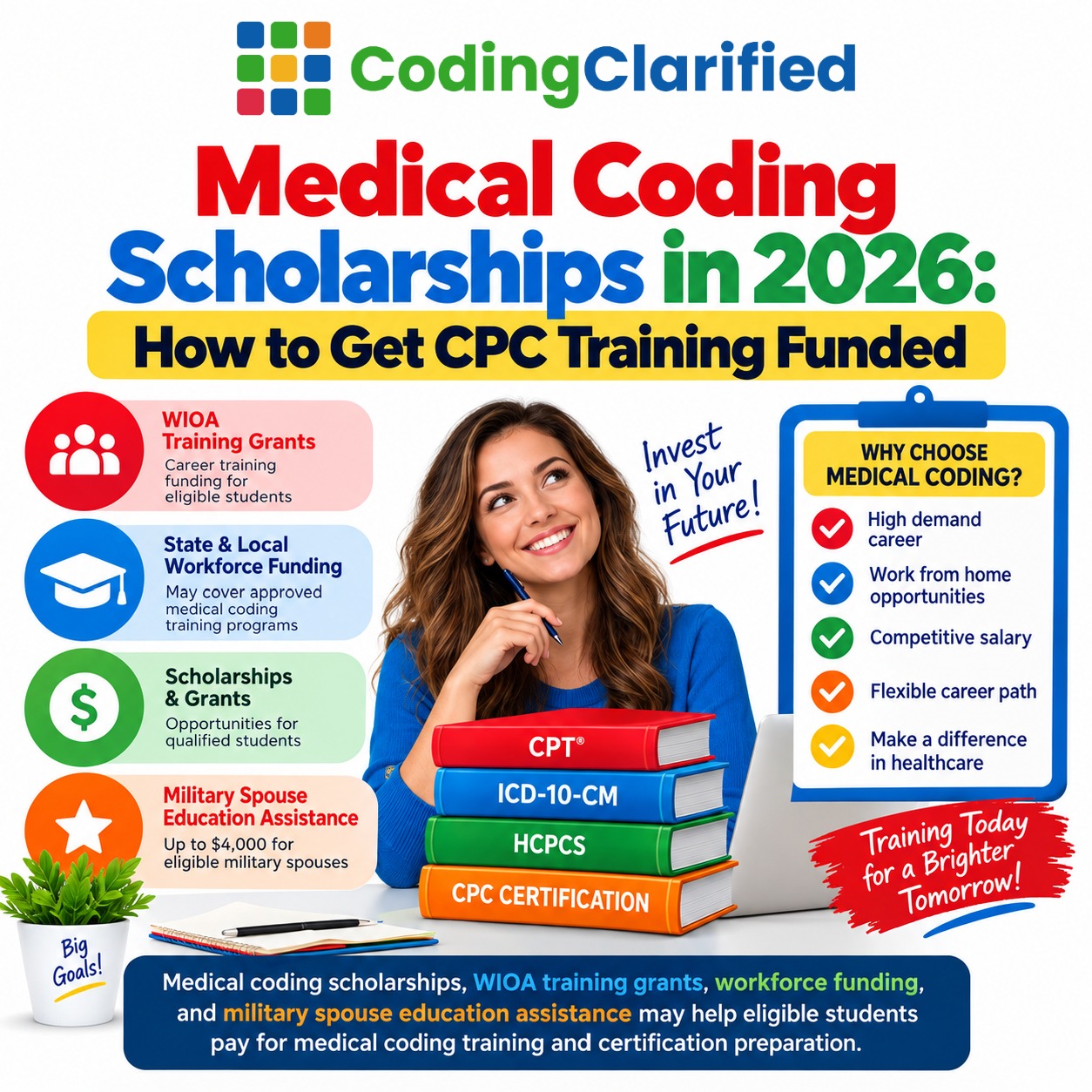
If the cost of medical coding school is stopping you from starting a new career, you may not have to pay the full cost yourself. In 2026, medical coding scholarships, WIOA training grants, workforce funding, and military spouse education assistance may help eligible students pay for medical coding training and certification preparation.
However, many people searching for a “medical coding scholarship” are actually looking for career-training funding rather than a traditional academic scholarship. That distinction matters because programs such as the Workforce Innovation and Opportunity Act (WIOA) generally require applicants to work with a local workforce agency and receive approval before starting training.
Coding Clarified works with workforce programs in more than 30 states to help qualified students pursue funding for CPC medical coding training. Nevertheless, funding is never automatic. Your state or local workforce agency determines your eligibility, available funding, and final approval.
This 2026 guide explains how medical coding scholarships and grants work, who may qualify, how to apply for WIOA funding, what to ask your caseworker, and how to avoid common mistakes that can delay approval.
Key Takeaways: Medical Coding Scholarships in 2026
- Medical coding students may qualify for WIOA grants and other workforce training funds that can reduce or eliminate eligible training costs.
- WIOA is not a traditional academic scholarship. Instead, local workforce agencies determine eligibility and funding.
- Coding Clarified works with workforce programs in 30+ states; however, approval and funding vary by state and local workforce area.
- Applicants should contact their local workforce or American Job Center before enrolling or paying for training.
- An approved or eligible training provider listing may be required before WIOA funds can pay for a program.
- Eligible military spouses may also qualify for up to $4,000 in tuition assistance through the SpouseWorks Scholarship program, formerly associated with MyCAA.
- Funding can take time. Therefore, start the process before your desired training date.
- A strong medical coding program should prepare you for certification while also helping you build practical coding and job-search skills.
What Are Coding Clarified Medical Coding Scholarships?
The phrase Coding Clarified medical coding scholarships generally refers to outside workforce funding that qualified students can use toward approved Coding Clarified training.
In other words, Coding Clarified does not simply select scholarship winners and hand students tuition checks. Instead, students typically apply through a workforce agency, which determines whether they qualify for training assistance.
One of the most important sources is the Workforce Innovation and Opportunity Act (WIOA). The U.S. Department of Labor administers WIOA workforce programs that provide employment and training services to job seekers across the country. These services can include classroom training and other forms of career preparation.
Additionally, WIOA uses Eligible Training Provider systems to help connect eligible participants with approved training programs. The exact process, funding limits, and requirements can vary by state and local workforce area.
Students can review Coding Clarified’s current state-by-state information here:
Coding Clarified CPC Medical Coding Scholarships & Grants
Can You Really Get Medical Coding Certification for Free?
Potentially, yes. However, “free medical coding certification” usually means that an approved funding source pays eligible training expenses on your behalf.
For example, an eligible student may receive WIOA training assistance that covers some or all approved program costs. Therefore, the student could have little or no out-of-pocket tuition expense.
Still, no training provider should guarantee that every applicant will receive government funding. Local agencies make those decisions based on program rules, individual eligibility, available funds, and local workforce priorities.
Consequently, the best question is not simply, “Is medical coding school free?”
Instead, ask:
“Do I qualify for workforce funding that can pay for an approved medical coding training program?”
That question puts you on the right path.
What Is WIOA Funding for Medical Coding?
The Workforce Innovation and Opportunity Act supports employment and training programs throughout the United States. For eligible adults and dislocated workers, WIOA may provide training services designed to help them gain skills for employment.
Moreover, the U.S. Department of Labor recognizes several types of WIOA training, including occupational skills training, skill upgrading, retraining, on-the-job training, and other approved training services.
Medical coding can fit within occupational training when the student, training program, and local funding requirements meet applicable criteria.
CareerOneStop, which is sponsored by the U.S. Department of Labor, also provides a state-based tool for finding WIOA-eligible training programs. However, students should still speak directly with their local American Job Center because eligibility for WIOA services must be determined locally.
Who May Qualify for a Medical Coding Grant?
There is no single nationwide checklist that guarantees WIOA funding. Instead, eligibility and funding decisions depend on federal rules, state policies, local workforce priorities, and the applicant’s circumstances.
However, applicants seeking training assistance may include:
- Unemployed workers
- Underemployed workers
- Workers affected by layoffs
- Dislocated workers
- Adults who need new occupational skills
- People changing careers
- Individuals who need training to compete for available jobs
- Eligible workers who meet local workforce program requirements
Additionally, your workforce office may request documentation related to employment, income, residency, education, or other eligibility factors.
Do not assume you are ineligible simply because you currently have a job. Likewise, employment does not guarantee eligibility. The best approach is to request an official screening from your local workforce office.
How to Apply for a Medical Coding Scholarship Through WIOA in 2026
Although procedures vary, most applicants can begin with the following steps.
Step 1: Find Your State’s Medical Coding Funding Information
Start with the Coding Clarified scholarship page and locate your state.
Explore Coding Clarified Medical Coding Scholarships by State
The instructions may include links to your state’s workforce system, local office information, provider verification steps, and documents you may need.
Step 2: Contact Your Local Workforce Office
Next, contact the workforce center or American Job Center that serves your area.
Tell the representative that you are interested in medical coding career training and want to determine whether you qualify for WIOA or other available training funds.
Additionally, ask specifically for an eligibility screening for occupational training.
Step 3: Tell Your Caseworker Which Program You Want
Once assigned a caseworker, explain that you want to train for a career in medical coding and identify Coding Clarified as your proposed training provider.
Depending on your state, the caseworker may need provider information, program details, occupational information, costs, or a formal training proposal.
Therefore, keep your caseworker’s full name and contact information available.
Step 4: Verify the Training Program
WIOA-funded training often involves programs on a state’s Eligible Training Provider List, or ETPL. The U.S. Department of Labor provides guidance governing eligible training providers and state ETP lists.
However, approval can vary by state, program, location, and funding source. For that reason, always verify the current program status with your caseworker before enrolling.
Step 5: Complete All Required Documents
Your workforce office may request several documents before making a decision.
For example, you may need identification, proof of residency, employment information, training program details, or other documents required by your local agency.
Furthermore, Coding Clarified provides training information and state-specific instructions that can help students complete the process.
Step 6: Wait for Written Approval Before Enrolling
This step is extremely important.
Do not assume that speaking with a caseworker means you have been approved.
Instead, wait until your workforce agency confirms the funding authorization and tells you what to do next. Once authorization is complete, you can follow the enrollment instructions provided by the workforce agency and Coding Clarified.
What Should You Look for in a Medical Coding Training Program?
Getting funding is only part of the decision. Ultimately, you want training that prepares you for certification and employment.
Therefore, compare what a program includes rather than choosing a school based only on tuition.
Look for training that covers:
- CPT coding
- ICD-10-CM coding
- HCPCS Level II
- Medical terminology
- Anatomy
- Coding guidelines
- Compliance
- CPC exam preparation
- Practice coding
- Career preparation
Additionally, consider whether the program includes certification-related resources, coding books, practice exams, instructor support, practical experience, and job-search assistance.
Students researching the profession may also want to read the Ultimate Medical Coding AAPC CPC Certification Guide before selecting training.
Why Medical Coding Training Still Matters in 2026
Medical coding continues to play an important role in healthcare reimbursement and health information.
The U.S. Bureau of Labor Statistics places medical coding within the broader medical records specialist occupation. According to the latest BLS data available in 2026, medical records specialists earned a median annual wage of $51,140 in May 2025. Furthermore, employment is projected to grow 8% from 2025 through 2035, which BLS classifies as much faster than the average for all occupations.
BLS also projects about 14,000 openings per year on average during that period. At the same time, BLS notes that increased use of AI-powered tools may affect demand by making some coding processes more efficient.
Consequently, students entering medical coding in 2026 should focus on more than memorizing codes. Strong knowledge of guidelines, documentation, compliance, payer rules, and real-world coding remains important as technology changes the profession.
For more career information, read Medical Coding: Job Growth, CPC Certification, Job Search Strategy and Salary.
Other Ways to Pay for Medical Coding Training in 2026
WIOA is an important option, but it is not the only possible source of education assistance.
Military Spouse Education Assistance
Eligible military spouses should also investigate the current SpouseWorks Scholarship program. In 2026, the official Military OneSource scholarship site states that eligible participants can receive up to $4,000 in tuition assistance, along with career coaching and an Education and Training Plan.
Because eligibility rules apply, military spouses should confirm their status and obtain required approval before beginning training.
State and Local Workforce Programs
Some areas may offer additional workforce programs beyond standard WIOA funding. Therefore, ask your caseworker whether other state, county, local, veteran, dislocated-worker, or career-transition funds are available.
Payment Options
If you do not qualify for a grant, you may still have other ways to make training more affordable.
Additionally, comparing the total cost of training options can help you avoid taking on unnecessary debt. Read Medical Coding Career: Comparing AAPC CPC Coding Clarified Course vs. College Associate Degree Costs for another perspective on training costs.
Common Mistakes to Avoid When Applying for Medical Coding Funding
Enrolling Before Receiving Approval
Do not pay for or begin training simply because you expect WIOA to reimburse you later. Instead, confirm your funding and enrollment instructions first.
Calling It Only a “Scholarship”
Your local office may recognize terms such as WIOA training assistance, occupational skills training, Individual Training Account, workforce grant, or career-training funding more readily than “medical coding scholarship.”
Therefore, clearly explain that you are seeking workforce funding for medical coding occupational training.
Not Asking for an Eligibility Screening
A receptionist or general information representative may not determine your eligibility. Instead, specifically ask how to complete a WIOA eligibility screening or speak with the appropriate workforce representative.
Giving Up After One Phone Call
Workforce systems can involve several steps. Consequently, keep notes, save emails, record the names of contacts, and follow up when needed.
Providing Incomplete Paperwork
Missing information can delay the process significantly. Therefore, review every form before submitting it and respond quickly when your caseworker requests additional information.
Assuming Approval Is Guaranteed
Coding Clarified cannot decide who receives WIOA funding. Instead, state and local workforce agencies make eligibility and funding decisions.
That distinction protects you from making plans based on funding that has not yet been authorized.
How to Improve Your Chances of a Smooth WIOA Application
Preparation can make the process easier.
First, be ready to explain why medical coding fits your career goals. Additionally, research the occupation so you can discuss the skills required and the type of work you plan to pursue.
Next, keep all requested documents organized. Respond promptly to your caseworker, and make sure you understand each required step before moving forward.
Finally, do not focus only on getting the training paid for. Your long-term goal should be to complete the training, prepare for certification, develop practical coding skills, and become competitive for employment.
For additional information about paying for training, see Medical Coding Grants in 2026: How to Pay for Medical Coding Training.
Start Your Medical Coding Scholarship Application
If cost has been preventing you from pursuing medical coding, investigate your options before deciding that training is out of reach.
In 2026, WIOA and other workforce programs may help eligible students pay for career training. Additionally, qualified military spouses may have another route through military spouse education assistance.
Start by finding your state, contacting your workforce office, and requesting an eligibility screening.
View Coding Clarified Medical Coding Scholarships and State Instructions
Most importantly, do not enroll until your funding agency has confirmed your approval and given you instructions to proceed.
Frequently Asked Questions About Medical Coding Scholarships in 2026
Can I get a scholarship for medical coding school?
Yes. Eligible students may qualify for WIOA workforce funding, state or local training assistance, military spouse education benefits, or other programs. However, eligibility and available funding vary, so applicants should confirm their options with the organization providing the funds.
Can WIOA pay for medical coding training?
WIOA may pay for eligible occupational training when the applicant and training program meet applicable requirements. Moreover, state Eligible Training Provider systems help identify programs that may qualify for WIOA-funded training. Your local workforce agency makes the final determination for your situation.
How do I apply for a Coding Clarified medical coding scholarship?
Start with the Coding Clarified scholarship page and find the instructions for your state. Next, contact your local workforce office and request an eligibility screening for WIOA or other career-training assistance. Finally, complete the required workforce and training-provider paperwork before enrolling.
Does everyone qualify for WIOA medical coding funding?
No. Eligibility depends on the applicant’s circumstances, local policies, available funding, and program requirements. Therefore, Coding Clarified cannot guarantee that an applicant will receive funding.
Do I need to be unemployed to qualify for WIOA?
Not necessarily. WIOA serves different groups, including adults and dislocated workers, and local programs determine eligibility. Consequently, employed or underemployed applicants should still contact their workforce office rather than assuming they cannot qualify.
How long does WIOA approval take?
There is no single national approval timeline. Processing time depends on your workforce area, required documentation, caseworker process, program verification, and available funds. Therefore, begin the process as early as possible and avoid selecting an immediate training start date unless your caseworker confirms it is realistic.
Can military spouses get help paying for medical coding training?
Eligible military spouses may qualify for the SpouseWorks Scholarship. As of 2026, the official program states that the scholarship provides up to $4,000 in tuition assistance, along with career coaching and an Education and Training Plan. Eligibility requirements apply.
Is medical coding worth training for in 2026?
Medical coding remains part of the growing medical records field. The latest BLS projections show employment for medical records specialists growing 8% from 2025 to 2035, with about 14,000 openings projected each year on average. However, technology and AI continue to change the field, so students should build strong coding, compliance, documentation, and problem-solving skills rather than relying only on basic code selection.