
Medical Coding and Billing Guidelines for Artificial Openings
Artificial openings are openings that surgeons create in the body to divert bodily waste or provide access for medical treatments. People commonly call them stomas or ostomies. These can include colostomies, ileostomies, urostomies, and other similar procedures. When coding and billing for medical services related to artificial openings, it is crucial to follow specific guidelines and accurately document the procedure, the diagnosis, and any related care. As a result, below is an outline of the key considerations and steps for coding and billing artificial openings:
Understand the Key Types of Artificial Openings
For example, artificial openings may include the following, although the list is not complete:
- Colostomy – Opening of the colon to divert stool.
- Ileostomy – Opening of the ileum (small intestine) to divert stool.
- Urostomy – Surgical creation of an opening for urine drainage.
- Gastrostomy – Opening for feeding tube placement.
- Tracheostomy – Opening in the trachea for breathing assistance.
The type of artificial opening will dictate the specific CPT® code (for procedures) and ICD-10-CM codes (for diagnoses) you will use for billing.
Use the Correct CPT Codes for Procedure
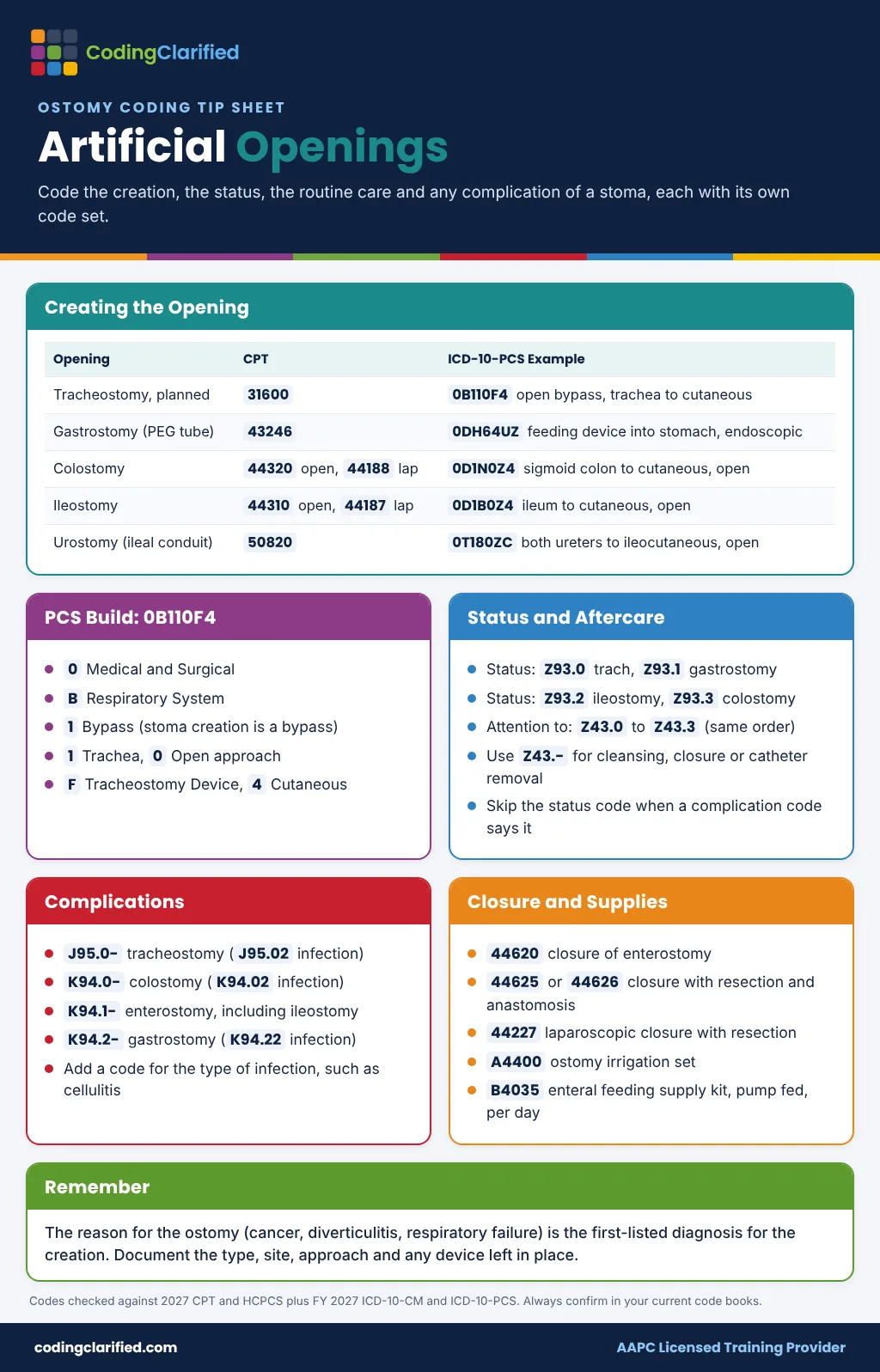
CPT codes describe medical procedures and services. For example, below are some common CPT codes for artificial openings:
- Ostomy Creation:
- 44320: Colostomy or skin level cecostomy, open
- 44188: Laparoscopic colostomy or skin level cecostomy
- 44310: Ileostomy or jejunostomy, non-tube, open
- 44187: Laparoscopic ileostomy or jejunostomy, non-tube
- 50820: Ureteroileal conduit (ileal conduit urostomy), including intestine anastomosis
- 43246: Upper endoscopy with placement of a percutaneous gastrostomy tube (PEG)
- 31600: Tracheostomy, planned
- Colostomy/Ileostomy Closure:
- 44620: Closure of enterostomy, large or small intestine
- 44625: Closure of enterostomy with resection and anastomosis other than colorectal
- 44626: Closure of enterostomy with resection and colorectal anastomosis (e.g., closure of Hartmann type procedure)
- 44227: Laparoscopic closure of enterostomy, large or small intestine, with resection and anastomosis
In addition, use the modifiers (such as modifier 22 for increased procedural services) and the correct HCPCS codes (for supplies like ostomy bags or feeding tubes) appropriately.
Accurate Diagnosis Coding with ICD-10-CM
The ICD-10-CM codes reflect the diagnosis that led to the creation of the artificial opening. Common diagnoses related to artificial openings may include:
- K57.20-K57.33: Diverticular disease (e.g., diverticulitis) of the large intestine
- C18.0-C18.9 – Colon cancer (leading to colostomy)
- K56.0-K56.7: Paralytic ileus and intestinal obstruction (may require an ostomy)
- C67.0-C67.9: Malignant neoplasm of bladder (cystectomy with urostomy)
- R63.30-R63.39: Feeding difficulties (gastrostomy for nutritional support)
- J96.90 – Respiratory failure (tracheostomy for respiratory support)
Ensure that the primary diagnosis code reflects the condition requiring the creation of the artificial opening. In addition, secondary diagnoses can include complications, infections, or any comorbidities related to the patient’s condition or recovery.
Consider Post-Operative Care and Maintenance
Artificial openings often require follow-up care, maintenance, and potential complications that may need specific codes, including:
- Routine care:
- A4331: Extension drainage tubing, any type, any length, with connector/adaptor, for use with urinary leg bag or urostomy pouch, each
- A4400: Ostomy irrigation set
- Z43.2-Z43.3: Attention to ileostomy or colostomy (ICD-10-CM, for ostomy care visits)
- Z93.2-Z93.3: Ileostomy or colostomy status (ICD-10-CM)
- Complications:
- T81.40XA-T81.49XA: Infection following a procedure (initial encounter)
- K94.00-K94.39: Complications of colostomy, enterostomy, gastrostomy, or esophagostomy (e.g., K94.02 colostomy infection, K94.22 gastrostomy infection)
Also, modifiers may be necessary for post-operative care depending on the scenario.
Billing for Ostomy Supplies and Equipment
Billing for durable medical equipment (DME) is crucial for ostomy patients who need supplies such as ostomy bags, catheters, or feeding tubes. Therefore, use the correct HCPCS codes to reflect these supplies:
- A4386: Ostomy skin barrier (check the current HCPCS book for the full descriptor)
- A4387: Ostomy pouch, closed, with barrier attached, with built-in convexity (1 piece), each
- A4450: Tape, non-waterproof, per 18 square inches
- B4035: Enteral feeding supply kit, pump fed, per day
Suppliers often bill these items on a monthly or per-use basis. However, some insurances may limit how many items they will reimburse, so be sure to verify coverage details.
Modifier Usage in Ostomy Care
Similarly, the correct use of modifiers is important for accurate billing. For example, modifiers can indicate various circumstances such as:
- Modifier 22 – Increased procedural services (for more complex procedures)
- Modifier 59 – Distinct procedural services (to show a procedure is distinct from other services on the same day)
- Modifier 78 – Unplanned return to the operating room for a related procedure
- Modifier 79 – Unrelated procedure or service by the same provider
Considerations for Medicare and Medicaid Billing
Billing for Medicare and Medicaid can vary, especially for ostomy supplies and services:
- Medicare typically covers ostomy supplies under Part B as prosthetic device supplies, which DME suppliers bill, provided the patient is enrolled and the supplies are medically necessary.
- Medicaid coverage can vary significantly by state and may have restrictions on the number of supplies covered.
Therefore, always verify patient eligibility and check the local coverage determinations (LCDs) or national coverage determinations (NCDs) for specific guidelines regarding coverage.
Documentation Best Practices
In general, complete and accurate documentation is crucial for ensuring proper reimbursement and avoiding denials. Some best practices include:
- Ensure the physician’s notes clearly state the medical necessity for the procedure.
- Document the type of artificial opening, including the procedure performed and its location.
- Record any complications or additional procedures (e.g., wound care, infection management).
- Keep detailed records of follow-up care, including the frequency of ostomy supply needs.
Proper coding and billing for artificial openings require a thorough understanding of both the surgical procedure and the ongoing care needs of the patient. By selecting the correct CPT and ICD-10 codes, understanding the modifiers and supplies involved, and following payer-specific guidelines, you can submit claims correctly and on time. Always stay updated on changes in codes and payer requirements to avoid delays or denials in reimbursement.