How to Code Thoracoabdominal Aortic Aneurysm Repair in 2026: CPT and ICD-10-CM Case Study
By Janine Mothershed CPC, CPC-I
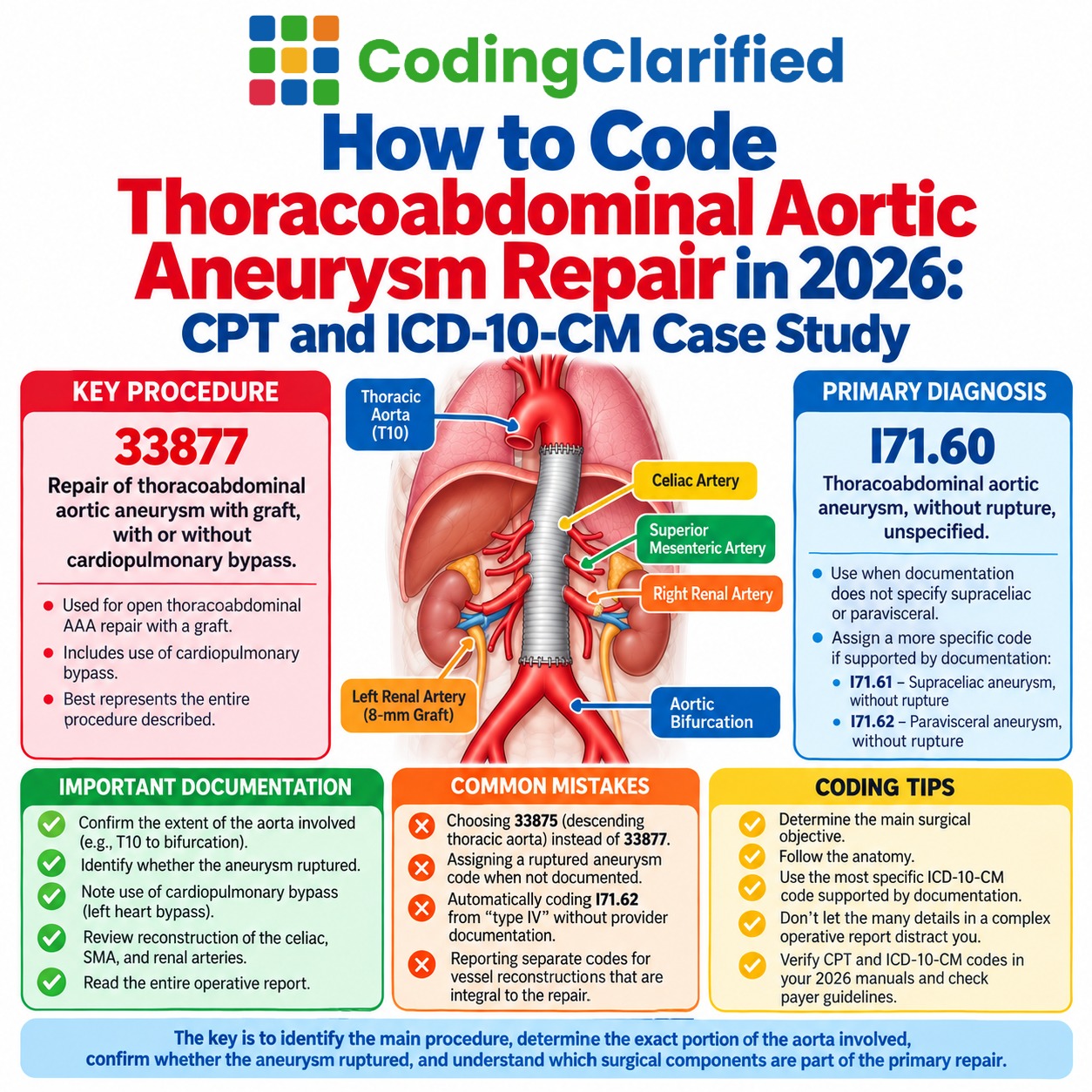
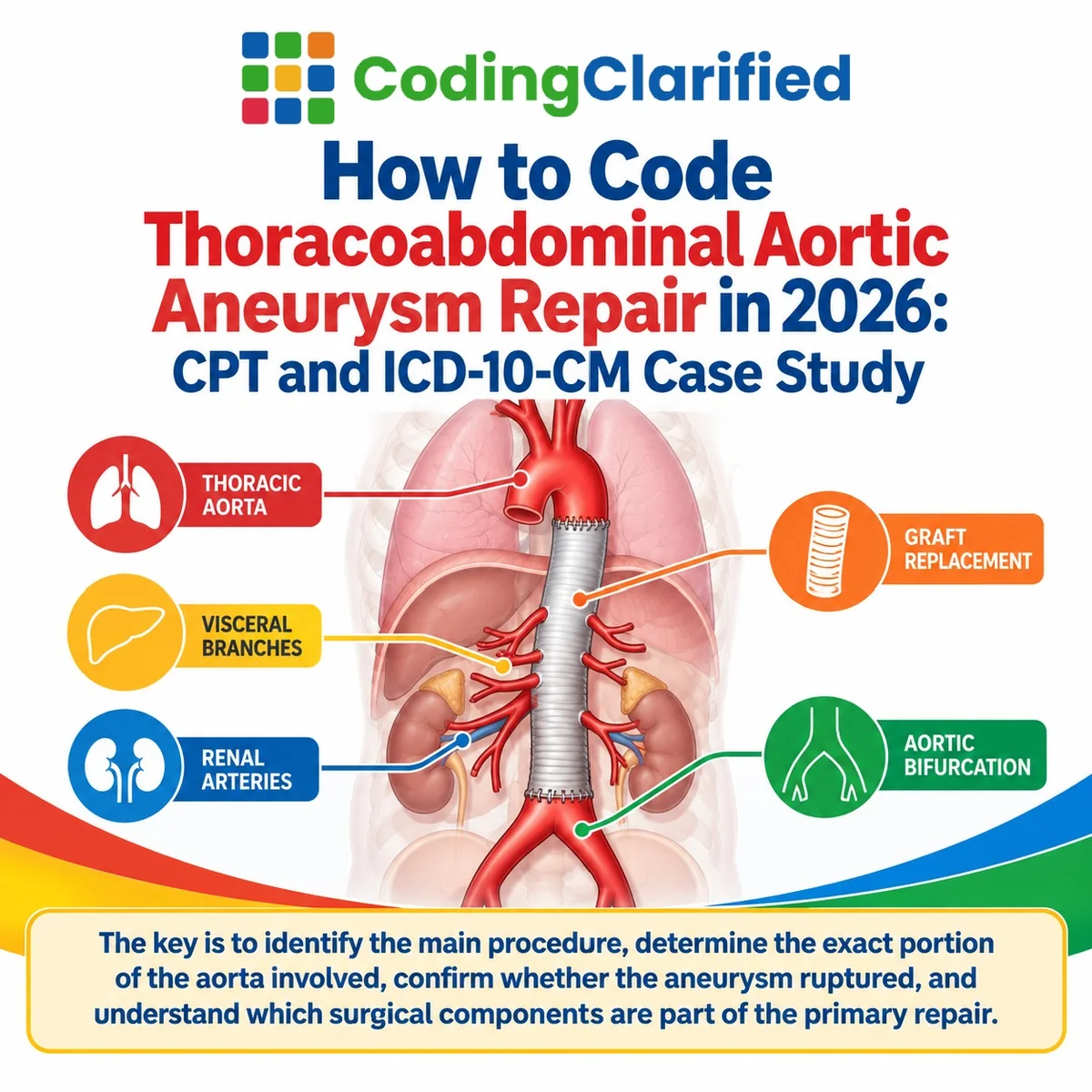
Coding an open thoracoabdominal aortic aneurysm repair can look overwhelming because the operative report may describe a long list of surgical steps. However, the key is to identify the main procedure, determine the exact portion of the aorta involved, confirm whether the aneurysm ruptured, and understand which surgical components are part of the primary repair.
In this 2026 medical coding case study, the surgeon replaces a type IV thoracoabdominal aortic aneurysm with a 26-mm Dacron graft. In addition, the surgeon reimplants the celiac artery, superior mesenteric artery (SMA), and right renal artery as an island. The left renal artery receives a separate 8-mm Dacron interposition graft. Left heart bypass and cerebrospinal fluid drainage are also used.
Learn more in our guide to coding brain aneurysms.
For physician CPT coding, the operative report supports 33877, repair of a thoracoabdominal aortic aneurysm with graft, with or without cardiopulmonary bypass.
Key Takeaways
- CPT: 33877 is the key procedure code for open repair of a thoracoabdominal aortic aneurysm using a graft, with or without cardiopulmonary bypass.
- The operation extends from approximately T10 to the aortic bifurcation, confirming that this is more than an isolated descending thoracic or abdominal aortic repair.
- The surgeon reimplants the celiac artery, SMA, and right renal artery into the replacement graft and separately reconstructs the left renal artery.
- The postoperative diagnosis documents a type IV thoracoabdominal aneurysm and does not document rupture.
- For ICD-10-CM, do not automatically convert the surgical classification “type IV” into “paravisceral” or “supraceliac” unless the provider documentation supports that terminology.
- I71.60 is the appropriate thoracoabdominal aortic aneurysm without rupture code when the documentation does not establish the more specific ICD-10-CM classification.
- If the provider specifically documents a paravisceral thoracoabdominal aneurysm without rupture, I71.62 may be appropriate.
- Always code from the complete operative report rather than from the procedure title alone.
2026 Coding Answer at a Glance
Primary CPT code: 33877 — Open repair of thoracoabdominal aortic aneurysm with graft, with or without cardiopulmonary bypass.
ICD-10-CM diagnosis: I71.60 — Thoracoabdominal aortic aneurysm, without rupture, unspecified.
Potential more specific diagnosis if supported by provider clarification: I71.62 — Paravisceral aneurysm of the thoracoabdominal aorta, without rupture.
The 2026 ICD-10-CM code set distinguishes unspecified thoracoabdominal aneurysms from supraceliac and paravisceral aneurysms. Therefore, coders should use the documentation—not assumptions based solely on a Crawford or “type IV” classification—to choose the final diagnosis code.
The Thoracoabdominal Aneurysm Coding Scenario
Medical Specialty: Cardiovascular / Pulmonary
Postoperative Diagnosis: Type IV thoracoabdominal aneurysm.
Procedure: A 26-mm Dacron graft replacement of a type IV thoracoabdominal aneurysm from T10 to the bifurcation of the aorta. The surgeon reimplants the celiac artery, superior mesenteric artery, and right renal artery as an island. Additionally, the surgeon reconstructs the left renal artery using an 8-mm interposition Dacron graft. The team uses left heart bypass and cerebrospinal fluid drainage.
During the operation, the surgeon makes a thoracoabdominal incision and enters through the eighth interspace. Next, the surgeon enters the retroperitoneal space to expose the aorta. The surgeon dissects the aorta at approximately T10 and also exposes the aortic bifurcation and both iliac arteries.
After heparinization, the team places cannulas and starts left heart bypass. The surgeon then cross-clamps the aneurysmal aorta and places a 26-mm graft.
Next, the surgeon opens the aorta longitudinally and completely transects it at the bifurcation. The surgeon prepares the SMA, celiac artery, and right renal artery as one island and prepares the left renal artery separately as a Carrel patch.
The visceral artery island is sewn into the Dacron graft. Blood flow to these vessels is then restored. Afterward, the surgeon fits the distal graft to the aortic bifurcation and sutures it into place.
Finally, the surgeon attaches an 8-mm graft to the left renal artery and connects it to the main graft. The team then restores flow, administers protamine, achieves hemostasis, places chest tubes, and closes the incision.
Step 1: Identify the Main Surgical Objective
The first question should always be: What did the surgeon primarily repair?
In this case, the answer is the thoracoabdominal aorta.
The surgeon did not perform an isolated renal artery bypass or a stand-alone mesenteric bypass. Instead, those vessels required reconstruction because they arise from the portion of the aorta that was replaced.
Furthermore, the surgeon replaced a long segment of diseased aorta with a prosthetic Dacron graft. The operative report describes a thoracoabdominal incision, proximal control around T10, distal reconstruction at the aortic bifurcation, and reconstruction of major visceral branches.
Therefore, the overall operative objective points directly toward open thoracoabdominal aortic aneurysm repair.
Step 2: Select the CPT Code
The key CPT code is:
33877 — Repair of thoracoabdominal aortic aneurysm with graft, with or without cardiopulmonary bypass.
AAPC places 33877 within the CPT repair procedures for thoracic aortic aneurysm and describes it as repair of a thoracoabdominal aneurysm using a graft. Importantly, the code applies whether or not the surgeon uses cardiopulmonary bypass.
That final point matters in this case because the surgeon specifically documents left heart bypass. However, coders should not search for a different primary aneurysm-repair CPT code simply because bypass was used.
Why Not CPT 33875?
A common mistake would be choosing 33875, which represents a descending thoracic aortic graft with or without bypass.
This operation goes well beyond the descending thoracic aorta. Specifically, the graft extends through the thoracoabdominal aorta to the aortic bifurcation, and the visceral arteries require reconstruction.
Therefore, 33877 better represents the complete procedure described in the operative report.
Step 3: Understand the Visceral and Renal Artery Reconstruction
This portion of the report can make the case seem more complicated than it is.
The surgeon dissects the celiac artery, SMA, and right renal artery as a single island. Next, that island is implanted into the main Dacron graft. The left renal artery is managed separately with an 8-mm Dacron graft.
These steps are essential parts of restoring blood flow after replacing the diseased thoracoabdominal aorta.
For that reason, coders should avoid automatically breaking every anastomosis described in a complex vascular operation into a separate CPT procedure. Instead, first determine what work is inherent to accomplishing the primary thoracoabdominal aneurysm repair.
A long operative note does not necessarily mean a long list of CPT codes.
Step 4: Code the Thoracoabdominal Aortic Aneurysm Diagnosis
The postoperative diagnosis states:
Type IV thoracoabdominal aneurysm.
No rupture is documented.
For 2026, ICD-10-CM includes the following nonruptured thoracoabdominal aneurysm options:
- I71.60 — Thoracoabdominal aortic aneurysm, without rupture, unspecified
- I71.61 — Supraceliac aneurysm of the thoracoabdominal aorta, without rupture
- I71.62 — Paravisceral aneurysm of the thoracoabdominal aorta, without rupture
This distinction is important because the operative report describes the aneurysm’s relationship to the visceral arteries in great detail. Nevertheless, coders cannot automatically convert every clinical or surgical classification into an ICD-10-CM diagnosis term.
The safest approach is to report I71.60 when the provider documents a thoracoabdominal aneurysm without rupture but does not specifically establish whether it is supraceliac or paravisceral for ICD-10-CM purposes.
If the surgeon clarifies that the aneurysm is paravisceral, however, I71.62 provides greater specificity.
Does “Type IV” Automatically Mean I71.62?
Not necessarily.
“Type IV” commonly refers to a Crawford classification used to describe the anatomical extent of a thoracoabdominal aneurysm. Meanwhile, ICD-10-CM uses specific terms such as supraceliac and paravisceral.
Although the operative anatomy may strongly suggest one category, coding should remain based on documented diagnoses and official coding conventions. Therefore, a provider query may be appropriate when greater specificity is clinically supported but not clearly documented.
For more help with this process, review our guide to ICD-10-CM Coding Conventions and our step-by-step ICD-10-CM coding process.
Why Rupture Status Matters
One of the most important details in aortic aneurysm coding is whether the aneurysm has ruptured.
In this case, neither the postoperative diagnosis nor the procedure description states that rupture occurred. Consequently, a ruptured thoracoabdominal aneurysm code should not be assigned.
ICD-10-CM separately identifies ruptured thoracoabdominal aortic aneurysms within I71.5- and nonruptured thoracoabdominal aneurysms within I71.6-.
Never assume rupture because the patient required major surgery. Likewise, do not interpret extensive graft replacement, blood loss, bypass, or complex vascular reconstruction as proof of rupture.
The provider’s documented diagnosis controls code selection.
2026 Freshness Check for Medical Coders
Medical coders working with this case in 2026 should verify both CPT and ICD-10-CM using their current-year resources.
CMS maintains the official ICD-10-CM files and publishes annual and, when applicable, April updates. The 2026 files should therefore be checked for encounters occurring within the applicable 2026 date range.
For additional guidance, see our ICD-10 Updates April 2026 article.
Coders should also confirm 33877 in the current AMA CPT code set. Never rely only on an old operative coding example because CPT instructions, parenthetical notes, edits, and payer policies can change.
Coding Scenario Sample
Sample Operative Documentation
A patient with a documented nonruptured type IV thoracoabdominal aortic aneurysm undergoes open repair. The surgeon exposes the thoracoabdominal aorta and replaces the diseased segment from approximately T10 to the aortic bifurcation with a 26-mm Dacron graft.
During reconstruction, the celiac artery, SMA, and right renal artery are reimplanted as a visceral island. The left renal artery is reconstructed separately using an 8-mm Dacron graft. Left heart bypass is used during the procedure.
Coding Answer
CPT: 33877
ICD-10-CM: I71.60
Rationale: The main procedure is an open graft repair of a thoracoabdominal aortic aneurysm. The documented use of bypass does not change the primary CPT code because 33877 describes the repair with or without cardiopulmonary bypass.
Additionally, the diagnosis establishes a thoracoabdominal aneurysm without documented rupture. Because “type IV” alone does not explicitly establish the ICD-10-CM supraceliac or paravisceral terminology, I71.60 is the conservative code based on the supplied documentation. A query may support greater specificity if the surgeon confirms a paravisceral aneurysm.
Documentation Elements Coders Should Look For
When reviewing an open thoracoabdominal aneurysm repair, first identify the aneurysm’s anatomical location and extent. Next, determine whether rupture is documented and note where the graft begins and ends.
Coders should also review whether the surgeon reconstructed the celiac, mesenteric, or renal arteries. Furthermore, document whether bypass was used, what type of graft was placed, and whether other separately identifiable procedures occurred.
These details help distinguish 33877 from codes describing isolated descending thoracic or abdominal aortic repairs.
For a broader look at complex vascular procedure coding, see our Vascular & Interventional Radiology Coding Guidelines and Tips.
Common Mistakes to Avoid
Mistake 1: Coding Only the Abdominal Portion
The surgeon works extensively within the abdomen, but the operative report clearly describes a thoracoabdominal repair beginning near T10. Therefore, coders should not focus only on the distal abdominal portion of the procedure.
Mistake 2: Choosing 33875
33875 describes a descending thoracic aortic graft. In contrast, this procedure extends through the thoracoabdominal segment to the aortic bifurcation and requires visceral artery reconstruction. Thus, 33877 better represents the operation.
Mistake 3: Reporting a Ruptured Aneurysm
Nothing in the supplied postoperative diagnosis identifies rupture. Consequently, do not assign a ruptured aneurysm code simply because the surgery is extensive.
Mistake 4: Automatically Coding I71.62 From “Type IV”
Although the operative anatomy involves the visceral vessels, ICD-10-CM diagnosis assignment should follow provider documentation. Therefore, do not automatically convert a Crawford type IV designation to I71.62 without adequate diagnostic documentation.
Mistake 5: Separately Coding Every Surgical Step
Complex cardiovascular surgery involves many necessary steps, including vessel exposure, cross-clamping, cannulation, graft positioning, anastomoses, and restoration of circulation. However, those details do not automatically represent separately billable procedures.
Mistake 6: Coding From the Procedure Heading Alone
The heading gives coders a starting point, but the body of the operative report establishes what actually happened. Therefore, read the entire report before choosing the final CPT code.
For more tips on handling lengthy coding cases, review How to Approach a Long Medical Coding Exam Scenario.
CPC Student Tips for Thoracoabdominal Aneurysm Cases
CPC students can make complex operative reports easier by identifying three items before opening the CPT book: anatomy, procedure, and diagnosis.
First, underline “thoracoabdominal aneurysm.” Next, circle “Dacron graft replacement.” Finally, note the documented absence or presence of rupture.
After that, follow the anatomy. The graft starts around T10 and extends to the aortic bifurcation, which is a major clue that this is not merely a descending thoracic repair.
Do not let terms such as “Carrel patch,” “left heart bypass,” “visceral island,” and “interposition graft” distract you from the main procedure. Instead, ask what the surgeon was ultimately trying to accomplish.
Another helpful CPC exam strategy is to eliminate clearly incorrect code choices first. If one answer describes only a descending thoracic graft while another describes thoracoabdominal aneurysm repair with a graft, the documented anatomy can guide you toward the correct family.
Most importantly, never choose a diagnosis code based only on what seems anatomically likely. Use the provider’s diagnosis, verify the Alphabetic Index, and then confirm the code in the Tabular List.
Authoritative Coding Resources
Medical coders should verify current-year code selection with authoritative resources before submitting claims.
The Centers for Medicare & Medicaid Services (CMS) publishes the official ICD-10-CM files and guidelines used for diagnosis coding in the United States.
AAPC provides coding education and access to Codify resources. Its CPT information for 33877 identifies the procedure within the thoracoabdominal aortic aneurysm repair family.
The American Medical Association (AMA) maintains CPT. Therefore, coders should use the current AMA CPT code set to verify descriptors, notes, and reporting instructions before billing.
Final Coding Summary
This operative report supports 33877 because the surgeon performs open graft replacement of a thoracoabdominal aortic aneurysm. The repair extends from approximately T10 to the aortic bifurcation, while the celiac artery, SMA, and renal arteries require reconstruction to maintain visceral and renal blood flow.
For diagnosis coding, the documentation establishes a thoracoabdominal aortic aneurysm without documented rupture. Therefore, I71.60 is supported when the record does not explicitly identify the aneurysm as supraceliac or paravisceral. If the provider documents a paravisceral thoracoabdominal aneurysm, I71.62 may provide the appropriate additional specificity.
Ultimately, the most important coding lesson is simple: code the complete operation, but do not turn every operative step into a separate code. Identify the primary surgical objective, follow the anatomy, verify rupture status, and use the most specific diagnosis that the provider’s documentation supports.
Frequently Asked Questions About Thoracoabdominal Aortic Aneurysm Coding
What CPT code is used for open thoracoabdominal aortic aneurysm repair?
CPT 33877 is used for repair of a thoracoabdominal aortic aneurysm with a graft, with or without cardiopulmonary bypass. Always verify the code and applicable instructions in the current-year CPT manual.
What ICD-10-CM code is used for a thoracoabdominal aortic aneurysm without rupture?
ICD-10-CM provides several choices. I71.60 describes a thoracoabdominal aortic aneurysm without rupture when the more specific type is not documented. Meanwhile, I71.61 identifies a supraceliac aneurysm and I71.62 identifies a paravisceral aneurysm.
Is a type IV thoracoabdominal aneurysm coded as I71.62?
Do not automatically assign I71.62 solely because the surgeon documents “type IV.” The Crawford classification and ICD-10-CM terminology are not interchangeable coding terms. Instead, use the documented diagnosis and query the provider when additional supported specificity is needed.
Does CPT 33877 include bypass?
Yes. CPT 33877 describes thoracoabdominal aortic aneurysm repair with a graft, with or without cardiopulmonary bypass. Therefore, the use of bypass does not require choosing a different primary aneurysm-repair CPT code.
Should CPT 33875 be used for this case?
No. 33875 describes a descending thoracic aortic graft with or without bypass. This case involves the thoracoabdominal aorta and extends to the aortic bifurcation, making 33877 the more appropriate primary procedure code.
Can I code the renal artery graft separately?
Do not automatically report an additional code simply because the operative report describes a separate renal artery graft. First determine whether the reconstruction is integral to the thoracoabdominal aneurysm repair, and then check current CPT instructions, NCCI edits, and payer-specific rules before separately reporting additional vascular work.
How do I know whether the aneurysm was ruptured?
Use the provider’s diagnosis and operative documentation. Do not infer rupture from the size or complexity of the operation, use of bypass, blood loss, or urgent treatment. If rupture status is unclear and affects code assignment, seek provider clarification.
What is the best way for CPC students to solve a long vascular surgery coding case?
Start with the main diagnosis and surgical objective. Next, identify the exact anatomy and determine what was repaired or replaced. Then locate the CPT code family, review the complete descriptor and instructions, and verify the ICD-10-CM diagnosis through the Index and Tabular List. This approach keeps lengthy operative details from distracting you from the primary service.