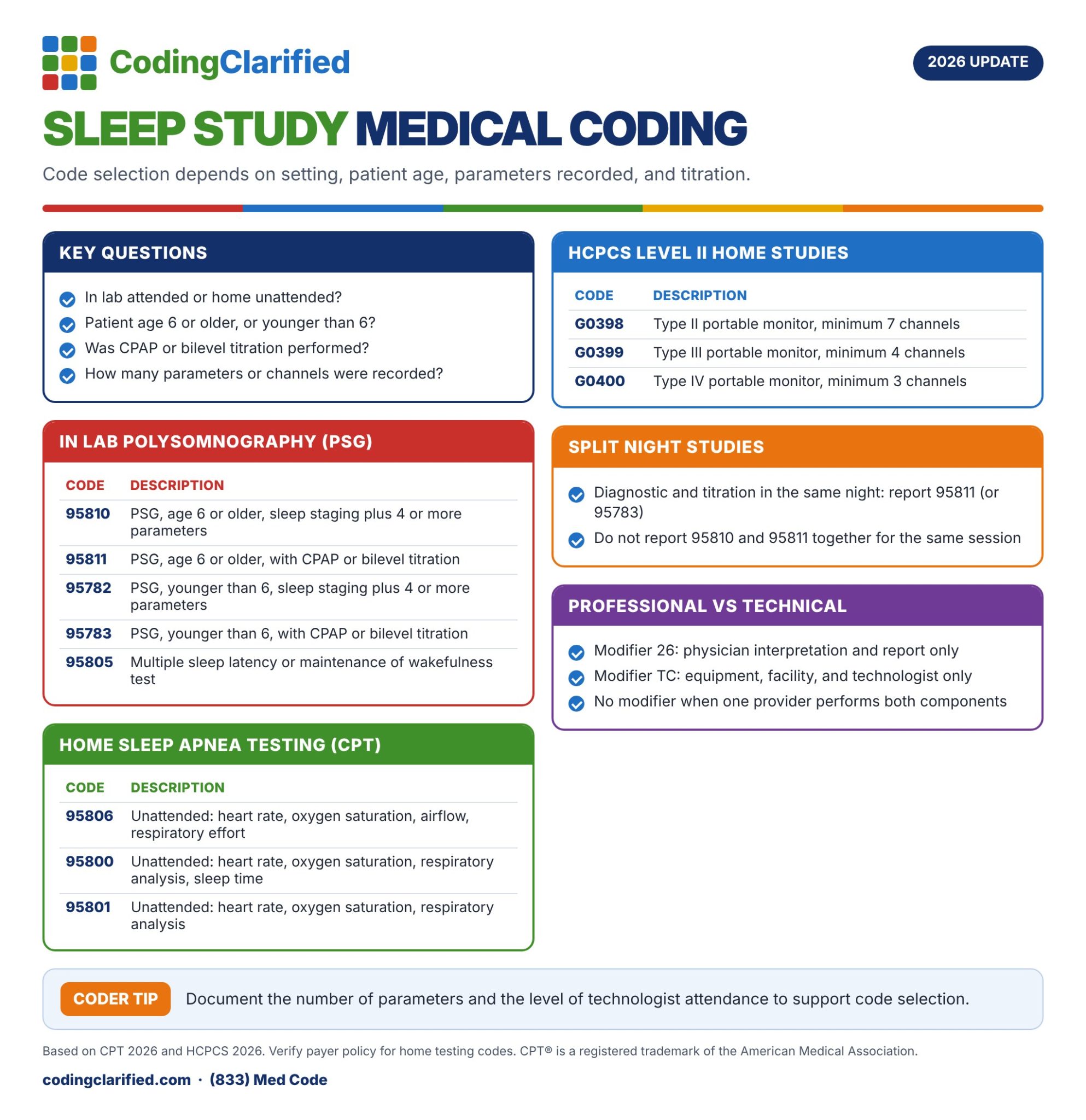
Sleep Study Follow-Up Medical Coding Guide (2026): CPT, ICD-10-CM, HCPCS, Documentation Tips, and CPC Exam Insights
By Janine Mothershed CPC, CPC-I
Key Takeaways
- This encounter represents a follow-up evaluation after diagnostic polysomnography results were reviewed.
- The sleep study ruled out obstructive sleep apnea and significant sleep-disordered breathing.
- Documentation supports psychophysiologic insomnia and excessive daytime sleepiness/fatigue.
- Medication-induced daytime somnolence is an important contributing factor.
- Coders must distinguish between symptoms, confirmed diagnoses, and conditions that were ruled out.
- For CPC exam success, always code confirmed findings first and avoid coding suspected sleep apnea when testing is negative.
- No separately billable HCPCS supplies or medications are documented during this encounter.
Medical Coding for Sleep Study Follow-Up Visits in 2026
Sleep medicine coding continues to evolve as providers increasingly evaluate patients for insomnia, fatigue, daytime somnolence, and suspected sleep apnea. However, not every sleep study confirms obstructive sleep apnea (OSA).
In this real-world coding scenario, a 48-year-old female returns to review the results of an overnight sleep study. Although she initially presented with symptoms suggestive of sleep apnea, the study ultimately revealed no significant sleep-disordered breathing. Instead, the physician identifies psychophysiologic insomnia, medication-related sedation, and poor sleep hygiene as the primary contributors to her symptoms.
Consequently, coders must carefully review the documentation to determine which diagnoses are supported and which should not be reported.
Clinical Summary
The patient returns after undergoing overnight polysomnography to evaluate:
- Daytime fatigue
- Daytime sleepiness
- Insomnia
- Sleep disruption
- History of snoring
- Prior nocturnal choking episodes
The sleep study demonstrated:
- No significant sleep apnea
- No REM sleep
- No periodic limb movement disorder
- Intermittent inspiratory flow limitation compatible with snoring
- Oxygen saturation remained stable
The physician concluded that symptoms were multifactorial and related primarily to:
- Psychophysiologic insomnia
- Sedating medications
- Smoking-related sleep disruption
- Poor sleep hygiene
CPT Coding
CPT Code Selection
99214 — Office or Other Outpatient Visit for the Evaluation and Management of an Established Patient
Rationale:
This is an established patient follow-up visit involving:
- Review of diagnostic testing
- Detailed assessment of sleep study findings
- Medication review
- Risk assessment
- Counseling regarding insomnia
- Sleep hygiene education
- Discussion of psychiatric medication effects
Under current E/M guidelines, medical decision-making supports reporting 99214 because the provider:
- Reviewed a diagnostic sleep study
- Evaluated multiple chronic conditions
- Discussed medication management considerations
- Developed a treatment plan
Therefore, 99214 is the most appropriate CPT code for this encounter.
Final CPT Code
- 99214
ICD-10-CM Coding
Primary Diagnosis
F51.04 Psychophysiologic Insomnia
Why?
The provider specifically documents:
“The patient has a component of psychophysiologic insomnia.”
Because the diagnosis is clearly stated in the assessment and plan, it becomes the primary diagnosis for this visit.
Secondary Diagnosis
R53.83 Other Fatigue
The patient repeatedly reports:
- Morning fatigue
- Daytime fatigue
- Feeling tired despite sleep
These symptoms were evaluated and addressed during the encounter.
R40.0 Somnolence
Documentation supports:
- Daytime sleepiness
- Falling asleep while reading
- Falling asleep while watching television
- Frequent napping
The physician specifically addresses daytime sedation from medications.
R06.83 Snoring
The sleep study notes:
- Inspiratory flow limitation
- Snoring
Additionally, family members report hearing snoring during sleep.
F17.210 Nicotine Dependence, Cigarettes, Uncomplicated
The physician specifically identifies smoking as contributing to sleep disruption and counsels avoidance of nicotine during evening hours.
F32.A Depression, Unspecified
The patient’s depression is documented as an active condition and continues to affect treatment planning.
Z79.891 Long-Term (Current) Use of Opiate Analgesic
The patient remains on methadone maintenance therapy.
This diagnosis supports the physician’s discussion regarding medication-induced sedation.
Conditions NOT Coded
One of the most important CPC exam lessons from this case is understanding what NOT to code.
Do Not Code Obstructive Sleep Apnea
Not Reported:
G47.33
Although the patient underwent testing for sleep apnea, the study demonstrated:
- Less than one event per hour
- No significant sleep-disordered breathing
Since the condition was ruled out, it cannot be coded.
Do Not Code Periodic Limb Movement Disorder
Not Reported:
G47.61
The sleep study specifically states:
“The patient had no periodic limb movements during sleep.”
Therefore, no diagnosis code is assigned.
Coding Clarified Final Coding Summary
CPT
- 99214
ICD-10-CM
- F51.04 Psychophysiologic insomnia
- R53.83 Other fatigue
- R40.0 Somnolence
- R06.83 Snoring
- F17.210 Nicotine dependence, cigarettes, uncomplicated
- F32.A Depression, unspecified
- Z79.891 long term use of opiate analgesic
HCPCS
- None supported by documentation
Coding Rationales Explained
Many coders incorrectly focus on the sleep study itself. However, this encounter is not the sleep study procedure.
Instead, it is the follow up visit where the physician:
- Interprets findings
- Discusses results
- Evaluates symptoms
- Reviews medications
- Provides treatment recommendations
As a result, the E/M service becomes the primary coding focus.
Furthermore, coders should always remember that negative testing results do not justify coding a disease that was ruled out.
CPC Exam Tips
Tip #1: Code Confirmed Diagnoses First
Always assign confirmed diagnoses documented in the assessment and plan before symptom codes whenever possible.
Tip #2: Do Not Code Ruled-Out Conditions
For outpatient encounters, suspected or ruled-out conditions are not coded.
This is a frequent CPC exam trap.
Tip #3: Review the Assessment Carefully
Many students focus only on the history section.
However, the assessment and plan often contain the provider’s final diagnosis.
Tip #4: Watch for Medication-Induced Symptoms
Medication side effects frequently explain fatigue, dizziness, insomnia, and somnolence.
Always review medication discussions in the plan.
Tip #5: Sleep Studies Do Not Automatically Mean Sleep Apnea
A patient can undergo polysomnography and still not have OSA.
Therefore, coders must rely on the final interpretation.
Common Mistakes to Avoid
Coding Sleep Apnea When Testing Is Negative
This is the most common error in sleep medicine coding.
Always review the final sleep study interpretation.
Coding Every Historical Condition
The patient has multiple historical conditions, including hepatitis C and substance abuse.
However, not every historical diagnosis affected treatment during this encounter.
Only report diagnoses that meet reporting requirements.
Missing Medication-Related Somnolence
The physician clearly documents that methadone, trazodone, and Seroquel contribute to daytime sedation.
Many coders overlook this important clinical relationship.
Selecting a Lower-Level E/M Code
Because diagnostic testing was reviewed and treatment recommendations were provided, many coders incorrectly select 99213 instead of 99214.
Always evaluate medical decision-making carefully.
2026 Documentation Tips for Sleep Medicine Coders
As payer scrutiny continues in 2026, providers should clearly document:
- Sleep study findings
- Final diagnoses
- Sleep hygiene recommendations
- Medication-related sleep disturbances
- Daytime functioning limitations
- Diagnostic interpretation
Better documentation ultimately supports cleaner claims and fewer denials.
Additional Coding Clarified Resources
Continue your sleep medicine and evaluation & management coding education with these related articles:
- Medical Coding Obesity
- Medical Coding Chronic Obstructive Pulmonary Disease (COPD)
- Medical Coding for Nicotine & Tobacco Use: ICD-10-CM Guidelines, Documentation Tips, and CPT Coding (2026 Update)
- Medical Coding Asthma
- Medical Coding Remote Patient Monitoring (RPM) and Remote Therapeutic Monitoring (RTM)
Additional coding guidance can also be found through the official resources from the AAPC website and Centers for Medicare & Medicaid Services.
Additional Authoritative Resources
Because sleep medicine coding, insomnia documentation, and evaluation and management (E/M) services continue to evolve, coders should regularly review guidance from trusted industry organizations. The following resources can help reinforce the concepts discussed in this case study and provide additional education on sleep disorders, documentation requirements, and coding compliance.
Centers for Medicare & Medicaid Services (CMS)
Medicare Coverage for Sleep Studies
CMS provides guidance regarding sleep testing, medical necessity requirements, and coverage considerations for diagnostic sleep studies used to evaluate sleep-related breathing disorders.
CMS Local Coverage Determinations (LCDs) for Polysomnography and Sleep Testing
Evaluation and Management (E/M) Services
Since this encounter was coded with CPT® 99214, coders should stay current on Medicare’s E/M documentation requirements and medical decision-making guidelines.
CMS Evaluation and Management Services Guide
Medicare Learning Network (MLN)
The Medicare Learning Network offers educational materials covering documentation, compliance, medical necessity, and outpatient coding.
Frequently Asked Questions
What CPT code is used for a sleep study follow-up visit?
In this scenario, 99214 is supported because the physician reviewed diagnostic testing, evaluated multiple conditions, discussed medication effects, and developed a treatment plan.
Can I code obstructive sleep apnea if the patient was tested for it?
No. Since the sleep study was negative for significant sleep-disordered breathing, G47.33 should not be reported.
Is snoring coded separately?
Yes. When documented and clinically evaluated, R06.83 may be assigned.
Can fatigue and somnolence both be coded?
Yes. Fatigue (R53.83) and somnolence (R40.0) represent distinct symptoms and are both addressed during the encounter.
Why is psychophysiologic insomnia coded?
The provider specifically identifies psychophysiologic insomnia as a contributor to the patient’s sleep disruption, supporting F51.04.
Are HCPCS codes required for this encounter?
No. The documentation does not support any separately reportable HCPCS Level II supplies, medications, or services.
What is the most common CPC exam mistake in sleep medicine coding?
The most common mistake is assigning sleep apnea when diagnostic testing was negative.
How can providers improve documentation for sleep medicine visits?
Providers should clearly document sleep study interpretations, final diagnoses, treatment recommendations, medication effects, and sleep hygiene counseling to support accurate coding and reimbursement.
Coding Clarified Final Thoughts
This sleep study follow-up encounter demonstrates why coders must focus on documented conclusions rather than suspected conditions. Although the patient underwent testing for sleep apnea, the provider ultimately diagnosed psychophysiologic insomnia, daytime somnolence, and fatigue related to sleep disruption and sedating medications. Consequently, accurate code selection requires careful review of the sleep study findings, assessment, and treatment plan. For CPC students and experienced coders alike, this case serves as an excellent reminder that the provider’s final documented diagnosis always drives coding accuracy.
HCPCS Modifier RE indicates that a drug, biological, or service was furnished in full compliance with an FDA-mandated Risk Evaluation and Mitigation Strategy (REMS).
Key Details for Coders
Primary Purpose: It proves to Medicare and other payers that the provider met strict FDA safety protocols required for dispensing or administering high-risk medications.
Application: It can generally be appended to any HCPCS or CPT procedure code that is associated with a REMS drug or service.
Reimbursement: While it doesn’t always guarantee higher payment, omitting it can lead to claim denials or audits if the payer requires REMS compliance for the specific drug being billed