Medical Coding for Long-Term Drug Therapy in 2026: ICD-10-CM Guidelines, Z79 Codes, Documentation Tips, and CPC Exam Insights
By Janine Mothershed CPC, CPC-I
Learn how to code long-term drug therapy in 2026 using ICD-10-CM category Z79. Includes Z79.4, Z79.84, Z79.85, Z79.899, documentation tips, coding examples, CMS guidance, common mistakes, and CPC exam strategies.
Key Takeaways
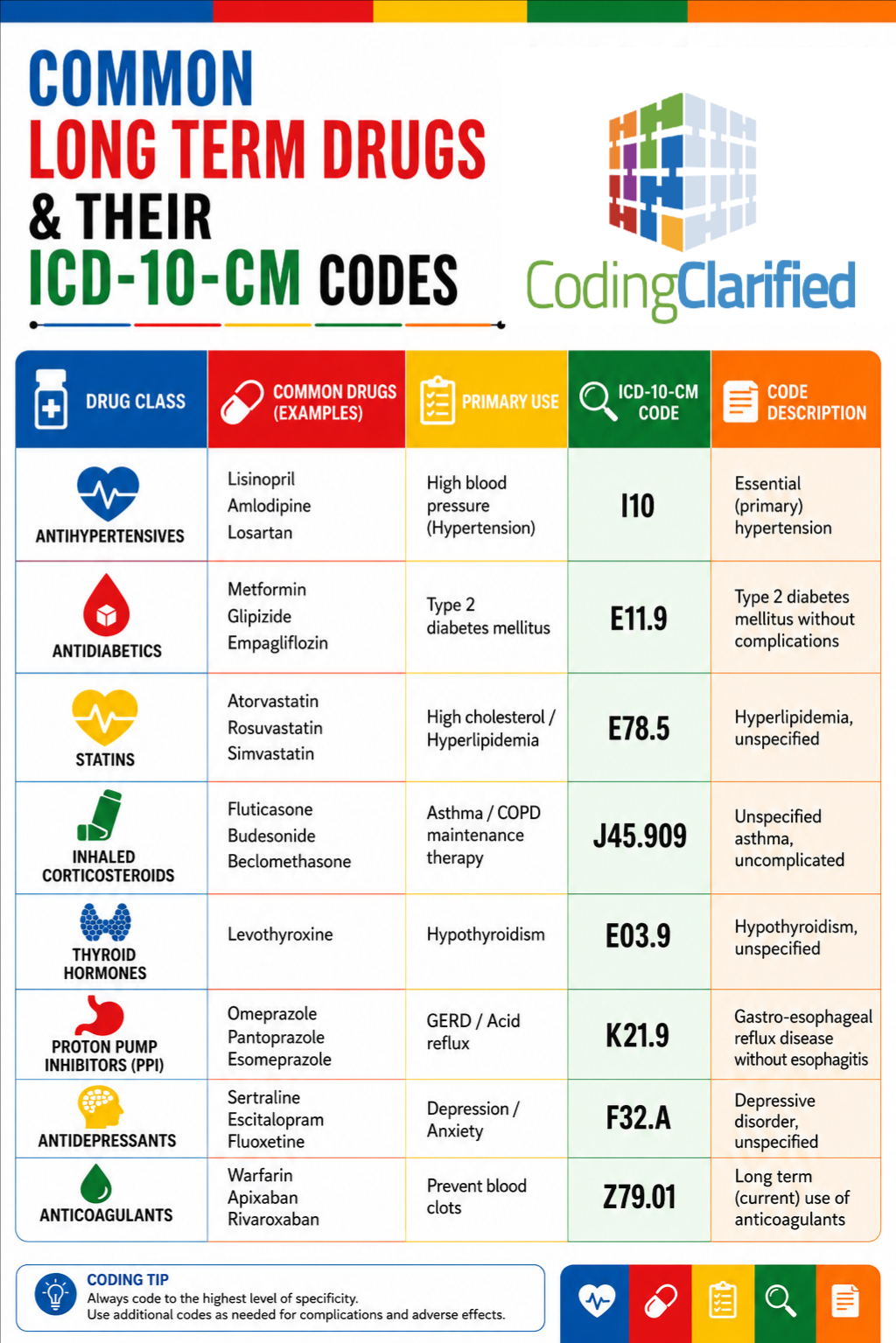
- Category Z79 identifies a patient’s long-term (current) use of medications prescribed for chronic conditions or prophylactic treatment.
- Long-term drug therapy codes help support medical necessity, risk adjustment, quality reporting, and accurate reimbursement.
- Coders should assign specific Z79 codes whenever available rather than defaulting to Z79.899.
- Long-term medication use generally refers to medications taken continuously for more than three months.
- Temporary medication use for acute illnesses should not be reported with Z79 codes.
- Documentation should clearly identify the medication, indication, duration, and whether the use is ongoing.
- Diabetes coding has unique requirements involving Z79.4, Z79.84, and Z79.85.
- CPC exam candidates should understand when Z79 codes are appropriate and when they should not be reported.
Understanding Medical Coding for Long-Term Drug Therapy in ICD-10-CM
Accurate medical coding remains essential for healthcare reimbursement, quality reporting, risk adjustment, and regulatory compliance. In 2026, coders continue to encounter documentation involving patients who take medications for months or even years to manage chronic diseases, prevent complications, or maintain therapeutic outcomes.
Consequently, understanding the proper use of long-term drug therapy codes is critical. Although many coders recognize Z79.899, Other long-term (current) drug therapy, selecting the most specific code available often improves coding accuracy and supports medical necessity.
Furthermore, proper reporting of long-term drug therapy helps paint a complete clinical picture of the patient. This information may affect treatment decisions, Hierarchical Condition Category (HCC) risk adjustment documentation, quality measures, and payer audits.
What Is Long-Term Drug Therapy?
Long-term drug therapy refers to the continuous or ongoing use of prescribed medication for the treatment of a chronic condition, prevention of disease progression, or prophylactic purposes.
Generally, healthcare providers consider medication use lasting longer than three months to be long-term therapy.
Common examples include:
- Insulin for diabetes management
- Anticoagulants following thrombotic events
- Aspirin therapy for cardiovascular disease prevention
- Methotrexate for rheumatoid arthritis
- Inhaled corticosteroids for asthma
- Oral hypoglycemic medications for Type 2 diabetes
- Hormonal therapies for breast cancer treatment
- Immunosuppressants following organ transplantation
Additionally, many patients receive long-term medications to prevent future complications rather than actively treat an existing condition.
Why Long-Term Drug Therapy Coding Matters
Accurate reporting of long-term medication use provides several benefits.
First, it demonstrates the complexity of patient management. Second, it supports the medical necessity of diagnostic testing and follow-up services. Third, it assists healthcare organizations in documenting chronic disease severity.
Moreover, many payers review medication histories during audits. Therefore, missing or inaccurate Z79 coding may result in incomplete clinical documentation.
Benefits of proper coding include:
- Improved claim accuracy
- Enhanced risk adjustment reporting
- Better quality measure compliance
- Stronger medical necessity support
- Reduced audit risk
- More complete patient records
ICD-10-CM Category Z79: Long-Term (Current) Drug Therapy
The ICD-10-CM category Z79 identifies patients receiving medications on a continuous basis for chronic treatment or prophylactic purposes.
According to ICD-10-CM Official Guidelines, these codes are appropriate when a patient receives medication:
- For a chronic condition
- For disease prevention
- For prolonged treatment
- For ongoing maintenance therapy
However, these codes should not be assigned when medications are prescribed temporarily for acute illnesses or injuries.
Appropriate Use Examples
- Arthritis treated with methotrexate
- Diabetes treated with insulin
- Long-term anticoagulation therapy
- Cancer treatment requiring hormonal therapy
- Long-term aspirin therapy
Inappropriate Use Examples
- Seven-day antibiotic treatment for acute bronchitis
- Short-term pain medication following surgery
- Temporary insulin use during hospitalization for glucose stabilization
2026 ICD-10-CM Long-Term Drug Therapy Codes
The following are some of the most commonly reported long-term drug therapy codes:
| ICD-10-CM Code | Description |
|---|---|
| Z79.01 | Long-term use of anticoagulants |
| Z79.02 | Long-term use of antithrombotics/antiplatelets |
| Z79.1 | Long-term use of NSAIDs |
| Z79.2 | Long-term use of antibiotics |
| Z79.3 | Long-term use of hormonal contraceptives |
| Z79.4 | Long-term use of insulin |
| Z79.51 | Long-term use of inhaled steroids |
| Z79.52 | Long-term use of systemic steroids |
| Z79.810 | Long-term use of selective estrogen receptor modulators |
| Z79.811 | Long-term use of aromatase inhibitors |
| Z79.818 | Long-term use of other agents affecting estrogen receptors and estrogen levels |
| Z79.82 | Long-term use of aspirin |
| Z79.83 | Long-term use of bisphosphonates |
| Z79.84 | Long-term use of oral hypoglycemic drugs |
| Z79.85 | Long-term use of injectable non-insulin antidiabetic drugs |
| Z79.891 | Long-term use of opiate analgesics |
| Z79.899 | Other long-term (current) drug therapy |
Coding Tip
Whenever a specific Z79 code exists, assign it instead of defaulting to Z79.899.
Diabetes Coding and Long-Term Drug Therapy
One of the most frequently tested areas on the CPC exam involves diabetes coding and medication use.
The ICD-10-CM guidelines require additional Z79 codes to identify long-term treatment methods.
Type 2 Diabetes with Insulin
Report:
- E11.-
- Z79.4
Type 2 Diabetes with Oral Hypoglycemics
Report:
- E11.-
- Z79.84
Type 2 Diabetes with Injectable Non-Insulin Drugs
Report:
- E11.-
- Z79.85
Combination Therapy
When documentation supports multiple therapies, assign multiple codes.
Example:
A patient with Type 2 diabetes takes insulin and metformin.
Report:
- E11.9
- Z79.4
- Z79.84
Importantly, Z79.4 should not be assigned when insulin is administered temporarily to bring blood glucose under control during a single encounter.
Common Conditions Associated with Long-Term Drug Therapy
Coders frequently encounter long-term medication use in patients diagnosed with:
- Diabetes mellitus
- Hypertension
- Coronary artery disease
- Chronic obstructive pulmonary disease (COPD)
- Asthma
- Rheumatoid arthritis
- Lupus
- Organ transplant status
- Osteoporosis
- Breast cancer
- Chronic pain disorders
Therefore, reviewing medication lists alongside provider documentation can help identify appropriate secondary diagnosis coding opportunities.
Documentation Requirements for Long-Term Drug Therapy Coding
Accurate documentation is the foundation of proper ICD-10-CM coding. Even when a medication appears on the patient’s medication list, coders should ensure that the provider documents its ongoing use and clinical relevance to the encounter.
Additionally, supporting documentation should identify:
- The medication name
- The condition being treated
- Whether the therapy is ongoing
- Whether the medication is prophylactic or therapeutic
- Any medication monitoring performed during the encounter
For example, a provider documenting “Type 2 diabetes controlled on long-term insulin therapy” clearly supports assignment of both E11.9 and Z79.4.
Conversely, if the medication history merely lists insulin without confirming ongoing use, additional clarification may be necessary based on facility policy.
Documentation Example
Provider Note:
“Patient continues warfarin therapy for history of recurrent deep vein thrombosis. INR reviewed and medication management discussed.”
Appropriate coding may include:
- Z86.718 Personal history of other venous thrombosis and embolism
- Z79.01 Long-term (current) use of anticoagulants
Because the medication directly impacts patient management, reporting the long-term drug therapy code helps communicate the patient’s clinical status.
When Should Z79 Codes Be Reported?
Many coders struggle with determining when long-term drug therapy codes should be assigned.
Generally, assign a Z79 code when:
- Medication use is ongoing
- The drug is prescribed for chronic treatment
- The medication is used for prophylaxis
- Documentation confirms long-term use
On the other hand, do not assign a Z79 code when:
- Medication is prescribed temporarily
- Treatment is for an acute illness only
- Drug use is related to substance abuse, dependence, or detoxification programs
- Documentation does not support current long-term use
As a result, reviewing the treatment plan carefully is essential before assigning any Z79 code.
Understanding Z79.899: Other Long-Term (Current) Drug Therapy
For many coders, Z79.899 is one of the most frequently reported codes in the category.
This code serves as a catch-all option when a more specific long-term therapy code does not exist.
Coding Clinic guidance has supported the use of Z79.899 for various medications, including:
- Injectable non-insulin diabetic medications (before creation of Z79.85)
- Immunosuppressive therapies
- Fluticasone (Flonase)
- Biologic agents
- Certain disease-modifying antirheumatic drugs (DMARDs)
Furthermore, this code may apply to numerous specialty medications used in rheumatology, oncology, dermatology, gastroenterology, and transplant medicine.
Common Examples Supporting Z79.899
- Long-term methotrexate therapy
- Long-term Humira therapy
- Long-term Remicade therapy
- Long-term hydroxychloroquine use
- Long-term immunotherapy
- Long-term antiviral therapy
- Long-term antidepressant therapy
- Long-term antipsychotic therapy
However, coders should always verify whether a more specific Z79 code exists before assigning Z79.899.
Common Long-Term Drug Therapy Categories
Anticoagulants
Patients receiving warfarin, Eliquis, Xarelto, Pradaxa, or similar medications often qualify for:
Z79.01 Long-term (current) use of anticoagulants
These medications are commonly prescribed for:
- Atrial fibrillation
- Deep vein thrombosis
- Pulmonary embolism
- Mechanical heart valves
Antiplatelet Therapy
Patients taking medications such as Plavix may qualify for:
Z79.02 Long-term (current) use of antithrombotics/antiplatelets
Aspirin Therapy
Patients receiving long-term aspirin therapy may qualify for:
Z79.82 Long-term (current) use of aspirin
Steroid Therapy
For inhaled corticosteroids:
Z79.51 Long-term (current) use of inhaled steroids
For systemic corticosteroids:
Z79.52 Long-term (current) use of systemic steroids
Diabetes Medications
Diabetes management often involves:
- Z79.4 Long-term (current) use of insulin
- Z79.84 Long-term (current) use of oral hypoglycemic drugs
- Z79.85 Long-term (current) use of injectable non-insulin antidiabetic drugs
Chronic Pain Management
Patients receiving long-term opioid treatment may qualify for:
Z79.891 Long-term (current) use of opiate analgesic
Importantly, this code does not indicate opioid abuse or dependence.
Coding Scenarios and Examples
Scenario 1: Type 2 Diabetes on Insulin
Clinical Documentation
Patient presents for diabetic follow-up. Type 2 diabetes remains stable. Continues long-term insulin therapy.
Codes
- E11.9 Type 2 diabetes mellitus without complications
- Z79.4 Long-term (current) use of insulin
Scenario 2: Chronic Anticoagulation
Clinical Documentation
Patient with atrial fibrillation maintained on Eliquis. Medication reviewed and continued.
Codes
- I48.91 Unspecified atrial fibrillation
- Z79.01 Long-term (current) use of anticoagulants
Scenario 3: Rheumatoid Arthritis on Methotrexate
Clinical Documentation
Patient continues methotrexate therapy for rheumatoid arthritis management.
Codes
- M06.9 Rheumatoid arthritis, unspecified
- Z79.899 Other long-term (current) drug therapy
Scenario 4: Osteoporosis Treated with Bisphosphonates
Clinical Documentation
Patient remains on long-term Fosamax therapy.
Codes
- Appropriate osteoporosis diagnosis code
- Z79.83 Long-term (current) use of bisphosphonates
Common Mistakes to Avoid
Even experienced coders make mistakes when assigning long-term drug therapy codes. Fortunately, understanding the most common errors can improve accuracy significantly.
Reporting Z79 Codes for Short-Term Therapy
One of the most common errors involves assigning a Z79 code for medications prescribed temporarily.
For example, a 10-day antibiotic course for acute sinusitis does not support Z79.2.
Automatically Assigning Z79.899
Another frequent mistake is defaulting to Z79.899 when a more specific code exists.
Always review the entire Z79 category before selecting a code.
Missing Diabetes Drug Therapy Codes
Many coders report the diabetes diagnosis but forget the required secondary drug therapy code.
This omission may result in incomplete clinical reporting.
Confusing Chronic Use With Substance Dependence
Long-term prescribed medication use is not the same as substance abuse, dependence, or addiction.
Therefore, Z79 codes should not replace appropriate F11-F19 substance-related disorder codes when applicable.
Ignoring Medication Monitoring Documentation
Medication management often provides important evidence supporting long-term therapy coding.
Review assessment and plan sections carefully.
CPC Student Tips for Exam Success
Long-term drug therapy questions frequently appear on CPC examinations and coding assessments.
To improve exam performance:
Tip #1: Memorize the Most Common Z79 Codes
Focus on:
- Z79.4
- Z79.84
- Z79.85
- Z79.01
- Z79.82
- Z79.891
- Z79.899
Tip #2: Watch for Diabetes Coding Questions
AAPC exam questions frequently test insulin and oral medication combinations.
Remember that multiple Z79 codes may be required.
Tip #3: Look for the Word “Long-Term”
Examination scenarios often include phrases such as:
- Continues therapy
- Chronic medication use
- Maintenance therapy
- Ongoing treatment
These phrases commonly signal the need for a Z79 code.
Tip #4: Eliminate Short-Term Treatment Options
If documentation describes temporary medication use, a Z79 code is generally not appropriate.
Tip #5: Learn Common Medication Classes
Understanding which medications fall into anticoagulants, antiplatelets, steroids, and hypoglycemics can help you identify the correct code quickly.
Additional Resources for Medical Coders
For the most current coding guidance, review these authoritative resources:
CMS ICD-10-CM Official Guidelines
https://www.cms.gov/files/document/fy-2025-icd-10-cm-coding-guidelines.pdf
AAPC Coding Resources
ICD-10-CM Tabular List and Alphabetic Index
https://www.cdc.gov/nchs/icd/icd-10-cm.htm
CMS Medicare Learning Network
https://www.cms.gov/training-education/medicare-learning-network
ICD-10-CM Official Coding Guidelines
Always review the latest annual updates before reporting diagnosis codes.
Related Coding Clarified Resources
To further strengthen your understanding of diagnosis coding, chronic disease management, and documentation requirements, explore these additional Coding Clarified articles:
- Medical Coding for Diabetes Mellitus in 2026
- ICD-10 Medical Coding for Pain
- Medical Coding for Hypertension in 2026
- Medical Coding for Chronic Kidney Disease (CKD)
- Medical Coding and Billing Guidelines for Infusion Services in 2026
These resources provide additional coding scenarios, documentation examples, CPC exam tips, and ICD-10-CM guidance that complement long-term drug therapy coding.
2026 Coding Trends Affecting Long-Term Drug Therapy Documentation
As healthcare continues shifting toward value-based care, risk adjustment, and population health management, documenting long-term medication use has become increasingly important.
Additionally, specialty medications continue to grow rapidly across numerous specialties including:
- Oncology
- Rheumatology
- Endocrinology
- Dermatology
- Gastroenterology
- Neurology
Consequently, coders are seeing more encounters involving biologics, immunotherapies, injectable medications, and advanced pharmaceutical treatments.
Furthermore, artificial intelligence and clinical documentation improvement (CDI) programs increasingly identify medication-related documentation gaps. As a result, providers are being encouraged to document medication management more thoroughly than ever before.
In 2026, coders should continue paying close attention to:
- Long-term medication monitoring
- Medication-related risk factors
- Chronic disease management
- Prophylactic medication use
- Risk adjustment documentation opportunities
- Specificity within the Z79 category
Because payers and auditors increasingly evaluate chronic disease burden and treatment complexity, accurate reporting of long-term drug therapy remains essential.
Why Long-Term Drug Therapy Coding Impacts Reimbursement
Although Z79 codes typically do not drive reimbursement independently, they often provide valuable supporting information that demonstrates treatment complexity and medical necessity.
For example, documentation showing:
- Long-term anticoagulant therapy
- Chronic insulin use
- Long-term immunosuppressive therapy
- Ongoing opioid management
may help explain why certain laboratory testing, follow-up visits, monitoring services, and specialty consultations are medically necessary.
Moreover, these codes contribute to a more complete patient profile, which may support quality initiatives, care management programs, and payer reporting requirements.
Therefore, coders should view long-term drug therapy coding as an important component of comprehensive documentation rather than simply an optional secondary diagnosis.
Quick Reference: Most Common Long-Term Drug Therapy Codes
| Medication Category | ICD-10-CM Code |
|---|---|
| Anticoagulants | Z79.01 |
| Antiplatelets | Z79.02 |
| NSAIDs | Z79.1 |
| Antibiotics | Z79.2 |
| Hormonal Contraceptives | Z79.3 |
| Insulin | Z79.4 |
| Inhaled Steroids | Z79.51 |
| Systemic Steroids | Z79.52 |
| Aspirin Therapy | Z79.82 |
| Bisphosphonates | Z79.83 |
| Oral Hypoglycemics | Z79.84 |
| Injectable Non-Insulin Antidiabetics | Z79.85 |
| Opiate Analgesics | Z79.891 |
| Other Drug Therapy | Z79.899 |
CPC Exam Memory Trick
Think of the most tested codes as:
- Z79.4 = Insulin
- Z79.84 = Oral diabetes medications
- Z79.85 = Injectable non-insulin diabetes medications
- Z79.01 = Blood thinners
- Z79.82 = Aspirin
- Z79.899 = Everything else that lacks a more specific option
Final Takeaway
Long-term drug therapy coding remains an important component of accurate ICD-10-CM reporting in 2026. While many coders immediately think of Z79.899, the entire Z79 category contains numerous codes that provide greater specificity and improve documentation accuracy.
Additionally, coders should remember that these codes are intended for ongoing treatment, chronic disease management, and prophylactic medication use. They should not be assigned for temporary therapies associated with acute illnesses or injuries.
As healthcare documentation continues evolving, understanding when and how to report long-term drug therapy will remain an essential skill for medical coders, auditors, CDI specialists, and CPC exam candidates alike.
Most importantly, always review the provider’s documentation, verify medication duration and purpose, and select the most specific Z79 code available.
Frequently Asked Questions (FAQ)
What is considered long-term drug therapy in ICD-10-CM?
Generally, long-term drug therapy refers to medications taken continuously for more than three months to manage chronic conditions, prevent complications, or provide ongoing maintenance treatment.
When should a Z79 code be assigned?
A Z79 code should be assigned when documentation supports ongoing use of a prescribed medication for chronic treatment or prophylactic purposes.
Can Z79 codes be reported for short-term antibiotic therapy?
No. Temporary medications prescribed for acute illnesses generally do not qualify for reporting from category Z79.
What is the difference between Z79.4 and Z79.84?
Z79.4 identifies long-term insulin use, while Z79.84 identifies long-term use of oral hypoglycemic medications.
Can a patient have multiple Z79 codes?
Yes. Patients receiving multiple long-term medications may require more than one Z79 code.
For example:
- Z79.4 Long-term insulin use
- Z79.84 Long-term oral hypoglycemic drug use
may both be reported when documentation supports combination therapy.
When should Z79.899 be reported?
Z79.899 should be assigned when a patient receives long-term medication therapy and no more specific Z79 code exists.
Examples include:
- Methotrexate
- Biologic agents
- Immunosuppressants
- Certain antidepressants
- Certain antipsychotics
Does long-term drug therapy affect reimbursement?
Although Z79 codes generally do not drive reimbursement independently, they help support medical necessity, treatment complexity, risk adjustment reporting, and overall documentation quality.
Is long-term opioid therapy coded with a Z79 code?
Yes. Patients receiving chronic opioid treatment may qualify for Z79.891, Long-term (current) use of opiate analgesic, when documentation supports ongoing prescribed use.