Medical Coding for Single-Chamber Pacemaker Insertion (2026)
CPT, ICD-10-CM, Documentation, Reimbursement, and CPC Exam Guide
Key Takeaways
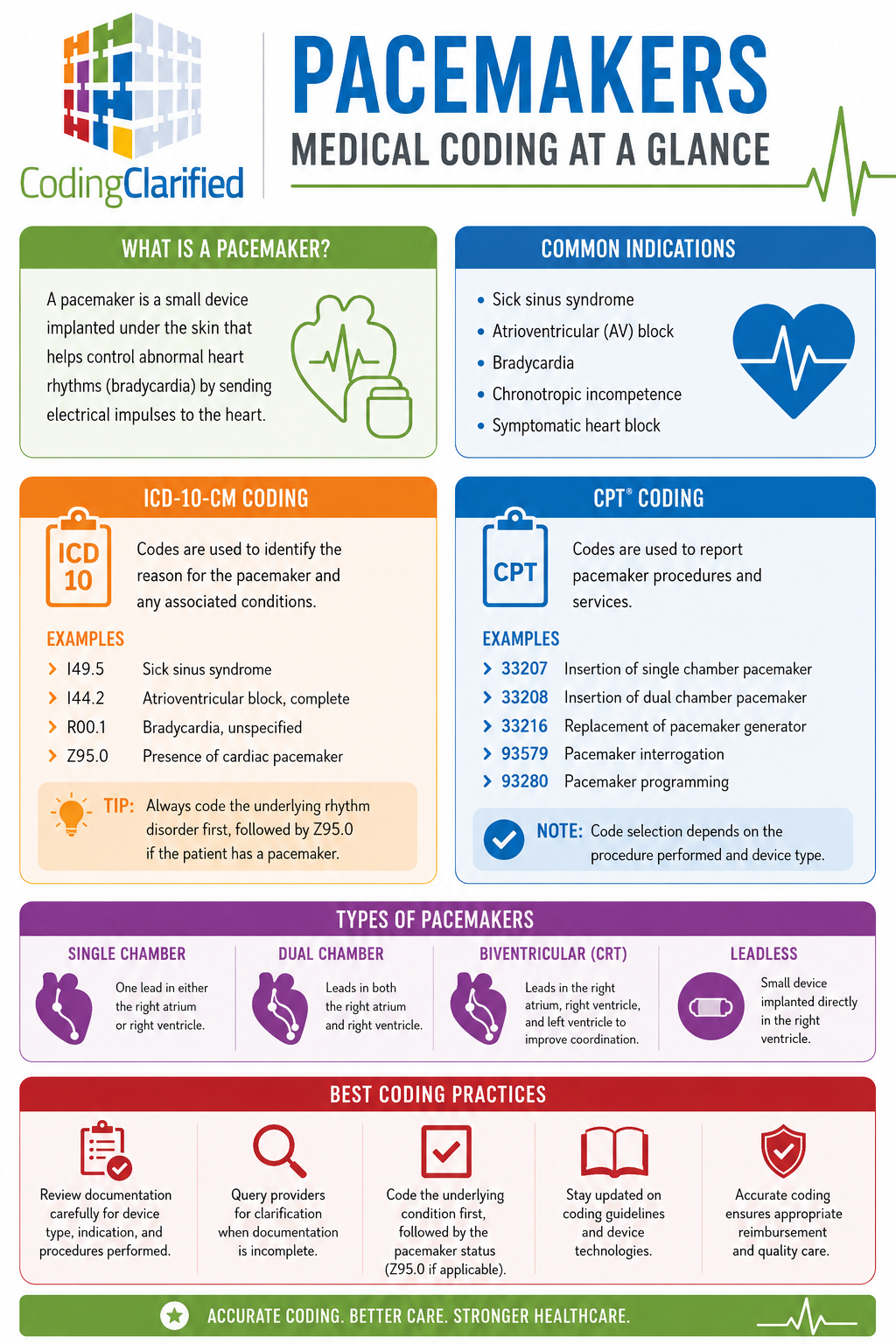
- A single-chamber ventricular pacemaker insertion is commonly reported with CPT 33207.
- Documentation must support transvenous lead placement into the right ventricle.
- Tachy-brady syndrome is one of the most common indications for permanent pacemaker implantation.
- Device interrogation settings, thresholds, sensing values, and lead placement should be documented.
- Chest x-rays performed after implantation are generally considered part of routine postoperative care.
- Proper diagnosis coding affects medical necessity and reimbursement.
- CPC students should understand the difference between single-chamber, dual-chamber, and biventricular pacemaker procedures.
Medical Coding Scenario
Operative Summary
The physician implanted a permanent pacemaker.
The ventricular lead was described as a screw-in, steroid-eluting lead placed into the apex of the right ventricle.
Final device programming included:
- VVIR pacing mode
- Lower rate 60 bpm
- Upper rate 120 bpm
- Amplitude 3.5 volts
- Pulse width 0.4 ms
- Sensitivity 2.8
Testing confirmed:
- Threshold voltage 0.6 volts
- Current 1 mA
- Resistance 600 ohms
- R-wave sensing 11 mV
Fortunately, the patient tolerated the procedure well.
The physician planned:
- Postoperative chest x-ray
- IV antibiotics
- Continued treatment of congestive heart failure
- Continued treatment of tachy-brady arrhythmia
Step 1: Determine the CPT Code
The operative report documents:
- Permanent pacemaker insertion
- Single ventricular lead
- Transvenous placement
- Right ventricular lead implantation
Correct CPT Code
33207 – Insertion of new or replacement of permanent pacemaker with transvenous electrode(s); ventricular
Why CPT 33207?
In this case, the physician implanted a permanent pacemaker.
- One ventricular lead
- No atrial lead
- No dual-chamber system
- No cardiac resynchronization device
Therefore, CPT 33207 accurately describes the service. Additionally, the operative note specifically documents placement of a transvenous lead into the right ventricular apex. As a result, the documentation fully supports reporting a single-chamber ventricular pacemaker insertion. Furthermore, no evidence suggests placement of an atrial lead or a dual-chamber system.
Why Other Pacemaker CPT Codes Do Not Apply
CPT 33206
33206 describes insertion of a permanent pacemaker with atrial electrode only.
More importantly, the operative report clearly documents ventricular lead placement.
Therefore, 33206 is incorrect.
CPT 33208
33208 describes insertion of a dual-chamber pacemaker with both atrial and ventricular leads.
The report documents only a right ventricular lead.
Consequently, 33208 should not be reported.
CPT 33249
33249 describes insertion of an implantable cardioverter-defibrillator (ICD).
No defibrillator capability was documented.
As a result, this code does not apply.
Correct ICD-10-CM Coding
The physician documented:
- Tachy-brady arrhythmia
- Congestive heart failure
Consequently, diagnosis coding should reflect both conditions when supported by the record. In addition, accurate diagnosis coding helps establish medical necessity for pacemaker implantation. Likewise, proper ICD-10-CM selection reduces the risk of denials and reimbursement delays.
Primary Diagnosis
I49.5
Sick sinus syndrome
Tachy-brady syndrome is classified to I49.5.
This is typically the diagnosis supporting medical necessity for pacemaker implantation.
Secondary Diagnosis
I50.9
Heart failure, unspecified
The documentation states congestive heart failure.
If additional documentation identifies:
- Systolic heart failure
- Diastolic heart failure
- Combined heart failure
A more specific ICD-10-CM code should be assigned.
However, based on the available documentation, I50.9 is appropriate.
Final Code Assignment
CPT
| Code | Description |
|---|---|
| 33207 | Single-chamber permanent pacemaker insertion with ventricular lead |
ICD-10-CM
| Code | Description |
| I49.5 | Sick sinus syndrome (tachy-brady syndrome) |
| I50.9 | Heart failure, unspecified |
Are There Any HCPCS Codes?
In this scenario, no additional HCPCS Level II code is separately reportable by the physician.
The pacemaker generator and lead are generally billed by the hospital facility using the appropriate revenue and device reporting requirements.
Therefore, physician coding consists primarily of:
- CPT 33207
- Associated ICD-10-CM diagnoses
Documentation Requirements for 2026
CMS and commercial payers continue to focus heavily on device implantation documentation.
Therefore, providers should document:
- Medical necessity
- Arrhythmia diagnosis
- Lead location
- Lead type
- Device type
- Threshold testing
- Sensing measurements
- Programming parameters
- Complications or lack of complications
Moreover, complete documentation helps support reimbursement and compliance. At the same time, detailed operative notes help coders defend code selection during audits. For this reason, providers should ensure all device settings and testing results are recorded before finalizing the operative report.
Coding Tips for Single-Chamber Pacemakers
When coding pacemaker procedures, always determine the number of leads implanted.
First, identify whether one or more leads were inserted. Next, verify the location of each lead. Afterward, determine whether the device was newly implanted or replaced. Finally, review the entire operative report for any additional procedures performed during the same encounter.
By following these steps, coders can significantly reduce coding errors. Additionally, this approach improves coding accuracy and audit readiness.
How many leads were implanted?
One lead generally indicates a single-chamber system.
Two leads generally indicate a dual-chamber system.
Where were the leads placed?
Common locations include:
- Right atrium
- Right ventricle
Was the system new or replaced?
Replacement procedures often require different CPT codes.
Was an ICD implanted?
Pacemakers and defibrillators use different code families.
Consequently, careful review of the operative report is essential.
Common Mistakes to Avoid
Mistake #1: Coding a Dual-Chamber Device
Many coders automatically assume pacemakers are dual chamber.
However, this operative note documents only one ventricular lead.
However, this operative note documents only one ventricular lead. Therefore, reporting 33208 would be inappropriate. Instead, the documentation supports 33207.
Mistake #2: Missing Tachy-Brady Syndrome
Some coders assign only a general arrhythmia code.
Instead, the physician specifically documented tachy-brady syndrome.
Nevertheless, the physician specifically documented tachy-brady syndrome. Consequently, I49.5 provides the most accurate diagnosis assignment. More importantly, diagnosis specificity strengthens medical necessity.
Mistake #3: Reporting Postoperative Chest X-Rays
Routine postoperative imaging is generally not separately billable by the implanting physician.
Although a chest x-ray may be ordered after pacemaker placement, it is frequently considered routine postoperative care. Therefore, coders should carefully review payer policies before reporting additional services.
Mistake #4: Confusing Pacemakers and ICDs
Pacemakers regulate heart rhythm.
ICDs also provide defibrillation therapy.
Consequently, the coding differs significantly.
CPC Student Tips
For CPC exam success, focus on identifying the device type before reviewing the CPT code range. Next, determine the number of leads documented. Then, verify whether the procedure involved a new insertion, replacement, revision, or removal. Additionally, pay close attention to terminology such as single chamber, dual chamber, ICD, and CRT device. Ultimately, these details often determine the correct code selection.
CPC Tip #1
Look for keywords:
- Single chamber
- Dual chamber
- Biventricular
- ICD
- Lead insertion
These terms often determine the correct code.
CPC Tip #2
If only one ventricular lead is documented, consider 33207 first.
CPC Tip #3
Always verify whether the procedure involves:
- New insertion
- Generator replacement
- Lead revision
- Lead removal
The CPT code changes based on the service performed.
CPC Tip #4
Review the entire operative report before selecting a code.
Lead placement details frequently appear near the end of the report.
2026 Reimbursement and Compliance Updates
For 2026, payers continue to scrutinize cardiac device claims.
As a result, documentation accuracy remains essential. Furthermore, providers should clearly establish medical necessity before implantation. Likewise, diagnosis coding should reflect the highest level of specificity supported by the medical record. Meanwhile, CMS and commercial payers continue to focus on proper documentation of device testing and programming parameters. Consequently, incomplete documentation may increase the risk of denials and audit findings.
Related Coding Clarified Articles
For additional cardiovascular and coding education, review:
- Coronary Artery Disease (CAD) Medical Coding
- Angiography & Cardiac Catheterization Coding “Clarified” Scenario
- EKG/ECG CPT & ICD-10 Coding (2026 Update)
- Medical Coding “Clarified” Chest Tube Insertion
- Medical “Clarified” Coding For Angina
More articles are available at:
Authoritative Resources
- American Academy of Professional Coders (AAPC)
- Centers for Medicare & Medicaid Services (CMS)
- National Library Of Medicine
- American College of Cardiology
Frequently Asked Questions
What CPT code is used for a single-chamber ventricular pacemaker insertion?
The correct code is 33207 when a new permanent pacemaker is implanted with a transvenous ventricular lead.
What ICD-10-CM code is used for tachy-brady syndrome?
The appropriate diagnosis code is I49.5 for sick sinus syndrome.
Does CPT 33207 include lead placement?
Yes. The code includes insertion of the ventricular lead and implantation of the pacemaker system.
Can CPT 33208 be reported for this case?
No. 33208 requires both an atrial and ventricular lead. This operative report documents only a ventricular lead.
Is postoperative chest x-ray separately reportable?
Routine postoperative chest x-rays are generally not separately billable by the implanting physician.
What pacing mode was documented in this scenario?
The physician programmed the device to VVIR mode with a lower rate of 60 bpm and an upper rate of 120 bpm.
What diagnosis usually supports medical necessity for a pacemaker?
Common diagnoses include I49.5 (sick sinus syndrome), symptomatic bradycardia, heart block, and tachy-brady syndrome.
What is the most common CPC exam mistake involving pacemaker coding?
Many students mistakenly code a dual-chamber device when documentation supports only a single ventricular lead. Always verify the number and location of leads before selecting a CPT code.
Final Coding Answer
CPT
33207
ICD-10-CM
I49.5 – Sick sinus syndrome (tachy-brady syndrome)
I50.9 – Heart failure, unspecified
HCPCS
No separately reportable physician HCPCS code supported by the documentation.
Coding Rationale
The physician implanted a new permanent single-chamber ventricular pacemaker using a transvenous right ventricular lead. The documented medical necessity is tachy-brady syndrome (I49.5) with concurrent congestive heart failure (I50.9). The operative note fully supports reporting CPT 33207.