Medical coding continues to evolve every year. New regulations, annual code updates, artificial intelligence (AI), payer policy changes, and increased documentation requirements all affect how coders perform their work. Therefore, staying current is no longer optional. It is one of the most important skills every medical coder can develop.
Whether you’re preparing for the CPC® exam, working in a physician office, hospital, outpatient facility, or remote coding position, understanding today’s medical coding trends can improve coding accuracy, reduce claim denials, and strengthen your career opportunities.
This 2026 guide explains the latest medical coding trends, best practices, employer expectations, and practical strategies every coder should know.
Key Takeaways on Medical Coding Trends in 2026
- Medical coding continues to change because of annual ICD-10-CM, CPT®, and HCPCS updates.
- AI is becoming a valuable coding assistant but cannot replace experienced medical coders.
- Documentation quality remains the foundation of accurate coding.
- Audits, compliance, and payer-specific rules continue to increase.
- Remote coding jobs remain popular, but employers expect stronger coding accuracy than ever before.
- Continuous education helps coders remain competitive in today’s healthcare industry.
Why Medical Coding Continues to Change in 2026
Healthcare never stays the same. Every year, new diseases, treatments, technologies, and government regulations require updates to medical coding systems.
As a result, medical coders must learn new guidelines while continuing to apply existing coding principles correctly.
Several factors are driving changes in 2026:
- Annual ICD-10-CM code revisions
- Annual CPT® code changes published by the AMA
- New HCPCS Level II updates
- Artificial intelligence coding tools
- Increased payer audits
- Value-based healthcare initiatives
- More detailed provider documentation requirements
- Expanded telehealth services
- Increased use of electronic health records (EHRs)
Organizations that invest in coder education often experience fewer denials, better reimbursement, and improved compliance.
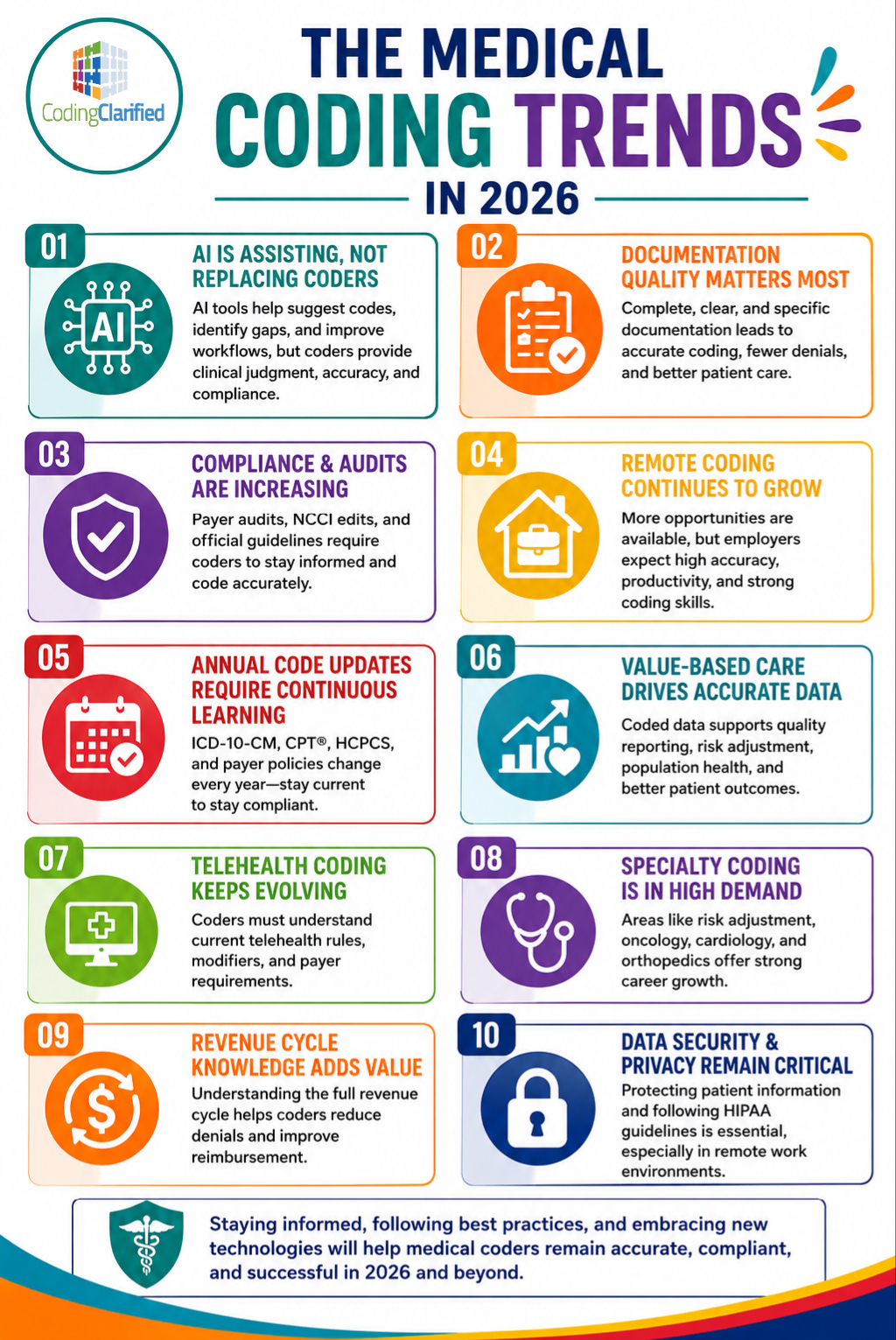
Trend #1: Artificial Intelligence Is Assisting—Not Replacing—Medical Coders
Artificial intelligence continues to receive significant attention throughout healthcare. While some fear AI will replace coders, the reality is much different.
Today’s AI systems can:
- Suggest diagnosis codes
- Recommend procedure codes
- Identify documentation gaps
- Flag possible compliance concerns
- Improve coding workflow
However, AI still struggles with:
- Medical necessity
- Complex coding guidelines
- Sequencing rules
- Clinical judgment
- Modifier selection
- Payer-specific requirements
Experienced coders remain essential because they understand coding guidelines that AI cannot consistently interpret.
For example, selecting the proper diagnosis between E11.9, E11.65, or E11.22 requires reviewing provider documentation, Official Coding Guidelines, and clinical context—not simply choosing the first suggested code.
Instead of replacing coders, AI is becoming another productivity tool.
2026 Best Practice
Learn how AI coding software works, but always verify every suggested code before submission.
Trend #2: Documentation Quality Matters More Than Ever
Medical coders can only code what providers document.
Unfortunately, incomplete documentation remains one of the leading causes of claim denials.
Common documentation issues include:
- Missing laterality
- Unspecified diagnoses
- Incomplete procedure descriptions
- Missing physician signatures
- Missing medical necessity
- Lack of treatment details
For example, instead of documenting:
Knee pain
Providers should document:
Primary osteoarthritis of the right knee with chronic pain requiring corticosteroid injection.
That level of documentation supports far more accurate code selection.
Better documentation leads to:
- Cleaner claims
- Fewer payer denials
- Improved compliance
- Better quality reporting
- More accurate reimbursement
Trend #3: Coding Compliance Remains a Top Priority
Government agencies and commercial insurance companies continue increasing auditing efforts.
Medical coders should understand:
- National Correct Coding Initiative (NCCI) edits
- Official ICD-10-CM Coding Guidelines
- Medicare billing requirements
- Local Coverage Determinations (LCDs)
- National Coverage Determinations (NCDs)
- Modifier usage
- Documentation standards
Compliance isn’t simply avoiding fraud.
Rather, it ensures every claim accurately reflects the services provided.
Organizations with strong compliance programs generally experience:
- Lower audit risk
- Fewer repayments
- Better coding accuracy
- Higher provider confidence
Trend #4: Remote Medical Coding Continues to Grow
Remote coding remains one of the most desirable career paths in healthcare.
Many employers now hire coders across the United States.
However, remote positions have become increasingly competitive.
Today’s employers often expect applicants to demonstrate:
- Strong anatomy knowledge
- Coding guideline expertise
- Familiarity with multiple specialties
- Experience using electronic health records
- Productivity benchmarks
- Coding accuracy above 95%
Although entry-level remote positions exist, experienced coders continue to have the greatest opportunities.
Students preparing for remote careers should begin building strong coding habits during training rather than after certification.
Trend #5: Annual Code Updates Require Continuous Learning
Medical coding education does not end after passing the CPC exam.
Every year brings changes to:
- ICD-10-CM
- CPT®
- HCPCS Level II
- Medicare policies
- Commercial payer requirements
- Official coding guidance
Even experienced coders regularly attend webinars, read coding publications, and complete continuing education to stay current.
Making continuing education part of your routine is one of the best long-term career investments you can make.
Best Practices Every Medical Coder Should Follow in 2026
Technology continues to improve coding efficiency. However, the fundamentals of accurate coding have not changed. Successful coders consistently follow proven best practices regardless of specialty or practice setting.
Always Code From the Documentation
Medical coders should never assume information that is not documented.
Instead, carefully review the:
- History
- Examination
- Assessment
- Diagnostic findings
- Procedure note
- Medical decision making
- Provider signature
If the documentation does not support a diagnosis or procedure, the code should not be assigned.
This simple habit prevents many compliance problems before they occur.
Verify Every Code in the Tabular List
Even experienced coders avoid selecting a code directly from the Alphabetic Index.
Always verify:
- Inclusion terms
- Excludes1 notes
- Excludes2 notes
- Code first notes
- Use additional code notes
- Laterality
- Seventh characters
- Combination code instructions
Skipping the Tabular List remains one of the easiest ways to make coding errors.
Stay Current With Annual Code Changes
Medical coding is a profession that requires lifelong learning.
Every year brings changes to:
- ICD-10-CM
- CPT®
- HCPCS Level II
- Medicare policies
- Commercial payer policies
The 2026 CPT® code set includes new and revised codes for digital health services, remote monitoring, and AI-assisted medical services, reflecting how healthcare technology continues to evolve.
Even a small annual coding update can affect reimbursement.
Value-Based Care Continues to Influence Coding
Healthcare organizations increasingly rely on coded data to measure patient outcomes and quality performance.
Because of this shift, coding accuracy now affects much more than reimbursement.
Accurate coding also supports:
- Quality reporting
- Population health
- Risk adjustment
- Clinical research
- Performance measures
- Healthcare analytics
Consequently, coders play an important role in helping healthcare organizations demonstrate the complexity of the patients they treat.
Telehealth Coding Continues to Evolve
Although many emergency pandemic policies have ended, telehealth remains an important part of healthcare delivery.
Medical coders should stay informed about:
- Medicare telehealth policies
- Commercial payer requirements
- Place of Service reporting
- Modifier requirements
- Documentation standards
CMS finalized several 2026 telehealth changes, including streamlined review processes for telehealth services and continued flexibility for certain virtual services through 2027.
Since payer requirements may differ, verifying current guidance before claim submission remains essential.
Specialty Coding Is Becoming More Valuable
General coding knowledge provides an excellent foundation. Nevertheless, many employers now seek coders with specialty experience.
Growing specialty areas include:
- Cardiology
- Orthopedics
- Oncology
- Emergency Medicine
- Risk Adjustment (HCC)
- Interventional Radiology
- Home Health
- Behavioral Health
- Gastroenterology
- Surgical specialties
Specialty coders often develop greater expertise, making them valuable resources for providers and employers.
Revenue Cycle Knowledge Gives Coders an Advantage
Modern employers increasingly value coders who understand the entire revenue cycle.
This includes knowledge of:
- Insurance verification
- Prior authorization
- Charge capture
- Coding
- Claim submission
- Denial management
- Appeals
- Payment posting
Understanding how coding affects reimbursement helps coders make more informed decisions.
As a result, coders who understand both coding and billing frequently have broader career opportunities.
Data Security and HIPAA Remain Essential
With more coders working remotely, protecting patient information is more important than ever.
Best practices include:
- Using secure networks
- Locking computers when unattended
- Following employer security policies
- Protecting passwords
- Avoiding unauthorized access to medical records
Even small security mistakes can create significant compliance risks.
AI Is Creating New Opportunities for Medical Coders
Rather than replacing coding professionals, AI is changing how many coding departments operate.
Today’s computer-assisted coding platforms can:
- Recommend diagnosis codes
- Suggest procedure codes
- Identify missing documentation
- Highlight possible coding conflicts
However, experienced coders continue to review complex encounters, validate AI-generated suggestions, and ensure compliance with official coding guidelines. The AMA has also expanded its AI taxonomy within CPT® as AI-related medical services continue to grow.
Learning to work alongside AI will likely become an expected skill for future medical coders.
CPC Student Tips for Success
If you’re studying for the CPC® exam, developing good habits early will make both the exam and your future career easier.
Consider these tips:
- Read every coding guideline before assigning codes.
- Practice coding complete medical records instead of isolated questions.
- Learn anatomy and medical terminology alongside coding.
- Become comfortable using the CPT®, ICD-10-CM, and HCPCS manuals every day.
- Review your mistakes to understand why an answer was incorrect.
- Stay current with annual coding updates even before certification.
- Practice coding under timed conditions to build speed and confidence.
Strong coding habits developed during training often become lifelong professional strengths.
Common Mistakes to Avoid
Even experienced coders occasionally make mistakes. Fortunately, many errors can be prevented with careful review.
Common mistakes include:
- Selecting codes without reading the full documentation
- Using unspecified diagnosis codes when greater specificity is documented
- Forgetting required modifiers
- Ignoring payer-specific billing rules
- Failing to verify codes in the Tabular List
- Overlooking sequencing instructions
- Missing annual code updates
- Depending entirely on AI-generated coding suggestions without human review
Taking a few extra minutes to verify coding decisions often prevents costly denials and compliance issues.
Consider linking to these related Coding Clarified articles:
The Future of Medical Coding
Medical coding will continue evolving as healthcare becomes more digital, data-driven, and focused on quality outcomes. Although technology will improve efficiency, skilled medical coders will remain essential for ensuring coding accuracy, regulatory compliance, and proper reimbursement.
Healthcare organizations continue to rely on experienced coders to interpret complex documentation, apply official coding guidelines, and identify errors that automated systems may overlook. Therefore, coders who combine strong technical knowledge with ongoing education will remain in high demand.
Whether you are preparing for your CPC® certification, transitioning into a specialty, or advancing your career, investing in your coding skills today can create new opportunities tomorrow.
The most successful coders share several habits. They stay current with annual code updates, review official guidance regularly, strengthen their understanding of anatomy and medical terminology, and embrace new technologies without depending on them entirely.
Medical coding is more than assigning diagnosis and procedure codes. It supports patient care, protects compliance, improves reimbursement, and contributes to better healthcare data nationwide.
Frequently Asked Questions About Medical Coding Trends in 2026
Quick answers to the questions coders ask most about medical coding trends in 2026.
What is the biggest medical coding trend in 2026?
Artificial intelligence (AI) continues to be one of the biggest trends in medical coding. AI can help suggest diagnosis and procedure codes, identify documentation gaps, and improve workflow. However, certified medical coders remain responsible for reviewing documentation, applying official coding guidelines, and ensuring coding accuracy.
Will AI replace medical coders?
No. AI is designed to assist medical coders rather than replace them. While AI can automate repetitive tasks, it cannot consistently apply clinical judgment, interpret complex documentation, understand payer-specific rules, or determine the correct sequencing of diagnoses and procedures.
Healthcare employers continue to value experienced coders who can verify AI-generated suggestions before claims are submitted.
Why is continuing education important for medical coders?
Medical coding changes every year. New ICD-10-CM, CPT®, and HCPCS Level II updates, along with Medicare and commercial payer policy changes, require coders to continually expand their knowledge.
Continuing education also helps coders:
- Maintain professional certifications
- Improve coding accuracy
- Reduce claim denials
- Stay competitive in the job market
- Prepare for specialty coding opportunities
What skills do employers look for in medical coders today?
Many employers seek candidates who demonstrate:
- Strong knowledge of anatomy and medical terminology
- Accurate ICD-10-CM, CPT®, and HCPCS coding skills
- Understanding of official coding guidelines
- Familiarity with electronic health records (EHRs)
- Knowledge of payer policies and compliance
- Attention to detail
- Strong communication skills
- Ability to work independently in remote environments
Professional certifications, such as the CPC®, can also strengthen employment opportunities.
How can CPC students prepare for the future of medical coding?
Students should focus on building a strong foundation before taking the CPC® exam. Reviewing coding guidelines daily, practicing with complete medical records, improving anatomy knowledge, and learning how to navigate coding manuals efficiently can make a significant difference.
In addition, becoming familiar with AI-assisted coding tools and electronic health record systems will help students transition into today’s healthcare workforce.
Which medical coding specialties are growing?
Several specialty areas continue to experience strong demand, including:
- Risk Adjustment (HCC)
- Home Health
- Cardiology
- Orthopedics
- Oncology
- Emergency Medicine
- Gastroenterology
- Behavioral Health
- Interventional Radiology
- Surgical Coding
Developing expertise in one or more specialties can improve career advancement opportunities and earning potential.
How often do medical coding guidelines change?
Medical coding is updated every year.
Generally:
- ICD-10-CM updates become effective October 1.
- CPT® updates become effective January 1.
- HCPCS Level II updates are released annually, with quarterly updates when applicable.
- Medicare and commercial payer policies may change throughout the year.
Successful coders routinely monitor these updates to ensure continued coding accuracy and compliance.
Additional Coding Clarified Resources
Continue building your coding knowledge with these helpful articles from Coding Clarified:
- What Medical Coding Recruiters Are Looking for on a Resume in 2026
- Medical Coding – Job Growth – CPC Certification – Job Search Strategy and Salary
- Ultimate Medical Coding AAPC CPC Certification Guide
- Medical Coding: Outlook for 2026 and Beyond
- Will AI Take Over Medical Coding
- About Coding Clarified
These resources provide additional guidance for CPC® students, new medical coders, and experienced professionals looking to strengthen their coding skills.
Authoritative Resources
For the most current coding guidance, vaccine recommendations, and payer policies, consult these trusted sources:
- American Academy of Professional Coders (AAPC)
- Centers for Medicare & Medicaid Services (CMS)
- National Correct Coding Initiative (NCCI)
- ICD-10-CM Official Guidelines for Coding and Reporting
Always refer to the latest official publications before assigning codes, as coding guidance and vaccine recommendations may change.
Coding Clarified Final Thoughts
Medical coding remains one of the fastest-evolving professions in healthcare. Every year introduces new technologies, revised coding guidelines, expanded documentation requirements, and changing payer expectations. Consequently, lifelong learning has become one of the most valuable skills a medical coder can develop.
Rather than viewing these changes as obstacles, successful coders embrace them as opportunities to grow. Staying informed about annual code updates, understanding emerging technologies such as AI-assisted coding, and consistently applying official coding guidelines will help you build a successful and rewarding career.
Whether you are just beginning your journey toward CPC® certification or have years of coding experience, focusing on accuracy, compliance, and continuous education will keep your skills relevant well into the future.
At Coding Clarified, our goal is to help students and experienced coders gain the knowledge and confidence needed to succeed in today’s healthcare industry. By combining quality training with practical experience and up-to-date education, you can position yourself for long-term success in medical coding.