ICD-10-CM Z Codes 2026: SDOH, Homelessness, Unemployment, Sequencing & Billing Guide
Updated October 2026 | Includes FY 2027 ICD-10-CM guidance effective October 1, 2026
Medical coding involves more than reporting diseases, injuries, and procedures. Healthcare providers also document circumstances that influence a patient’s health, treatment, and access to care.
For a closely related topic, see our guide to Z codes for principal vs secondary diagnosis.
These circumstances include homelessness, unemployment, financial hardship, food insecurity, and lack of social support.
ICD-10-CM Z codes help medical coders capture these important details. In addition, many Z codes identify preventive services, medical history, follow-up visits, long-term medication use, and other reasons for healthcare encounters.
For 2026, understanding Z codes is especially important as healthcare organizations continue to focus on social determinants of health (SDOH), documentation accuracy, and appropriate diagnosis reporting.
This guide explains how to select, sequence, and report Z codes correctly while avoiding common medical billing mistakes.
Key Takeaways
- Z codes identify factors that influence health status and healthcare encounters, even when the patient does not have an active disease or injury.
- SDOH Z codes capture circumstances such as homelessness, unemployment, food insecurity, financial hardship, and inadequate social support.
- Z codes can be first-listed or secondary diagnoses, depending on the reason for the encounter and official sequencing rules.
- Certain SDOH codes may be assigned using documentation from qualified non-provider clinicians, including social workers and nurses, under official guidelines.
- Documentation must support every reported code. Coders should never assume a patient’s social circumstances.
- 2026 coding accuracy requires checking the code set effective on the date of service, including updates effective October 1, 2026.
- CPC students should understand the difference between screening, social risk factors, medical history, and active diagnoses.
What Are ICD-10-CM Z Codes?
Z codes belong to Chapter 21 of ICD-10-CM, titled Factors Influencing Health Status and Contact With Health Services.
Unlike traditional diagnosis codes, Z codes often describe why a patient receives healthcare or identify circumstances that affect treatment.
For example, a patient may visit a physician for an annual physical, receive screening services, or require monitoring because of long-term medication use.
Additionally, healthcare professionals may document social challenges that affect the patient’s ability to follow a treatment plan.
Common Z code categories include:
- Preventive examinations and screenings
- Follow-up care after completed treatment
- Personal and family medical history
- Long-term medication use
- Social determinants of health
- Counseling and other healthcare encounters
Important: Z codes are not automatically secondary diagnoses. Some appropriately serve as the first-listed diagnosis.
What Are Social Determinants of Health (SDOH) Z Codes?
Social determinants of health describe the nonmedical circumstances that influence a person’s health and well-being.
These factors may affect whether patients can afford medication, attend appointments, maintain stable housing, or access nutritious food.
For medical coders, SDOH codes generally appear within categories Z55–Z65.
These categories address challenges involving education, employment, housing, economic circumstances, social environments, and other psychosocial factors.
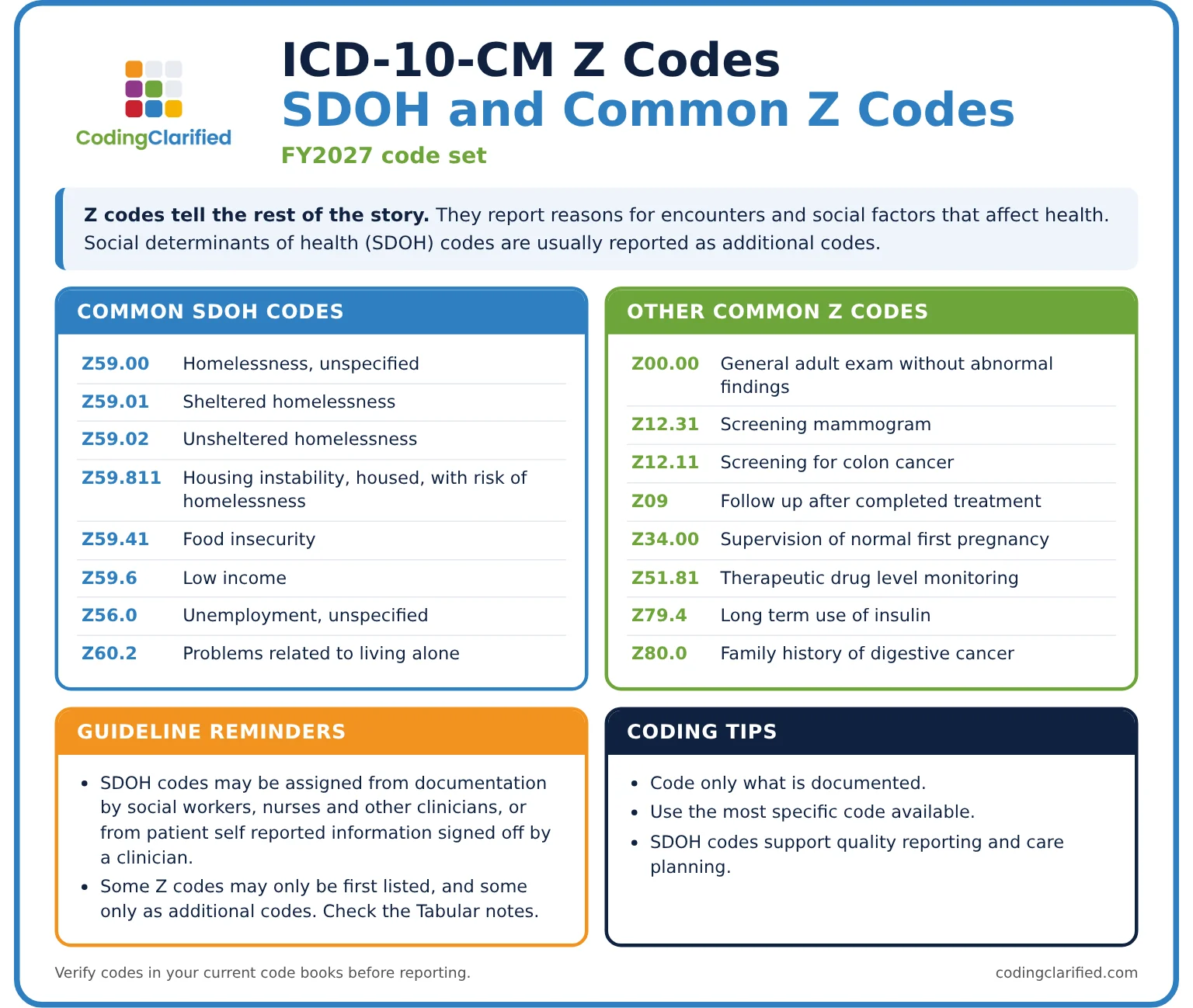
Common SDOH Z Codes for 2026
| ICD-10-CM Code | Description |
|---|---|
| Z59.00 | Homelessness, unspecified |
| Z59.01 | Sheltered homelessness |
| Z59.02 | Unsheltered homelessness |
| Z59.811 | Housing instability, housed, with risk of homelessness |
| Z59.41 | Food insecurity |
| Z59.6 | Low income |
| Z56.0 | Unemployment, unspecified |
| Z56.2 | Threat of job loss |
| Z60.2 | Problems related to living alone |
| Z63.8 | Other specified problems related to primary support group |
| Z63.5 | Disruption of family by separation and divorce |
These codes represent different circumstances. Therefore, coders must select the most specific code supported by the documentation.
How Do You Code Homelessness?
Homelessness can create significant barriers to healthcare.
For example, patients experiencing homelessness may struggle to store medications, maintain personal hygiene, attend appointments, or recover safely after procedures.
Medical coders should distinguish among:
- Z59.00 — Homelessness, unspecified
- Z59.01 — Sheltered homelessness
- Z59.02 — Unsheltered homelessness
Coding tip: Do not automatically assign an unsheltered homelessness code simply because a patient lacks a permanent address.
Instead, review the documented living situation and apply the most accurate code.
How Do You Code Unemployment?
Unemployment may influence a patient’s financial stability, health insurance coverage, and access to treatment.
The commonly used code Z56.0 identifies unspecified unemployment.
However, documentation may support another code when the patient experiences a different employment-related problem.
For example, Z56.2 describes a threat of job loss rather than current unemployment.
Coders should avoid treating these circumstances as interchangeable.
How Do You Code Lack of Social Support?
Lack of social support can affect treatment adherence, recovery, and overall health.
A patient may have difficulty managing medications, obtaining transportation, or receiving help after surgery.
However, coders must distinguish among living alone, family relationship problems, and inadequate support.
For example:
- Z60.2 — Problems related to living alone
- Z63.8 — Other specified problems related to primary support group
Living alone does not automatically mean a patient lacks social support.
Likewise, coders should not assign a family-related code unless the documentation supports that specific circumstance.
How Should Z Codes Be Sequenced in Medical Coding?
Correct diagnosis sequencing remains one of the most important parts of medical coding and billing.
The first-listed diagnosis should reflect the condition, problem, or reason chiefly responsible for the services provided, according to the applicable setting and official guidelines.
When Can a Z Code Be First-Listed?
A Z code may serve as the first-listed diagnosis when it appropriately describes the primary reason for the encounter.
Examples include:
- Z00.00 — Encounter for general adult medical examination without abnormal findings
- Z09 — Encounter for follow-up examination after completed treatment for conditions other than malignant neoplasm
- Z12.11 — Encounter for screening for malignant neoplasm of colon
For instance, a patient attending a routine preventive examination may appropriately receive Z00.00 as the first-listed diagnosis.
When Should a Z Code Be Secondary?
A Z code often serves as an additional diagnosis when it provides relevant information about the patient’s medical history, health status, or social circumstances.
For example, a patient receiving treatment for diabetes may also have documented homelessness that affects medication storage and follow-up care.
In that situation, the diabetes diagnosis may be first-listed, while the homelessness code provides additional context.
Remember: Sequencing depends on the encounter, care setting, documentation, and applicable guidelines. Never assume every Z code belongs in the secondary position.
For additional guidance, read our Medical Coding Sequencing Guide.
Medical Coding Scenario: Diabetes, Homelessness, and Unemployment
Patient scenario
A 52-year-old patient visits an outpatient clinic for management of type 2 diabetes.
The physician documents that the patient has difficulty maintaining blood glucose control because they cannot consistently store insulin or obtain regular meals.
During the visit, a social worker documents that the patient is living in an emergency shelter, recently lost their job, and experiences food insecurity.
The provider reviews the patient’s diabetes treatment plan and coordinates additional support services.
Step 1: Identify the Main Condition
The patient receives medical management for type 2 diabetes.
Therefore, the coder selects the appropriate diabetes code based on the documented clinical condition.
For this example, assume the provider documents type 2 diabetes without complications.
E11.9 — Type 2 diabetes mellitus without complications
Step 2: Identify Relevant SDOH Codes
The documentation supports several additional circumstances:
Z59.01 — Sheltered homelessness
Z56.0 — Unemployment, unspecified
Z59.41 — Food insecurity
Each code captures a separate social circumstance affecting the patient’s care.
Step 3: Report Long-Term Medication Use
The patient routinely uses insulin for diabetes management.
Therefore, the coder may also report:
Z79.4 — Long-term (current) use of insulin
For this scenario, the complete code selection is:
| Code | Coding purpose |
|---|---|
| E11.9 | First-listed diabetes diagnosis |
| Z79.4 | Long-term insulin use |
| Z59.01 | Sheltered homelessness |
| Z56.0 | Unemployment |
| Z59.41 | Food insecurity |
Step 4: Review Documentation and Sequencing
Before submitting the claim, the coder should verify that each diagnosis is supported.
Additionally, the coder should confirm that the code set, sequencing, and payer requirements match the date and setting of service.
CPC exam tip: The patient’s homelessness does not automatically replace diabetes as the first-listed diagnosis when the encounter primarily addresses diabetes management.
Can Social Workers and Nurses Document SDOH Z Codes?
Yes. This is an important exception to traditional diagnosis coding documentation rules.
Official ICD-10-CM guidelines permit code assignment for social determinants of health using documentation from clinicians other than the patient’s provider when the documentation meets the applicable requirements.
These clinicians may include nurses, social workers, and other qualified healthcare professionals involved in the patient’s care.
However, the information must appear in the medical record and meet organizational and official coding requirements.
Patient self-reported information may also support SDOH coding when it becomes part of the medical record through the appropriate documentation process.
Important distinction: This exception does not mean that every diagnosis can be coded from non-provider documentation.
Coders must follow the specific guidelines for the condition or circumstance being reported.
How Do Z Codes Affect Medical Billing and Reimbursement?
Z codes provide important information about the reason for an encounter and circumstances affecting patient care.
However, assigning an SDOH Z code does not automatically increase reimbursement.
Payment depends on several factors, including:
- The services performed
- Medical necessity
- Documentation
- Payer coverage policies
- Applicable CPT or HCPCS codes
- The patient’s insurance plan
For example, a provider may document homelessness during an evaluation and management encounter.
The coder can report the supported SDOH diagnosis, but that diagnosis alone does not establish a separate billable service.
In addition, some payers and healthcare programs use SDOH information for quality reporting, care coordination, or population health initiatives.
Medical coders should distinguish between reporting a social risk factor and billing for a covered service.
For additional context, review our Evaluation and Management Coding Guide.
Commonly Used Z Codes Beyond Social Determinants of Health
Z codes also identify preventive care, follow-up encounters, personal history, family history, and long-term medication use.
| Code | Description |
|---|---|
| Z00.00 | General adult medical examination without abnormal findings |
| Z09 | Follow-up examination after completed treatment |
| Z34.00 | Supervision of normal first pregnancy, unspecified trimester |
| Z79.4 | Long-term use of insulin |
| Z79.01 | Long-term use of anticoagulants |
| Z82.49 | Family history of ischemic heart disease and other circulatory diseases |
| Z80.0 | Family history of malignant neoplasm of digestive organs |
| Z51.81 | Encounter for therapeutic drug level monitoring |
Important Corrections to Common Z Code Examples
Several Z codes are frequently misunderstood.
First, Z79.1 describes long-term use of non-steroidal anti-inflammatory drugs (NSAIDs), not antihypertensive medication.
Second, Z51.81 identifies therapeutic drug level monitoring, not chemotherapy administration.
Additionally, Z34.00 refers to supervision of a normal first pregnancy with an unspecified trimester. It should not be described as a first-trimester code.
Finally, Z09 applies to follow-up after completed treatment for conditions other than malignant neoplasm. Follow-up after completed cancer treatment may require a different code, such as Z08.
These distinctions matter because incorrect descriptions can lead to inaccurate claims and coding errors.
Common Mistakes to Avoid When Coding Z Codes
1. Assuming All Z Codes Are Secondary
Some Z codes appropriately serve as first-listed diagnoses.
Always determine the main reason for the encounter before sequencing diagnoses.
2. Coding Social Circumstances Without Documentation
Do not assume that unemployment means a patient lacks health insurance.
Similarly, never assume that living alone means the patient lacks social support.
Report only documented circumstances.
3. Using Unspecified Codes When Specific Information Exists
When documentation identifies sheltered homelessness, select the supported specific code rather than automatically using Z59.00.
Greater specificity improves the accuracy of the medical record.
4. Confusing Follow-Up With Active Treatment
A patient receiving ongoing treatment for an active condition is not necessarily attending a follow-up examination after completed treatment.
Review the purpose of the encounter before assigning Z09.
5. Confusing Family History With Personal History
Z80.0 describes a family history of malignant neoplasm of digestive organs.
It does not describe the patient’s own history of cancer.
6. Reporting Every Available Z Code
More diagnosis codes do not necessarily create a better claim.
Instead, select codes that accurately describe the encounter and meet reporting requirements.
7. Ignoring Annual ICD-10-CM Updates
Using an outdated code description or deleted code may create billing problems.
Always verify codes against the code set effective on the service date.
CPC Student Tips for Mastering Z Codes
Z codes appear throughout ICD-10-CM, making them important for CPC exam preparation and real-world coding.
Tip 1: Identify the reason for the encounter first.
Before reviewing additional diagnoses, determine why the patient received services.
Tip 2: Understand preventive versus problem-oriented visits.
An annual examination differs from an appointment for treatment of an active illness.
Tip 3: Study the Chapter 21 guidelines.
Focus on when Z codes can serve as first-listed diagnoses and when additional codes provide supporting information.
Tip 4: Recognize common SDOH categories.
Pay particular attention to housing, employment, financial hardship, food insecurity, and social support.
Tip 5: Practice documentation-based coding.
Never choose a diagnosis simply because it seems likely. Instead, locate the documentation that supports the code.
Tip 6: Use your coding books correctly.
Verify the Alphabetic Index, Tabular List, instructional notes, and applicable official guidelines.
For more CPC preparation strategies, review our Guide to Long Medical Coding Exam Scenarios.
2026 ICD-10-CM Updates and Official Coding Resources
The 2026 calendar year includes two ICD-10-CM fiscal-year code sets.
- FY 2026: October 1, 2025, through September 30, 2026
- FY 2027: October 1, 2026, through September 30, 2027
Because the FY 2027 code set took effect on October 1, 2026, coders working with current October 2026 dates of service must use the applicable updated codes and guidelines.
For more information, review our ICD-10-CM 2027 Updates Guide.
Authoritative Coding Resources
- CMS ICD-10 Resources
- CDC National Center for Health Statistics — ICD-10-CM
- AAPC Medical Coding Resources
- CMS Health Equity Resources
These resources help coders confirm official code descriptions, annual updates, and documentation guidance.
Frequently Asked Questions About ICD-10-CM Z Codes
1. What are Z codes used for in medical coding?
Z codes identify factors influencing health status and healthcare encounters. They may describe preventive services, screening, medical history, long-term medication use, or social circumstances such as homelessness and unemployment.
2. Can a Z code be the primary diagnosis?
Yes. A Z code may be first-listed when it appropriately describes the primary reason for the encounter. For example, Z00.00 may be first-listed for a routine adult preventive examination without abnormal findings.
3. What ICD-10-CM code is used for homelessness?
Common codes include Z59.00 for unspecified homelessness, Z59.01 for sheltered homelessness, and Z59.02 for unsheltered homelessness. The documentation determines which code applies.
4. What is the ICD-10-CM code for unemployment?
Z56.0 identifies unspecified unemployment. Other codes may apply when documentation describes a different employment-related problem, such as Z56.2 for threat of job loss.
5. Can medical coders assign SDOH codes from social worker documentation?
Yes. Official ICD-10-CM guidelines permit the use of documentation from certain non-provider clinicians for SDOH code assignment. However, the information must meet the applicable documentation requirements.
6. Do SDOH Z codes increase reimbursement?
Not automatically. SDOH codes provide additional information about circumstances affecting care, but reimbursement depends on the payer, covered services, medical necessity, and billing requirements.
7. What is the difference between Z codes and diagnosis codes?
Z codes belong to ICD-10-CM and are diagnosis codes. However, they often describe circumstances, health status, or reasons for encounters rather than active diseases or injuries.
8. What should CPC students remember about Z code sequencing?
CPC students should remember that Z codes are not always secondary. The reason for the encounter, official sequencing rules, and supporting documentation determine whether a Z code belongs in the first-listed or additional diagnosis position.
Final Thoughts
Accurate ICD-10-CM Z code reporting helps healthcare organizations document more than a patient’s medical diagnosis.
Homelessness, unemployment, food insecurity, and lack of social support may affect treatment decisions and access to healthcare.
By understanding SDOH codes, sequencing requirements, and documentation guidelines, medical coders can improve diagnosis reporting and support accurate billing.
For 2026, coders should continue reviewing annual ICD-10-CM updates, verifying code specificity, and following official guidelines.
The most important rule remains simple: Code what the documentation supports, follow the official guidelines, and select the most accurate code for the encounter.
Important 2026 coding clarification
I verified the FY 2027 official ICD-10-CM guidelines, effective October 1, 2026. Two points are especially important before publication:
-
SDOH Z codes must be reported as secondary diagnoses, even though other types of Z codes can be first-listed.
-
Living alone does not automatically justify Z60.2. Documentation must identify an associated problem, risk, or unmet need.